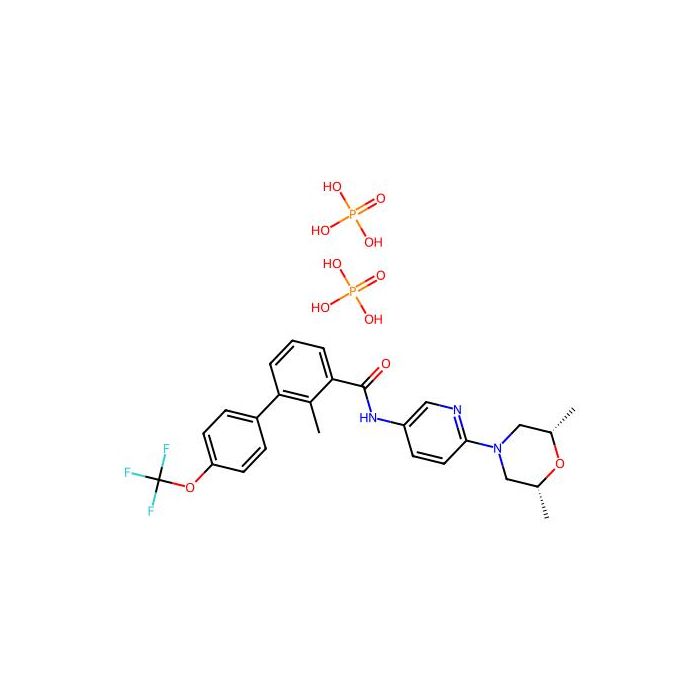
Sonidegib diphosphate (Erismodegib diphosphate) is a potent and selective Smo antagonist with IC 50 of 1.3 nM and 2.5 nM for mouse and human Smo in binding assay, respectively
In Vitro
The IC 50 values for Sonidegib (NVP-LDE225) for the major human CYP450 drug metabolizing enzymes is greater than 10 μM. Sonidegib (LDE225), a small molecule, clinically investigated SMO inhibitor, used alone and in combination with Nilotinib, inhibits the Hh pathway in CD34 + chronic phase (CP)-chronic myeloid leukaemia (CML) cells, reducing the number and self-renewal capacity of CML leukaemia stem cell (LSC). Sonidegib interacts directly with SMO, in a similar fashion to cyclopamine, to reduce expression of downstream Hh signaling targets. Primary CD34 + CP-CML cells are cultured in serum free media (SFM)±Sonidegib for 6, 24 and 72 hours (h). At 72 h, while there is variability between the biological samples, GLI1 is significantly downregulated following exposure to Sonidegib (10 nM; 0.78-fold and 100 nM; 0.73-fold, respectively (p<0.01). MCE has not independently confirmed the accuracy of these methods. They are for reference only.
In Vivo
Sonidegib (NVP-LDE225) is a weak base with a measured pK a of 4.2 and exhibits relatively poor aqueous solubility. In the subcutaneous Ptch +/- p53 -/- medulloblastoma allograft mouse model, Sonidegib demonstrates dose-related antitumor activity after 10 days of oral administration of a suspension of the diphosphate salt. At a dose of 5 mg/kg/day qd, Sonidegib significantly inhibits tumor growth, corresponding to a T/C value of 33% (p<0.05 as compared to vehicle controls). When dosed at 10 and 20 mg/kg/day qd, Sonidegib affords 51 and 83% regression, respectively . Bone marrow cells and spleen cells from a subset of treated mice are transplanted into secondary recipient mice. Transplantation of either bone marrow (BM) or spleen cells from mice treated with Sonidegib (LDE225)+Nilotinib results in reduced white cell count (WCC) and reduces leukaemia development in secondary recipients compared to Sonidegib or Nilotinib alone. MCE has not independently confirmed the accuracy of these methods. They are for reference only.
Cell Assay
CD34 + CP-CML cells are seeded in SFM alone±Sonidegib±Nilotinib and cultured for 24-72 h prior to assessment. Proliferation is measured using colorimetric assessment of BrDU incorporation. Proportion of viable cells versus those in early and late apoptosis is assessed by flow cytometry using annexin V-FITC and 7-amino-actinomycin D (7-AAD, Via-Probe solution). Cell cycle status is assessed using Ki67 (FITC) expression and 7-AAD incorporation. MCE has not independently confirmed the accuracy of these methods. They are for reference only.
Animal administration
Mice The transgenic EGFP + /SCLtTA/TRE-BCR-ABL mouse model is used to investigate the effect of Sonidegib treatment on CML LSC in vivo. Scl-tTa-BCR-ABL mice in the FVB/N background are crossed with transgenic GFP-expressing mice. Bone marrow cells are obtained 4 weeks post induction, GFP + cells are selected by flow cytometry and transplanted by tail vein injection (10 6 cells/mouse) into wild-type FVB/N recipient mice, irradiated at 900 cGy, generating a large cohort of mice with similar time of onset of leukemia. Blood samples obtained 4 weeks post transplantation confirmed a neutrophilic leukocytosis in recipient mice. Mice are treated with Nilotinib (50 mg/kg by gavage, daily), Sonidegib (80 mg/kg by gavage, daily), Sonidegib+Nilotinib, or with vehicle alone (control). After 3 weeks of treatment, animals are euthanised and marrow content of femurs and tibiae, spleen cells and blood obtained. Total white cell count (WCC), GFP-expressing WCC, myeloid cells, and GFP+ progenitors and stem cells are measured by flow cytometry. Survival is assessed in a subset of mice for 120d post discontinuation of treatment. Spleen and BM cells from a subset of mice in each arm are pooled and 5×10 6 cells/mouse (8 mice/condition) are transplanted into wild-type FVB/N recipient mice irradiated at 900 cGy. Engraftment is monitored by drawing peripheral blood (PB) every 4 weeks. The percentage of GFP + cells in PB is analyzed by flow cytometry. aladdin has not independently confirmed the accuracy of these methods. They are for reference only.
IC50& Target:IC50: 1.3 nM (mSmo), 2.5 nM (hSmo)