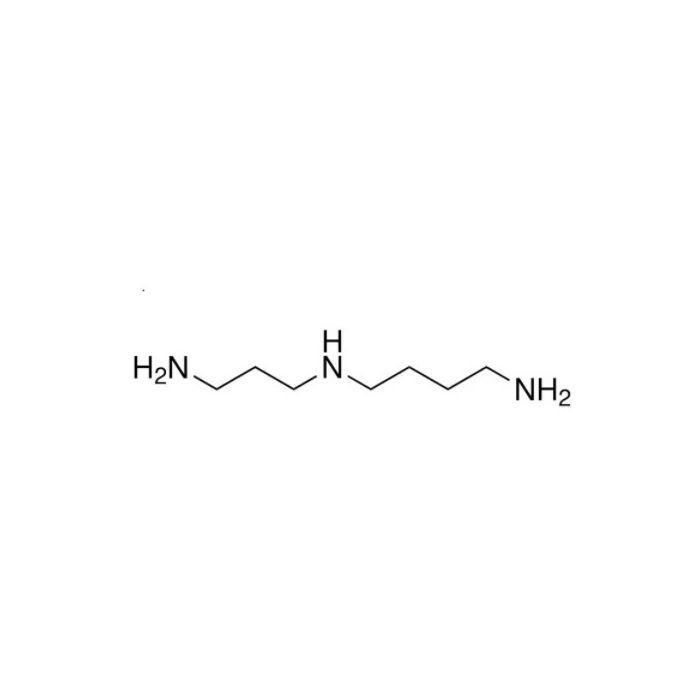
Spermidine - UltraBio™, adapté à la biologie moléculaire, ≥99.5%(GC) , CAS No.124-20-9

CAS: 124-20-9 Cat. No.: S755738 Formule: C7H19N3 Poids moléculaire: 145.25 Beilstein Registry Number: 1698591 Numéro CE: 204-689-0
DISPONIBLE À COMMANDE
GRADE & PURITY UltraBio™ ? UltraBio™ — Aladdin's line for molecular-biology applications. Use for nuclease-free, high-consistency reagents across molecular workflows. Suitable for molecular biology ? Molecular-biology grade — free of nucleases and contaminants that degrade DNA/RNA. Use in cloning, PCR, and nucleic-acid work needing clean reagents. ≥99.5%(GC)
Synonyms
1,8-Diamino-4-azacetane, N-(3-Aminopropyl)-1,4-diaminobutane | 1,8-Diamino-4-azacetane | N-(3-Aminopropyl)-1,4-diaminobutane | N1-(3-Aminopropyl)butane-1,4-diamine
Storage
A conserver à 2-8°C,A l'abri de la lumière,Chargé en argon
Shipped In
Glace humide
★
Size
USA
Allemagne (EU)*
Price
Qty
1g
S755738-1g
Sur commande · 8–12 semaines
184,90$US
5g
S755738-5g
Sur commande · 8–12 semaines
637,90$US
Enter a quantity for the sizes you want to add.
🧪
Why this grade

UltraBio™, adapté à la biologie moléculaire, ≥99.5%(GC) Suitable for molecular biology,UltraBio™ for sensitive chromatographic and analytical workflows requiring minimal baseline interference.

🌡

Storage & shipping

A conserver à 2-8°C,A l'abri de la lumière,Chargé en argon Ships Glace humide Check lot-specific COA for exact specifications.

📋

Quality documents

SDS, COA, datasheet, and spec sheet available for download. Lot-specific COA accessible via lot number lookup.

📚

Literature proof

Cited in 58 peer-reviewed publications across chromatography, organic synthesis, and cross-coupling reactions.

Vue d’ensemble

La spermidine est une polyamine et un cation organique trivalent.La spermidine est un composé polyaminé naturel aux propriétés biochimiques diverses. Elle joue un rôle essentiel dans l'expression des gènes, en participant aux processus de réplication, de transcription et de traduction de l'ADN. La spermidine est cruciale pour la croissance, la prolifération et la différenciation des cellules, influençant la progression du cycle cellulaire et le développement des tissus. Elle possède une activité antioxydante qui protège les cellules contre le stress oxydatif en piégeant les radicaux libres. La spermidine stimule également l'autophagie, favorisant le renouvellement des organites endommagés et des agrégats de protéines pour l'homéostasie cellulaire. Grâce à ses effets neuroprotecteurs, elle favorise la survie des neurones et la plasticité synaptique, et protège contre les maladies neurodégénératives. En outre, la spermidine module les voies de signalisation cellulaires impliquées dans l'inflammation et les réponses immunitaires.

Application :

La spermidine a été utilisée
  • comme composant du tampon d'isolement des chromosomes
  • comme composant du tampon de transcription
  • comme composant du tampon d'homogénéisation

Specifications

Synonymes
1,8-Diamino-4-azacetane, N-(3-Aminopropyl)-1,4-diaminobutane | 1,8-Diamino-4-azacetane | N-(3-Aminopropyl)-1,4-diaminobutane | N1-(3-Aminopropyl)butane-1,4-diamine
Spécifications et pureté
UltraBio™, adapté à la biologie moléculaire, ≥99.5%(GC)
Mécanismes biochimiques et physiologiques
Inhibe l'oxyde nitrique synthase neuronale (nNOS). Se lie à l'ADN et le précipite ; stimule l'activité de la T4 polynucléotide kinase. Inhibe l'oxyde nitrique synthase neuronale (nNOS). Se lie et précipite l'ADN ; peut être utilisé pour la purification de
Conditions de stockage de stockage
A conserver à 2-8°C,A l'abri de la lumière,Chargé en argon
Expédié en
Glace humide
Grade
Suitable for molecular biology, UltraBio™
Pureté
≥99.5%(GC)
Noms et identifiants
PH
12.0-13.5 (25 °C, 1 M in H 2 O)
Sourires canoniques
NCCCCNCCCN
IUPAC Name
N'-(3-aminopropyl)butane-1,4-diamine
InChIKey
ATHGHQPFGPMSJY-UHFFFAOYSA-N
INCHI
1S/C7H19N3/c8-4-1-2-6-10-7-3-5-9/h10H,1-9H2
Isomères SMILES
C(CCNCCCN)CN
WGK Allemagne
3
Numéro ONU
2735
Poids moléculaire
145.25
Beilstein
1698591

Documentation

📋 Safety Data Sheet (SDS)

Comprehensive hazard, handling, storage, and regulatory compliance document.

Download SDS →

✅ Certificate of Analysis (COA)

Lot-specific quality data. Enter your lot number to retrieve the exact COA.

Look up COA →

📊 Datasheet

Quick-reference summary of product specifications and applications.

View datasheet →

🔬 Specification Sheet

Full quality attributes and acceptance criteria for this grade.

View spec sheet →

Advanced Data

Taxonomic Classification

Taxonomy Tree

KingdomOrganic compounds
SuperclassOrganic nitrogen compounds
ClasseOrganonitrogen compounds
SubclassAmines
Intermediate Tree Nodes Secondary amines
Direct ParentDialkylamines
Alternative Parents Organopnictogen compounds  Monoalkylamines  Hydrocarbon derivatives  
Molecular FrameworkAliphatic acyclic compounds
Substituents Secondary aliphatic amine - Organopnictogen compound - Hydrocarbon derivative - Primary amine - Primary aliphatic amine - Aliphatic acyclic compound
DescriptionThis compound belongs to the class of organic compounds known as dialkylamines. These are organic compounds containing a dialkylamine group, characterized by two alkyl groups bonded to the amino nitrogen.
External Descriptors triamine - polyazaalkane
Structure 3D
Modèle de structure chimique interactif


Certificats (CoA, COO, BSE/TSE et tableau d'analyse)
C of A & Other Certificates(BSE/TSE, COO):
Analytical Chart:
Propriétés chimiques et physiques
SolubilitéH 2 O: 1 M at 20 °C, clear, colorless
SensibilitéLight sensitive;Moisture sensitive;Light sensitive
Indice de réfraction1.4785-1.4805
Point d'éclair (°F)230°F
Point d'éclair (°C)>110°
Point d'ébullition (°C)128-130°C
Point de fusion (°C)22-25°C
Poids moléculaire145.250 g/mol
XLogP3-1.000
Hydrogen Bond Donor Count3
Hydrogen Bond Acceptor Count3
Rotatable Bond Count7
Exact Mass145.158 Da
Monoisotopic Mass145.158 Da
Topological Polar Surface Area64.099 Ų
Heavy Atom Count10
Formal Charge0
Complexity56.800
Isotope Atom Count0
Defined Atom Stereocenter Count0
Undefined Atom Stereocenter Count0
Defined Bond Stereocenter Count0
Undefined Bond Stereocenter Count0
The total count of all stereochemical bonds0
Covalently-Bonded Unit Count1
FAQ et articles
UltraBio™: Defining Excellence in Molecular Biology Applications
Molecular Biology Grade
Principles and Application Strategies of Common PCR Enhancers
Furin: A Review of Its Structural Features, Substrate Recognition, and Research Applications
Experimental Judgment in mRNA In Vitro Transcription: Template Design, 5′ Capping, and dsRNA Control
What Are Polyamines? Structural Features, Classification and Representative Compounds, Applications, and Synthetic Strategies
Autophagy Signaling Pathways and Selective Autophagy Research
Sources, Host-Regulatory Mechanisms, and Tumor-Immune Effects of Gut Microbiota-Derived Metabolites
Regulatory Mechanisms of Aging-Related Nutrient Sensing, Inflammation, and Homeostatic Signaling Pathways
Citations of This Product
Calculateurs de solution
Avis

Avis des clients

Shall we send you a message when we have discounts available?

Remind me later

Thank you! Please check your email inbox to confirm.

Oops! Notifications are disabled.