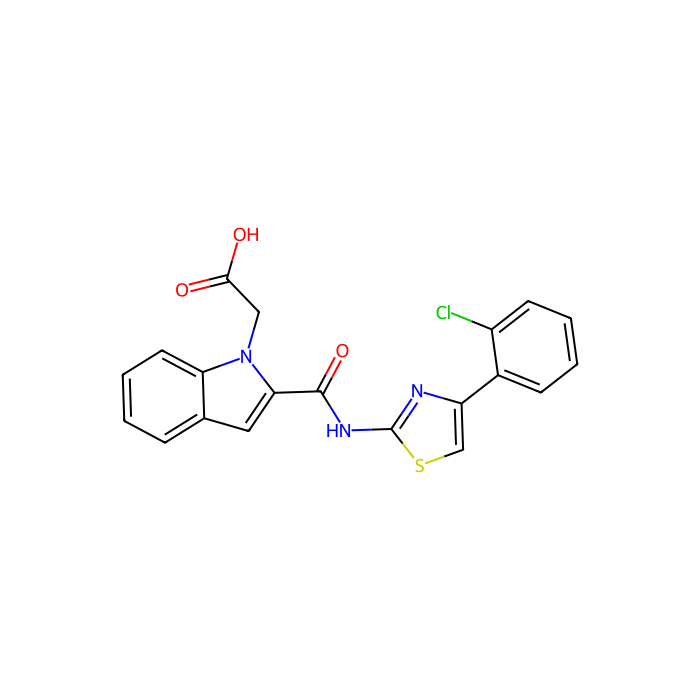
Determine the necessary mass, volume, or concentration for preparing a solution.
| Activity Type | Activity Value -log(M) | Mechanism of Action | Activity Reference | Publications (PubMed IDs) |
|---|

Moligand™, ≥98% Moligand™ for sensitive chromatographic and analytical workflows requiring minimal baseline interference.
Store at -20°C Ships Ice chest + Ice pads Check lot-specific COA for exact specifications.
SDS, COA, datasheet, and spec sheet available for download. Lot-specific COA accessible via lot number lookup.
Cited in 0 peer-reviewed publications across chromatography, organic synthesis, and cross-coupling reactions.
Explanation:
Lintitript (SR 27897) is a highly potent, selective, orally active, competitive and non-peptide cholecystokinin (CCK1) receptor antagonist with an EC50 of 6 nM and a Ki of 0.2 nM. Lintitript displays > 33-fold selectivity more selective for CCK1 than CCK2 receptors (EC50 value of 200 nM). Lintitript increases plasma concentration of leptin and food intake as well as plasma concentration of insulin。
Comprehensive hazard, handling, storage, and regulatory compliance document.
Download SDS →Lot-specific quality data. Enter your lot number to retrieve the exact COA.
Look up COA →Full quality attributes and acceptance criteria for this grade.
View spec sheet →Taxonomy Tree
| Kingdom | Organic compounds |
|---|---|
| Superclass | Organoheterocyclic compounds |
| Classe | Indoles and derivatives |
| Subclass | Indolyl carboxylic acids and derivatives |
| Intermediate Tree Nodes | Not available |
| Direct Parent | Indolyl carboxylic acids and derivatives |
| Alternative Parents | Alpha amino acids and derivatives N-alkylindoles Indoles 2,4-disubstituted thiazoles Chlorobenzenes Substituted pyrroles Aryl chlorides Heteroaromatic compounds Propargyl-type 1,3-dipolar organic compounds Azacyclic compounds Monocarboxylic acids and derivatives Carboximidic acids Carboxylic acids Hydrocarbon derivatives Carbonyl compounds Organic oxides Organochlorides Organonitrogen compounds Organopnictogen compounds |
| Molecular Framework | Aromatic heteropolycyclic compounds |
| Substituents | Indolyl carboxylic acid derivative - Alpha-amino acid or derivatives - N-alkylindole - Indole - 2,4-disubstituted 1,3-thiazole - Chlorobenzene - Halobenzene - Aryl chloride - Aryl halide - Monocyclic benzene moiety - Benzenoid - Substituted pyrrole - Azole - Heteroaromatic compound - Thiazole - Pyrrole - Azacycle - Carboximidic acid - Carboximidic acid derivative - Carboxylic acid derivative - Carboxylic acid - Organic 1,3-dipolar compound - Propargyl-type 1,3-dipolar organic compound - Monocarboxylic acid or derivatives - Organopnictogen compound - Organic oxygen compound - Organic oxide - Hydrocarbon derivative - Organic nitrogen compound - Organooxygen compound - Organonitrogen compound - Carbonyl group - Organohalogen compound - Organochloride - Aromatic heteropolycyclic compound |
| Description | This compound belongs to the class of organic compounds known as indolyl carboxylic acids and derivatives. These are compounds containing a carboxylic acid chain (of at least 2 carbon atoms) linked to an indole ring. |
| External Descriptors | Not available |
| Activity Type | Activity Value -log(M) | Mechanism of Action | Activity Reference | Publications (PubMed IDs) |
|---|
| Activity Type | Relation | Activity value | Units | Action Type | Journal | PubMed Id | doi | Assay Aladdin ID |
|---|
| Activity Type | Relation | Activity value | Units | Action Type | Journal | PubMed Id | doi | Assay Aladdin ID |
|---|
| Activity Type | Relation | Activity value | Units | Action Type | Journal | PubMed Id | doi | Assay Aladdin ID |
|---|
| Activity Type | Relation | Activity value | Units | Action Type | Journal | PubMed Id | doi | Assay Aladdin ID |
|---|
| Activity Type | Relation | Activity value | Units | Action Type | Journal | PubMed Id | doi | Assay Aladdin ID |
|---|
| Activity Type | Relation | Activity value | Units | Action Type | Journal | PubMed Id | doi | Assay Aladdin ID |
|---|
| Activity Type | Relation | Activity value | Units | Action Type | Journal | PubMed Id | doi | Assay Aladdin ID |
|---|
| Activity Type | Relation | Activity value | Units | Action Type | Journal | PubMed Id | doi | Assay Aladdin ID |
|---|
| Activity Type | Relation | Activity value | Units | Action Type | Journal | PubMed Id | doi | Assay Aladdin ID |
|---|
| Activity Type | Relation | Activity value | Units | Action Type | Journal | PubMed Id | doi | Assay Aladdin ID |
|---|
| Activity Type | Relation | Activity value | Units | Action Type | Journal | PubMed Id | doi | Assay Aladdin ID |
|---|
| Activity Type | Relation | Activity value | Units | Action Type | Journal | PubMed Id | doi | Assay Aladdin ID |
|---|
| Activity Type | Relation | Activity value | Units | Action Type | Journal | PubMed Id | doi | Assay Aladdin ID |
|---|
| Activity Type | Relation | Activity value | Units | Action Type | Journal | PubMed Id | doi | Assay Aladdin ID |
|---|
| Activity Type | Relation | Activity value | Units | Action Type | Journal | PubMed Id | doi | Assay Aladdin ID |
|---|
| Activity Type | Relation | Activity value | Units | Action Type | Journal | PubMed Id | doi | Assay Aladdin ID |
|---|
| Activity Type | Relation | Activity value | Units | Action Type | Journal | PubMed Id | doi | Assay Aladdin ID |
|---|
| Activity Type | Relation | Activity value | Units | Action Type | Journal | PubMed Id | doi | Assay Aladdin ID |
|---|
| Activity Type | Relation | Activity value | Units | Action Type | Journal | PubMed Id | doi | Assay Aladdin ID |
|---|
| Activity Type | Relation | Activity value | Units | Action Type | Journal | PubMed Id | doi | Assay Aladdin ID |
|---|
| Activity Type | Relation | Activity value | Units | Action Type | Journal | PubMed Id | doi | Assay Aladdin ID |
|---|
| Activity Type | Relation | Activity value | Units | Action Type | Journal | PubMed Id | doi | Assay Aladdin ID |
|---|
| Activity Type | Relation | Activity value | Units | Action Type | Journal | PubMed Id | doi | Assay Aladdin ID |
|---|
| Activity Type | Relation | Activity value | Units | Action Type | Journal | PubMed Id | doi | Assay Aladdin ID |
|---|
| Activity Type | Relation | Activity value | Units | Action Type | Journal | PubMed Id | doi | Assay Aladdin ID |
|---|
| Activity Type | Relation | Activity value | Units | Action Type | Journal | PubMed Id | doi | Assay Aladdin ID |
|---|
| Activity Type | Relation | Activity value | Units | Action Type | Journal | PubMed Id | doi | Assay Aladdin ID |
|---|
| Activity Type | Relation | Activity value | Units | Action Type | Journal | PubMed Id | doi | Assay Aladdin ID |
|---|
| Activity Type | Relation | Activity value | Units | Action Type | Journal | PubMed Id | doi | Assay Aladdin ID |
|---|
| Activity Type | Relation | Activity value | Units | Action Type | Journal | PubMed Id | doi | Assay Aladdin ID |
|---|
| Activity Type | Relation | Activity value | Units | Action Type | Journal | PubMed Id | doi | Assay Aladdin ID |
|---|
| Activity Type | Relation | Activity value | Units | Action Type | Journal | PubMed Id | doi | Assay Aladdin ID |
|---|
| Activity Type | Relation | Activity value | Units | Action Type | Journal | PubMed Id | doi | Assay Aladdin ID |
|---|
| Activity Type | Relation | Activity value | Units | Action Type | Journal | PubMed Id | doi | Assay Aladdin ID |
|---|
| Activity Type | Relation | Activity value | Units | Action Type | Journal | PubMed Id | doi | Assay Aladdin ID |
|---|
| Activity Type | Relation | Activity value | Units | Action Type | Journal | PubMed Id | doi | Assay Aladdin ID |
|---|
Find and download the COA for your product by matching the lot number on the packaging.
| Lot Number | Certificate Type | Date | Article |
|---|---|---|---|
 K2211821 | Certificate of Analysis | Aug 04, 2026 | S276166 |
| K2211833 | Certificate of Analysis | Aug 04, 2026 | S276166 |
| K2211860 | Certificate of Analysis | Aug 04, 2026 | S276166 |
| K2211868 | Certificate of Analysis | Aug 04, 2026 | S276166 |
| K2211922 | Certificate of Analysis | Aug 04, 2026 | S276166 |
| Solubilité | Soluble in DMSO to 100 mM |
|---|---|
| Poids moléculaire | 411.900 g/mol |
| XLogP3 | 4.500 |
| Hydrogen Bond Donor Count | 2 |
| Hydrogen Bond Acceptor Count | 5 |
| Rotatable Bond Count | 5 |
| Exact Mass | 411.044 Da |
| Monoisotopic Mass | 411.044 Da |
| Topological Polar Surface Area | 112.000 Ų |
| Heavy Atom Count | 28 |
| Formal Charge | 0 |
| Complexity | 595.000 |
| Isotope Atom Count | 0 |
| Defined Atom Stereocenter Count | 0 |
| Undefined Atom Stereocenter Count | 0 |
| Defined Bond Stereocenter Count | 0 |
| Undefined Bond Stereocenter Count | 0 |
| The total count of all stereochemical bonds | 0 |
| Covalently-Bonded Unit Count | 1 |
No manufacturer-validated application protocols are provided for this item in the Product Data. The following general procedures are offered as literature-style guidance only and should be optimized by the user.
Example general protocol: preparation of DMSO stock and dosing in cells
Example general protocol: receptor binding assay (membranes)
These are illustrative only. Refer to your institution’s SOPs and adapt conditions to the biology and detection modality (fluorescence, BRET, radiometric, etc.).
General literature context (not item-specific specifications):
Use in experimental biology (examples):
Important limitations:
This product is a small-molecule research ligand and is not a buffering agent. Therefore, conventional buffer formulation guidance (pKa selection, buffer capacity calculations) is not typically applicable.
Practical notes for assay buffers (general guidance):
For precise buffer recipes or pH ranges, refer to your assay SOP. No item-specific buffer properties are provided for this product.
As a research ligand typically used in small quantities, the principal green-chemistry leverage points are solvent choices and waste minimization during assay preparation.
Greener handling strategies (general guidance):
Comparison of common vehicles (general; not item-specific):
Waste reduction:
Note: Always verify that the chosen alternative vehicle maintains compound integrity and biological performance. Consult the CoA/Spec Sheet for any item-specific recommendations or incompatibilities.
No pharmacopeial or excipient status is provided for this item. This product is supplied strictly for research use only.
Context for discovery workflows (general, not item-specific):
Compliance reminders:
Item-specific physical constants are not provided in the Product Data for this listing.
General literature guidance for small-molecule screening ligands (not item-specific):
Important: For any quantitative property (solubility limits, pKa, logP, UV cutoff), consult the product’s CoA/Spec Sheet or primary literature tied explicitly to CAS 136381-85-6. Do not use generalized values for method validation.
Grade: Moligand™
About Moligand™ (general description of the grade in our catalog):
What this means for end users:
Documentation:
This product is offered as a research ligand rather than a synthetic reagent. Accordingly, its principal applications are in pharmacological and biochemical studies rather than as a transformable building block.
Research applications (general literature context for SR 27897/Lintitript):
Assay setup considerations (general, not item-specific):
Note: If you intend to use SR 27897 in synthetic elaboration (e.g., bioconjugation), obtain the definitive structural information from the CoA and confirm functional group compatibility before planning transformations.
This item is not typically used as a reagent in chemical synthesis; thus, specific reaction conditions are not applicable.
If you plan chemical transformations (general advice):
For any concrete synthetic plan, first consult the CoA/Spec Sheet for the verified structure and confirm reactivity by small-scale scouting experiments.
Safety overview for SR 27897 (Lintitript):
General laboratory handling recommendations (good practice; not a substitute for SDS):
Thermal and storage cautions:
Consult the SDS for authoritative hazard, toxicological, and disposal information specific to this item.
Item-specific solubility is not provided. The following guidance reflects common practice for lipophilic research ligands and should be verified experimentally for this item.
Comparison (general, not item-specific):
Note: Determine actual solubility and stability for SR 27897 (Lintitript) under your assay conditions. Consult the CoA for any item-specific solvent recommendations.
Item-specific storage (from Product Data):
Reconstitution guidance (general, not item-specific specifications):
Handling tips:
Always defer to the lot-specific CoA and SDS for authoritative instructions regarding storage, handling, and solution stability.
Brief overview: SR 27897 (Lintitript) is listed in our Small Molecule & Compound Library catalog as a research-use ligand under the Moligand™ grade.
Item-specific identifiers (from Product Data):
Structural features (general literature context, not item-specific specs):
2D structure description (general guidance):
Note: Always reconcile the CAS and structure with your internal registration or ELN before initiating studies.
SR 27897 (Lintitript) is offered as a finished research ligand, not as a synthetic intermediate or building block. In the absence of a confirmed structure in the Product Data, specific functional group–based reactivity cannot be described for this catalog entry.
General considerations (if chemical modification is contemplated):
Because this item’s value is primarily as a bioactive reference ligand, users generally deploy it as received rather than incorporating it into multistep syntheses.
Item-specific target and selectivity data are not provided in the Product Data.
Note: Although SR 27897 (Lintitript) is discussed in the literature in the context of cholecystokinin receptor pharmacology, Aladdin supplies this item without a target guarantee beyond what is documented on the CoA for the specific lot. Users should confirm activity and selectivity under their own assay conditions.
Our grade selection guide covers purity, stabilizer status, and application suitability for all variants in our catalog.
View Moligand™ grade guide →