GRADE & PURITYMoligand™?Moligand™ — Aladdin's line of ligands and bioactive small molecules. Use for receptor, pathway, and binding studies needing defined small-molecule tools.10mM in DMSO
Moligand™, 10mM in DMSO Moligand™ for sensitive chromatographic and analytical workflows requiring minimal baseline interference.
🌡
Storage & shipping
Protected from light,Store at -80°C Ships Dry ice packs + Cold packs Check lot-specific COA for exact specifications.
📋
Quality documents
SDS, COA, datasheet, and spec sheet available for download. Lot-specific COA accessible via lot number lookup.
📚
Literature proof
Cited in 0 peer-reviewed publications across chromatography, organic synthesis, and cross-coupling reactions.
Vue d’ensemble
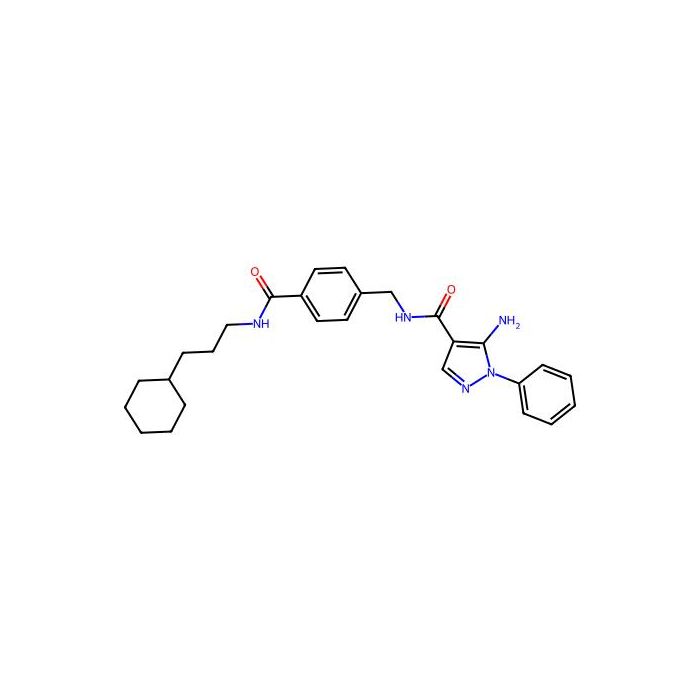
SR-318 is a potent and highly selective p38 MAPK inhibitor with IC 50 s of 5 nM, 32 nM and 6.11 μM for p38α , p38β and p38α/β, respectively. SR-318 potently inhibits the TNF-α release in whole blood with an IC 50 of 283 nM. SR-318 has anti-cancer and anti-inflammatory activity
In Vitro
SR-318 presents a potent and selective type-II inhibitor of p38α/β that can be used as a chemical probe for targeting this particular inactive state of these two p38 isoforms. MCE has not independently confirmed the accuracy of these methods. They are for reference only.
SR-318 is a potent and highly selective p38 MAPK inhibitor with IC 50 s of 5 nM, 32 nM and 6.11 μM for p38α , p38β and p38α/β, respectively. SR-318 potently inhibits the TNF-α release in whole blood with an IC 50 of 283 nM. SR-318 has anti-cancer and anti
Conditions de stockage de stockage
Protected from light,Store at -80°C
Expédié en
Dry ice packs + Cold packs
Ce produit nécessite l'expédition en chaîne froide. Les services terrestres et autres services économiques ne sont pas disponibles.
Certificats (CoA, COO, BSE/TSE et tableau d'analyse)
C of A & Other Certificates(BSE/TSE, COO):
Analytical Chart:
Propriétés chimiques et physiques
Sensibilité
light sensitive
Calculateurs de solution
Molarity Calculator
Determine the necessary mass, volume, or concentration for preparing a solution.
Dilution Calculator
Determine the dilution needed to prepare a stock solution.
Reconstitution Calculator
Avis
Avis des clients
Application Protocols
No tested application protocols are provided for SR-318 in the Product Data.
General usage templates for screening compounds (informational; adjust to your assay):
Preparation of DMSO stock: Weigh compound quickly under low light; dissolve to 10–50 mM in anhydrous DMSO; vortex and, if necessary, warm gently (≤40°C) briefly. Filter through 0.22 µm PTFE if required. Aliquot into amber tubes/plates to avoid repeated freeze–thaw.
Plate-based biochemical assay: Prepare serial dilutions (e.g., 10-point, 3-fold) in assay buffer with matched DMSO. Include vehicle control, positive control (reference inhibitor/agonist), and counter-assay where applicable.
Cell-based assay: Confirm sterility of working solutions; limit final DMSO to ≤0.5–1% where possible. Include viability/toxicity counterscreens.
Data QA: Run in technical triplicate and biological duplicate at minimum; apply appropriate curve-fitting models (e.g., 4PL) and inspect residuals.
Item-specific recommended dilutions, incubation times, or positive controls: Not specified for this item; refer to CoA/Spec Sheet or internal SOPs.
Biological Roles
Item-specific biological targets, mechanisms, and pathways for SR-318 are not provided in the Product Data. Therefore, no definitive biological role can be assigned here. Consult the CoA/Spec Sheet or internal program annotations for target information.
General considerations for small-molecule ligands in discovery:
Potential roles range from enzyme inhibition/activation, receptor modulation (orthosteric/allosteric), ion channel interaction, transporter engagement, to protein–protein interaction modulation.
Off-target risks: aggregator behavior, redox cycling, metal chelation, and covalent reactivity can confound phenotypic or biochemical readouts. Employ orthogonal counterscreens (e.g., detergent shift assays, redox interference panels) to assess liabilities.
ADME-relevant properties (solubility, permeability, metabolic stability) will influence observed biology; absent item-specific parameters, generate empirical data early.
Practical guidance:
Maintain consistent vehicle controls and final solvent percentages across all conditions.
Where fluorescence/absorbance readouts are used, run inner-filter and autofluorescence controls to rule out optical artifacts.
For cellular systems, begin with a broad, low-toxicity dose range (e.g., 0.03–30 µM) with viability counterscreens to contextualize primary effects (general practice; adjust to assay sensitivity).
Note: For any claimed target specificity or mode of action, provide primary assay conditions, replicate statistics, and confirmatory secondary assays to ensure robustness.
Buffer Applications
SR-318 is a small-molecule screening compound and is not a buffering reagent. No relevant buffer pKa systems or recipes apply to this item.
Practical notes related to buffers in assays (general):
Choose assay buffers to balance target stability and compound solubility (e.g., HEPES, Tris, PBS). Maintain consistent ionic strength and pH across wells.
Include 0.005–0.05% nonionic surfactant (e.g., Tween-20/80) to mitigate nonspecific aggregation if your target tolerates it.
Control for DMSO content when diluting compound stocks; maintain constant final DMSO across treatments and controls.
Item-specific buffer properties: Not specified for this item; refer to CoA/Spec Sheet if any recommendations are provided.
Green Alternatives
As a screening compound used at low mass/volume, the primary “green chemistry” lever is solvent and workflow selection rather than replacement of the molecule itself.
Greener handling strategies (general):
Prefer DMSO–water cosolvent systems over high-boiling dipolar aprotics (DMF, NMP) when assay-compatible.
Use ethanol or 2-propanol for initial dissolutions if solubility permits, then dilute into buffers to reduce DMSO burden in aqueous waste streams.
Minimize stock concentration to what is necessary for dosing accuracy to reduce solvent consumption and off-spec waste.
Adopt plate-based miniaturization (384/1536-well) to cut solvent usage per data point.
Comparison of common solvents (informational):
DMSO: Good solvency; low volatility; relatively favorable EHS profile versus DMF/NMP; may cause assay interference above ~1–2% (literature guidance).
DMF/NMP: Strong solvency but reproductive toxicity concerns; reserve for last-resort dissolution.
Operational improvements:
Use amber polypropylene plates to limit photodegradation and extend solution life, reducing re-makes.
Consolidate freezer inventory and track plate usage to avoid redundant preparations and waste.
Note: No greener “substitute molecule” is proposed because SR-318’s structure and function in your specific assay determine suitability; consider mechanism-based alternatives within your chemical series if needed.
Pharmaceutical Uses
SR-318 is sold for research use only. No pharmacopeial status, clinical, or therapeutic use is claimed or implied.
Formulation-related considerations for research settings (general):
Stock preparation: Typically in DMSO at 10–50 mM; verify solubility and stability at intended storage temperature. Use amber vials if photolabile.
Exploratory dosage forms for in vivo research (if permitted by your institution) often use co-solvent systems (e.g., PEG400/saline, Captisol, or Tween-80/ethanol/saline). Because no item-specific stability or safety data are provided, develop formulations cautiously and under appropriate IACUC/EHS oversight.
Adsorption mitigation: For hydrophobic compounds, dose solutions through low-bind plastics or glass and flush lines to reduce losses.
Regulatory note:
Not a GMP material. Not for human or veterinary use. No clinical or excipient claims are made.
Item-specific excipient compatibility, impurity profile, and pharmacokinetics: Not specified for this item; refer to CoA/Spec Sheet and generate data as needed for your research context.
Physical Properties
Item-specific physicochemical properties have not been supplied in the Product Data. Do not treat the following as specifications; consult the CoA/Spec Sheet for authoritative values.
Appearance: Not specified for this item; refer to CoA/Spec Sheet.
Molecular weight: Not specified for this item; refer to CoA/Spec Sheet.
Molecular formula: Not specified for this item; refer to CoA/Spec Sheet.
Melting point: Not specified for this item; refer to CoA/Spec Sheet.
Boiling point: Not specified for this item; refer to CoA/Spec Sheet.
Density: Not specified for this item; refer to CoA/Spec Sheet.
Refractive index: Not applicable/unknown for a solid; Not specified for this item; refer to CoA/Spec Sheet.
pKa/logP/logD: Not specified for this item; refer to CoA/Spec Sheet.
Solubility: Not specified for this item; refer to CoA/Spec Sheet. In practice, many screening molecules are dissolved at 10–50 mM in anhydrous DMSO for primary storage and then diluted into assay buffer containing a final DMSO fraction ≤1–2% (general literature practice; verify experimentally).
General laboratory guidance (non-spec, literature-based):
For unknown solids, begin solubility screening with DMSO, DMF, or ethanol, then extend to aqueous buffers with surfactant or cosolvent if needed.
Filter (0.22 µm PTFE) solutions destined for cell-based assays to reduce particulates.
Avoid repeated freeze–thaw of concentrated DMSO stocks to minimize precipitation and potential degradation.
Quality and Grades
Grade/Purity: Moligand™ (as provided). Moligand™ denotes inclusion in Aladdin’s small-molecule ligand/screening collection intended for discovery workflows (HTS, fragment/lead identification, chemogenomic probes) under research-use-only terms.
What Moligand™ generally implies (informational; not a specification):
Sourcing/curation suitable for screening libraries, with emphasis on chemical diversity, tractable scaffolds, and medchem-relevant substructures.
Availability of identity/purity documentation (e.g., LC–MS, HPLC area% purity) via CoA/Spec Sheet upon request.
Packaging aligned to plate-friendly handling (e.g., DMSO-stock compatibility) and controlled cold-chain logistics.
Item-specific notes:
HPLC purity, residual solvent levels, water content, and metal/peroxide/UV-cutoff limits: Not specified for this item; refer to CoA/Spec Sheet.
Stabilizers or salt form: Not specified for this item; refer to CoA/Spec Sheet.
Best practices for quality assurance in screening campaigns:
Record lot/batch numbers in ELN/LIMS and tie bioactivity data to analytical files.
If potency data are sensitive to impurities, consider in-house re-purification and full recharacterization (1H/13C NMR, HRMS, HPLC/UPLC) before progression.
For photolabile motifs, prepare amber vials/plates and verify purity after light exposure studies as needed.
Reaction and Applications
Intended use: SR-318 is provided as a research screening ligand (Moligand™). It is primarily used as a test article in biochemical, cellular, or biophysical assays rather than as a synthetic reagent.
Applications in discovery workflows (general):
Target engagement studies: thermal shift (DSF), CETSA, nanoBRET/bioluminescence resonance assays using DMSO stocks and controlled final solvent fractions.
Biochemical enzyme assays: IC50/Ki determinations in plate formats; incorporate serial dilution schemes (e.g., 3-fold or 10-fold) and DMSO-matched controls.
Biophysical characterization: Microscale thermophoresis (MST), SPR, ITC—optimize buffer components to minimize nonspecific binding and maintain compound solubility.
If used in chemistry follow-up (structure unknown in this listing):
Without functional group disclosure, specific reaction classes cannot be recommended. Should derivatization be desired, consult the structure (via CoA/PubChem) to map handles for diversification (e.g., aryl halides for cross-coupling, amines for amide coupling, alcohols for carbamate/ester formation). Selectively protect sensitive motifs before late-stage functionalization.
Practical tips:
Validate identity/purity before SAR decisions. Re-test activity after any reformatting or long-term storage.
Implement orthogonal readouts to de-risk artifact mechanisms (redox cycling, aggregation, fluorescence interference, metal chelation).
Reaction Conditions
No item-specific reactivity or transformation conditions are provided for SR-318. Because the structure is not disclosed here, prescriptive synthetic conditions are not applicable.
General procedural context for late-stage analog synthesis (informational):
Cross-coupling (if aryl/heteroaryl halides present): Pd catalysts (e.g., Pd-PEPPSI, XPhos/Pd2(dba)3) in greenish solvents like 2-MeTHF or CPME; bases such as K3PO4 or Cs2CO3; 50–100°C; 1–12 h.
Amide couplings (if amine/acid present): HATU/DIPEA or EDCI/HOAt in DMF or MeCN; room temp to 50°C; 0.5–4 h; consider green alternatives (T3P/EtOAc).
Reductive amination (if carbonyl/amine present): NaBH3CN or BH3·THF, or catalytic hydrogenation; MeOH/THF; pH control with AcOH.
Assay-related handling conditions (general):
DMSO stock solutions prepared under inert gas and low light can improve shelf-life for oxidatively or photolabile chemotypes.
Dilution into assay buffer at room temperature with gentle mixing; inspect for precipitation; filter if needed.
Reminder: Treat the above as general literature practices, not specifications or recommendations for SR-318. Consult the CoA/Spec Sheet and the actual structure before planning any reactions.
Safety and Handling
Safety information in the Product Data is incomplete. Always consult the SDS for SR-318 and follow institutional EHS guidance.
GHS and hazard statements:
Signal word: Not specified for this item; refer to SDS.
H-statements: Not specified for this item; refer to SDS.
GHS classification and pictograms: Not specified for this item; refer to SDS.
General laboratory precautions (good practice for small molecules):
Use in a chemical fume hood. Avoid inhalation, ingestion, and skin/eye contact.
PPE: lab coat, safety glasses, and appropriate chemically resistant gloves (e.g., nitrile). For weighed powders, consider a dust mask or balance enclosure.
Incompatibilities: Unknown for this item; as a precaution, segregate from strong oxidizers/acids/bases until specific reactivity is known (general guidance).
First aid (summary; defer to SDS): In case of skin/eye contact, rinse with copious water for 15 minutes; remove contaminated clothing. If inhaled, move to fresh air. If ingested, rinse mouth; seek medical advice for all exposures.
Spill/accident response: Absorb small spills with inert material; avoid creating dust/aerosols. Dispose of waste via approved chemical waste stream.
Light/temperature sensitivity: Product Data indicates protect from light and store at −80°C. Handle rapidly on ice or at ambient only as needed. Minimize freeze–thaw cycles.
Note: Screening compounds may have uncharacterized toxicological profiles; handle as potentially harmful.
Solvent Selection
Given the absence of item-specific solubility data, select solvents following general practices for small-molecule screening compounds.
Primary stock solvent:
DMSO (anhydrous) is typically preferred for 10–50 mM stocks due to broad solvency and assay compatibility at ≤1–2% v/v (general literature guidance). Verify solubility empirically.
Alternative organic solvents (general options):
DMF or NMP for challenging solutes (note: higher cytotoxicity; limit final assay %).
Ethanol or isopropanol for better biocompatibility with some cell assays, though solvency is narrower than DMSO.
Aqueous systems:
If water solubility is required, consider co-solvent systems (e.g., 5–20% DMSO or ethanol) or inclusion of surfactants (0.01–0.05% Tween-80) as assay-permitted.
Selection considerations:
Polarity/logP unknown: start with a tiered screen (DMSO → DMF → EtOH) and monitor for precipitation upon dilution into buffer/media.
Avoid adsorptive losses by using low-bind plastics or glass for hydrophobic compounds; pre-wet tips/vials with working solution when dosing at low nM–µM.
Filtration: Use PTFE or PVDF membranes for organic-rich solutions; use PES for mostly aqueous.
Small comparison (general):
DMSO: highest solvency; potential assay interference at >1–2%.
EtOH: lower solvency; more benign for cells; higher volatility.
DMF/NMP: strong solvency; use sparingly in bioassays due to toxicity.
Always confirm compatibility with your biological or analytical platform.
Storage and Reconstitution
Storage conditions (from Product Data):
Store at −80°C.
Protect from light.
Shipped on dry ice packs + cold packs to maintain the cold chain.
General handling and reconstitution (informational; not a specification):
Upon receipt: Keep the container closed and cold. Allow to equilibrate to −20°C or 4°C in a desiccated, dark environment before opening to minimize condensation.
Reconstitution: Prepare concentrated stocks in anhydrous DMSO unless otherwise indicated on the CoA/Spec Sheet. Typical screening stocks are 10–50 mM; verify actual solubility and stability experimentally.
Aliquoting: Divide into single-use portions in amber vials or 96/384-well plates to avoid freeze–thaw cycles and light exposure.
Freeze–thaw: Minimize cycles; repeated thawing can promote precipitation or degradation for many chemotypes.
Short-term working storage: Keep thawed DMSO stocks at 4°C protected from light and use within a working window established by your stability tests (e.g., days to weeks depending on chemotype; establish empirically).
Long-term storage: Maintain at −80°C as specified. Periodically re-check purity by LC–MS/HPLC after extended storage.
Item-specific appearance, solvent recommendations, and stability limits: Not specified for this item; refer to CoA/Spec Sheet.
Research use note: For research use only.
Structure and Identity
Brief overview: SR-318 is supplied as a research small molecule in Aladdin’s Moligand™ collection. Item-specific structural identifiers are not disclosed in the Product Data below; consult the CoA/Spec Sheet for definitive structural information.
SKU: S655951
Product name: SR-318 (screening compound)
CAS: 2413286-32-3 (provided)
PubChem CID: 139030333 (provided)
InChIKey: Not specified for this item; refer to CoA/Spec Sheet.
SMILES: Not specified for this item; refer to CoA/Spec Sheet.
Molecular formula: Not specified for this item; refer to CoA/Spec Sheet.
Molecular weight: Not specified for this item; refer to CoA/Spec Sheet.
Structural features (general guidance):
Functional groups, ring systems, heteroatoms, and stereochemistry are not provided in the current listing. If you require a structural assessment (e.g., to predict solubility, pKa, or logP), please request the CoA/Spec Sheet or consult the PubChem CID listed above.
2D structure description: Not specified for this item; refer to CoA/Spec Sheet.
Notes for identity confirmation (general best practices):
Verify identity by LC–MS (exact mass), 1H/13C NMR, and HPLC purity as appropriate for your application.
Cross-check the CAS and CID with your internal databases to ensure alignment with assay registration records.
If using in structure–activity relationship (SAR) studies, maintain linkage to the batch/lot number and analytical package to avoid data drift across campaigns.
Synthetic Utility
Primary role: SR-318 is offered as a screening ligand (Moligand™) rather than as a synthetic reagent or building block. Without a disclosed structure, concrete synthetic transformations cannot be recommended.
General guidance if derivatization is planned (requires structure from CoA/PubChem):
Protecting groups: Choose orthogonal strategies (Boc/CBz/Fmoc for amines; silyl or benzyl for alcohols) that survive planned steps and can be removed under mild conditions.
Solubility-aware synthesis: Select solvents and bases compatible with the motif (e.g., polar aprotic for cross-couplings on heteroaryls; nonpolar for SNAr on electron-poor systems).
Analytical QA for intermediates and analogs:
Track purity with LC/UPLC at multiple wavelengths and orthogonal MS detection to catch UV-silent impurities.
Confirm structure via 2D NMR (HSQC/HMBC/NOESY) when regio- or stereochemical ambiguity exists.
Note: For hit-to-lead programs, retain the original SR-318 reference sample and analytical data to benchmark potency shifts across synthetic iterations.
Target Specificity
Target information for SR-318 is not provided in the Product Data.
Intended target/class: Not specified for this item; refer to CoA/Spec Sheet or your program annotations.
Species selectivity: Not specified for this item; refer to CoA/Spec Sheet.
Assay-validated mode of action: Not specified for this item; refer to CoA/Spec Sheet.
Guidance for users:
If SR-318 is a hit from a screen, conduct follow-up selectivity profiling against related isoforms/family members and orthogonal counterscreens to rule out assay artifacts.
Report and archive the exact batch/lot, analytical data, and assay conditions used to establish specificity to ensure reproducibility.
Need help choosing the grade?
Our grade selection guide covers purity, stabilizer status, and application suitability for all variants in our catalog.
Nous utilisons des cookies pour garantir le bon fonctionnement du site et, lorsque cela est autorisé, pour améliorer votre expérience. Vous pouvez gérer vos préférences à tout moment dans les Paramètres. Pour en savoir plus, consultez notre Politique relative aux cookies.
Souhaitez-vous que nous vous envoyions un message lorsque des réductions seront disponibles?
Me rappeler plus tard
Merci ! Veuillez vérifier votre boîte de réception e-mail pour confirmer.
Products are supplied to verified businesses, institutions, and qualified professionals for research and development use only. Not for use in humans, animals, diagnosis, or therapy.