QUALITÉ & PURETÉPrimorTrace™?PrimorTrace™ — Aladdin's trace-metal-analysis line with ultra-low metal background. Use for ICP/AAS trace-metal work where contamination must be minimal.≥99.99% metals basis
PrimorTrace™, ≥99.99% metals basis PrimorTrace™ pour les flux de travail chromatographiques et analytiques sensibles nécessitant une interférence de ligne de base minimale.
🌡
Stockage & expédition
Room temperature Expédition Normal. Consultez le COA spécifique au lot pour les spécifications exactes.
📋
Documents qualité
SDS, COA, fiche technique et fiche de spécifications disponibles au téléchargement. COA spécifique au lot accessible via la recherche par numéro de lot.
📚
Preuve documentaire
Cité dans 24 publications à comité de lecture couvrant la chromatographie, la synthèse organique et les réactions de couplage croisé.
This compound belongs to the class of inorganic compounds known as alkaline earth metal fluorides. These are inorganic compounds in which the largest halogen atom is fluorine, and the heaviest metal atom is a lanthanide.
External Descriptors
Not available
1. Djoumbou Feunang Y, Eisner R, Knox C, Chepelev L, Hastings J, Owen G, Fahy E, Steinbeck C, Subramanian S, Bolton E, Greiner R, and Wishart DS. ClassyFire: Automated Chemical Classification With A Comprehensive, Computable Taxonomy. Journal of Cheminformatics, 2016, 8:61.
Determine the necessary mass, volume, or concentration for preparing a solution.
Dilution Calculator
Determine the dilution needed to prepare a stock solution.
Reconstitution Calculator
Avis
Avis des clients
Application Protocols
Not applicable. No immunoassay or bioassay protocols (e.g., WB, IHC, IF, FC) are associated with this inorganic salt. For materials or analytical workflows, refer to Reaction Conditions and Storage & Reconstitution.
Biological Roles
This section provides general, literature-based context; it is not specific to this catalog item and does not imply biological use claims.
Fluoride ion (F−)
Interacts with metal centers in enzymes, often acting as an inhibitor at sufficient concentration by forming strong M–F bonds or mimicking hydroxide in metalloenzyme active sites.
In biological fluids, free fluoride speciation depends on pH and complexation with Ca2+, Mg2+, and other cations.
Strontium (Sr2+)
Alkaline-earth cation chemically similar to Ca2+. It can substitute into calcium sites in biominerals (e.g., apatite) in trace amounts, affecting crystallinity and spectroscopic signatures.
Cellular transport is generally via Ca2+-handling pathways with lower affinity; not an essential element but commonly used as a tracer for calcium-related studies in geochemistry and biomineralization.
Toxicology notes (general)
Soluble fluoride salts can be acutely toxic; SrF2 is sparingly soluble, moderating immediate bioavailability, but ingestion or acid exposure can release bioavailable fluoride. Laboratory handling should prevent exposure and environmental release.
Application relevance
For biochemical experiments requiring fluoride inhibition or strontium substitution, more soluble salts (e.g., NaF, SrCl2) are typically employed. SrF2 is primarily relevant to materials/analytical workflows rather than biological buffers or assays.
Buffer Applications
SrF2 is an insoluble inorganic salt and is not typically used to prepare biological or analytical buffer systems.
Guidance
For fluoride-containing buffers or enzyme inhibition studies, choose soluble fluoride sources (NaF, KF) to achieve defined concentrations and pH control.
If Sr2+ is desired in solution, use soluble strontium salts (e.g., SrCl2) rather than SrF2.
Conclusion
Not typically applicable; refer instead to sections on Reaction & Applications and Synthetic Utility for relevant uses.
Green Alternatives
Choice of fluoride source or strontium precursor impacts safety, waste, and energy.
Context: Fluoride delivery to organic substrates
Greener vs conventional options (literature/general)
KF/CsF (solid, lower toxicity than HF; can be used with phase-transfer catalysts) often preferred over HF or sulfonyl fluorides for certain substitutions.
TBAF/TASF provide solubility but add quaternary ammonium waste and may contain water; thermal stability is limited.
SrF2 provides a low-dust, nonhygroscopic solid with minimal volatility but limited reactivity and requires longer times/higher temperatures.
Context: Strontium feed for materials
Carbonate/oxide routes (SrCO3, SrO) may offer CO2 or water byproducts and easier aqueous handling compared with halide routes; however, fluorides can lower processing temperatures as fluxes.
Comparative considerations
Worker safety: Avoid HF-based systems whenever possible; solid inorganic fluorides (KF, SrF2, CaF2) are safer to handle than anhydrous HF but still require care.
Waste minimization: Choose fluoride sources that allow straightforward solid–solid separation or can be recycled as benign salts.
Small comparison (general)
KF: Higher reactivity/solubility; greener for many substitutions; hygroscopicity moderate.
SrF2: Low solubility, nonhygroscopic, easier handling; lower reactivity; good for flux/matrix uses.
CaF2: Very low solubility; widely used as flux; minimal toxicity relative to many fluorides.
Pharmaceutical Uses
No pharmacopeial or excipient designation is provided for this item. SrF2 is not commonly used as a pharmaceutical excipient.
Item-specific status
Not specified for this item; refer to CoA/Spec Sheet.
General context (non-clinical)
In pharmaceutical materials science research, high-purity inorganic salts like SrF2 may serve as reference materials in solid-state characterization (e.g., XRD calibrants) or as hosts in exploratory optical materials. However, soluble strontium or fluoride salts are preferred for any formulation-related studies.
Compliance note
This product is for research use only. No medical or clinical claims are made or implied.
Physical Properties
Item-specific specs are not provided; values below are typical literature data for SrF2 (do not construe as specifications for this SKU).
Appearance: Not specified for this item; refer to CoA/Spec Sheet.
Phase at RT: Solid (ionic crystal) (literature)
Color: Colorless to white (literature)
Melting point: ~1477 °C (literature)
Boiling point: ~2460 °C (literature; high-temperature vaporization/decomposition)
Density (25 °C): ~4.24 g/cm³ (literature)
Solubility (25 °C): Very slightly soluble in water (on the order of 10−4 to 10−3 mol·L−1; literature); insoluble in common organic solvents; more soluble in strong acids/complexing media (literature)
Dielectric/Polarity: Ionic solid; not meaningfully described by molecular polarity parameters (literature)
Refractive index (n): ~1.438 (at 589 nm for optical-grade crystal; literature)
pKa/LogP: Not applicable (inorganic salt) (literature)
Hygroscopicity: Low; does not strongly absorb moisture (literature)
Notes
Due to its lattice energy, SrF2 exhibits low aqueous solubility compared with many other strontium salts.
Optical-grade crystals exploit the wide band gap and low phonon energy; these details are relevant for photonics, not as reagent specifications.
Quality and Grades
Item-specific grade
Grade: PrimorTrace™ (as provided). Specific numeric impurity limits for this SKU are not listed here. Not specified for this item; refer to CoA/Spec Sheet.
What PrimorTrace™ generally implies (general description; not SKU-specific specs)
Engineered for trace analysis and elemental workflows where background metal content and anionic contaminants are tightly controlled to minimize blanks and interferences.
Typical use-cases include preparation of matrix standards, fluxes, and reagents for ICP-OES/ICP-MS sample prep, as well as high-purity inorganic synthesis where extraneous cations/anions can poison catalysts or alter materials properties.
Why grade matters for SrF2
Trace alkali/alkaline-earth or transition-metal impurities can impact optical transparency, defect chemistry, and sintering behavior of fluoride ceramics/crystals.
For analytical chemistry, fluoride and strontium background must be consistent and low to avoid drift and spectral interferences.
Documentation
For lot-specific assay, trace metal profile, loss on drying, and other quality attributes: Not specified for this item; refer to CoA/Spec Sheet.
UV/Vis characteristics, stabilizers, or inhibitors
Not specified for this item; refer to CoA/Spec Sheet. SrF2 typically requires no stabilizers.
Precursor for strontium-containing materials: SrF2 serves as a feed in the preparation of fluoride ceramics, scintillators, and as a component or flux in crystal growth (fluorite-type lattices, mixed-metal fluorides).
Solid-state routes: Reaction of SrF2 with other metal fluorides/oxides at elevated temperature yields mixed phases (e.g., alkaline-earth/lanthanide fluorides), often employing SrF2 for its thermal stability and defined fluoride stoichiometry.
Heterogeneous fluoride source
As a sparingly soluble fluoride donor, SrF2 can participate in ion-exchange/metathesis with compatible electrophiles at the solid–liquid interface in polar aprotic solvents. Reaction rates are generally slower than with soluble fluorides (KF/CsF/TBAF), but SrF2 offers a less hygroscopic, thermally robust alternative.
Analytical chemistry
High-purity SrF2 is used to prepare standards or to condition instruments where strontium or fluoride background must be controlled (ICP-MS/ICP-OES). It can also act as a matrix in pressed pellets for XRF analysis of oxide/fluoride materials.
Optical and electronic applications
Due to its wide band gap and low phonon energies, optical-grade SrF2 is a substrate/host material in IR optics and laser/ scintillation research. PrimorTrace™ grade minimizes extraneous dopants that quench emission or increase absorption.
Practical tips (general)
For metathesis use, maximize surface area (fine powders), ensure rigorous stirring, and consider phase-transfer additives or crown ethers if a competing cation is present.
Avoid acidic contaminants which consume fluoride and can evolve HF.
Reaction Conditions
Guidance below is literature-based and general; adapt to your system and consult primary sources. Not product specifications.
Solid-state/materials synthesis
Temperature: 500–1000+ °C typical for forming mixed fluorides/oxyfluorides; final densification or crystal growth may require >1200 °C depending on system.
Atmosphere: Dry inert gas (N2/Ar) to avoid hydrolysis/oxidation; for oxyfluorides, controlled O2/F− activity (e.g., with co-fluxes like LiF/AlF3).
Time: Hours to days with intermittent grinding to ensure homogeneity.
Heterogeneous fluoride metathesis
Solvents: Polar aprotics (MeCN, DMF, DMSO). Add phase-transfer catalysts or crown ethers if competing cations are present to facilitate interfacial transfer.
Temperature: Ambient to 120 °C depending on substrate reactivity; elevated temperatures markedly increase rates with heterogeneous fluoride sources.
Stoichiometry: Use excess SrF2 (surface-area limited). Employ fine powders and strong agitation.
Analytical digestion (to bring Sr into solution for ICP)
Acid: Concentrated HNO3 (often 2–8 M in final solution) with heating until complete dissolution; avoid HF unless instrument and lab controls permit.
Dilution: Matrix-match and filter particulates prior to nebulization.
Expected outcomes
Compared with KF/CsF, SrF2 affords slower conversions in nucleophilic fluorination/halide exchange; select when a nonhygroscopic, low-blank fluoride source or a Sr-containing residue is advantageous.
Safety and Handling
GHS/SDS details for this catalog item are not provided here. Always consult the product SDS for authoritative information.
GHS information (this item)
Signal word: Not specified for this item; refer to SDS.
Hazard statements: Not specified for this item; refer to SDS.
Pictograms/classification: Not specified for this item; refer to SDS.
General hazards (literature/general for alkaline-earth fluorides)
Low volatility solid; harmful if swallowed in quantity. Fluoride ions can be acutely toxic at sufficient dose. Dust may cause eye/respiratory irritation.
Contact with strong acids can liberate hydrogen fluoride (HF), a highly corrosive and toxic gas/acid.
Handling
Avoid dust generation; use local exhaust when weighing or transferring powders.
Keep away from strong acids and acid chlorides to prevent HF formation.
Use compatible materials (polyethylene, PTFE, glass) for handling; avoid prolonged contact with strong acids.
Personal protective equipment (typical laboratory practice)
Safety glasses or face shield, lab coat, and chemical-resistant gloves (e.g., nitrile). Use a dust mask or respirator if airborne dust may be generated (per risk assessment and SDS).
First aid (overview; defer to SDS)
Inhalation: Move to fresh air; seek medical attention if symptoms persist.
Skin/eye: Rinse with copious water; remove contaminated clothing; obtain medical assistance for persistent irritation.
Ingestion: Rinse mouth; do not induce vomiting; seek medical advice.
Fire and reactivity
Nonflammable inorganic solid. Incompatible with strong acids. Thermal decomposition at very high temperature may release fluoride-containing fumes.
Storage
Store at room temperature (as provided), tightly closed, dry, away from acids.
Solvent Selection
SrF2 is an inorganic ionic solid of very low solubility in water and essentially insoluble in organic solvents. Solvent choice is therefore driven by the process context (slurry processing, ion-exchange/metathesis, or dissolution in reactive media), rather than simple dissolution.
Miscibility/solubility (literature/general)
Water: Very low solubility; behaves as a suspended solid in most aqueous media.
Organic solvents (e.g., alcohols, ethers, hydrocarbons): Essentially insoluble; use as heterogeneous phase only.
Acidic media: Dissolves in strong mineral acids (e.g., HCl, HNO3) via formation of solvated Sr2+; avoid HF/HF-generating systems unless intended and properly controlled.
Complexing media: Chelators for Sr2+ (e.g., EDTA) assist dissolution after acidification.
Practical guidance
For heterogeneous fluoride metathesis or scavenging, employ polar aprotic solvents (acetonitrile, DMF, DMSO) to wet the solid and facilitate interfacial ion transfer; agitation and temperature assist kinetics.
For analytical sample prep aiming to get Sr into solution, digest with concentrated HNO3 (often with heat) and dilute appropriately for ICP.
When to choose alternatives
For soluble fluoride in organic media, consider TBAF, TASF, or KF/CsF (with phase-transfer catalysts or crown ethers) rather than SrF2.
For aqueous fluoride, NaF/KF offer higher solubility and simpler stoichiometry control.
Storage and Reconstitution
Item-specific storage and shipping
Storage Conditions: Room temperature (per Product Data).
Shipped In: Normal (per Product Data).
General storage guidance (inorganic fluoride salts)
Keep container tightly closed in a dry place. Protect from strong acids to avoid HF formation and product dissolution.
Use clean, low-contamination tools to preserve PrimorTrace™ purity.
Reconstitution/solution preparation
Water: Very limited solubility; expect a suspension, not a true solution.
Dissolution: For complete dissolution, use strong mineral acids (e.g., HNO3) with controlled heating; then dilute and neutralize/complex as needed for your application. Avoid HF unless specifically required and permitted by your safety program.
Slurries: For heterogeneous reactions, pre-wet the powder with the reaction solvent and sonicate to disperse; maintain vigorous stirring during use.
Stability
Thermally stable at ambient conditions; unaffected by air and normal humidity. Avoid exposure to acids and prolonged high temperatures in moist environments.
Additional item-specific details
Appearance and any lot-specific parameters: Not specified for this item; refer to CoA/Spec Sheet.
Structure and Identity
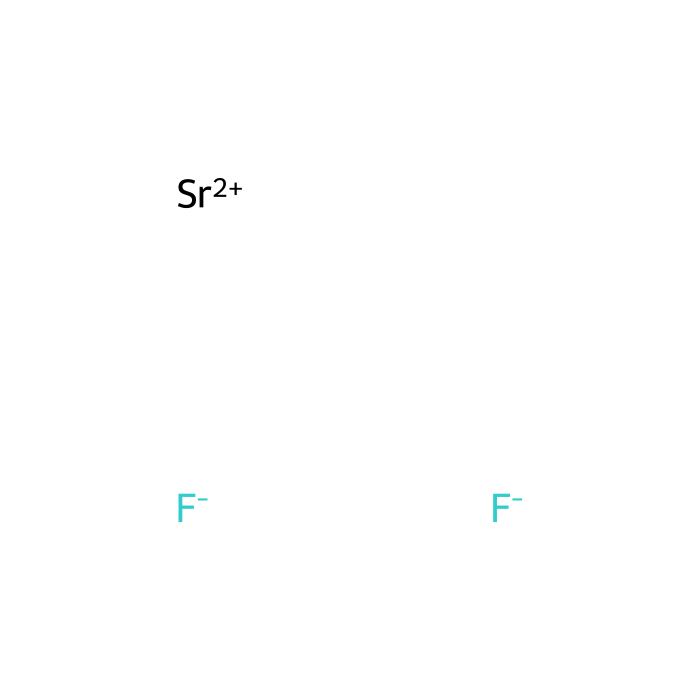
Strontium fluoride is an inorganic ionic compound composed of divalent strontium and monovalent fluoride anions.
Item-specific identifiers (from Product Data)
SKU: S102887
CAS: 7783-48-4
CID: 82210
InChIKey: 93425 (as provided)
Grade: PrimorTrace™
Storage: Room temperature (as supplied)
Shipped: Normal conditions
Research Use: For research use only
Core identity (literature/general)
Chemical name: Strontium fluoride
Molecular formula: SrF2 (literature)
Formula weight: 125.62 g/mol (literature)
Structural description: Rock-salt–related fluorite lattice (CaF2-type). Each Sr2+ is eight-coordinate in a cubic environment by F−, and each F− is tetrahedrally coordinated by Sr2+. No stereochemistry or isomerism applies.
Functional groups: Inorganic salt; hard Lewis acid/base ion pair (Sr2+ / F−).
2D/ionic features in words
A repeating ionic lattice of Sr2+ cations and F− anions; no discrete molecules, rings, or covalent functional groups.
SMILES and InChI (note)
SMILES: Not specified for this item; refer to CoA/Spec Sheet. (Ionic salts often lack a meaningful single SMILES.)
InChI: Not specified for this item; refer to CoA/Spec Sheet.
Synthetic Utility
Functional characteristics
Hard–hard ionic pair (Sr2+/F−) with high lattice energy; behaves as a thermally robust, weakly basic, heterogeneous fluoride source.
Roles in synthesis (literature/general)
Solid-state precursor: Provides both Sr and F stoichiometrically for preparing mixed-metal fluorides, oxyfluorides, and doped fluorite-type lattices under high-temperature conditions.
Flux/transport agent: Alkaline-earth fluorides can lower melting/processing temperatures and assist mass transport in crystal growth or ceramic sintering.
Heterogeneous fluoride donor: Can effect metathesis with suitable electrophiles in polar aprotic solvents—slower but cleaner than more soluble fluoride reagents; minimal water introduction compared with hydrates.
Scavenger: Fluoride can sequester hard Lewis acids or silicon-containing byproducts, though CaF2 is more common in this role.
Retrosynthetic value
For materials chemists, SrF2 is a convenient node in strontium speciation: convertible to SrO/Sr(OH)2/SrCO3 by controlled hydrolysis/carbonation, or to alternative halides via halide exchange routes.
Compatibility
Stable toward many organic media; avoid acidic conditions that generate HF and dissolve the solid, undermining heterogeneity advantages.
Target Specificity
Not applicable. This product is an inorganic salt, not a biological affinity reagent. No antigen/epitope/clone/isotype characteristics apply.
Foire aux questions
How should this product be stored?
Store at room temperature.
How is this product shipped?
This product ships under standard ambient conditions. No temperature-controlled packaging is required.
What does the trace-metals specification mean?
This product is specified at ≥99.99% on a trace-metals basis. That figure describes metallic impurity content rather than overall chemical assay, so it is the relevant specification for ICP-MS, semiconductor and battery applications. Lot-specific values are stated on the Certificate of Analysis.
What does PrimorTrace? mean?
PrimorTrace? indicates that the chemical has been purified and tested specifically for use in trace and elemental analysis. Key specifications typically include controlled UV absorbance at common detection wavelengths, low non-volatile residue, controlled moisture content, and verified lot-to-lot consistency. PrimorTrace? is used for mobile phases, sample preparation and analytical standards in this workflow.
What are the CAS number, molecular formula and molecular weight?
The CAS Number is 7783-48-4, the molecular formula is SrF2, and the molecular weight is 125.62 g/mol. InChIKey FVRNDBHWWSPNOM-UHFFFAOYSA-L.
What documentation is provided?
Available product documentation, including Certificates of Analysis (COA), Safety Data Sheets (SDS), and specification sheets, is shown in the product document area. Document availability and access follow the current site policy.
Notre guide de sélection des qualités couvre la pureté, le statut du stabilisant et l'adéquation à l'application pour toutes les variantes de notre catalogue.
Nous utilisons des cookies pour garantir le bon fonctionnement du site et, lorsque cela est autorisé, pour améliorer votre expérience. Vous pouvez gérer vos préférences à tout moment dans les Paramètres. Pour en savoir plus, consultez notre Politique relative aux cookies.
Souhaitez-vous que nous vous envoyions un message lorsque des réductions seront disponibles?
Me rappeler plus tard
Merci ! Veuillez vérifier votre boîte de réception e-mail pour confirmer.
Products are supplied to verified businesses, institutions, and qualified professionals for research and development use only. Not for use in humans, animals, diagnosis, or therapy.

 I2623115