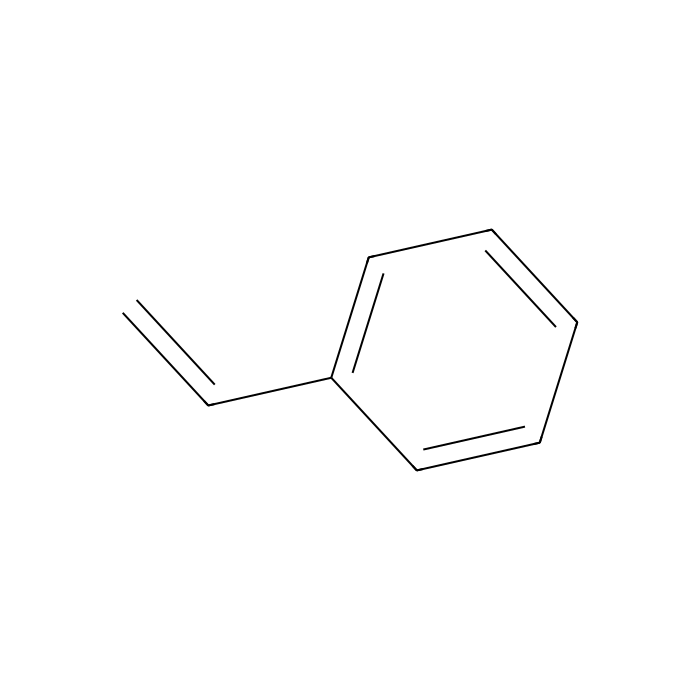
Styrene Standard - 2000ug/ml in Purge and Trap Methanol , CAS No.100-42-5

CAS: 100-42-5 Cat. No.: S128151 Formule: C8H8 Poids moléculaire: 104.15 Beilstein Registry Number: 1071236 Numéro CE: 202-851-5
DISPONIBLE À COMMANDE
QUALITÉ & PURETÉ 2000ug/ml in Purge and Trap Methanol
Synonyms
STYRENE|Ethenylbenzene|Vinylbenzene|Phenylethylene|100-42-5|Styrol|Benzene, ethenyl-|Cinnamene|Phenylethene|Styrolene|Phenethylene|Styrene monomer|Vinylbenzol|Vinyl benzene|Styropol SO|9003-53-6|Styren|Styrole|Benzene, vinyl-|Ethylene, phenyl-|Vinylbenzen
Storage
Store at -20°C
Shipped In
Ice chest + Ice pads,FedEx DG Service
★
Taille
USA
Allemagne (EU)*
Prix
Qté
1ml
S128151-1ml
2 En stock
—

153,90$US

200,90$US
Enregistrer 47,00 $US (23.39%)
Enter a quantity for the sizes you want to add.
🧪
Pourquoi cette qualité

2000ug/ml in Purge and Trap Methanol pour les flux de travail chromatographiques et analytiques sensibles nécessitant une interférence de ligne de base minimale.

🌡

Stockage & expédition

Store at -20°C Expédition Ice chest + Ice pads,FedEx DG Service. Consultez le COA spécifique au lot pour les spécifications exactes.

📋

Documents qualité

SDS, COA, fiche technique et fiche de spécifications disponibles au téléchargement. COA spécifique au lot accessible via la recherche par numéro de lot.

📚

Preuve documentaire

Cité dans 810 publications à comité de lecture couvrant la chromatographie, la synthèse organique et les réactions de couplage croisé.

Vue d’ensemble

Volatile Organic Compounds (VOCs) Single Component Standards US EPA Methods:502.2,524.2,8021,8021A,8021B,624,8240B,8260B

Spécifications

Synonymes
STYRENE | Ethenylbenzene | Vinylbenzene | Phenylethylene | 100-42-5 | Styrol | Benzene, ethenyl- | Cinnamene | Phenylethene | Styrolene | Phenethylene | Styrene monomer | Vinylbenzol | Vinyl benzene | Styropol SO | 9003-53-6 | Styren | Styrole | Benzene, vinyl- | Ethylene, phenyl- | Vinylbenzen
Spécifications et pureté
2000ug/ml in Purge and Trap Methanol
Conditions de stockage de stockage
Store at -20°C
Expédié en
Ice chest + Ice pads,FedEx DG Service
Ce produit nécessite l'expédition en chaîne froide. Les services terrestres et autres services économiques ne sont pas disponibles.
Noms et identifiants
Isomères SMILES
C=CC1=CC=CC=C1
WGK Allemagne
1
Numéro ONU
2055
Groupe d'emballage
III
Poids moléculaire
104.15
Beilstein
1071236

Documentation

📋 Fiche de données de sécurité (FDS)

Document complet couvrant les dangers, la manipulation, le stockage et la conformité réglementaire.

<<<<<<< HEAD Télécharger la SDS → ======= Télécharger la SDS → >>>>>>> release248-p3

✅ Certificat d'analyse (COA)

Données qualité spécifiques au lot. Saisissez votre numéro de lot pour récupérer le COA exact.

Rechercher le COA →

📊 Fiche technique

Résumé de référence rapide des spécifications et applications du produit.

Voir la fiche technique →

🔬 Fiche de spécifications

Attributs de qualité complets et critères d'acceptation pour cette qualité.

Voir la fiche de spécifications →

Données avancées

Certificats (CoA, COO, BSE/TSE et tableau d'analyse)
C of A & Other Certificates(BSE/TSE, COO):
Analytical Chart:

Find and download the COA for your product by matching the lot number on the packaging.

1 results found

Lot NumberCertificate TypeDateArticle
G2201096G2201096Certificate of AnalysisJun 07, 2022 S128151
Propriétés chimiques et physiques
Indice de réfraction1.55
Point d'éclair (°F)89.6 °F
Point d'éclair (°C)32°C
Point d'ébullition (°C)145-146°C
Point de fusion (°C)-31°C(lit.)
FAQ et articles
Make “Aryl Chlorides + Low Pd Loading + Scale-Up Reproducibility” Reliable: The Initiation and Durability Logic of Pd–NHC (Palladium–N-Heterocyclic Carbene) Cross-Coupling (with Selection Navigation and Product Tables)
Experimental Selection Logic for C-C Bond Construction: Understanding Fragment Coupling, Carbonyl Chain Extension, Olefination, and Late-Stage Bond-Forming Pathways by Bond-Forming Task
Experimental Decision-Making for Cross-Coupling Reactions: Target Bond Type, Substrate Combination, and Catalytic System Selection
Application and Selection Guide for Alkyd Resin Coatings: Advantages, Limitations, Formulation Control, and Modification Directions
Structural and Performance Design of Acrylic Resins for Coatings: Monomer Composition, Key Parameters, and Film Formation/Curing Mechanisms
When Should You Choose Silicone Resin? Selection Comparison with Epoxy, Acrylic, Polyurethane, Fluororesin, and Other Coating Resins
Film Formation and Curing Mechanisms of Polyester Resins for Coatings: From Functional Groups and Curing Systems to Crosslinked Networks
Vinyl Ester Resin Systems: Structural Features, Curing Mechanism, and Key Application Considerations
How to Select Vinyl-Related Resins: Building Formulation Judgment Based on Substrate, Performance Targets, and Failure Risks
Applicability Boundaries, Failure Risks, and Alternative System Selection for Chlorinated Rubber Resin in Coatings
Waterborne Resin Technology Explained: Waterborne Forms, Performance Balance, and a Technology Map
Guide to Common Waterborne Resin Types and Application-Based Selection: How to Choose Acrylics, PUD, Waterborne Epoxy, Waterborne Alkyd, VAE, and Related Chemicals
From Water to Film: Film-Formation Mechanisms and Performance Development of Waterborne Emulsions and Dispersions
Diagnosis of Coating Performance Issues and Selection of Resin Modification Routes
Mechanisms and Control of Coating Yellowing: From Chromophoric Structure Formation to Source Diagnosis and Formulation Optimization
Structural Design Logic of Common Resin Modification Technologies: Molecular Chain Structure, Functional Groups, Phase Structure, Crosslinked Networks, and Hybrid/Functional Design
Resin Polarity in Coating Formulations: From Molecular Structure to Dissolution, Compatibility, Interfacial Interactions, and Formulation Design
Key Variable in the Long-Term Stability of Waterborne Pigment Concentrates: How Dispersant Molecular Weight Distribution (MWD) Affects Pigment Dispersion, Surface Adsorption-Layer Formation, and Storage Stability
From Diverse Ketones to Three-Dimensional Spirocyclic Building Blocks: Reaction Design of [1.1.1]Propellane-Involved Ketone Ring Expansion
Tether Effects in Intramolecular [2+2] Photocycloadditions: Straight and Crossed Regioselectivity and Stepwise C–C Bond Formation
How to Evaluate Reaction Generality through Substrate Scope: From the Number of Examples to Standardized Substrate Selection
Citations of This Product
Calculateurs de solution
Avis

Avis des clients

Foire aux questions

How should this product be stored?
Store at ?20 °C. Freezer storage is required to maintain the specified shelf life.
How is this product shipped?
This product ships in an insulated container with ice pads. Unpack on arrival and transfer it to the storage condition stated above.
What are the CAS number, molecular formula and molecular weight?
The CAS Number is 100-42-5, the molecular formula is C8H8, and the molecular weight is 104.15 g/mol.
What documentation is provided?
Available product documentation, including Certificates of Analysis (COA), Safety Data Sheets (SDS), and specification sheets, is shown in the product document area. Document availability and access follow the current site policy.

Souhaitez-vous que nous vous envoyions un message lorsque des réductions seront disponibles?

Me rappeler plus tard

Merci ! Veuillez vérifier votre boîte de réception e-mail pour confirmer.

Oups ! Les notifications sont désactivées.