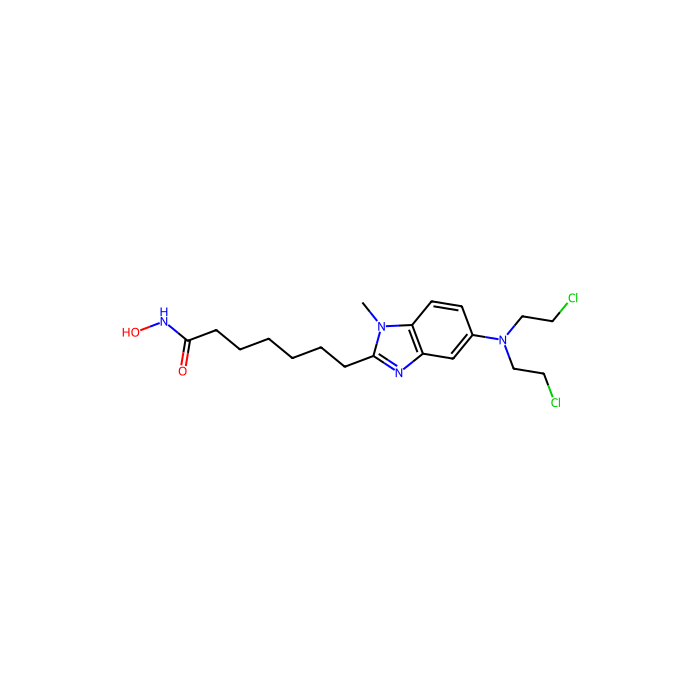
Tinostamustine - ≥98% , CAS No.1236199-60-2

CAS: 1236199-60-2 Cat. No.: T414166 Formule: C19H28Cl2N4O2 Poids moléculaire: 415.36 Numéro CE: 985-846-7 PubChem CID: 46836227
DISPONIBLE À COMMANDE
QUALITÉ & PURETÉ ≥98%
Synonyms
7-(5-(bis(2-chloroethyl)amino)-1-methyl-1H-benzo[d]imidazol-2-yl)-N-hydroxyheptanamide | 1236199-60-2 | 1H-Benzimidazole-2-heptanamide, 5-(bis(2-chloroethyl)amino)-N-hydroxy-1-methyl- | DB15147 | UNII-29DKI2H2NY | 7-{5-[Bis(2-chloroethyl)amino]-1-methyl-1
Storage
Store at -20°C
Shipped In
Ice chest + Ice pads
★
Taille
USA
Allemagne (EU)*
Prix
Qté
1mg
T414166-1mg
6 En stock
—

87,90$US

131,90$US
Enregistrer 44,00 $US (33.36%)
5mg
T414166-5mg
6 En stock
—

223,90$US

335,90$US
Enregistrer 112,00 $US (33.34%)
10mg
T414166-10mg
4 En stock
—

403,90$US

605,90$US
Enregistrer 202,00 $US (33.34%)
25mg
T414166-25mg
4 En stock
—

881,90$US

1 322,90$US
Enregistrer 441,00 $US (33.34%)
50mg
T414166-50mg
4 En stock
—

1 586,90$US

2 380,90$US
Enregistrer 794,00 $US (33.35%)
Enter a quantity for the sizes you want to add.
🧪
Pourquoi cette qualité

≥98% pour les flux de travail chromatographiques et analytiques sensibles nécessitant une interférence de ligne de base minimale.

🌡

Stockage & expédition

Store at -20°C Expédition Ice chest + Ice pads. Consultez le COA spécifique au lot pour les spécifications exactes.

📋

Documents qualité

SDS, COA, fiche technique et fiche de spécifications disponibles au téléchargement. COA spécifique au lot accessible via la recherche par numéro de lot.

📚

Preuve documentaire

Cité dans 0 publications à comité de lecture couvrant la chromatographie, la synthèse organique et les réactions de couplage croisé.

Vue d’ensemble

Information

Tinostamustine(EDO-S101) is a first-in-classalkylating deacetylaseinhibitor with IC50 values of 9 nM, 9 nM, 25 nM and 107 nM for HDAC1, HDAC2, HDAC3 and HDAC8 (Class 1 HDACs) respectively and 6 nM, 72 nM for HDAC6 and HDAC10 (Class II HDACs).


Targets

HDAC6 (Cell-free assay); HDAC1 (Cell-free assay); HDAC2 (Cell-free assay); HDAC3 (Cell-free assay); HDAC10 (Cell-free assay) 31723,6 nM; 9 nM; 9 nM; 25 nM; 72 nM


In vitro

The IC50s of EDO-S101 range between 5-13 μM in 8 myeloma cell lines. EDO-S101 has significant synergistic cytotoxicity with the proteasome inhibitors bortezomib and carfilzomib across all cell types tested. EDO-S101 induces strong protein and histone acetylation and is a strong inducer of pIRE-1, the key activator protein of the UPR in MM cells.


Cell Research(from reference)

Cell lines:HL-60 cells 

Concentrations:4 μM 

Incubation Time:0, 6, 12, 18, 24h 

Spécifications

Synonymes
7-(5-(bis(2-chloroethyl)amino)-1-methyl-1H-benzo[d]imidazol-2-yl)-N-hydroxyheptanamide | 1236199-60-2 | 1H-Benzimidazole-2-heptanamide, 5-(bis(2-chloroethyl)amino)-N-hydroxy-1-methyl- | DB15147 | UNII-29DKI2H2NY | 7-{5-[Bis(2-chloroethyl)amino]-1-methyl-1
Spécifications et pureté
≥98%
Mécanismes biochimiques et physiologiques
Tinostamustine(EDO-S101) is a first-in-class alkylating deacetylase inhibitor with IC50 values of 9 nM, 9 nM, 25 nM and 107 nM for HDAC1, HDAC2, HDAC3 and HDAC8 (Class 1 HDACs) respectively and 6 nM, 72 nM for HDAC6 and HDAC10 (Class II HDACs).
Conditions de stockage de stockage
Store at -20°C
Expédié en
Ice chest + Ice pads
Ce produit nécessite l'expédition en chaîne froide. Les services terrestres et autres services économiques ne sont pas disponibles.
Pureté
≥98%
Propriétés du produit
ALogP
4.36
Nombre de HBD
1
Liaison rotative
12
Noms et identifiants
Pubchem Sid
Pubchem Sid Url
https://pubchem.ncbi.nlm.nih.gov/substance/488201369
Sourires canoniques
CN1C2=C(C=C(C=C2)N(CCCl)CCCl)N=C1CCCCCCC(=O)NO
IUPAC Name
7-[5-[bis(2-chloroethyl)amino]-1-methylbenzimidazol-2-yl]-N-hydroxyheptanamide
InChIKey
GISXTRIGVCKQBX-UHFFFAOYSA-N
INCHI
1S/C19H28Cl2N4O2/c1-24-17-9-8-15(25(12-10-20)13-11-21)14-16(17)22-18(24)6-4-2-3-5-7-19(26)23-27/h8-9,14,27H,2-7,10-13H2,1H3,(H,23,26)
Isomères SMILES
CN1C2=C(C=C(C=C2)N(CCCl)CCCl)N=C1CCCCCCC(=O)NO
PubChem CID
46836227
Poids moléculaire
415.36

Documentation

📋 Fiche de données de sécurité (FDS)

Document complet couvrant les dangers, la manipulation, le stockage et la conformité réglementaire.

<<<<<<< HEAD Télécharger la SDS → ======= Télécharger la SDS → >>>>>>> release248-p3

✅ Certificat d'analyse (COA)

Données qualité spécifiques au lot. Saisissez votre numéro de lot pour récupérer le COA exact.

Rechercher le COA →

📊 Fiche technique

Résumé de référence rapide des spécifications et applications du produit.

Voir la fiche technique →

🔬 Fiche de spécifications

Attributs de qualité complets et critères d'acceptation pour cette qualité.

Voir la fiche de spécifications →

Données avancées

Taxonomic Classification

Taxonomy Tree

KingdomOrganic compounds
SuperclassOrganoheterocyclic compounds
ClasseBenzimidazoles
SubclassNot available
Intermediate Tree Nodes Not available
Direct ParentBenzimidazoles
Alternative Parents Nitrogen mustard compounds  Dialkylarylamines  N-substituted imidazoles  Benzenoids  Heteroaromatic compounds  Hydroxamic acids  Amino acids and derivatives  Azacyclic compounds  Organopnictogen compounds  Organochlorides  Organic oxides  Hydrocarbon derivatives  Carbonyl compounds  Alkyl chlorides  
Molecular FrameworkAromatic heteropolycyclic compounds
Substituents Benzimidazole - Dialkylarylamine - Tertiary aliphatic/aromatic amine - Nitrogen mustard - Benzenoid - N-substituted imidazole - Heteroaromatic compound - Imidazole - Azole - Tertiary amine - Hydroxamic acid - Amino acid or derivatives - Azacycle - Carboxylic acid derivative - Organic nitrogen compound - Organic oxygen compound - Organopnictogen compound - Organic oxide - Hydrocarbon derivative - Organooxygen compound - Organonitrogen compound - Organochloride - Organohalogen compound - Carbonyl group - Amine - Alkyl halide - Alkyl chloride - Aromatic heteropolycyclic compound
DescriptionThis compound belongs to the class of organic compounds known as benzimidazoles. These are organic compounds containing a benzene ring fused to an imidazole ring (five member ring containing a nitrogen atom, 4 carbon atoms, and two double bonds).
External Descriptors Not available
Structure 3D
Modèle de structure chimique interactif


Cibles associées (humaines)
NB-4 (999 Activities)
Activity TypeRelationActivity valueUnitsAction TypeJournalPubMed IddoiAssay Aladdin ID
Panel NCI-60 (60 carcinoma cell lines) (1088 Activities)
Activity TypeRelationActivity valueUnitsAction TypeJournalPubMed IddoiAssay Aladdin ID
Kasumi 1 (420 Activities)
Activity TypeRelationActivity valueUnitsAction TypeJournalPubMed IddoiAssay Aladdin ID
Cibles associées (non humaines)
Hdac1 Histone deacetylase 1 (93 Activities)
Activity TypeRelationActivity valueUnitsAction TypeJournalPubMed IddoiAssay Aladdin ID
Mécanismes d'action
Certificats (CoA, COO, BSE/TSE et tableau d'analyse)
C of A & Other Certificates(BSE/TSE, COO):
Analytical Chart:

Find and download the COA for your product by matching the lot number on the packaging.

21 results found

Lot NumberCertificate TypeDateArticle
A2412678A2412678Certificate of AnalysisOct 13, 2025 T414166
A2412679A2412679Certificate of AnalysisOct 13, 2025 T414166
A2412680A2412680Certificate of AnalysisOct 13, 2025 T414166
A2412681A2412681Certificate of AnalysisOct 13, 2025 T414166
A2412683A2412683Certificate of AnalysisOct 13, 2025 T414166
A2412684A2412684Certificate of AnalysisOct 13, 2025 T414166
A2412685A2412685Certificate of AnalysisOct 13, 2025 T414166
A2412686A2412686Certificate of AnalysisOct 13, 2025 T414166
A2412687A2412687Certificate of AnalysisOct 13, 2025 T414166
A2412677A2412677Certificate of AnalysisOct 13, 2025 T414166
F2316298F2316298Certificate of AnalysisMar 04, 2025 T414166
F2316328F2316328Certificate of AnalysisMar 04, 2025 T414166
F2316326F2316326Certificate of AnalysisMar 04, 2025 T414166
F2316325F2316325Certificate of AnalysisMar 04, 2025 T414166
F2316324F2316324Certificate of AnalysisMar 04, 2025 T414166
F2316317F2316317Certificate of AnalysisMar 04, 2025 T414166
F2316316F2316316Certificate of AnalysisMar 04, 2025 T414166
F2316315F2316315Certificate of AnalysisMar 04, 2025 T414166
F2316314F2316314Certificate of AnalysisMar 04, 2025 T414166
I2525085I2525085Certificate of AnalysisNov 14, 2023 T414166
F2316329F2316329Certificate of AnalysisMay 15, 2023 T414166
Propriétés chimiques et physiques
SolubilitéSolubility (25°C) In vitro DMSO: 14 mg/mL (33.7 mM); Ethanol: 2 mg/mL (4.81 mM); Water: Insoluble;
DMSO (mg/mL) Solubilité maximale14
DMSO (mM) Solubilité maximale33.7057010785824
Eau (mg/mL) Solubilité maximale<1
Poids moléculaire415.400 g/mol
XLogP33.600
Hydrogen Bond Donor Count2
Hydrogen Bond Acceptor Count4
Rotatable Bond Count12
Exact Mass414.159 Da
Monoisotopic Mass414.159 Da
Topological Polar Surface Area70.400 Ų
Heavy Atom Count27
Formal Charge0
Complexity438.000
Isotope Atom Count0
Defined Atom Stereocenter Count0
Undefined Atom Stereocenter Count0
Defined Bond Stereocenter Count0
Undefined Bond Stereocenter Count0
The total count of all stereochemical bonds0
Covalently-Bonded Unit Count1
Calculateurs de solution
Avis

Avis des clients

Application Protocols
  • Item-specific validated applications, recommended dilutions, and controls: Not specified for this item; refer to CoA/Spec Sheet or internal SOPs.

  • General workflow suggestions (literature/general)

    • Cell-based HDAC/DNA-damage studies:
      • Prepare fresh DMSO stock; treat cells with a dose range and include DMSO vehicle control.
      • Readouts: histone acetylation (WB/ELISA), γH2AX foci (IF), cell-cycle profiling (flow cytometry), viability (ATP or resazurin assays).
    • Biochemical HDAC assays:
      • Use fluorogenic or MS-based deacetylase assays to gauge HDAC inhibition; include zinc chelator controls to benchmark hydroxamate behavior.
    • Omics profiling:
      • RNA-seq or proteomics after defined exposures to map pathway responses; include time-course for dynamics.

These are non-validated, literature-style outlines. Optimize conditions for your platform and consult institutional guidelines.

Biological Roles
  • Nature of the compound (literature/general)

    • Tinostamustine is a bifunctional small molecule combining a histone deacetylase (HDAC) inhibitory hydroxamate with a nitrogen mustard DNA-alkylating moiety.
  • Roles in cellular studies (literature/general)

    • Chromatin modulation: Inhibition of HDACs increases histone acetylation, promoting a more open chromatin state; used to probe transcriptional regulation and chromatin accessibility.
    • DNA damage induction: Alkylation can lead to interstrand crosslinks and other lesions, enabling interrogation of DNA damage response pathways (e.g., ATR/ATM signaling, Fanconi anemia pathway).
    • Synthetic lethality exploration: By coupling chromatin effects with DNA lesions, researchers study vulnerabilities in DNA repair–deficient cell systems.
    • Cell-cycle effects: Often associated with S/G2 checkpoint activation in response to induced damage (context-dependent; verify in your model).
  • Selectivity considerations (literature/general)

    • Hydroxamate-based HDAC ligands are typically pan-HDAC with varying potency across isoforms; exact isoform profile for tinostamustine should be obtained from primary literature and is not specified for this item.

All statements above describe research/biochemical utility only. No clinical or medical claims are made. Consult primary literature for quantitative potency and isoform data.

Buffer Applications

This compound is a small-molecule research tool and does not function as a buffering agent.

  • Practical handling in buffers (literature/general)
    • Prepare concentrated DMSO stocks, then dilute into biological buffers (e.g., PBS, HBSS, culture media) ensuring the final DMSO percentage is compatible with the system.
    • If precipitation occurs upon dilution, consider adding the stock slowly with vigorous mixing, warming gently to ambient temperature, or using minimal cosolvent-compatible surfactant.
    • Avoid strongly basic buffers that may promote hydroxamate hydrolysis or mustard degradation.

No defined pKa-based buffer systems are applicable to this item.

Green Alternatives

This product is a targeted research compound rather than a process solvent or commodity reagent. “Green alternatives” are therefore more about handling media and vehicles than replacing the compound itself.

  • Greener solvent choices for stock/assay preparation (literature/general)

    • Prefer water-compatible systems with minimal DMSO where possible; evaluate cyclodextrin inclusion or low levels of approved surfactants to reduce organic cosolvent.
    • If organic cosolvent is required, DMSO remains widely accepted for in vitro work; small amounts of ethanol may be acceptable in some assays. Avoid high volumes of DMF/DMAC due to toxicity and environmental profiles.
  • Operational green chemistry practices

    • Microscale experimentation to minimize cytotoxic waste.
    • Closed handling (vials with septa) to limit exposure and volatilization.
    • Waste segregation for cytotoxic/alkylating agents; consider on-site neutralization only if validated by EHS.

Comparison (general)

  • Direct substitution of tinostamustine with a “green alternative” is not applicable, as its dual-function mechanism is unique to the research question. Optimize solvents and workflows around it to reduce environmental and exposure impact.
Pharmaceutical Uses

No therapeutic, diagnostic, or clinical claims are made for this product. It is supplied strictly for research use only.

  • Formulation context in research (literature/general)

    • For in vitro work, small volumes of DMSO stock are commonly diluted into assay media.
    • For in vivo research (if permitted by local regulations), co-solvent systems such as DMSO:PEG400:saline or Captisol-based vehicles are sometimes explored; exact compositions must be developed and validated by the user and are not specified for this item.
    • Endotoxin/sterility are not implied for small-molecule solids unless explicitly stated in accompanying documentation.
  • Pharmacopeial status

    • No pharmacopeial monograph is implied. Any use in regulated settings requires independent qualification and validation.
Physical Properties
  • Item-specific specs (from Product Data)

    • Appearance: Not specified for this item; refer to CoA/Spec Sheet.
    • Molecular Weight: Not specified for this item; refer to CoA/Spec Sheet.
    • Melting/Boiling Point, Density, Refractive Index, UV cutoff: Not specified for this item; refer to CoA/Spec Sheet.
    • Solubility: Not specified for this item; refer to CoA/Spec Sheet.
  • Literature/general expectations (for planning only; confirm experimentally)

    • Physical state: Typically handled as a solid in small-molecule libraries.
    • Solubility strategy: Frequently prepared as concentrated DMSO stocks (e.g., millimolar range) and diluted into aqueous assay buffers with cosolvent; actual limits depend on batch/form and counterions.
    • pKa behavior: Hydroxamic acids (general) pKa ~8–9 (literature, class-wide); tertiary amines often have pKaH ~7–10 (class-wide). Exact values for this item are not specified.
    • Partitioning: Amphiphilic due to both polar (hydroxamate/amide) and lipophilic (aryl/mustard) regions; expect moderate protein binding and limited aqueous solubility without cosolvent—verify experimentally.

Note: Use these literature/general notes only for preliminary planning. For specifications required in regulated or quantitative work, consult the item’s CoA/Spec Sheet and SDS.

Quality and Grades
  • Item-specific grade/purity (from Product Data)

    • Grade/Purity: Not specified for this item; refer to CoA/Spec Sheet.
  • Interpreting common grades (general guidance)

    • Screening/Library grade: Suitable for biochemical/cellular assays; often accompanied by NMR/LC-MS identity and purity data (e.g., HPLC area%).
    • Analytical/Reagent grades: Emphasize low inorganic/organic impurities; may not be relevant for bioactivity screening unless accompanied by bioassay-grade documentation.
    • Stabilizers/Counterions: Hydroxamate-containing compounds are sometimes provided as free acids/bases or salts; counterion and water content can influence solubility and assay performance.
  • Practical recommendations

    • Request the CoA for exact purity (HPLC), residual solvents, and salt form.
    • Verify identity/purity on receipt (e.g., LC–MS, 1H NMR) before critical studies.
    • If used in quantitative biology, confirm endotoxin/bioburden only if relevant to your application; not typically provided for small molecules unless specified.
Reaction and Applications
  • Applicability as a reagent

    • Tinostamustine is a specialized bioactive probe and is not commonly used as a general-purpose synthetic reagent. It is principally applied in chemical biology and phenotypic screening.
  • Research applications (literature/general)

    • Epigenetics/Chromatin studies: Hydroxamic-acid motif engages HDACs; used to explore histone acetylation dynamics.
    • DNA damage/repair research: Nitrogen-mustard moiety forms DNA adducts; applied in assays of DNA damage response (DDR), checkpoint activation, and repair pathway dependencies.
    • Combination mechanism studies: Serves as a tool compound to evaluate synergy between chromatin relaxation (HDAC inhibition) and DNA alkylation within a single molecule.
    • Omics profiling: Employed in transcriptomic/proteomic studies to map global responses to dual HDAC inhibition and alkylation stress.
  • Practical notes

    • Prepare fresh working solutions to limit time-dependent degradation of mustard and hydroxamate functionalities.
    • Control for solvent vehicle effects and include appropriate comparators (e.g., a pure HDAC inhibitor and a pure alkylator) to deconvolute mechanisms.
    • Use light-protective handling if photolability is suspected; limit exposure to moisture and elevated temperature during assays.

For synthetic transformations or building-block applications, this molecule is not typically selected; see the Synthetic Utility section for context.

Reaction Conditions

This product is a bioactive probe rather than a synthetic reagent; standard “reaction conditions” are not typically applicable.

  • Handling/assay conditions (literature/general)
    • Stock solutions: Prepare in anhydrous DMSO at a concentration suitable for your assay; aliquot and store at −20 °C to minimize freeze–thaw.
    • Working concentrations: Determined empirically per model system. Include vehicle controls and, where relevant, comparator compounds (HDAC inhibitor alone; alkylator alone).
    • Incubation parameters: Time- and dose-dependence should be profiled; monitor endpoints such as histone acetylation (e.g., H3/H4 Ac by Western blot) and DNA damage markers (e.g., γH2AX).
    • Stability: Avoid prolonged exposure to moisture and elevated temperature which can promote hydroxamate hydrolysis and mustard decomposition.

All quantitative conditions (concentrations, exposure times) must be derived from primary literature or pilot experiments; they are not specified for this item.

Safety and Handling
  • Item-specific hazard data (from Product Data)

    • Signal Word / H-Statements / GHS Classification / Pictograms: Not specified for this item; refer to SDS.
  • General safety guidance (literature/general for alkylating/HDAC-inhibiting research chemicals)

    • Hazard profile: Nitrogen mustards are potent alkylating agents; hydroxamic acids can chelate metals. Expect potential for acute toxicity, skin/eye irritation, respiratory irritation, and mutagenicity. Handle as a cytotoxic research chemical.
    • Controls/PPE: Work in a certified chemical fume hood or ventilated enclosure. Wear lab coat, double nitrile gloves (change regularly), safety glasses or face shield for splash risk. Use dedicated cytotoxic waste containers.
    • Incompatibilities: Avoid strong bases/acids that may degrade hydroxamates; avoid reactive nucleophiles and strong oxidizers. Protect from moisture for stability where applicable.
    • Spill/Exposure (overview): For small spills, absorb with inert material while wearing appropriate PPE; dispose as hazardous cytotoxic waste. Skin/eye contact: immediate decontamination with copious water for ≥15 min; seek medical attention. Ingestion/inhalation: seek medical attention; provide SDS to responders.
    • Decontamination: Use appropriate deactivating/oxidizing agents only if validated; otherwise, physical containment and disposal are preferred for alkylators.

Always defer to the current SDS and institutional cytotoxic handling procedures for authoritative guidance.

Solvent Selection
  • Item-specific solubility data: Not specified for this item; refer to CoA/Spec Sheet.

  • Literature/general guidance for tinostamustine and similar amphiphilic bioactives

    • Stock preparation: DMSO is commonly used due to broad solvency and assay compatibility. Prepare concentrated stocks and dilute into aqueous buffers with final DMSO typically ≤0.1–0.5% v/v for cell-based assays (verify tolerance).
    • Alternative solvents: DMF and ethanol can dissolve many hydroxamate/mustard hybrids; cosolvent systems (e.g., DMSO:water, DMSO:PBS, or DMSO:PEG400:saline) may be employed depending on assay.
    • Aqueous buffers: Limited inherent aqueous solubility is expected; surfactants (e.g., 0.01–0.1% Tween-80) or complexation (cyclodextrins) can aid dissolution, subject to assay constraints.
    • pH effects: Hydroxamate deprotonation and amine protonation can alter solubility; avoid high pH that can hydrolyze hydroxamates and conditions that promote mustard decomposition.
  • Practical tips

    • Filter-sterilize final working solutions (0.22 µm) when used in cell culture.
    • Minimize freeze–thaw of DMSO stocks; aliquot upon first dissolution.
    • Confirm absence of precipitation after dilution into assay media (visual check, nephelometry).

All solvent choices should be validated in pilot experiments for the specific biological system.

Storage and Reconstitution
  • Item-specific instructions (from Product Data)

    • Storage Conditions: Store at −20 °C.
    • Shipped In: Ice chest + ice pads.
  • Reconstitution (general guidance)

    • Use anhydrous, oxygen- and moisture-minimized conditions when first opening the container.
    • Dissolve in high-purity DMSO to prepare a concentrated stock; mix gently until fully dissolved. Exact solubility and concentration limits are not specified for this item; refer to CoA/Spec Sheet and verify experimentally.
    • Filter if particulate is observed (PTFE, 0.22 µm) and aliquot into amber vials to avoid repeated freeze–thaw and potential light sensitivity.
  • Handling and stability (general)

    • Store aliquots at −20 °C, tightly sealed, desiccated, and protected from light. Avoid multiple freeze–thaw cycles.
    • For aqueous working solutions, prepare fresh just prior to use; discard unused portions according to cytotoxic waste procedures.

Always consult the product’s CoA and SDS for definitive storage stability, re-test intervals, and any specific cautions for this lot.

Structure and Identity

A bifunctional small molecule combining a DNA-alkylating nitrogen mustard and a hydroxamic-acid HDAC inhibitor pharmacophore (commonly referenced in the literature as EDO-S101).

  • Item-specific identifiers (from Product Data)

    • Product Name: Tinostamustine
    • SKU: T414166
    • CAS: 1236199-60-2
    • CID: 46836227
    • InChIKey: 103143 (as provided)
    • SMILES: Not specified for this item; refer to CoA/Spec Sheet.
    • Molecular Formula: Not specified for this item; refer to CoA/Spec Sheet.
    • Molecular Weight: Not specified for this item; refer to CoA/Spec Sheet.
  • Structural features (literature/general)

    • Functional groups: hydroxamic acid (Zn2+-chelating HDAC-binding motif), di(2-chloroethyl)amino mustard (alkylator), amide/urea-like linkages, aromatic linkers.
    • Bifunctional design: enables chromatin modulation (HDAC inhibition) concurrent with DNA alkylation.
    • Ionization: hydroxamate can be deprotonated under basic conditions; tertiary amine may be protonated under acidic conditions.
  • 2D structure description (literature/general)

    • An aromatic core bearing a tether to a terminal hydroxamate; a separate pendant tertiary amino nitrogen substituted with two 2-chloroethyl arms (mustard). The architecture provides a polar chelating terminus (hydroxamate) and a lipophilic/alkylating terminus (mustard) joined through amide/aryl linkers.
Synthetic Utility

Tinostamustine itself is not typically used as a synthetic intermediate; it is a finalized, functionally complex probe molecule. Nonetheless, understanding its functionality informs derivatization and analogue synthesis (literature/general):

  • Reactive motifs and implications

    • Hydroxamic acid: amenable to O-acylation, metal chelation, and potential hydrolysis to corresponding acids/amides under forcing conditions.
    • Nitrogen mustard (bis(2-chloroethyl)amino): intramolecular aziridinium formation under physiological/basic conditions enables alkylation of nucleophiles (e.g., DNA bases); this reactivity limits many downstream chemical manipulations on the intact molecule.
    • Amide/aryl linkers: provide sites for analogue development via amide coupling, Suzuki/Heck cross-couplings in precursor scaffolds (not typically on the final mustard-bearing molecule due to instability).
  • Retrosynthetic considerations

    • Convergent assembly from a protected HDAC-ligand fragment (hydroxamate introduced late-stage) and a mustard-bearing amine fragment (installed under carefully controlled, dry conditions to avoid premature decomposition).
  • Derivatization strategies

    • Prodrug or masked hydroxamate approaches (e.g., O-alkyl hydroxamates) are explored in literature to tune PK/stability; any modifications should be validated for retained dual-function behavior.

For routine synthesis tasks, choose simpler building blocks; employ tinostamustine primarily as a research probe.

Target Specificity
  • Item-specific target data: Not specified for this item; refer to CoA/Spec Sheet and primary literature.

  • Literature/general context

    • Designed to engage HDAC enzymes via hydroxamate chelation of the catalytic Zn2+ while independently delivering DNA-alkylating activity through a nitrogen mustard. Isoform-level HDAC specificity, potency values (IC50/Ki), and cellular target engagement are model- and study-dependent and are not specified here.

Users should consult peer-reviewed studies for quantitative target profiles relevant to their system.

Souhaitez-vous que nous vous envoyions un message lorsque des réductions seront disponibles?

Me rappeler plus tard

Merci ! Veuillez vérifier votre boîte de réception e-mail pour confirmer.

Oups ! Les notifications sont désactivées.