This compound belongs to the class of organic compounds known as nitriles. These are compounds having the structure RC#N; thus C-substituted derivatives of hydrocyanic acid, HC#N.
External Descriptors
Not available
1. Djoumbou Feunang Y, Eisner R, Knox C, Chepelev L, Hastings J, Owen G, Fahy E, Steinbeck C, Subramanian S, Bolton E, Greiner R, and Wishart DS. ClassyFire: Automated Chemical Classification With A Comprehensive, Computable Taxonomy. Journal of Cheminformatics, 2016, 8:61.
Determine the necessary mass, volume, or concentration for preparing a solution.
Dilution Calculator
Determine the dilution needed to prepare a stock solution.
Reconstitution Calculator
Avis
Avis des clients
Application Protocols
Not applicable.
No immunoassay or bioanalytical “tested applications” (e.g., WB, IHC, IF, FC) are relevant to this small-molecule intermediate.
Practical usage notes (general chemistry)
For synthetic use, see the Reaction Conditions and Synthetic Utility sections for stepwise guidance and references to common transformations.
Always pilot on small scale to confirm reactivity and workup before scale-up.
Biological Roles
Scope note
This product is supplied strictly for research use. No medical or clinical claims are made.
General/literature perspective
Long-chain aliphatic nitriles like tridecanenitrile are not established primary metabolites. However, nitrile functionalities occur in nature (e.g., cyanogenic pathways and specialized metabolites), and long hydrophobic chains are hallmarks of lipids and membrane components.
After chemical transformation (e.g., to tridecanoic acid or tridecylamine), the resulting molecules map onto fatty-acid/alkyl-amine chemical space that influences membrane packing, micellization, and protein–lipid interactions.
The strong dipole of the nitrile group combined with a long apolar tail makes such molecules useful model compounds in biophysical studies to dissect hydrophobic partitioning versus polar headgroup interactions in membranes or micelles (once converted to bio-relevant headgroups).
In environmental and biotransformation contexts, microorganisms and enzymes (nitrilases/nitrile hydratases, amidases) can hydrolyze aliphatic nitriles to amides/acids under mild conditions; enzyme selectivity studies often use linear nitriles as substrates to probe chain-length effects (literature observations).
Takeaway
While tridecanenitrile itself has no specific, recognized biological role, it serves as a convenient synthetic precursor to odd-chain fatty derivatives and amphiphiles used in biochemical and biophysical research.
Buffer Applications
Not typically applicable.
Tridecanenitrile is a hydrophobic organic intermediate, not a buffering agent. It has negligible water solubility and does not participate in common laboratory buffer systems.
For aqueous work, focus instead on extraction/phase separation behavior and select appropriate organic co-solvents or emulsifiers if dispersion in buffer is required for a specific assay.
Green Alternatives
Perspective
Tridecanenitrile is a specialty intermediate rather than a bulk solvent. Green considerations focus on route selection to and from the nitrile, solvent choice, and catalyst selection rather than replacing the molecule itself.
Greener route considerations (literature/general)
From bio-based feedstocks: access the C13 chain length via renewable fatty alcohols/acids (e.g., from plant oils) followed by oxime formation/dehydration or ammoxidation to the nitrile; compare lifecycle impacts to petro routes.
Functional group interconversions: if the target is a C13 acid, amide, or amine, consider starting directly from tridecanol/tridecanoic acid (bio-derived) to avoid cyanide-related steps and waste.
Catalysis and solvents: favor heterogeneous hydrogenation catalysts (Ni, Pd) in greener solvents (ethanol, 2-MeTHF, water/ethanol biphasic) where compatible. Replace chlorinated solvents with CPME, 2-MeTHF, or toluene where feasible.
Trade-offs
Nitrile routes can be atom-efficient (e.g., one-step ketone formation from organometallic addition) but may involve hazardous acids or cyanide intermediates. Alternative acylation paths (acid chlorides/anhydrides) may increase waste and corrosivity.
Illustrative comparison (general)
Goal: C13 primary amine
Via nitrile: tridecanenitrile + H2 (Ni, ethanol) → tridecylamine; typically high selectivity, minimal salts.
Via carboxylic acid: tridecanoic acid → amide → Hofmann/Curtius → amine; more steps, additional reagents and waste.
Recommendation
Evaluate solvent/catalyst choices with PMI/E-factor metrics and consider biogenic carbon routes to the C13 backbone to improve sustainability.
Pharmaceutical Uses
Scope note
For research use only. No therapeutic or clinical use is implied.
Direct use as a pharmaceutical excipient is uncommon for aliphatic nitriles, especially at C13 chain length, due to limited regulatory precedence and solubility constraints.
Synthetic intermediate: Tridecanenitrile can serve in upstream routes to tridecanoic acid derivatives, tridecylamines, amides, and quaternary ammonium salts employed as building blocks in APIs, lipophilic linkers, or process aids.
Process chemistry: As a hydrophobic intermediate, it may be leveraged to tune crystallization behavior or impurity purge profiles when transformed to downstream functionalities, enabling phase-based separations.
Quality considerations
If used in GMP-related development as an intermediate, ensure identity/purity control (GC, NMR, IR), residual solvent profiles, and impurity tracking in accordance with ICH Q7/Q11 guidance for intermediates. Any specifications (e.g., assay, residual cyanide, acidity) must be set project-specifically; none are provided for this catalog item.
Conclusion
The principal relevance in pharma is as a synthetic intermediate toward lipophilic motifs rather than as a direct excipient. Consult project-specific regulatory strategy for suitability.
Physical Properties
Item-specific (from Product Data)
Appearance: Not specified for this item; refer to CoA/Spec Sheet.
Physical constants (bp, mp, density, refractive index, UV cutoff, water/peroxide/metal content): Not specified for this item; refer to CoA/Spec Sheet.
Phase at ambient conditions: generally a hydrophobic, high-boiling liquid or low-melting solid depending on exact purity and temperature (long-chain aliphatic nitrile).
Volatility: low; vapor pressure is expected to be very low at room temperature compared with short-chain nitriles (literature trend).
Solubility: very low in water; miscible with nonpolar and moderately polar organic solvents (e.g., hexane, toluene, ethers, chlorinated solvents) (literature).
Boiling point: high; values around the upper-200s to ~300 °C are reported for C13 aliphatic nitriles; consult primary data sources for exact values (literature, source-dependent).
Melting behavior: long-chain nitriles may show polymorphism and mp near or below ambient; verify specific mp on CoA (literature note).
Partitioning: strongly hydrophobic (high logP expected for C13 chain), facilitating extraction into organic phases (literature trend).
Practical implications
Low volatility reduces inhalation exposure risk relative to short-chain nitriles but increases persistence on surfaces; use appropriate decontamination.
Hydrophobicity supports use in nonaqueous systems and phase-separable workups.
All quantitative property values must be confirmed against the item’s CoA; literature statements above are general and non-binding.
Quality and Grades
Item-specific (from Product Data)
Grade/Purity: Not specified for this item; refer to CoA/Spec Sheet.
Guidance on quality expectations (general)
Identity confirmation: For linear aliphatic nitriles, 1H/13C NMR should show the terminal methyl triplet and methylene envelope; a characteristic 13C resonance near 118–122 ppm (CN carbon) and 1H absence at the nitrile terminus. IR displays a strong, sharp C≡N stretch typically near 2240–2260 cm−1 (literature). GC–MS provides retention and m/z 195 (for C13H25N) with fragments from alkyl cleavage (literature).
Purity assessment: GC-FID or GC–MS area% is commonly used. For applications sensitive to trace acids/bases or moisture (e.g., organometallic additions), Karl Fischer water, acid/base number, and residual solvent screens may be useful. Reported values, if any, will appear on the CoA.
Low-UV/Chromatography suitability: If offered as “HPLC grade” or similar, expect low UV background and filtration; since no grade is specified for this item, verify suitability via test injections before LC use.
Stabilizers: None are typically required for saturated aliphatic nitriles; if any stabilizer is present, it will be explicitly declared on the label/CoA.
Recommendations
Request and review the latest CoA/SDS for batch-specific purity, residual solvents, and identification tests. For critical synthesis, perform a small-scale pilot to confirm performance with your specific reaction.
Reaction and Applications
General roles (literature/typical for aliphatic nitriles)
Versatile C1-acceptor synthon via the nitrile carbon: enables conversion to carboxylic acid derivatives, amides, amidines, ketones, and primary amines while retaining or transforming the C13 hydrophobic tail.
Representative transformations
Hydrolysis sequence: tridecanenitrile → tridecanamide (controlled hydration) → tridecanoic acid (complete hydrolysis) under acidic or basic conditions; useful for accessing odd-chain fatty derivatives.
Reduction/hydrogenation: catalytic hydrogenation (Raney Ni, Pd/C, Ru/C) affords tridecylamine; hydride reagents (e.g., DIBAL-H, BH3) can give aldehydes or amines depending on conditions (literature).
Organometallic addition: addition of RMgX/RLi to the nitrile carbon followed by aqueous workup provides imine/imine-magnesium adducts that hydrolyze to ketones (named approach: addition to nitriles to form ketones; literature).
Pinner/amidine routes: in anhydrous alcohol with dry HCl, form imidate salts; subsequent reaction with ammonia or amines yields amidines (Pinner reaction; literature).
Ritter-type amidation: strong acid-promoted reaction of carbocation precursors with nitriles to give amides—tridecanenitrile can serve as the nitrile partner in nonpolar media (literature).
Application domains
Intermediate for surfactants, lubricants, and materials where a defined C13 chain length is needed (e.g., specialty amides, amines, quats).
Probe of hydrophobic chain-length effects in self-assembly and interfacial studies when converted to corresponding acids/amines.
Practical tips
Control water and acid/base content to steer selectivity (amide vs acid). For organometallic additions, ensure rigorously anhydrous conditions and low temperatures during initial addition to manage exotherm and prevent side reactions.
Reaction Conditions
All conditions below are literature/general guidance for aliphatic nitriles and must be optimized experimentally for your system. They are not item specifications.
Acidic hydrolysis to tridecanoic acid
Typical: reflux in aqueous mineral acid (e.g., 6 M H2SO4 or HCl) or aqueous alcohol with strong acid; hours to overnight. Workup by neutralization/extraction. Selectivity for amide vs acid depends on acid strength, water content, and time.
Basic hydrolysis (saponification) to tridecanoic acid
Typical: reflux with NaOH/KOH in aqueous ethanol or isopropanol; several hours to overnight. Acidify to precipitate the acid.
Controlled hydration to tridecanamide
Catalytic hydration (literature): nitrile hydration catalysts (e.g., Ru, Pd, or metal–ligand systems) in aqueous/organic solvents at 25–100 °C; or enzymatic nitrile hydratases at mild temperatures and neutral pH.
Catalytic hydrogenation to tridecylamine
Conditions: H2 (10–100 bar), Raney Ni, Pd/C, or Ru/C; solvents such as ethanol, isopropanol, or toluene; 50–150 °C; several hours. Ammonia or basic additives can suppress secondary imine coupling.
Partial reduction to tridecanal
DIBAL-H in toluene/hexane at −78 to −20 °C; quench carefully to avoid over-reduction; yields vary with workup stringency (literature).
Grignard/organolithium addition to afford ketones
Add RMgX or RLi (1.1–1.5 equiv) to nitrile in anhydrous THF/Et2O at −78 to 0 °C; after completion, acidic hydrolysis to the ketone; typical reaction times: 1–4 h addition plus 1–2 h stir (literature).
Analytical monitoring
IR for loss of C≡N band; GC/LC for conversion; NMR for product verification.
Safety and Handling
Item-specific safety (from Product Data)
GHS classification: Not specified for this item; refer to SDS.
Signal word / H-statements / pictograms: Not specified for this item; refer to SDS.
General safety considerations for long-chain aliphatic nitriles (literature/experience)
Hazard profile: Aliphatic nitriles can be harmful if swallowed, inhaled, or absorbed through skin. While long-chain homologs are less volatile than short-chain nitriles, avoid aerosol generation and skin contact. Thermal decomposition or severe hydrolysis can release toxic species (e.g., hydrogen cyanide under extreme conditions).
Combustibility: Typically combustible; keep away from flames and strong ignition sources. Flash points are significantly higher than for short-chain nitriles but should still be respected.
Incompatibilities: Strong acids or bases (promote hydrolysis to amides/acids or generate ammonia/cyanide under extreme conditions); strong oxidizers; strong reducing agents; nitrile-hydrolyzing catalysts.
Recommended PPE: Lab coat, safety glasses or chemical splash goggles, and suitable chemically resistant gloves (e.g., nitrile gloves). Use in a fume hood to control vapors and aerosols.
First aid overview: If inhaled, move to fresh air; seek medical attention if symptoms occur. Skin contact, wash with soap and water; remove contaminated clothing. Eye contact, rinse cautiously with water for several minutes; remove contact lenses if easy; seek medical advice. If swallowed, rinse mouth; do not induce vomiting; obtain medical attention.
Spill/cleanup: Absorb with inert material (vermiculite, sand), collect in suitable container for disposal. Prevent entry to drains.
Always consult the product-specific SDS for authoritative hazard, exposure limits, and response measures.
Solvent Selection
Applicability
Tridecanenitrile is primarily a hydrophobic building block/intermediate rather than a general-purpose solvent. It is not commonly chosen as a reaction solvent due to its high boiling point and low polarity. This section focuses on solvent choice when using tridecanenitrile as a substrate.
General solvent compatibility (literature/general)
Polarity class: nonpolar to weakly polar solute dominated by a long alkyl chain; dissolves well in nonpolar and moderately polar aprotic media.
Recommended solvents for synthesis and handling: hexanes/heptane, toluene, xylene, cyclohexane, dichloromethane, chloroform, MTBE/ethers, THF, CPME. Polar protic solvents (MeOH, EtOH) are feasible but may participate in acid-catalyzed Pinner-type chemistry if strong acid is present.
Aqueous media: negligible solubility; biphasic systems can be advantageous for extractions and separations.
When to choose which solvent (guidelines)
Organometallic additions to the nitrile (e.g., RMgX, RLi): use ethereal solvents (THF, diethyl ether) or toluene/THF mixtures under anhydrous conditions.
Catalytic hydrogenation to amine: employ alcohols, hydrocarbons, or ammonia-containing solvents; select based on catalyst wettability and mass transfer.
Hydrolysis to acid or amide: aqueous alcohols or biphasic organic/aqueous with phase-transfer catalyst; avoid extensive heating in neat protic solvents unless hydrolysis is intended.
Practical tips
Pre-dissolve the nitrile in a minimal amount of a compatible organic solvent before charging to heterogeneous or aqueous systems.
Verify solvent impurities (water, acids/bases) are controlled to prevent unintended hydrolysis or imidate formation during acid-catalyzed steps.
Storage and Reconstitution
Item-specific (from Product Data)
Storage conditions: Room temperature.
Shipped in: Normal.
General guidance (literature/practice)
Container: Store in a tightly closed, chemical-resistant container (amber glass recommended) to minimize oxidative or hydrolytic exposure. Although saturated aliphatic nitriles are generally air-stable, good housekeeping reduces contamination and evaporation losses.
Atmosphere: Inert gas blanket (nitrogen/argon) is optional for long-term storage, especially after opening, to limit moisture ingress if highly moisture-sensitive applications are planned.
Environment: Keep away from strong acids/bases and oxidizers. Protect from excessive heat; avoid temperatures near the compound’s boiling point.
Reconstitution: Not applicable. If the material solidifies at lower temperatures, warm gently to ambient and homogenize before use. For preparing solutions, dissolve in a compatible organic solvent (e.g., hexane, toluene, THF) under dry conditions when water-sensitive reactions are intended.
Stability checks: Periodically verify identity/purity by GC or NMR if stored for extended periods or used in critical syntheses.
Always defer to the product label and SDS/CoA for definitive storage and handling instructions.
Structure and Identity
Item-specific (from Product Data)
SKU: T161600
Product name: Tridecanenitrile
CAS: 629-60-7
PubChem CID: 12390
InChIKey: 400744 (as provided)
SMILES: Not specified for this item; refer to CoA/Spec Sheet.
Molecular formula: Not specified for this item; refer to CoA/Spec Sheet.
Molecular weight: Not specified for this item; refer to CoA/Spec Sheet.
Literature/General chemical identity (for reference only)
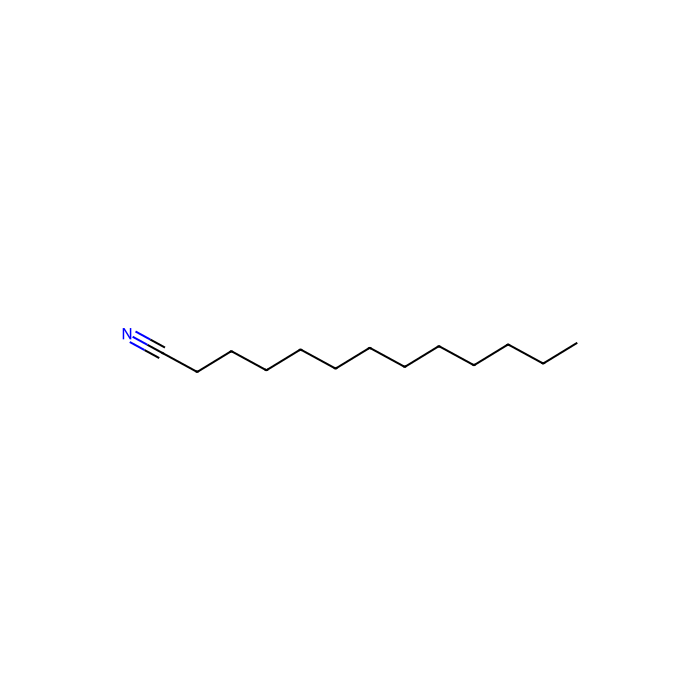
Representative SMILES: N#CCCCCCCCCCCC (literature; linear C13 chain terminating in a nitrile)
Structural features (descriptive)
Functional groups: one terminal nitrile (–C≡N) attached to a saturated, linear C12 alkyl chain (total C13).
Saturation/stereochemistry: fully saturated aliphatic chain; no stereocenters; no rings.
2D description: a straight n-alkyl backbone (CH3–(CH2)11–) bearing a terminal sp-hybridized carbon triple-bonded to nitrogen. Electron-withdrawing nitrile at one end, hydrophobic tail dominates bulk properties.
Notes
Identity details provided under “Literature/General” are typical for this CAS and are not item specifications. Always confirm exact identity parameters on the item’s CoA/SDS.
Synthetic Utility
Functional reactivity (literature/general)
Electrophilic carbon of the nitrile enables diverse downstream chemistry while preserving the C13 hydrophobic segment. Key manifolds:
Hydrolysis: to amide (controlled) or carboxylic acid (exhaustive) under acid/base catalysis.
Reduction: to aldehyde (partial, e.g., DIBAL-H at low temperature) or primary amine (catalytic hydrogenation; borane reductions).
Nucleophilic addition: RMgX/RLi additions culminating in ketones after hydrolysis.
Pinner reaction: formation of imidate salts in alcohol/HCl, advancing to amidines/esters.
Cross-coupling surrogacy: via conversion to imidoyl halides or oxime derivatives enabling further C–C bond formation (advanced literature strategies).
Retrosynthetic value
Tridecanenitrile serves as a convergent handle: append a desired carbon fragment onto the nitrile to forge ketones in a single step, avoiding acid chloride preparation. Alternatively, hydrogenate to tridecylamine to access cationic surfactant scaffolds.
Selectivity/control
Water and acid/base content dictate amide vs acid outcomes in hydrolysis. In reductions, catalyst choice tunes selectivity (e.g., nitrile → imine → amine; suppress over-hydrogenolysis of side groups if present). Organometallic additions benefit from low-temperature initiation to control exotherms and avoid enolization or over-addition.
Practical analytics
Monitor by IR (C≡N at ~2240–2260 cm−1 disappearing upon conversion), GC/GC–MS for volatile/semivolatile profiling, and NMR for product-state confirmation (ketone carbonyl near 205–215 ppm in 13C).
Target Specificity
Not applicable.
This product is a small-molecule chemical intermediate, not a biological targeting reagent (e.g., antibody, enzyme inhibitor with defined target panel). No antigen/epitope, species reactivity, clone, or isotype information applies.
We use cookies to ensure the website functions properly and, where permitted, to improve your experience. You can manage your preferences at any time in Settings. Learn more in our Cookie Policy.
Shall we send you a message when we have discounts available?
Remind me later
Thank you! Please check your email inbox to confirm.
Products are supplied to verified businesses, institutions, and qualified professionals for research and development use only. Not for use in humans, animals, diagnosis, or therapy.

 H2112394