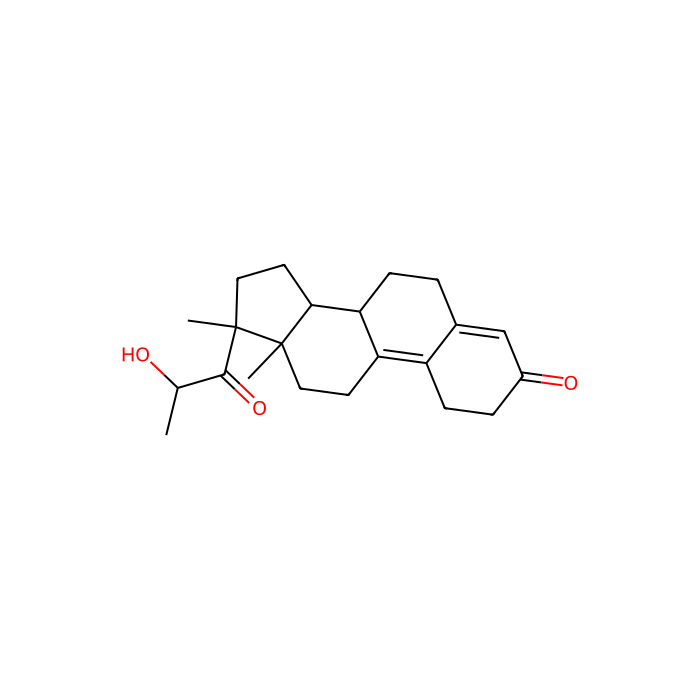
This compound belongs to the class of organic compounds known as 20-oxosteroids. These are steroid derivatives carrying a C=O group at the 20-position of the steroid skeleton.
External Descriptors
Not available
1. Djoumbou Feunang Y, Eisner R, Knox C, Chepelev L, Hastings J, Owen G, Fahy E, Steinbeck C, Subramanian S, Bolton E, Greiner R, and Wishart DS. ClassyFire: Automated Chemical Classification With A Comprehensive, Computable Taxonomy. Journal of Cheminformatics, 2016, 8:61.
P305+P351+P338:IF IN EYES: Rinse cautiously with water for several minutes. Remove contact lenses if present and easy to do - continue rinsing.
P264+P265:Wash hands [and …] thoroughly after handling. Do not touch eyes.
P337+P317:If eye irritation persists: Get medical help.
Calculateurs de solution
Molarity Calculator
Determine the necessary mass, volume, or concentration for preparing a solution.
Dilution Calculator
Determine the dilution needed to prepare a stock solution.
Reconstitution Calculator
Avis
Avis des clients
Application Protocols
No manufacturer-validated protocols are provided for this SKU. The following are general, non-binding examples to aid method setup.
Preparation of stock solutions (general)
Weigh the required amount quickly under low light. Dissolve in anhydrous DMSO to 10–50 mM. Vortex and, if needed, sonicate briefly. Aliquot into amber microvials, purge with inert gas if available, cap tightly, and store at 2–8 °C. Record exact concentration.
LC–MS/MS calibration curve setup (example)
Prepare serial dilutions in 50:50 acetonitrile:water (0.1% formic acid) from a DMSO intermediate, keeping final DMSO ≤1%. Spike into blank matrix for matrix-matched calibration. Use a structurally related internal standard where possible. Evaluate linearity, LOD/LOQ, carryover, and stability (bench-top, autosampler).
Cell-based reporter assay (example)
Seed PR-expressing cells in 96-well plates. After 24 h, treat with serial dilutions prepared from DMSO stock; final vehicle ≤0.1% v/v. Incubate 16–24 h, then read reporter activity. Include vehicle control and a reference curve with endogenous progesterone for comparison.
These examples must be adapted and validated for specific instruments, cell lines, and regulatory requirements.
Biological Roles
Context (literature; no clinical claims)
Trimegestone is a synthetic progestin that functions as a high-affinity ligand for the progesterone receptor (PR) in biochemical systems. As with other progestins, it can modulate PR-dependent transcription in cell-based reporter assays and serves as a reference compound to benchmark potency/efficacy against endogenous progesterone.
Mechanistic considerations (general for steroidal progestins)
Binds to nuclear PR isoforms (PR-A/PR-B) leading to recruitment of co-regulators and regulation of target gene expression in responsive cell lines.
Lipophilic structure supports passive membrane diffusion; intracellular distribution can be influenced by binding proteins and membrane components.
Metabolism: Subject to oxidative transformations (e.g., 6β-, 16α/β-hydroxylation) and subsequent conjugation (glucuronidation/sulfation) in microsomal/S9 systems, producing more polar metabolites suitable for excretion.
Experimental implications
Vehicle effects: Ensure matched solvent controls (ethanol/DMSO) because PR signaling can be sensitive to solvent composition.
Adsorptive losses: High surface binding to plastics can reduce apparent concentrations; include internal standards and low-binding consumables.
Time-dependent effects: Equilibration with cellular compartments may be slow; account for pre-incubation times and steady-state conditions in kinetic studies.
Buffer Applications
This product is a hydrophobic small-molecule reference compound and is not used to prepare buffer systems.
Practical note: When Trimegestone must be introduced into aqueous buffers (for bioassays), dissolve first in a miscible organic vehicle (e.g., DMSO or ethanol) to make a concentrated stock, then dilute into the buffer ensuring the final organic content remains within assay-tolerated limits (commonly ≤0.1–0.5% v/v). Include vehicle-only controls.
Surfactant aids (general): If permitted by the assay, minimal amounts of solubilizing agents (e.g., ≤0.01% nonionic surfactant) may reduce adsorption and improve apparent solubility; validate for biological compatibility.
Green Alternatives
As a solid reference compound, Trimegestone itself is not replaceable by a “greener” chemical. However, greener choices can be made for solvents and workflows used with it.
Greener solvent substitutions (general guidance)
Replace dichloromethane/chloroform with ethyl acetate, 2-MeTHF, or methyl tert-butyl ether (MTBE) when feasible for extractions/purifications.
Favor ethanol or isopropanol over acetonitrile/methanol where assay tolerance allows.
Use supercritical CO2 for preparative chromatography if available.
Comparison (literature; typical pros/cons)
Ethyl acetate vs DCM: Lower toxicity and environmental impact; slightly lower solvency for very nonpolar matrices; higher boiling point affects evaporation time.
2-MeTHF vs THF: Bio-based origin, more hydrophobic (facilitates separations), peroxide formation slower than THF but still monitor; can improve phase behavior in liquid–liquid extractions.
Aqueous-organic microemulsions: Reduce neat organic solvent usage in sample prep; validate recovery due to adsorption and partitioning.
Process considerations
Minimize DMSO percentage in biological assays to reduce solvent load and improve cell viability.
Apply miniaturization (microtiter assays) and solid-phase techniques (SPE) to lower solvent consumption.
All substitutions should be validated for recovery, stability, and assay performance specific to this analyte.
Pharmaceutical Uses
No therapeutic or clinical claims are made for this research product.
Research/formulation context (general)
May be used as a reference standard in analytical method development for dosage form testing (e.g., HPLC/LC–MS assay, dissolution profiling) where Trimegestone is present in complex matrices.
Useful as a system suitability compound and retention marker for steroid-focused chromatographic methods due to its lipophilic, polycyclic structure and carbonyl chromophore.
Employed in forced-degradation studies to map stability-indicating methods (oxidative, photolytic, thermal, and hydrolytic challenges) without implying suitability for human use.
Compendial status
No pharmacopeial monograph information is provided for this item; refer to current USP/EP/JP listings as applicable.
Excipients/stabilizers
None specified for this item; refer to CoA/Spec Sheet. For analytical standards, packaging in amber vials and inert headspace is common practice to mitigate light and oxidative degradation.
Physical Properties
Item-specific (from Product Data)
Appearance: Not specified for this item; refer to CoA/Spec Sheet.
Storage/transport (from Product Data)
Storage: Store at 2–8 °C.
Shipped: Wet ice.
Literature/typical properties for steroidal progestins (for context; not item specifications)
Physical state: Crystalline solid; non-volatile.
Solubility: Practically insoluble in water; soluble in polar aprotic organics (DMSO, DMF) and moderately in alcohols (ethanol, methanol) and chlorinated solvents; often requires co-solvent systems for aqueous assays.
Lipophilicity: High (typical cLogP > 2 for steroidal hormones), leading to strong partitioning into organic phases and plastics.
UV: Conjugated carbonyl/olefin chromophores typically give measurable absorbance in the 230–280 nm range (useful for HPLC-UV quantitation).
Thermal behavior: High melting range typical of rigid polycyclic steroids; negligible vapor pressure at room temperature.
Not provided here (item-specific values)
Melting point, density, refractive index, pKa, exact logP, UV cutoff, and aqueous solubility: Not specified for this item; refer to CoA/Spec Sheet.
Practical notes (general)
Prepare concentrated stocks in dry DMSO or ethanol; avoid repeated heating. For analytical work, determine extinction coefficient empirically for your solvent/grade.
Quality and Grades
Item-specific grade/purity
Grade/Purity: Not specified for this item; refer to CoA/Spec Sheet.
How to interpret grades for small-molecule reference standards (general guidance)
Research grade: Suitable for discovery and mechanistic studies; may not include pharmacopeial tests.
Analytical/Reference standard grade: Tight ID/purity specifications (e.g., NMR, HPLC area %, water) and trace impurity profiling; supports quantitative assays.
Pharmacopoeial grade (USP/EP/JP): Conforms to monograph where applicable; includes specific ID tests, impurity limits, and assay methods.
What to look for on the CoA (practical tips)
Identity: 1H NMR/13C NMR, MS, and HPLC purity with method.
Residual solvents: By GC in line with ICH Q3C.
Water content: Karl Fischer (particularly relevant if hydrate formation is possible; not specified for this item).
Solid-state form: Polymorph/crystallinity; DSC/TGA if applicable.
Stability: Results of re-test period or formal shelf life under 2–8 °C storage.
Stabilizers/antioxidants
None specified for this item; refer to CoA/Spec Sheet. For light/air-sensitive steroids, suppliers sometimes package under inert gas or amber containers; inspect packaging notes.
Reaction and Applications
This compound is most frequently used as a reference ligand/analytical standard rather than as a transforming reagent.
Metabolism studies: Substrate for microsomal/S9 incubations to characterize phase I/II biotransformations; LC–MS/MS method development and metabolite ID.
Bioanalytical standards: Calibration/QC samples for quantifying progestins in biological matrices by LC–MS/LC–UV; assessment of matrix effects and recovery.
Synthetic/derivatization utility (general)
Derivatization for analytics: Carbonyl-specific reagents (e.g., DNPH, Girard reagents) to enhance UV or MS response; silylation (TMS, TBDMS) of hydroxyls/carbonyl enolates for GC analysis if applicable.
Solid-phase extraction method development: Evaluating retention on C18/phenyl/HLB sorbents guided by lipophilicity and aromatic interactions.
Practical tips
Minimize adsorption losses by using silanized glassware or pre-rinsing plastics with solvent containing a small amount of analyte.
Control light and oxidation during long incubations; include vehicle controls and internal standards.
Note: No manufacturer application notes were provided for this SKU; the above reflects common research uses for steroidal progestins and should be adapted to specific experimental designs.
Reaction Conditions
There are no manufacturer-specified reaction conditions for this SKU as it is provided for research/analytical use rather than as a reagent.
General experimental conditions for working with steroidal progestins (literature/good practice)
Stock solutions: 10–50 mM in anhydrous DMSO or ethanol; store aliquots at 2–8 °C (short term) protected from light; avoid repeated freeze–thaw.
Enzymatic incubations: 0.1–10 µM typical substrate concentrations in phosphate or Tris buffers (pH ~7.4) with microsomes/S9; include NADPH for oxidative metabolism; 15–60 min at 37 °C with shaking; quench with organic solvent (e.g., acetonitrile) prior to LC–MS analysis.
Receptor assays: 0.01–100 nM test ranges common for PR activation/binding; vehicle kept ≤0.1–0.5% v/v; readouts after 6–24 h for reporter assays depending on cell line and promoter.
Stability testing (method development)
Forced degradation under oxidative (H2O2), photolytic (UV/visible), thermal (60–80 °C), and hydrolytic conditions to establish stability-indicating HPLC methods; monitor formation of characteristic degradation products (e.g., hydroxylated/epimerized species).
All parameters above are general literature guidance for steroidal analytes and must be optimized for specific experimental systems.
Safety and Handling
Item-specific hazard details
GHS classification: Not specified for this item; refer to SDS.
Signal word / H-statements / Pictograms: Not specified for this item; refer to SDS.
General laboratory precautions for steroidal small molecules (literature/good practice)
Avoid inhalation and skin contact; use a chemical fume hood when weighing or preparing solutions.
Wear appropriate PPE: lab coat, safety glasses, and nitrile gloves (double-gloving recommended for extended handling due to lipophilicity).
Prevent environmental release; collect organic waste according to institutional procedures.
Handling notes
Dust control: Use anti-static tools and weigh boats; consider pre-dissolving in a minimal volume of solvent to minimize airborne particles.
Adsorption/absorption: Highly lipophilic compounds can adsorb to plastic labware; use glass where feasible or pre-condition plastics with solvent.
Incompatibilities: Strong oxidizers may degrade steroids; avoid prolonged exposure to alkaline solutions which can induce enolization or isomerization.
Photolability: Many enone-containing steroids show light sensitivity; minimize light exposure during handling and storage.
First aid (overview; defer to SDS)
Skin/eye: Rinse with water for ≥15 min; remove contaminated clothing.
Inhalation: Move to fresh air; seek medical attention if symptoms persist.
Ingestion: Rinse mouth; do not induce vomiting; seek medical attention.
Always consult the current SDS for authoritative safety, spill response, and disposal guidance.
Solvent Selection
Trimegestone is a hydrophobic steroidal compound; solvent choice primarily targets dissolution and compatibility with the intended assay.
Polarity and miscibility (literature/typical for progestins)
Water: Practically insoluble; requires co-solvents or carriers.
Polar aprotic: DMSO and DMF provide high solubility; common for stock solutions.
Alcohols: Ethanol and methanol offer moderate solubility and are miscible with aqueous buffers up to limited percentages.
Halogenated/aromatic: CH2Cl2, chloroform, and ethyl acetate/toluene dissolve steroids; useful for extraction and preparative work (mind safety/green aspects).
Practical selection by use case (general guidance)
Cell-based assays: Prepare a concentrated DMSO stock (e.g., 10–50 mM), then dilute into media keeping final DMSO ≤0.1–0.5% v/v to minimize cytotoxicity.
Enzymology/receptor-binding: Ethanol or DMSO stocks; validate vehicle controls due to potential ligand–plastic interactions.
Chromatography: For HPLC/UPLC, acetonitrile–water or methanol–water with 0.1% formic acid are typical mobile phases; dissolve sample initially in the strong solvent portion to prevent on-column precipitation.
Small comparison (general)
DMSO: Highest solvency; may perturb biology at >0.5%.
Ethanol: Biocompatible at modest %; lower solvency than DMSO.
DMF: Strong solvency; less favored in bioassays.
Always verify solubility and compatibility empirically under your exact conditions.
Storage and Reconstitution
Item-specific storage and shipping (from Product Data)
Storage temperature: Store at 2–8 °C.
Shipping condition: Wet ice.
Container/packaging (general best practice)
Store in tightly sealed amber vials to protect from light. If provided under inert atmosphere, maintain minimal headspace exposure.
Dissolve solid in anhydrous DMSO or ethanol to prepare a concentrated stock (e.g., 10–50 mM). Mix thoroughly (vortex/brief sonication). Filter through a PTFE syringe filter if particulate is present.
Aliquot into small volumes to avoid repeated freeze–thaw and headspace oxygen ingress. Label with solvent, concentration, and preparation date.
Stability considerations (general)
Protect from light and air to minimize oxidative/photo-degradation, especially in solution. Short-term storage at 2–8 °C is generally suitable; for longer-term storage of solutions, consider −20 °C in sealed amber vials.
Retest/shelf life
Not specified for this item; refer to CoA/Spec Sheet.
Always inspect material upon receipt and before use. Allow cold shipments to equilibrate to room temperature in the sealed container to avoid condensation before opening.
Structure and Identity
Overview: Trimegestone is a synthetic progestin (steroidal scaffold) used widely as a reference compound in receptor-binding and metabolism studies.
Item-specific (from Product Data)
CAS: 74513-62-5
CID: 68926
InChIKey: 170474 (as provided)
SMILES: Not specified for this item; refer to CoA/Spec Sheet.
Molecular formula: Not specified for this item; refer to CoA/Spec Sheet.
Molecular weight: Not specified for this item; refer to CoA/Spec Sheet.
Structural features (general description; literature)
Steroidal tetracyclic perhydrophenanthrene core (rings A–D) typical of C19/C21 hormones.
Contains at least one enone/carbonyl functionality on the A- or C/D-ring system characteristic of progestational agents.
Multiple stereocenters embedded within the fused-ring system; rigid, lipophilic framework.
2D structure in words (literature, generic for this class)
Four fused cycloalkane rings (three six-membered, one five-membered), with axial/equatorial methyl substituents, and one or more ketone groups. Substitutions and unsaturations modulate progestin receptor affinity and metabolic stability.
Notes
The InChIKey presented in Product Data is not in the conventional 27-character format; consult the CoA/SDS for the definitive identifier used for regulatory and analytical purposes.
Synthetic Utility
As a fully elaborated steroidal framework, Trimegestone is not typically used as a building block in synthetic sequences. Nevertheless, it serves research and method-development roles:
Derivatization handles: Carbonyl groups can undergo oxime/hydrazone formation (e.g., with O-methoxyamine, DNPH) to enhance detectability or alter chromatographic behavior.
Protective transformations: Temporary silylation/acylation of hydroxyl/enolizable positions to enable GC or to modulate retention and stability during analysis.
Reference in retrosynthesis/structure–activity work (literature)
Provides a benchmark scaffold for SAR comparison in 19-norprogesterone/progestin series; aids in correlating substitution patterns with receptor affinity and metabolic stability.
Purification/characterization practice
Its rigid, lipophilic structure offers predictable retention on C18/phenyl LC phases; serves as a test analyte for evaluating stationary phase selectivity and gradient programs for steroids.
Given its specialized structure, chemists generally use Trimegestone as a target/analyte rather than a reagent or synthon.
Target Specificity
This product is a small-molecule progestin and not a biological macromolecule (e.g., antibody or enzyme). Therefore, antigen/epitope, clone, isotype, and species reactivity fields do not apply.
Context (literature)
In mechanistic studies, Trimegestone is used as a reference ligand for the progesterone receptor (PR). Any quantitative affinity/efficacy values are assay- and publication-dependent and are not specified for this item.
For assay-specific binding parameters, consult the primary literature and validate under your lab conditions.
Foire aux questions
How should this product be stored?
Store at 2–8 °C. Refrigerated storage is required to maintain the specified shelf life.
How is this product shipped?
This product ships chilled on wet ice. Unpack on arrival and transfer it to the storage condition stated above.
What are the CAS number, molecular formula and molecular weight?
The CAS Number is 74513-62-5, the molecular formula is C22H30O3, and the molecular weight is 342.47 g/mol. InChIKey JUNDJWOLDSCTFK-MTZCLOFQSA-N.
What documentation is provided?
Available product documentation, including Certificates of Analysis (COA), Safety Data Sheets (SDS), and specification sheets, is shown in the product document area. Document availability and access follow the current site policy.
Nous utilisons des cookies pour garantir le bon fonctionnement du site et, lorsque cela est autorisé, pour améliorer votre expérience. Vous pouvez gérer vos préférences à tout moment dans les Paramètres. Pour en savoir plus, consultez notre Politique relative aux cookies.
Souhaitez-vous que nous vous envoyions un message lorsque des réductions seront disponibles?
Me rappeler plus tard
Merci ! Veuillez vérifier votre boîte de réception e-mail pour confirmer.
Products are supplied to verified businesses, institutions, and qualified professionals for research and development use only. Not for use in humans, animals, diagnosis, or therapy.