GRADE & PURITYCarrier Free?Carrier-free — supplied without added carrier protein/stabilizer. Use when carriers (e.g. BSA) would interfere with conjugation or sensitive assays.ExactAb™?ExactAb™ — Aladdin's antibody line emphasizing precision and validated quality. Use for reliable, specificity-validated antibody applications.Validated?Validated grade — performance confirmed in defined applications before release. Use when you want documented assurance the reagent works as stated.High Performance?High-performance grade with optimized purity and performance characteristics. Use for sensitive analyses where ordinary grades fall short.0.5 mg/mL
ExactAb™, Validated, Carrier Free, High performance, 0.5 mg/mL
Espèce hôte
Mouse
Spécificité
VAV1
Immunogène
Recombinant protein of human VAV1 expressed in E.coli .
Contrôle positif
WB: Raji, THP-1, MOLT-4 and Jurkat cell lysates.
Conjugation
Unconjugated
Grade
Carrier Free, ExactAb™, High Performance, Validated
Isotype
Mouse IgG1
Type de chaîne lumineuse
kappa
SDS-PAGE
150 kDa
Méthode de purification
Protein G purified
Concentration
0.5 mg/mL
Product Line
Produits biologiques
Stockage et expédition
Forme
Liquid
Conditions de stockage de stockage
Store at -20°C,Avoid repeated freezing and thawing
Expédié en
Ice chest + Ice pads
Stabilité et stockage
Store at 4℃ short term (1-2 weeks). Store at -20℃ long term (24 months). Upon receipt, it is recommended to aliquot. Avoid freeze/thaw cycle.
Images
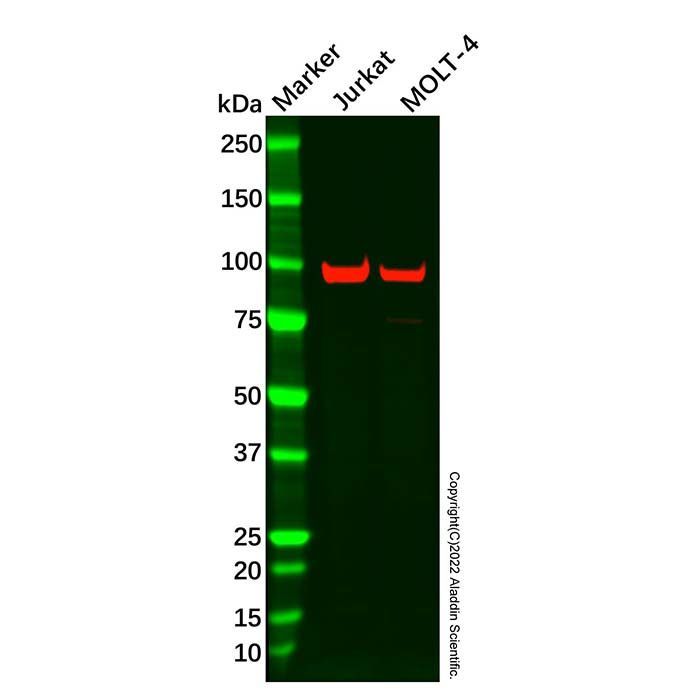
VAV1 Mouse mAb (Ab133953) - Western Blot All lanes: VAV1 Mouse mAb (Ab133953) at 1/4000 dilution Samples: Lysates at 20 µg per lane Secondary: Goat Anti-Mouse IgG H&L (HRP) (Ab179001) at 1/40000 dilution
Predicted band size: 98 kDa Observed band size: 96 kDa Exposure time: 10.0 s
VAV1 Mouse mAb (Ab133953) - Western Blot All lanes: VAV1 Mouse mAb (Ab133953) at 1/4000 dilution Samples: Lysates at 20 µg per lane Secondary: Goat Anti-Mouse IgG H&L (HRP) (Ab179001) at 1/40000 dilution
Predicted band size: 98 kDa Observed band size: 100 kDa Exposure time: 112.5 s
Application
Application
Dilution info
WB
1/4000
Documentation
📋 Safety Data Sheet (SDS)
Comprehensive hazard, handling, storage, and regulatory compliance document.
Determine the necessary mass, volume, or concentration for preparing a solution.
Dilution Calculator
Determine the dilution needed to prepare a stock solution.
Reconstitution Calculator
Avis
Avis des clients
Application Protocols
Tested/validated applications, recommended dilutions, and positive control samples are not specified for this item. Refer to the product CoA/Spec Sheet for any available application data, suggested working concentrations, and validation images. Until item-specific protocols are available, users should perform in-lab optimization with appropriate positive/negative controls for their sample type and detection system.
Biological Roles
General information about the antigen (literature/general)
VAV1 is a hematopoietic-specific guanine nucleotide exchange factor (GEF) that activates Rho family GTPases (notably Rac1) downstream of tyrosine kinase signaling. It integrates signals from immunoreceptors (e.g., TCR) via phosphorylation-dependent activation, orchestrating cytoskeletal remodeling and transcriptional responses.
Cellular roles: Critical for T cell receptor signaling, immune synapse assembly, calcium influx, MAPK and NF-κB pathway activation, and actin dynamics. Dysregulation has been implicated in aberrant immune responses and oncogenic signaling contexts (literature).
Relevance for an anti-VAV1 monoclonal antibody (general)
Utility: Detection, quantification, and localization of VAV1 in hematopoietic cells and cell lines; assessment of phosphorylation-dependent activation states when paired with phospho-specific tools; co-immunoprecipitation to explore signaling complexes.
Sample types: Cell lysates (T lymphocytes, hematopoietic lines), fixed cells/tissues with appropriate retrieval conditions, and immunoprecipitates.
Item-specific note
Target specificity details (epitope, isotype, species reactivity) are not specified for this item; confirm compatibility with your biological system using the CoA/Spec Sheet and positive/negative controls.
Buffer Applications
General guidance for monoclonal antibody handling (literature/general)
Working buffers: Phosphate-buffered saline (PBS, pH 7.2–7.4) or Tris-buffered saline (TBS, pH 7.4–8.0) are common. Add 0.05–0.1% nonionic surfactant (e.g., Tween-20) for wash buffers in immunoassays to reduce nonspecific binding.
Blocking: For assays requiring blocking (e.g., WB, ELISA, IHC), choose blockers compatible with a carrier-free primary (BSA, casein, serum, or synthetic blockers). Carrier-free primaries reduce background from carrier proteins but may be more prone to adsorption at very low concentrations; use low-bind plastics.
pH/Ionic strength: Maintain near-neutral pH to preserve antibody integrity. High salt (150–300 mM NaCl) can reduce nonspecific interactions in some assays.
Calcium/Magnesium: Typically not required unless supporting specific protein interactions; EDTA can be included to chelate divalent cations if needed for sample stability.
Additives: Avoid sodium azide if downstream detection uses HRP or if live-cell applications are planned. For long-term storage, compatible cryoprotectants (e.g., 10–50% glycerol) are often used, but this item is Carrier Free; any excipients present must be confirmed on the CoA/Spec Sheet before addition of new components.
Item-specific note
Exact supplied buffer and concentration are not specified for this item. Adjust buffer systems only after verifying the starting formulation on the CoA/Spec Sheet to ensure compatibility with your application and any planned conjugation.
Green Alternatives
Not directly applicable. This product is a biological reagent rather than an organic solvent or small-molecule reactant. Environmental considerations focus on minimizing cold-chain shipments, right-sizing order quantities to reduce waste, and following institutional best practices for biological waste management.
Pharmaceutical Uses
Not applicable. This product is supplied strictly for research use only and is not intended for human or veterinary use, diagnostic procedures, or as an active pharmaceutical ingredient or excipient. No pharmacopeial status or formulation role is specified for this item.
Physical Properties
Item-specific facts (from Product Data)
Appearance: Not specified for this item; refer to CoA/Spec Sheet.
Concentration, buffer composition, excipients: Not specified for this item; refer to CoA/Spec Sheet. Grade indicates Carrier Free (see Quality & Grades).
Literature/general properties for mouse IgG monoclonal antibodies
Molecular weight: Typically ~150 kDa for intact IgG; Fab ~50 kDa; Fc ~50 kDa; light chain ~25 kDa; heavy chain ~50 kDa (reducing SDS-PAGE).
Isoelectric point (pI): Commonly ~6–9 depending on isotype/sequence.
Solubility: Readily soluble in aqueous physiological buffers (e.g., PBS, TBS). Poorly soluble in organic solvents.
Stability: Increased stability at neutral pH, low ionic strength, refrigerated or frozen. Sensitive to repeated freeze–thaw and prolonged agitation/foaming.
Aggregation: Promoted by extremes of pH, elevated temperature, interfaces (air–liquid), and high shear; mitigated by optimized buffers, gentle handling, and single-use aliquots.
UV absorbance: ε280 ~ 1.4 (mg/mL)−1 cm (literature rule-of-thumb for IgG) for concentration estimation; exact extinction coefficient is sequence-dependent and not specified for this item.
Not provided for this item (specifications)
Exact molecular weight, pI, extinction coefficient, buffer composition, protein concentration, and purity profile: Not specified for this item; refer to CoA/Spec Sheet.
Quality and Grades
Item-specific designations (from Product Data)
Carrier Free: Provided without added protein carriers such as BSA or gelatin, and typically without glycerol; ideal for conjugation or assays sensitive to carriers. For exact excipient status (including any preservatives), refer to the CoA/Spec Sheet.
ExactAb™: Manufacturer designation indicating high lot-to-lot fidelity of the monoclonal antibody (e.g., sequence-defined or clonally consistent supply). Specific implementation details not specified for this item.
Validated, High Performance: Indicates the antibody has undergone internal performance verification. Specific tested applications, species reactivity, and performance metrics are not specified for this item; see Application Protocols/CoA when available.
What these grades mean in practice (general guidance)
Carrier-free format supports custom labeling (enzymatic, chemical, click) and reduces assay background from carrier proteins. It can increase adsorption losses at low concentration; consider low-bind tubes and prompt aliquoting.
ExactAb-class products are intended to improve reproducibility by minimizing lot drift; keep records of lot numbers for traceability.
“Validated/High Performance” flags suggest robust target recognition under defined conditions. However, experimental conditions vary; users should perform in-lab optimization and include appropriate controls.
Item-specific caveats
Because exact buffer composition, concentration, isotype, and clone are not specified for this item, users should consult the CoA/Spec Sheet prior to assay development or conjugation to confirm compatibility with planned chemistries (e.g., amine-reactive labels, Fc-specific binders).
Reaction and Applications
Chemical reaction use (e.g., as a reagent or solvent) is not applicable to this monoclonal antibody. Its relevance is in immunoassays and target detection/quantitation. Because specific tested applications for this item are not provided, please refer to Application Protocols (when available) and the CoA/Spec Sheet for validated uses and recommended conditions.
Reaction Conditions
Not applicable to chemical reactions. For experimental conditions in immunoassays (e.g., incubation times, temperatures, dilutions), see Application Protocols when available. Because specific tested applications and conditions are not provided for this item, consult the CoA/Spec Sheet and optimize empirically with appropriate controls.
Safety and Handling
Item-specific facts (from Product Data)
Storage: Store at −20°C. Avoid repeated freezing and thawing.
Shipping: Shipped in ice chest with ice pads.
GHS/CLP: Signal word, hazard statements, classification, pictograms: Not specified for this item; consult the SDS.
General guidance for monoclonal antibodies (literature/general; always defer to SDS)
Biosafety: Handle using good microbiological practices. Although recombinant antibodies are generally low hazard, treat as biological material. Avoid ingestion, inhalation of aerosols, and skin/eye contact.
PPE: Laboratory coat, nitrile gloves, and safety glasses; use a biological safety cabinet if procedures may generate aerosols.
Incompatibilities: Avoid strong oxidizers and extremes of pH that can denature proteins. Avoid metal-catalyzed oxidation and prolonged exposure to elevated temperature.
Handling: Do not vortex vigorously. Mix by gentle inversion. Keep on ice during use. Minimize surface adsorption by using low-binding plastics if concentrations are low.
Freeze–thaw: Repeated cycles can cause aggregation and activity loss; prepare small aliquots upon first thaw.
First aid (general): In case of skin/eye contact, rinse with water. If inhaled, move to fresh air. If ingested, rinse mouth. Seek medical attention if symptoms persist. Provide SDS to medical responders.
Waste disposal
Dispose of unused material and contaminated consumables according to institutional biosafety procedures for non-hazardous biologicals and local regulations.
Solvent Selection
Not typically applicable. As a protein biologic, this monoclonal antibody is formulated for use in aqueous buffers rather than organic solvents. For practical guidance on buffer choice and pH/ionic strength considerations, see the Buffer Applications and Storage & Reconstitution sections.
Storage and Reconstitution
Item-specific storage (from Product Data)
Storage temperature: Store at −20°C.
Handling: Avoid repeated freezing and thawing; aliquot upon first thaw to minimize activity loss.
Shipping: Shipped in an ice chest with ice pads to maintain cold chain.
General guidance (literature/general; confirm against CoA/Spec Sheet)
If received frozen: Thaw on ice. Mix gently by inversion—do not vortex. Prepare single-use aliquots in low-binding tubes sized to your expected usage to prevent multiple freeze–thaw cycles.
Short-term storage: 2–8°C for a few days may be acceptable once thawed; avoid microbial contamination by using sterile technique.
Long-term storage: −20°C or below. Some users add cryoprotectants (e.g., 10–50% glycerol) for storage at −20°C; however, this item is Carrier Free and exact formulation is not specified—verify compatibility before adding excipients.
Light/temperature: Protect from prolonged exposure to elevated temperatures and direct light to preserve activity.
Not specified for this item
Appearance, concentration, buffer composition, preservative status, and reconstitution steps (if lyophilized): Not specified for this item; refer to CoA/Spec Sheet.
Structure and Identity
Item-specific facts (from Product Data)
Product: VAV1 Mouse mAb (monoclonal antibody, mouse)
Grade/Purity: Carrier Free; ExactAb™; Validated; High Performance
CAS, InChIKey, SMILES: Not applicable to biologics of this type; not specified for this item.
General structural description (literature/general)
Molecular class: Immunoglobulin G (IgG)-type monoclonal antibody produced in mouse (exact isotype and clone not specified for this item; refer to CoA/Spec Sheet).
Architecture: Two heavy chains and two light chains (H2L2) linked by disulfide bonds; variable domains (VH/VL) form the antigen-binding sites recognizing VAV1 antigenic epitopes; constant Fc region mediates effector interactions.
Approximate mass: Typical intact IgG is ~150 kDa (literature); actual for this clone not specified for this item.
Post-translational features: Disulfide bonds; N-linked glycosylation on Fc is typical for IgG (site occupancy and glycoforms are clone- and process-dependent; not specified for this item).
Structural topology (2D description): Y-shaped molecule with two Fab arms containing complementarity-determining regions (CDRs) that confer specificity toward VAV1; stem corresponds to Fc constant domains.
Notes
Sequence, epitope, isotype, and clonality details are not specified for this item; refer to the product CoA/Spec Sheet for definitive identity attributes.
Synthetic Utility
Not applicable. As a mouse monoclonal antibody, this product is not used as a synthetic building block or reagent in chemical synthesis. Refer instead to the Biological Roles, Target Specificity, and Application Protocols sections for research-use contexts.
Target Specificity
Item-specific details (from Product Data)
Antigen/Target: VAV1
Clone, isotype, species reactivity, epitope: Not specified for this item; refer to CoA/Spec Sheet.
Notes
VAV1 is a signaling adaptor/GEF expressed mainly in hematopoietic cells (general literature). For application compatibility (WB, IHC, IF, IP, FC) and cross-reactivity profiles, verify on the product CoA/Spec Sheet when available.
Foire aux questions
What does ExactAb? mean?
ExactAb? indicates the product has been validated for use in rigorous antibody validation workflows. Validation may include positive/negative control samples, signal-to-noise testing, and protocol-specific QC. Lot-specific test data is published on the Certificate of Analysis where available.
What does Carrier Free mean?
Carrier Free indicates that the material has been processed and tested for specialty industrial processing. Specifications focus on the impurities that affect performance in that application — for example, metal content for electronics, particle size for batteries, refractive index for optics, or moisture content for moisture-sensitive processes.
How should this product be stored?
Store at ?20 °C. Avoid repeated freeze–thaw cycles. Aliquot into single-use volumes before freezing.
How is this product shipped?
This product ships in an insulated container with ice pads. Unpack on arrival and transfer it to the storage condition stated above.
What documentation is provided?
Available product documentation, including Certificates of Analysis (COA), Safety Data Sheets (SDS), and specification sheets, is shown in the product document area. Document availability and access follow the current site policy.
Which species reactivity has this antibody been validated against?
Validated reactivity is listed on the PDP and on each lot's datasheet. We validate against the most commonly tested species for the target (VAV1 Mouse mAb); cross-reactivity in untested species may exist but is not guaranteed. Contact technical support for specific species inquiries.
Need help choosing the grade?
Our grade selection guide covers purity, stabilizer status, and application suitability for all variants in our catalog.
Nous utilisons des cookies pour garantir le bon fonctionnement du site et, lorsque cela est autorisé, pour améliorer votre expérience. Vous pouvez gérer vos préférences à tout moment dans les Paramètres. Pour en savoir plus, consultez notre Politique relative aux cookies.
Souhaitez-vous que nous vous envoyions un message lorsque des réductions seront disponibles?
Me rappeler plus tard
Merci ! Veuillez vérifier votre boîte de réception e-mail pour confirmer.
Products are supplied to verified businesses, institutions, and qualified professionals for research and development use only. Not for use in humans, animals, diagnosis, or therapy.

 ZJ24F0303490