GRADE & PURITYMoligand™?Moligand™ — Aladdin's line of ligands and bioactive small molecules. Use for receptor, pathway, and binding studies needing defined small-molecule tools.≥98%
Moligand™,≥98% Moligand™ for sensitive chromatographic and analytical workflows requiring minimal baseline interference.
🌡
Storage & shipping
Store at -20°C,Argon charged Ships Ice chest + Ice pads Check lot-specific COA for exact specifications.
📋
Quality documents
SDS, COA, datasheet, and spec sheet available for download. Lot-specific COA accessible via lot number lookup.
📚
Literature proof
Cited in 0 peer-reviewed publications across chromatography, organic synthesis, and cross-coupling reactions.
Vue d’ensemble
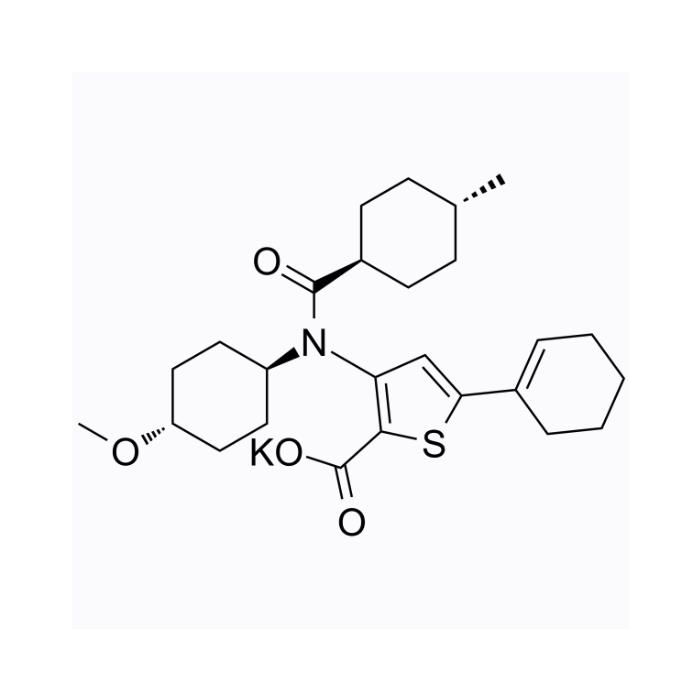
VCH-916 is a thiophene derivative and non-nucleoside inhibitor of HCV NS5B polymerase with sub-micromolar IC50 values versus genotype 1a and 1b replicons. VCH-916 binds to Thumb Site II. VCH-916 can be used for the research of hepatitis c virus (hcv) infection.
This compound belongs to the class of organic compounds known as thiophene carboxylic acids. These are compounds containing a thiophene ring which bears a carboxylic acid group.
External Descriptors
Not available
1. Djoumbou Feunang Y, Eisner R, Knox C, Chepelev L, Hastings J, Owen G, Fahy E, Steinbeck C, Subramanian S, Bolton E, Greiner R, and Wishart DS. ClassyFire: Automated Chemical Classification With A Comprehensive, Computable Taxonomy. Journal of Cheminformatics, 2016, 8:61.
Determine the necessary mass, volume, or concentration for preparing a solution.
Dilution Calculator
Determine the dilution needed to prepare a stock solution.
Reconstitution Calculator
Avis
Avis des clients
Application Protocols
No vendor-validated application protocols are provided for VCH-916 in the Product Data. The following are general best practices for small-molecule screening compounds and should be adapted to your assay.
General HTS/assay workflow (non-item-specific)
Stock solution: Prepare 10–50 mM in anhydrous DMSO. Aliquot into low-bind tubes; store at −20°C under inert gas to minimize oxidation/hydrolysis.
Plate preparation: Equilibrate stocks to room temperature before opening to prevent moisture condensation. Dispense using acoustic or pin tools, or dilute to intermediate plates to reach final assay concentrations with matched vehicle controls.
Final solvent: Keep DMSO at a constant percentage (e.g., 0.1–1.0% v/v) across all wells.
Controls: Include negative (vehicle), positive control (reference inhibitor/agonist), and, where applicable, detergent controls to diagnose aggregation artifacts.
Data quality: Track Z′ factor, signal-to-background, and intra-plate CVs. Repeat with fresh dilutions to confirm potency values.
Note
For protocol templates tailored to this item’s solubility and stability profile, consult the lot-specific CoA and SDS or contact technical support with your assay requirements.
Biological Roles
Item-specific biological targets or pathways for VCH-916 are not provided in the Product Data.
General context for screening ligands
Role: Such compounds are typically used as chemical probes or hits in early discovery to interrogate protein function, modulate biochemical pathways, or serve as starting points for SAR optimization. Any observed bioactivity should be treated as preliminary until confirmed via orthogonal assays and counter-screens.
Off-target risk: Without a defined target profile, broad selectivity assessments (e.g., panel screening) are recommended if the compound advances beyond initial triage.
ADME considerations: When progressing hits, assess solubility, permeability, and metabolic stability to distinguish true target engagement from exposure limitations.
Documentation and data hygiene
Record exact lot numbers, stock concentrations, solvent percentages, and plate maps. Replicate with independent preparations to rule out artifact contributions (e.g., colloidal aggregation, redox cycling, fluorescence interference).
Important
No therapeutic or clinical claims are made or implied. This product is explicitly for research use only, as stated in the Product Data. For any target-specific hypotheses, please consult your internal screening data or contact us under CDA to request additional information if available.
Buffer Applications
This product is a small-molecule screening ligand and is not itself a buffering reagent. Therefore, classical buffer system recipes (e.g., phosphate, HEPES, Tris) are not applicable.
Practical assay considerations (general guidance)
When preparing aqueous working solutions, use established biological buffers (e.g., PBS, HEPES, or Tris at pH 7.2–7.5) and introduce the compound via a DMSO or water-miscible cosolvent spike to a consistent final percentage across all samples and controls.
Include vehicle-only controls matching the highest solvent percentage used.
Item-specific buffer-related specifications (pKa, ionic effects, salt form)
Not specified for this item; refer to CoA/Spec Sheet if counterion or salt information is relevant to your assay design.
Green Alternatives
As a screening ligand rather than a bulk solvent or commodity reagent, “green alternative” considerations focus on solvent systems and handling practices rather than replacing the compound itself.
Greener handling strategies (general guidance)
Prefer aqueous-buffered systems with minimized organic cosolvent (≤0.1–0.5% DMSO v/v) when assay-compatible.
Choose less hazardous cosolvents when possible: ethanol or 2-propanol can sometimes replace acetonitrile or DMF in intermediate steps, subject to solubility and biological tolerance.
Reduce waste by preparing concentrated master stocks and performing on-demand dilutions; aliquot to reduce freeze–thaw cycles and spoilage.
Comparison of common cosolvents (general, literature)
DMSO: Excellent solubility, relatively low volatility; moderate EHS concerns at scale; broadly assay-compatible at low %.
2-MeTHF/CPME: Greener for synthesis but less typical for bioassay stocks; may be useful for preparative work if structure allows.
Operational tips for greener workflows
Use microvolumes and high-density plate formats to minimize solvent use.
Consolidate compound management in inert, low-temperature storage to extend shelf life and reduce re-synthesis needs.
Note
No item-specific green certification or solvent metrics are provided for this product; consult institutional green-chemistry policies for additional guidance.
Pharmaceutical Uses
No pharmacopeial status or excipient role is provided for this product. VCH-916 is offered strictly for research use, consistent with its listing in a small-molecule and compound library category.
General R&D context (non-clinical)
Potential roles in pharmaceutical research include use as a screening hit, tool compound candidate, or reference comparator in preclinical assays. Any transition toward development-grade materials would require comprehensive CMC, impurity profiling, and regulatory documentation not covered by this catalog item.
Important boundaries
Not for human or veterinary use. Not for clinical diagnostic procedures. Do not incorporate into APIs or GMP processes without prior requalification and appropriate quality upgrades.
Documentation
If your program requires elevated documentation (CoA with extended test panel, impurity ID, or stability data), contact technical support to discuss feasibility. Absent such arrangements, no pharmaceutical-use claims are made for this item.
Physical Properties
Item-specific physicochemical specifications are not listed on this page.
Appearance: Not specified for this item; refer to CoA/Spec Sheet.
Molecular weight (spec): Not specified for this item; refer to CoA/Spec Sheet.
Molecular formula (spec): Not specified for this item; refer to CoA/Spec Sheet.
Melting point, boiling point, density, refractive index: Not specified for this item; refer to CoA/Spec Sheet.
Solubility: Not specified for this item; refer to CoA/Spec Sheet. For screening compounds, DMSO stocks (10–50 mM) are commonly used (general practice, literature).
LogP/logD, pKa: Not specified for this item; refer to CoA/Spec Sheet.
General guidance (literature/practice, not item-specific)
Small-molecule screening ligands are typically provided as dry solids or high-purity powders and are most often reconstituted in anhydrous DMSO to prepare concentrated master stocks. If aqueous use is intended, cosolvents (DMSO 0.1–1% v/v in assay) and surfactants (e.g., 0.01% Tween-20) can aid dispersion.
If the compound is weakly basic or acidic, adjusting aqueous media near neutral pH (6.8–7.4) minimizes ionization-state drift during assays; confirm with item-specific pKa from the CoA when available.
Important
Do not interpret these general statements as specifications. For precise acceptance criteria and lot-released values, consult the Certificate of Analysis and Specification Sheet shipped with your order.
Quality and Grades
Grade/Purity: Moligand™
What Moligand™ implies (general description)
Moligand™ denotes a discovery-grade small-molecule ligand suitable for high-throughput screening (HTS), hit validation, and chemical biology assays. Emphasis is placed on high chemical purity and low residual solvent/volatile content appropriate for biochemical and cellular assays.
Typical expectations for such grade include: verified identity by LC-MS/HRMS and/or NMR, high assay purity by HPLC/UPLC, and controlled residual solvents/metals. Exact release tests and thresholds are lot-specific.
Item-specific disclosures
Purity percentage, assay method, water/peroxide/metal limits, and UV cutoffs: Not specified for this item; refer to CoA/Spec Sheet.
Stabilizers or counterions: Not specified for this item; refer to CoA/Spec Sheet.
Quality notes for practitioners
For screening campaigns, consistent purity across lots is critical to SAR interpretation. Retain and reference the lot-specific CoA in ELN records.
If using in UV-detect LC readouts or photoassays, request the UV-Vis profile from QC to understand background absorbance and photolability.
If downstream medicinal chemistry is anticipated, request impurity profiles and any stereochemical ratio information (if applicable) to ensure reproducibility of biological results.
Documentation
For regulated work or technology transfer, Certificates of Analysis and Specification Sheets are available upon request. QC can provide orthogonal identity data under appropriate confidentiality where needed.
Reaction and Applications
Primary use: VCH-916 (Moligand™) is positioned for discovery and screening applications rather than as a general-purpose synthetic reagent.
Discovery and screening contexts (general guidance)
Biochemical assays: Evaluate ligand–protein interactions in enzyme inhibition, binding displacement, or thermal-shift formats. Maintain consistent DMSO percentages across wells to avoid solvent artifacts.
Cell-based assays: Test phenotypic responses at graded concentrations. Begin with a solubility/compatibility scout (e.g., 0.1% DMSO final) and check for precipitation or cytotoxic solvent effects.
Orthogonal confirmation: Follow initial hits with secondary assays (e.g., SPR, MST, DSF, ITC) to assess binding. Ensure the same lot and stock age are used to minimize variability.
Assay development notes
Aggregation control: Include mild nonionic detergent (e.g., 0.01% Tween-20) and evaluate activity dependence on detergent to detect colloidal aggregators (literature practice).
Redox/photostability: If the scaffold is chromophoric or redox-active, conduct light- and peroxide-stability checks; prepare fresh dilutions and avoid extended room-temperature exposure.
Adsorption: To limit loss to plastics, precondition tips/plates with 0.01–0.1% surfactant when very low working concentrations are required.
Not a named-reaction reagent
Because the structure is not disclosed here, synthetic reaction roles (e.g., cross-coupling partner) are not described. For synthetic use, request structural information and reactivity data via CoA/technical support.
Reaction Conditions
This catalog entry is not positioned as a reagent for named synthetic reactions, and no structure-specific reactivity data are provided.
General laboratory handling conditions for assay preparation (not item-specific specs)
Stock preparation: Dissolve in anhydrous DMSO to a convenient concentration (e.g., 10–50 mM), vortex, and, if needed, sonicate briefly. Filter sterilize (0.22 µm PTFE) only if compatible with the compound and intended use.
Working solutions: Dilute stocks into assay buffers to the desired final concentration while keeping solvent percentage constant across samples.
Temperature: Prepare and handle at ambient temperature unless your assay specifies otherwise. Avoid extended exposure to elevated temperatures to minimize degradation risk.
Light: If unknown photostability, protect from light during preparation and storage.
Expected yields, rates, catalysts, or temperatures for chemical reactions are not applicable here due to the absence of structural and reactivity information. For any synthetic use, acquire detailed structural data and consult primary literature for closely related scaffolds.
Safety and Handling
Hazard classification is not provided in the Product Data for this item. Always review the product-specific SDS before handling.
GHS classification: Not specified for this item; refer to SDS.
Signal word and H-statements: Not specified for this item; refer to SDS.
Pictograms: Not specified for this item; refer to SDS.
General laboratory precautions (best practice)
PPE: laboratory coat, safety glasses, and appropriate chemically resistant gloves (e.g., nitrile). Use in a chemical fume hood to avoid inhalation of dusts/aerosols.
Storage incompatibilities: Segregate from strong oxidizers and strong acids/bases unless item-specific guidance indicates compatibility. Avoid moisture if the compound is hygroscopic.
Handling: Minimize exposure to air and humidity; promptly recap. For milligram-scale solids, use antistatic measures and weigh in a draft-free enclosure.
Special risks for small-molecule libraries: Some scaffolds may be photosensitive or air/moisture sensitive. The Product Data specifies inert storage: store under argon at −20°C. Maintain headspace inert when possible.
First-aid overview (consult SDS for full instructions)
Inhalation: Move to fresh air; seek medical attention if symptoms persist.
Skin/eye contact: Rinse with water for at least 15 minutes; remove contaminated clothing; seek medical advice if irritation continues.
Ingestion: Rinse mouth; do not induce vomiting; obtain medical attention.
Waste disposal
Dispose of residues and contaminated materials as organic chemical waste per institutional and local regulations.
Solvent Selection
This product is a small-molecule ligand typically handled as solid-to-solution for screening.
Practical solvent choices (general guidance, not item-specific specs)
Primary stock solvent: Anhydrous DMSO (common for 10–50 mM master stocks). Benefits include high solvating power and assay compatibility at 0.1–1% v/v in many biochemical and cell-based systems.
Secondary solvents/cosolvents: DMF, acetonitrile, ethanol, or 2-propanol can be considered for intermediate processing; compatibility depends on assay tolerance.
Aqueous work: Use buffered aqueous media (e.g., PBS, HEPES) with low percentages of DMSO or ACN to prevent precipitation. Filter through 0.22 µm when appropriate.
Polarity and miscibility considerations
Without item-specific logP/pKa, start with DMSO stocks and verify solubility visually and by LC. Titrate cosolvent down to the minimum that maintains clarity at the working concentration.
Selection vs alternatives
DMSO vs DMF: DMSO offers broader biocompatibility; DMF may be preferable for extremely nonpolar scaffolds but is less favored in live-cell assays.
ACN vs EtOH as diluent: ACN has lower viscosity and volatility advantages but can stress cells; ethanol is more biocompatible at low percentages.
Operational tips
Warm to room temperature before opening to avoid moisture condensation. Vortex and brief sonication can expedite dissolution. Record final solvent percentages in assay logs to ensure reproducibility.
Storage and Reconstitution
Storage conditions (item-specific)
Store at −20°C, argon charged (as provided in Product Data). Maintain container tightly closed; re-establish inert headspace after each use when feasible.
Shipping: Ice chest + ice pads.
Reconstitution (general best practice, not item-specific specs)
Solvent: Use anhydrous DMSO to prepare concentrated master stocks (e.g., 10–50 mM). If aqueous use is required, dilute the DMSO stock into buffer immediately before use while maintaining consistent final solvent percentage.
Technique: Allow vial to reach room temperature before opening to prevent moisture condensation. Weigh quickly, cap promptly, and purge headspace with argon or nitrogen after aliquoting.
Aliquoting: Prepare single-use aliquots in low-bind tubes to minimize freeze–thaw cycles. Label with concentration, solvent, date, and lot number.
Stability
Specific shelf-life, impurity growth, and photostability data: Not specified for this item; refer to CoA/Spec Sheet.
General guidance: Protect from light until stability is confirmed. Avoid repeated warming–cooling cycles; thaw on ice or at room temperature, then promptly return unused aliquots to −20°C under inert atmosphere.
Disposal
Dispose of unused solutions and contaminated materials as organic chemical waste in accordance with local regulations.
Research use note
For research use only (as stated in Product Data).
Structure and Identity
This item is supplied as a Moligand-class small molecule for screening collections; detailed structural information is not disclosed on this page.
Item name: VCH-916 (SKU: V128073)
CAS: 1200133-34-1
PubChem CID: 46930992
InChIKey: 329690 (as provided in Product Data)
SMILES: Not specified for this item; refer to CoA/Spec Sheet.
Molecular formula: Not specified for this item; refer to CoA/Spec Sheet.
Molecular weight: Not specified for this item; refer to CoA/Spec Sheet.
Structural description
Functional groups, ring systems, and stereochemistry: Not specified for this item; refer to CoA/Spec Sheet.
2D/3D depiction: Not provided on this page. Consult the supplied CoA/Spec Sheet or the SDS for any available identifiers or structural metadata.
Notes
The CAS and CID uniquely trace the substance in common cheminformatics databases; however, users should rely on the CoA/SDS accompanying their specific lot for definitive structural identifiers and any stereochemical qualifications.
VCH-916 is positioned as a screening ligand for discovery workflows; exact chemotype and scaffold family are intentionally absent here to maintain catalog simplicity. Please contact technical support if you need structural disclosure under CDA for assay development.
Synthetic Utility
Specific synthetic transformations for VCH-916 are not described because the structural features and functional groups are not disclosed in the Product Data.
General considerations for users intending synthetic manipulation
If derivatization or SAR expansion is planned, request structural information and any available protecting-group or functional-group compatibility data under CDA. This will inform feasible cross-couplings, homologations, or late-stage functionalizations.
Confirm the presence/absence of labile motifs (e.g., nitro, azo, aldehyde, diazirine, strained rings) before applying conditions that involve strong nucleophiles, oxidants, or reductants.
Best practices
Obtain the full CoA/SDS and, where possible, orthogonal identity confirmation (NMR, HRMS) on receipt. This safeguards against misassignment during downstream synthesis.
If chiral, determine enantiopurity and absolute configuration before planning asymmetric steps.
Note
In the absence of a disclosed structure, no claims are made about suitability for named reactions or specific synthetic roles. Contact technical support for structure-sharing options suitable for your program.
Target Specificity
No target, enzyme, receptor, or pathway specificity is provided for VCH-916 in the Product Data.
Antigen/epitope information, clone, isotype, species reactivity: Not applicable; this product is a small molecule, not an antibody or protein reagent.
Guidance for users
Determine apparent target engagement using a combination of biochemical assays (e.g., enzymology with mechanism-of-action analyses), biophysical binding methods (SPR, MST, ITC), and cellular phenotypic assays. Confirm specificity with counter-screens and off-target panels as appropriate for your project.
Foire aux questions
What is the purity of this product?
This product is supplied at ≥98% purity (chemical assay). Lot-specific values are stated on the Certificate of Analysis.
What is Moligand??
Moligand? is one of Aladdin Scientific's premium product lines, formulated for high-purity applications across multiple workflows. Compared to standard grades in the same workflow, Moligand? products typically offer tighter specifications, more rigorous QC, and stronger lot-to-lot consistency.
How should this product be stored?
Store at ?20 °C under argon. It is supplied under an argon blanket; reseal under inert gas after each use.
How is this product shipped?
This product ships in an insulated container with ice pads. Unpack on arrival and transfer it to the storage condition stated above.
What are the CAS number, molecular formula and molecular weight?
The CAS Number is 1200133-34-1, the molecular formula is C26H36KNO4S, and the molecular weight is 497.73 g/mol. InChIKey RYXIBQLRUHDYEE-UHFFFAOYSA-M.
What documentation is provided?
Available product documentation, including Certificates of Analysis (COA), Safety Data Sheets (SDS), and specification sheets, is shown in the product document area. Document availability and access follow the current site policy.
Need help choosing the grade?
Our grade selection guide covers purity, stabilizer status, and application suitability for all variants in our catalog.
Nous utilisons des cookies pour garantir le bon fonctionnement du site et, lorsque cela est autorisé, pour améliorer votre expérience. Vous pouvez gérer vos préférences à tout moment dans les Paramètres. Pour en savoir plus, consultez notre Politique relative aux cookies.
Souhaitez-vous que nous vous envoyions un message lorsque des réductions seront disponibles?
Me rappeler plus tard
Merci ! Veuillez vérifier votre boîte de réception e-mail pour confirmer.
Products are supplied to verified businesses, institutions, and qualified professionals for research and development use only. Not for use in humans, animals, diagnosis, or therapy.

 I2617275