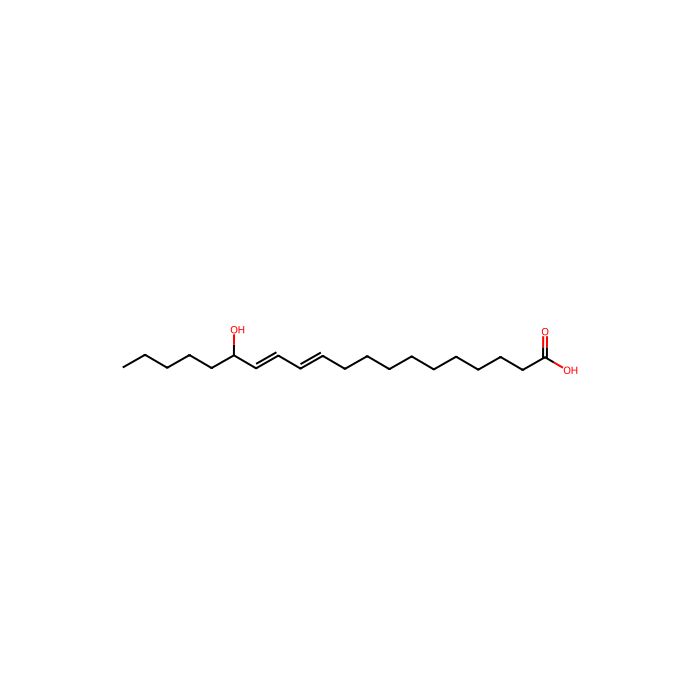
15(S)-HEDE has been identified in psoriatic skin scale extracts (undetermined 15-OH stereochemistry) and inhibits 5-LO (5-lipoxygenase) with an IC|50|of 26 μM.
Determine the necessary mass, volume, or concentration for preparing a solution.
Dilution Calculator
Determine the dilution needed to prepare a stock solution.
Reconstitution Calculator
レビュー
顧客レビュー
Application Protocols
No item-specific, vendor-validated application protocols are provided for this SKU. The following are general, literature‑based practices for small‑molecule lipid standards; adjust to your assay and validate internally.
Stock preparation: Weigh quickly in a low‑humidity environment. Dissolve to 10–50 mM in DMSO, ethanol, or acetonitrile. Vortex and sonicate briefly if needed. Aliquot into amber vials under inert gas.
LC–MS/MS (lipidomics): Use C18 reverse‑phase column; mobile phases A: water + 0.1% formic acid or 5 mM ammonium acetate; B: acetonitrile/isopropanol (7:3) + modifier. Monitor [M−H]− → characteristic fragments in negative ESI (optimize CE empirically). Keep autosampler at 4–8 °C.
GC–MS (after derivatization): Convert to methyl ester (FAME) and silylate the 15‑OH. Separate on low‑bleed polysiloxane columns (e.g., DB‑5MS) with temperature programming tailored for C20 derivatives.
Cell treatment (if applicable): Deliver in media with ≤0.1% DMSO/EtOH; consider BSA complexation. Include vehicle controls and antioxidant controls. Verify stability over the exposure period.
Note: For research use only. Always consult your internal SOPs and the SDS before experimentation.
Biological Roles
General/literature context (not product-specific, no clinical claims)
15(S)-HEDE is a hydroxylated derivative of eicosadienoic acid (C20:2). Hydroxyeicosanoids are formed enzymatically (e.g., via lipoxygenases or cytochrome P450s) or non‑enzymatically through free‑radical autoxidation of PUFAs.
Structural features—one carboxylate headgroup, a hydrophobic 20‑carbon tail with two double bonds, and a secondary alcohol—favor membrane association while allowing interactions with lipid‑binding proteins.
In biochemical systems, 15‑hydroxy eicosanoids can act as intermediates toward further oxidation (e.g., to keto derivatives) or esterification into phospholipids/neutral lipids, influencing local lipid composition.
Positional and stereochemical specificity (15(S)) is important for interactions with enzymes such as dehydrogenases and for recognition by lipid receptors or transporters (e.g., FABPs), though precise binding partners for 15(S)-HEDE may differ from those of more unsaturated analogs like HETE.
Analytical relevance
Often monitored as a marker of PUFA oxidation pathways distinct from arachidonate metabolism. Quantified in lipidomics to map LOX/P450 activity and oxidative stress signatures (literature practice).
Note
The above describes general biochemistry of hydroxyeicosadienoates; consult primary literature for pathway‑specific details relevant to your model system. This product is for research use only.
Buffer Applications
Not typically applicable. 15(S)-HEDE is a hydrophobic hydroxy‑fatty acid and does not function as a pH buffer.
Practical guidance (for handling in aqueous systems)
To introduce into buffered media, prepare concentrated stocks in DMSO or ethanol and dilute into buffer with vigorous mixing to final solvent ≤0.1–0.2% v/v.
For higher apparent solubility, adjust buffer to mildly basic pH (to form the carboxylate) or use carrier proteins (e.g., BSA at 0.1–1%) or cyclodextrins; verify that such additives do not confound your assay.
Avoid strong bases at elevated temperature to prevent isomerization or ester hydrolysis of derivatives.
Green Alternatives
Context: 15(S)-HEDE is a target analyte/tool compound rather than a solvent; “green alternatives” focus on greener handling and solvent selection during its use.
Greener handling strategies (literature/practice)
Use high‑solids or concentrated stock solutions to reduce solvent volumes.
Prefer ethanol or ethyl acetate over chlorinated solvents when solubility and stability permit.
Employ microscale derivatization (e.g., on‑cartridge methylation) to limit solvent consumption.
Illustrative comparison for common tasks (general guidance)
| Task | Conventional choice | Greener alternative | Considerations |
|---|---|---|---|
| Preparing stocks for LC–MS | Acetonitrile | Ethanol | Ethanol is safer; confirm chromatographic compatibility and ionization efficiency. |
| Extraction from matrices | Chloroform (Bligh–Dyer) | MTBE or ethyl acetate | MTBE/EtOAc reduce chlorinated waste; may alter partitioning/recoveries—revalidate methods. |
| Silica gel chromatography | Hexane/DCM | Heptane/EtOAc | Similar elution strength; check for stability and resolution. |
Trade-offs
Ethanol and ethyl acetate can contain peroxides/moisture; verify method robustness.
Avoid prolonged exposure of HEDE to basic aqueous ethanol to limit esterification/hydrolysis side reactions.
Waste minimization
Pool small aliquots to avoid repeated thawing and discarding of degraded material.
Use inert atmosphere to extend solution life, reducing repeated preparations.
Pharmaceutical Uses
No therapeutic or clinical claims are made. For research use only.
General formulation/manufacturing context (literature)
Hydroxy‑fatty acids like 15(S)-HEDE may be used as analytical reference standards during development and quality control of lipid-based formulations (e.g., to monitor oxidative degradation of PUFA excipients/oils).
Potential roles as process controls: spike‑in standards for LC–MS assays evaluating lipid impurity profiles in raw materials.
Regulatory notes
No pharmacopeial monograph is known for 15(S)-HEDE specifically (literature check recommended). Any use in GMP settings would require in‑house specifications, validated analytical methods, and stability data.
Formulation handling tips (general)
Prepare standards in ethanol or acetonitrile; store aliquots at −20 °C, protected from light/air.
For compatibility with aqueous systems, consider sodium or ammonium salts formed in situ immediately before use; validate impact on downstream analytics.
Physical Properties
Item-specific values
Grade/Purity: Not specified for this item; refer to CoA/Spec Sheet.
Appearance: Not specified for this item; refer to CoA/Spec Sheet.
Storage & shipping (from Product Data)
Storage: Store at −20 °C.
Shipped in: Ice chest + Ice pads.
Literature/Computed (for context; not item specifications)
Physical state: typically an oil or low-melting wax for long-chain hydroxy PUFAs.
Approximate formula and MW: C20H34O3; ~322.49 g/mol (literature for 15‑hydroxyeicosadienoic acid isomers).
Solubility: practically insoluble in water; soluble in polar aprotic organic solvents (DMSO) and lower alcohols (ethanol), and in nonpolar/medium-polar organic media (chloroform, ethyl acetate, MTBE) commonly used for lipid extraction (literature).
LogP: expected high (>>3), consistent with long-chain fatty acids (literature trend).
pKa: carboxylic acid typically ~4.5–5.0 in water; secondary alcohol non-ionizing (literature ranges for fatty acids).
UV characteristics: weak chromophore; conjugation extent depends on double-bond geometry/placement; analytical detection commonly by MS or by UV at 205–215 nm after derivatization (literature practice).
Notes for handling (practical)
Susceptible to autoxidation and isomerization due to unsaturation; minimize light, heat, and air exposure. Store under inert gas and include antioxidants if compatible with your application (general lipid handling guidance).
Quality and Grades
Item-specific quality information
Grade/Purity: Not specified for this item; refer to CoA/Spec Sheet.
What grade typically implies (general guidance)
Research-grade lipid standards are commonly supplied at ≥95% purity (HPLC/GC), with stereochemical and positional isomer content reported on the CoA. For chiral lipids like 15(S)-HEDE, the enantiomeric ratio or optical rotation may be provided by vendors; confirm on the CoA for this specific SKU.
Residual solvent content, peroxide value, and water content are critical for PUFA derivatives but are lot-dependent. Always verify on the CoA/SDS.
Stabilization and packaging (general practice)
Light/oxygen protection: typically packaged in amber, inert‑gas purged vials; sometimes supplied as solutions in ethanol or acetonitrile to enhance stability and ease of aliquoting. Check the label for solvent carrier, if any.
Stereochemical integrity: 15(S) configuration may racemize under harsh conditions; maintain cold, neutral to slightly acidic conditions during storage and handling to preserve stereochemistry.
Recommendations for QC on receipt (practical)
Inspect for discoloration or rancid odor—signs of oxidation in unsaturated fatty acids.
Verify identity by LC–MS (expected [M−H]− at m/z ~321, literature) and purity by HPLC-UV at 205–215 nm or by LC–MS with appropriate column (C18) and mobile phase (water/ACN with 0.1% formic acid or ammonium acetate).
Reaction and Applications
This compound is primarily employed as a biochemical/analytical reference standard and as a tool compound in lipid signaling research; however, it also serves as a versatile synthetic handle due to its carboxylic acid and secondary alcohol.
Common research uses (literature/practice)
Lipidomics standard: calibration/quantification of hydroxyeicosadienoates in biological samples by LC–MS/MS. Useful in method validation for PUFA metabolite panels.
Enzymology: substrate, product, or mechanistic probe for lipoxygenase (LOX), cyclooxygenase side-pathway oxidation, and P450-mediated hydroxylations (depending on the precursor eicosadienoic acid and pathway mapping).
Oxidative stability studies: model compound to investigate autoxidation, hydroperoxide formation, and antioxidant effects in unsaturated lipids.
Synthetic/derivatization applications
Esterification (Fischer/Steglich) to form methyl/ethyl esters for GC analysis or protection during multistep synthesis.
Amide formation with lipid amines (HATU/EDC couplings) to yield bioactive amides or affinity probes.
Silylation (TMS, TBDMS) of the secondary alcohol for GC–MS or to control reactivity; acylation to create carbonate/ester derivatives.
Practical tips
Protect from oxygen/light during reactions; include radical inhibitors if compatible.
Control stereochemistry at C‑15: mild conditions to avoid racemization; avoid strong acids/bases at elevated temperatures.
For LC–MS/MS applications, prepare fresh working solutions and use amber autosampler vials with low-bind inserts to minimize adsorption.
Reaction Conditions
General laboratory conditions for common transformations of hydroxy‑fatty acids (literature guidance; adjust to your system). These are not product specifications.
Esterification (Steglich): acid (1.0 eq), alcohol (1.5–5 eq), DCC or EDC (1.2–1.5 eq), DMAP (0.1 eq), CH2Cl2 or DMF, 0–25 °C, 2–16 h; typical isolated yields 70–95%.
Methylation for GC: TMS‑diazomethane in hexane/MeOH at 0–25 °C, minutes to 1 h; quench excess carefully. High conversion to methyl ester under mild conditions.
Silylation of the 15‑OH: BSTFA or MTBSTFA with 1% TMCS in acetonitrile or pyridine, 60 °C, 15–30 min; quantitative TMS/TBDMS ether formation.
Oxidation to 15‑keto: Dess–Martin periodinane (1.3 eq) in CH2Cl2, 0–25 °C, 0.5–2 h; yields commonly 70–90%. Protect carboxyl as ester if needed.
Hydrogenation of C=C: H2 (1–3 atm), Pd/C (5–10 wt%), EtOAc/EtOH, 25 °C, 1–6 h; monitor to avoid over‑reduction of other functionalities.
Handling notes
Perform reactions under inert atmosphere to curb autoxidation/isomerization of double bonds.
Use amber glassware and minimize strong acid/base exposure to preserve 15(S) stereochemistry.
For analytical workups, employ antioxidant-containing solvents when compatible, and keep temperatures low during concentration.
Safety and Handling
Authoritative safety data must be taken from the SDS for this specific lot.
Item-specific hazard data (from Product Data)
Signal Word: Not specified for this item; refer to SDS.
H-Statements: Not specified for this item; refer to SDS.
GHS Classification: Not specified for this item; refer to SDS.
Pictograms: Not specified for this item; refer to SDS.
General safety considerations for long‑chain hydroxylated fatty acids (literature/practice)
Expected hazards: may cause skin/eye irritation; avoid inhalation of aerosols/mists. Not known to be acutely toxic at small laboratory quantities, but handle as a hazardous chemical.
PPE: lab coat, nitrile gloves, safety glasses; use in a chemical fume hood when weighing, dissolving, or aliquoting organic solutions.
Incompatibilities: strong oxidizers (risk of exothermic reaction); avoid prolonged exposure to air, light, and elevated temperature to prevent peroxidation. Bases convert the acid to soaps (enhanced foaming, emulsions); acids/anhydrides can promote esterification.
Special risks for unsaturated lipids: autoxidation leading to hydroperoxides; consider handling under inert atmosphere (N2/Ar). Use amber vials; add BHT or other radical inhibitors only if compatible with downstream analysis.
First aid (overview; defer to SDS):
Skin/eye contact: rinse with water for ≥15 min; remove contaminated clothing; seek medical attention if irritation persists.
Inhalation: move to fresh air; seek medical attention for persistent symptoms.
Ingestion: rinse mouth; do not induce vomiting; seek medical attention.
Spill response: absorb with inert material (vermiculite), collect for disposal as organic waste. Clean surfaces with suitable solvent/detergent.
Solvent Selection
Applicability: As a hydrophobic, unsaturated hydroxy-fatty acid, 15(S)-HEDE dissolves readily in organic media but poorly in water.
General solvent behavior (literature/practice)
Polarity: amphiphilic; dominant hydrophobic character due to C20 chain.
Aqueous buffers: very low solubility at neutral pH; solubility increases in basic media (carboxylate form) or with co-solvents/surfactants (e.g., 0.1–1% DMSO, 0.5–2% ethanol) or complexing agents (cyclodextrins, BSA for biochemical assays).
Selection guidance by application
Analytical standards (LC–MS): prepare stock at 1–10 mg/mL in ethanol or acetonitrile; dilute with aqueous mobile phase containing ≤0.1% formic acid or ammonium acetate. Avoid high water fractions without co-solvent.
Bioassays/cell studies: dissolve in DMSO or ethanol to 10–50 mM; dilute into media to final carrier ≤0.1–0.2% v/v. Pre-warm media to reduce precipitation; consider BSA complexation for reproducibility.
Synthetic transformations: use anhydrous polar aprotic solvents (DMF, DCM) for ester/amide couplings; nonpolar solvents (toluene, hexane) for protection/deprotection under neutral conditions.
Small comparison (literature)
Versus HETE (more unsaturated): HEDE is slightly less prone to rapid peroxidation and may offer improved handling stability, with similar solubility profiles.
Versus saturated hydroxy C20 acids: HEDE has higher solubility in moderately polar organics due to unsaturation but remains water-insoluble.
Storage and Reconstitution
Item-specific instructions (from Product Data)
Storage Conditions: Store at −20 °C.
Shipped In: Ice chest + Ice pads.
General best practices for unsaturated hydroxy‑fatty acids (literature/practice)
Light/oxygen protection: Store in amber, airtight vials under inert gas (N2/Ar). Minimize headspace; consider adding compatible antioxidants to long‑term stocks.
Temperature: For multi‑month storage, −20 °C or below is appropriate; for long‑term archival, −80 °C is preferable.
Aliquoting: Prepare single‑use aliquots to avoid repeated freeze–thaw cycles. Warm to room temperature before opening to prevent moisture condensation.
Solid vs solution: If supplied neat, store as a neat material in inert, dry conditions. If prepared as a solution (e.g., in ethanol, acetonitrile, or DMSO), note the solvent and concentration on the label; validate stability in that solvent.
Solvents: DMSO, ethanol, acetonitrile, or chloroform for concentrated stocks; dilute into aqueous buffers with co‑solvent or carrier proteins as needed.
Target concentrations: Typical analytical stocks 1–10 mg/mL or 10–50 mM; adjust based on assay sensitivity.
Stability check: Monitor by LC–MS for signs of oxidation (new +16 Da species) or isomerization. Discard solutions showing significant degradation.
Research Use Note
For research use only.
Structure and Identity
Overview: 15(S)-HEDE is a monohydroxylated C20 polyunsaturated fatty acid (PUFA) bearing a terminal carboxylic acid and a single secondary alcohol at the C-15 position with S configuration (literature). It is a member of the eicosanoid-like hydroxyeicosadienoates.
Item-specific (from Product Data)
SKU: H334608
Product Name: 15(S)-HEDE
CAS: 92693-04-4
PubChem CID: 6610219
InChIKey: Not specified for this item; refer to CoA/Spec Sheet.
SMILES: Not specified for this item; refer to CoA/Spec Sheet.
Molecular Formula: Not specified for this item; refer to CoA/Spec Sheet.
Molecular Weight: Not specified for this item; refer to CoA/Spec Sheet.
Literature/General structural information (for context; not item specifications)
Approximate molecular weight: ~322.49 g/mol (literature; depends on exact double-bond geometry and placement)
Functional groups: one carboxylic acid (–CO2H), one secondary alcohol (–CHOH–), two C=C double bonds (positions vary by isomer system; S configuration at C-15).
Stereochemistry: single defined stereocenter at C-15 with S configuration; double-bond E/Z geometry may vary by specific isomer (literature variants exist).
2D structure described in words (literature)
A 20‑carbon aliphatic chain terminating in a carboxylate at C-1, featuring two internal alkene units (commonly separated by methylene spacers), and a secondary hydroxyl substituent at C-15 with S configuration. The hydroxy-bearing carbon is remote from the acid terminus, yielding an amphiphilic, kinked chain conducive to membrane association.
Synthetic Utility
Functional handles and strategies (literature/practice)
Carboxylic acid (C‑1): amenable to esterification (Fischer, Steglich/DMAP, TMS‑diazomethane methylation) and amide coupling (EDC/HOBt, HATU/DIPEA) to generate probes, prodrugs, or analytical derivatives.
Secondary alcohol (C‑15): enables selective protection (TBDMS, TBS, TMS) or acylation (acetates, carbonates) to modulate polarity and volatility (e.g., GC–MS suitability). Oxidation to a ketone (Dess–Martin, Swern) affords 15‑keto analogs.
Alkenes (2 units): hydrogenation (Pd/C) to tune saturation; epoxidation (mCPBA) or dihydroxylation (OsO4) for structure–activity exploration; ozonolysis for chain‑cleavage mapping.
Stereochemical considerations
Maintain the 15(S) configuration: use mild conditions; avoid strong acids/bases and elevated temperatures during protection/deprotection to limit epimerization at C‑15.
Analytical derivatization
Methyl ester + TMS ether dual derivatization enhances GC–MS detectability and chromatographic behavior of long‑chain hydroxy acids.
Retrosynthetic value
15(S)-HEDE serves as a reference point to benchmark stereocontrolled hydroxylation strategies on eicosadienoic acid backbones (Sharpless asymmetric dihydroxylation/kinetic resolution analogs, directed epoxidation–opening sequences), and for validating LOX/P450 biomimetic oxidation methodologies.
Target Specificity
Not applicable. This product is a small-molecule hydroxy‑fatty acid, not an antibody or targeted biologic. No antigen/epitope, species reactivity, clone, or isotype information applies.
よくある質問
What is the purity of this product?
This product is supplied at ≥98% purity (chemical assay). Lot-specific values are stated on the Certificate of Analysis.
How should this product be stored?
Store at ?20 °C. Freezer storage is required to maintain the specified shelf life.
How is this product shipped?
This product ships in an insulated container with ice pads. Unpack on arrival and transfer it to the storage condition stated above.
What are the CAS number, molecular formula and molecular weight?
The CAS Number is 92693-04-4, the molecular formula is C20H36O3, and the molecular weight is 324.5 g/mol. InChIKey ZTRWPEHMGCHTIT-IBGZPJMESA-N.
What documentation is provided?
Available product documentation, including Certificates of Analysis (COA), Safety Data Sheets (SDS), and specification sheets, is shown in the product document area. Document availability and access follow the current site policy.
Products are supplied to verified businesses, institutions, and qualified professionals for research and development use only. Not for use in humans, animals, diagnosis, or therapy.

 I2304384