This compound belongs to the class of organic compounds known as phenylpropanes. These are organic compounds containing a phenylpropane moiety.
External Descriptors
Not available
1. Djoumbou Feunang Y, Eisner R, Knox C, Chepelev L, Hastings J, Owen G, Fahy E, Steinbeck C, Subramanian S, Bolton E, Greiner R, and Wishart DS. ClassyFire: Automated Chemical Classification With A Comprehensive, Computable Taxonomy. Journal of Cheminformatics, 2016, 8:61.
Determine the necessary mass, volume, or concentration for preparing a solution.
Dilution Calculator
Determine the dilution needed to prepare a stock solution.
Reconstitution Calculator
レビュー
顧客レビュー
Application Protocols
No antibody or bioassay application protocols apply. For synthetic applications, see Reaction Conditions and Synthetic Utility for representative procedures.
General lab handling protocol (guidance):
Inspect container for crystallization or phase separation; warm gently to ambient and swirl if needed.
If moisture sensitive transformations are planned, dry the material by azeotroping with toluene or concentrating from dry solvents; verify by Karl Fischer if required (specs Not specified for this item; refer to CoA/Spec Sheet).
Validate identity and purity by NMR/GC/LC prior to use in scale‑up.
Biological Roles
This compound is a small organic synthetic intermediate without a known physiological role.
General notes (literature)
As a benzylic tertiary alcohol with an aryl bromide, it is not a metabolite, cofactor, or known signaling molecule in biological systems.
Any interactions with biomolecules would be non‑specific hydrophobic or halogen‑bonding interactions typical of aryl bromides; no defined biological pathway participation is established.
No medical, diagnostic, or therapeutic use is intended or implied. For research use only.
Buffer Applications
Not typically applicable. 2-(3-bromophenyl)propan-2-ol is not used as a buffering agent, pH modifier, or electrophoresis buffer component.
For experiments requiring this compound in aqueous media, dissolve first in a miscible organic co‑solvent (e.g., DMSO or EtOH) before dilution into buffer, verifying solubility and avoiding precipitation.
Select appropriate biological buffers (e.g., PBS, HEPES) independently of this reagent, as it does not contribute significant buffering capacity.
Green Alternatives
While 2-(3-bromophenyl)propan-2-ol is a target/intermediate rather than a solvent, greener choices can be made in its use and downstream transformations.
Greener solvent substitutions (general guidance)
Replace DCM/CHCl3 in workups and reactions with EtOAc or 2‑MeTHF when compatible.
Use CPME or 2‑MeTHF instead of 1,4‑dioxane in Pd‑catalyzed couplings; maintain water co‑solvent for base solubility as needed.
Favor toluene or anisole over benzene for aromatic media.
Benign reagents/conditions
For dehydration/solvolysis, employ solid acids (Amberlyst‑15) or catalytic p‑TsOH in green solvents (2‑MeTHF, EtOAc) rather than strong mineral acids in chlorinated media.
In cross‑coupling, use aqueous K2CO3 or K3PO4 bases with ethanol/water or 2‑MeTHF/water co‑solvent systems; consider Pd/C or ligand‑minimal systems.
For benzylic ether formation, explore catalytic Brønsted acids under continuous flow to minimize reagent excess and waste.
Comparison snapshot (general)
Conventional: DCM, dioxane, strong mineral acids, non‑aqueous bases.
Always verify catalyst performance and selectivity, as tertiary carbocation chemistry can be solvent‑ and acidity‑sensitive.
Pharmaceutical Uses
No direct excipient or pharmacopeial role is established for 2-(3-bromophenyl)propan-2-ol.
Context (general)
Compounds of this class are primarily synthetic intermediates used in discovery chemistry and route scouting, not as formulation components.
If incorporated into medicinal chemistry workflows, it serves as a building block for SAR via aryl bromide cross‑coupling or via benzylic functionalization.
No clinical or therapeutic claims are made. Research use only.
Physical Properties
Item-specific specifications
Appearance: Not specified for this item; refer to CoA/Spec Sheet.
Grade/Purity: Not specified for this item; refer to CoA/Spec Sheet.
Storage and shipping (from Product Data)
Storage: Room temperature
Shipped in: Normal conditions
Literature/typical physicochemical information (for reference; not item-specific specs)
Molecular formula: C9H11BrO (literature)
Molecular weight: ~215.09 g/mol (literature)
Physical state at ambient: typically a low‑melting solid or high‑boiling liquid for related cumyl alcohols; exact MP/BP Not specified for this item; refer to CoA/Spec Sheet.
Density, refractive index, UV cut‑off: Not specified for this item; refer to CoA/Spec Sheet.
Solubility profile (qualitative, literature): expected to be sparingly soluble in water; soluble in common organic solvents (e.g., DCM, EtOAc, THF, toluene, alcohols) owing to the aromatic ring and tertiary alcohol.
LogP and pKa: Not specified for this item; refer to CoA/Spec Sheet.
Notes: Provide exact numeric physical constants from the CoA/SDS when planning process design or purification.
Quality and Grades
Item-specific quality information
Grade/Purity: Not specified for this item; refer to CoA/Spec Sheet.
How to interpret grade (general guidance)
If provided as “AR/ACS” grade: meets analytical reagent specifications with tightly controlled impurities.
If provided as “>98%” or similar: indicates assay by GC/HPLC/NMR; confirm residual solvent, water, and inorganic residue on CoA.
Stabilizers/inhibitors: Not typically required for benzylic tertiary alcohols; if present (e.g., trace acid scavengers), they will be listed on the CoA.
Quality considerations for this structure
Benzylic tertiary alcohols can slowly dehydrate under strong acid; ensure neutral packaging materials. Trace acids/bases may alter stability—review acidity/alkalinity on CoA if listed.
Aryl bromide integrity is crucial for cross‑coupling; check halogen content and verify absence of significant debrominated/aromatized impurities by GC/MS or 1H/13C NMR.
Documentation
For exact acceptance criteria (assay method, residual solvents, water, metals, peroxides, UV cutoff, etc.): Not specified for this item; refer to CoA/Spec Sheet.
Reaction and Applications
Dual‑handle building block
Tertiary benzylic alcohol enables carbocation chemistry (SN1 solvolysis to benzylic ethers/esters, acid‑catalyzed dehydration to isopropenyl arenes).
Aryl bromide is cross‑coupling‑active (Pd‑catalyzed Suzuki–Miyaura, Buchwald–Hartwig amination after oxidative addition at Ar–Br, etc.).
Dehydration: H2SO4, p‑TsOH, or Lewis acids to afford 3‑bromocumene analog (isopropenyl arene); Zaitsev alkene forms via benzylic cation.
Benzylic ether/ester formation: Treat with ROH or RCO2H in the presence of acid (HCl(g), H2SO4, BF3·Et2O) to generate cumyl derivatives via SN1.
Halide exchange: Lucas reagent (conc. HCl, ZnCl2) can give the corresponding benzylic chloride; PBr3 not effective for tertiary centers; SOCl2 ineffective—use cationic routes instead.
Protective group strategies: Convert to tert‑alkyl carbonates/oxalates; these can act as redox‑active esters for radical generation under photoredox conditions.
Cross‑coupling at aryl–Br: Suzuki with boronic acids/esters, Stille with stannanes, Negishi with organozincs, Kumada with Grignards (the tertiary alcohol should be protected or conditions tuned to avoid solvolysis).
Application niches
Synthesis of meta‑brominated isopropenyl arenes, cumyl ethers/esters, and as a precursor to scaffolds where late‑stage diversification proceeds via the aryl bromide.
Reaction Conditions
General conditions from literature for transformations relevant to 2-(3-bromophenyl)propan-2-ol (guidance only; optimize per substrate):
Acid‑catalyzed dehydration to isopropenyl arene
Catalyst: p‑TsOH (5–10 mol%) or conc. H2SO4 (caution)
Solvent: toluene, benzene alternative such as anisole, or 2‑MeTHF
Temperature: reflux (110–140 °C depending on solvent)
Notes: Remove water (Dean–Stark) to drive equilibrium; monitor for rearrangements or polymerization.
SN1 solvolysis to benzylic ethers/esters
Reagents: ROH (neat) with catalytic acid (H2SO4, HCl gas) or BF3·Et2O; for esters, RCO2H with catalytic p‑TsOH/DMAP alternatives when compatible
Solvent: neat nucleophile or DCM/2‑MeTHF co‑solvent
Temperature: 0–25 °C (mild) to reflux (for less nucleophilic partners)
Notes: Avoid PBr3/SOCl2 (inefficient for tertiary alcohols); prefer cationic pathways.
Suzuki–Miyaura coupling at aryl–Br (alcohol tolerated with care)
Catalyst: Pd(PPh3)4 (1–3 mol%) or Pd-PEPPSI; Base: K2CO3 or Cs2CO3 (2–3 equiv)
Solvent: dioxane/H2O, toluene/H2O, or 2‑MeTHF/H2O
Temperature: 70–100 °C
Notes: If alcohol interferes, protect as carbonate; monitor for competitive solvolysis under strongly basic aqueous conditions.
Photoredox radical from oxalate derivative
Pre‑activation: form tert‑alkyl oxalate
Catalyst: Ir(ppy)3 or [Ru(bpy)3]2+
Light: blue LEDs; Solvent: MeCN or DCM
Temperature: ambient; Additive: Hantzsch ester or suitable acceptor
Notes: Enables Giese additions or C–C formations at the benzylic position.
Safety and Handling
Regulatory/SDS
GHS classification, signal word, pictograms, and H‑statements: Not specified for this item; refer to SDS.
Research use only; not for human or veterinary use.
General hazards (tertiary benzylic alcohols and aryl bromides; literature guidance)
May cause irritation to skin, eyes, and respiratory tract. Avoid inhalation of vapors/aerosols and contact with skin or eyes.
Aryl bromides are generally stable but can be harmful if ingested or absorbed; handle with standard lab PPE.
Recommended PPE and controls
Wear lab coat, safety glasses, and appropriate chemical‑resistant gloves (e.g., nitrile). Work in a fume hood to control vapors and reaction off‑gassing.
Incompatibilities and reactivity (general)
Strong acids can induce dehydration to the corresponding isopropenyl arene; strong bases/halogenating agents may convert the alcohol to benzylic halides.
Avoid strong oxidants; although tertiary alcohols resist oxidation to carbonyls, side reactions may occur under harsh conditions.
First aid (overview; defer to SDS)
Skin/eye contact: Rinse with water for several minutes; remove contaminated clothing; seek medical attention if irritation persists.
Inhalation: Move to fresh air; obtain medical attention if symptoms occur.
Ingestion: Rinse mouth; do not induce vomiting; seek medical attention.
Fire safety
Combustible organic compound. Use CO2, dry chemical, or foam for extinguishing. Thermal decomposition may release corrosive/irritant fumes (e.g., HBr from aryl bromides).
Solvent Selection
This product is a synthetic intermediate, not a solvent. However, solvent choice is critical for its handling and reactions.
Polarity and solubility (general)
Moderately lipophilic aromatic with a tertiary alcohol; good solubility in ethers (THF, MTBE), chlorinated solvents (DCM, CHCl3), aromatics (toluene), and polar aprotics (MeCN, DMF). Limited water solubility.
Typical solvent choices by transformation
Cross‑coupling at the aryl–Br: toluene, dioxane, THF, or mixtures with water/EtOH; base-dependent (K2CO3, Cs2CO3).
Benzylic substitutions (SN1) or dehydrations: non‑nucleophilic solvents (DCM, toluene) under acid catalysis; alcohol solvents when forming benzylic ethers via solvolysis.
Photoredox radical generation from derived oxalates/carbonates: MeCN, DCM, or DMF with appropriate photocatalyst.
Practical selection tips
Choose non‑protic, non‑acidic media to preserve the tertiary alcohol functionality when no transformation is intended.
For chromatographic purification, hexanes/EtOAc or toluene/EtOAc gradients give good band movement for benzylic alcohols.
Green considerations
When feasible, substitute DCM with EtOAc or 2‑MeTHF; replace dioxane with CPME/2‑MeTHF while validating catalyst performance.
Storage and Reconstitution
Storage conditions (from Product Data)
Store at room temperature. Ship under normal conditions.
Practical storage guidance (general)
Keep tightly closed in a dry, inert atmosphere to minimize adventitious acid/moisture exposure that could promote slow dehydration or solvolysis.
Store away from strong acids/bases and oxidizing agents. Use amber or opaque containers if long light exposure is expected (good practice for organics).
Stability and handling
Tertiary benzylic alcohols are generally stable at ambient conditions. If prolonged storage is anticipated, periodic re‑assay (NMR/GC) is recommended.
Reconstitution/Preparation for use
If solidified, warm to room temperature to liquefy (if applicable). Dissolve in a suitable dry organic solvent (e.g., DCM, THF, toluene, EtOAc) to the desired concentration.
For moisture‑sensitive reactions, pre‑dry by co‑evaporation with anhydrous toluene or use over molecular sieves.
Item-specific values such as water content, residual solvents, and stabilizers: Not specified for this item; refer to CoA/Spec Sheet.
Research Use Note: For research use only.
Structure and Identity
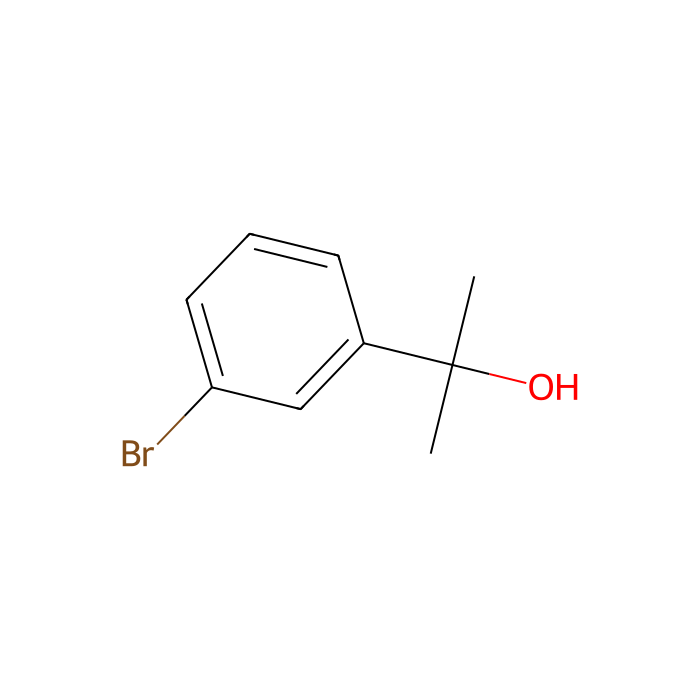
A benzylic, tertiary alcohol bearing a meta-bromophenyl substituent; useful as a functionalized aryl building block with both benzylic –C(OH)(CH3)2 and aryl–Br handles.
Item-specific identifiers (from Product Data)
SKU: B169466
CAS: 30951-66-7
PubChem CID: 15072383
InChIKey: Not specified for this item; refer to CoA/Spec Sheet.
SMILES: Not specified for this item; refer to CoA/Spec Sheet.
Literature/computed identity (for reference; not item-specific specs)
Preferred name (IUPAC): 2-(3-bromophenyl)propan-2-ol (tertiary benzylic alcohol)
Aromatic ring (phenyl) substituted by bromine at the meta position (3-bromo) and by a tertiary carbinol at the ipso carbon.
Tertiary alcohol center: C(OH)(CH3)2 attached directly to the aromatic ring (benzylic tertiary center).
Functional handles: benzylic tertiary alcohol (prone to SN1-type ionization/dehydration) and aryl bromide (cross-coupling competent).
2D description: a six‑membered benzene ring with Br at position 3; at position 1, a quaternary carbon bearing OH and two methyl groups (no stereogenic center).
Synthetic Utility
Functional group reactivity
Tertiary benzylic alcohol: readily forms a stabilized benzylic carbocation under Brønsted or Lewis acid catalysis; engages in SN1 solvolysis to give ethers/esters; undergoes dehydration to alkenes.
Aryl bromide: participates in oxidative addition with Pd(0)/Ni(0) catalysts, enabling Suzuki–Miyaura, Stille, Negishi, Kumada, and Buchwald–Hartwig couplings.
Orthogonal strategy
Protect or derivatize the alcohol (e.g., carbonate/oxalate) while exploiting the aryl–Br in cross‑coupling, or vice versa.
Radical tactics: convert to an oxalate ester; under photoredox, generate a tertiary benzylic radical for Giese additions or C–C bond formations.
Retrosynthetic value
Accessible via electrophilic aromatic substitution (Friedel–Crafts alkylation) of 3‑bromobenzene derivatives with acetone equivalents under strong acid, or by addition of organometallic reagents to corresponding ketones followed by quench (route dependent on halogen compatibility).
Purification/analysis
Benzylic tertiary alcohols typically show distinct 1H NMR signals for the gem‑dimethyl (δ ~1.2–1.6 ppm) and a downfield aromatic region; check for dehydration byproducts (alkenes) and for debrominated impurities using GC/MS or LC–MS.
Target Specificity
Not applicable. This product is a small‑molecule chemical reagent and does not possess biological target specificity (no antigen/epitope, clone, or isotype). Use the sections on Synthetic Utility and Reaction Conditions for relevant technical details.
よくある質問
What is the purity of this product?
This product is supplied at ≥97% purity (chemical assay). Lot-specific values are stated on the Certificate of Analysis.
How should this product be stored?
Store at room temperature.
How is this product shipped?
This product ships under standard ambient conditions. No temperature-controlled packaging is required.
What are the CAS number, molecular formula and molecular weight?
The CAS Number is 30951-66-7, the molecular formula is C9H11BrO, and the molecular weight is 215.09 g/mol. InChIKey ZRFMJMFYMQAUDO-UHFFFAOYSA-N.
What documentation is provided?
Available product documentation, including Certificates of Analysis (COA), Safety Data Sheets (SDS), and specification sheets, is shown in the product document area. Document availability and access follow the current site policy.
Products are supplied to verified businesses, institutions, and qualified professionals for research and development use only. Not for use in humans, animals, diagnosis, or therapy.

 L2214799