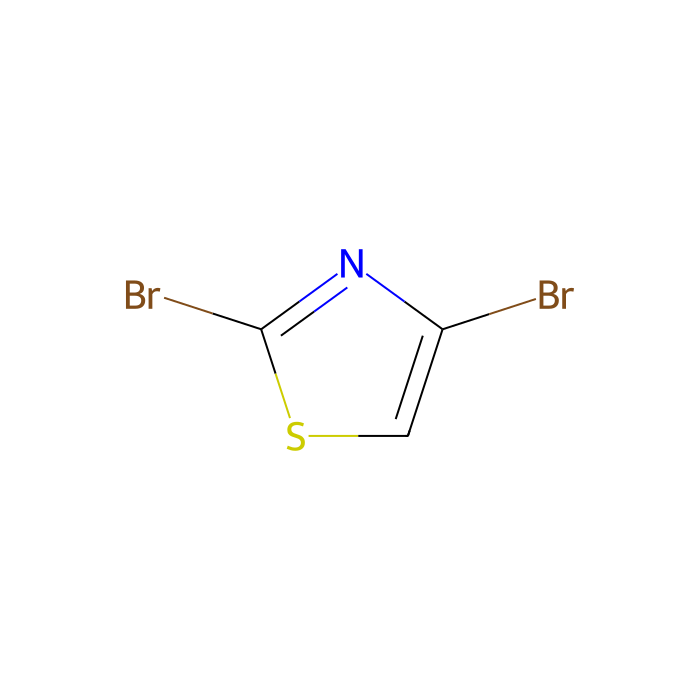
Determine the necessary mass, volume, or concentration for preparing a solution.
Taxonomy Tree
| Kingdom | Organic compounds |
|---|---|
| Superclass | Organoheterocyclic compounds |
| 分類 | Azoles |
| Subclass | Thiazoles |
| Intermediate Tree Nodes | Not available |
| Direct Parent | 2,4-disubstituted thiazoles |
| Alternative Parents | Aryl bromides Heteroaromatic compounds Azacyclic compounds Organopnictogen compounds Organonitrogen compounds Organobromides Hydrocarbon derivatives |
| Molecular Framework | Aromatic heteromonocyclic compounds |
| Substituents | 2,4-disubstituted 1,3-thiazole - Aryl halide - Aryl bromide - Heteroaromatic compound - Azacycle - Organic nitrogen compound - Organopnictogen compound - Hydrocarbon derivative - Organonitrogen compound - Organobromide - Organohalogen compound - Aromatic heteromonocyclic compound |
| 説明 | This compound belongs to the class of organic compounds known as 2,4-disubstituted thiazoles. These are compounds containing a thiazole ring substituted at the positions 2 and 3. |
| External Descriptors | Not available |
Find and download the COA for your product by matching the lot number on the packaging.
| Lot Number | Certificate Type | 日付 | 商品 |
|---|---|---|---|
| Certificate of Analysis | Sep 22, 2026 | D122731 | |
| Certificate of Analysis | Sep 21, 2026 | D122731 | |
| Certificate of Analysis | May 08, 2026 | D122731 | |
| Certificate of Analysis | May 08, 2026 | D122731 | |
| Certificate of Analysis | May 08, 2026 | D122731 | |
| Certificate of Analysis | Oct 13, 2025 | D122731 | |
| Certificate of Analysis | Sep 06, 2025 | D122731 | |
| Certificate of Analysis | Feb 20, 2024 | D122731 | |
| Certificate of Analysis | Dec 11, 2023 | D122731 | |
| Certificate of Analysis | Nov 08, 2023 | D122731 | |
| Certificate of Analysis | Sep 13, 2023 | D122731 | |
| Certificate of Analysis | Sep 07, 2023 | D122731 | |
| Certificate of Analysis | Dec 07, 2021 | D122731 | |
| Certificate of Analysis | Dec 07, 2021 | D122731 | |
| Certificate of Analysis | Dec 07, 2021 | D122731 | |
| Certificate of Analysis | Dec 07, 2021 | D122731 |
| 溶解度 | Soluble in Methanol |
|---|---|
| 融点(°C) | 82°C |
| 分子量 | 242.92 |
| XLogP3 | 3.000 |
| Hydrogen Bond Donor Count | 0 |
| Hydrogen Bond Acceptor Count | 2 |
| Rotatable Bond Count | 0 |
| Exact Mass | 242.818 Da |
| Monoisotopic Mass | 240.82 Da |
| Topological Polar Surface Area | 41.100 Ų |
| Heavy Atom Count | 7 |
| Formal Charge | 0 |
| Complexity | 70.000 |
| Isotope Atom Count | 0 |
| Defined Atom Stereocenter Count | 0 |
| Undefined Atom Stereocenter Count | 0 |
| Defined Bond Stereocenter Count | 0 |
| Undefined Bond Stereocenter Count | 0 |
| The total count of all stereochemical bonds | 0 |
| Covalently-Bonded Unit Count | 1 |
H302:Harmful if swallowed
H315:Causes skin irritation
H318:Causes serious eye damage
H335:May cause respiratory irritation
P261:Avoid breathing dust/fume/gas/mist/vapors/spray.
P264:Wash hands [and …] thoroughly after handling.
P270:Do not eat, drink or smoke when using this product.
P271:Use only outdoors or in a well-ventilated area.
P280:Wear protective gloves/protective clothing/eye protection/face protection.
P321:Specific treatment (see ... on this label).
P330:Rinse mouth.
P302+P352:IF ON SKIN: wash with plenty of water.
P304+P340:IF INHALED: Remove person to fresh air and keep comfortable for breathing.
P362+P364:Take off contaminated clothing and wash it before reuse.
P405:Store locked up.
P403+P233:Store in a well-ventilated place. Keep container tightly closed.
P501:Dispose of contents/container to an approved waste disposal plant.
P264+P265:Wash hands [and …] thoroughly after handling. Do not touch eyes.
P301+P317:IF SWALLOWED: Get medical help.
P305+P354+P338:IF IN EYES: Immediately rinse with water for several minutes. Remove contact lenses if present and easy to do. Continue rinsing.
P317:Get emergency medical help.
P332+P317:If skin irritation occurs: Get medical help.
P319:Get medical help if you feel unwell.
No biological assay protocols (WB, IHC, IF, FC) are applicable to this small-molecule building block. For synthetic use, see Reaction Conditions for starting points on cross-coupling, amination, and metalation workflows.
Research Use Note: For research use only.
This product is a small-molecule heteroaromatic building block and is not intended for biological use. No endogenous biological role is associated with 2,4-dibromothiazole.
General note (literature/general): Thiazole rings are found in natural products and cofactors (e.g., thiamine/vitamin B1), but 2,4-dibrominated thiazole is a synthetic intermediate without known physiological function.
Research Use Note: For research use only. Not for human or veterinary use.
Not typically applicable. 2,4-Dibromothiazole is a neutral, poorly water-soluble heteroaromatic and is not used to prepare laboratory buffer systems. For relevant guidance, see Solvent Selection and Reaction & Applications for synthetic uses in organic media.
Greener strategies when working with 2,4-dibromothiazole focus on solvent and catalyst choices, waste minimization, and energy efficiency (literature/general).
Solvent substitution:
Comparative snapshot (general):
Catalyst and loading:
Process intensification:
Trade-offs:
No direct excipient or formulation role is expected for 2,4-dibromothiazole. It may serve as a synthetic intermediate toward thiazole-containing APIs or advanced intermediates (literature/general), but this item is supplied strictly for research and development.
Research Use Note: For research use only; not for human or veterinary applications.
Item-specific specifications (this lot):
Literature/computed properties (for general reference; not guaranteed for this item):
Notes:
Item-specific quality information:
Context and expectations for this compound class (general guidance):
As a dihalogenated thiazole, 2,4-dibromothiazole is a versatile heteroaryl electrophile enabling stepwise or differential functionalization of the 2- and 4-positions.
Key application families (literature/general):
Practical notes:
General conditions reported for heteroaryl bromide transformations (apply with optimization to 2,4-dibromothiazole):
Suzuki–Miyaura coupling (literature guidance):
Buchwald–Hartwig amination:
Negishi/Stille couplings:
Halogen–lithium exchange / directed metalation:
Carbonylative coupling:
All conditions are literature/general guidance and require optimization for your substrate set and selectivity goals.
Authoritative safety data are provided in the product SDS; always review before use.
Item-specific hazard data from Product Data:
General safety guidance for brominated heteroaromatics (literature/general):
Use case-driven solvent choices for 2,4-dibromothiazole (general guidance):
Polarity/miscibility (literature/general):
Typical selections by application:
Practical tips:
Brief comparison (general):
Item-specific storage from Product Data:
General handling guidance (literature/general):
Note: When specific shelf-life or assay limits are required, consult the product’s CoA/Spec Sheet and SDS.
Brief overview: 2,4-Dibromothiazole is a dihalogenated thiazole ring system useful as a heteroaryl coupling partner and electrophilic building block.
Item-specific identifiers (from Product Data):
Literature/typical identity information (for reference only; not item-specific specs):
2D structural description (general):
Functional groups/features:
Functional group set and reactivity (literature/general):
Retrosynthetic value:
Named/typical transformations:
Practical synthesis tips:
Not applicable. This product is a small-molecule chemical reagent, not a biological targeting agent (e.g., antibody, probe, or inhibitor). No antigen/epitope or species reactivity data apply.