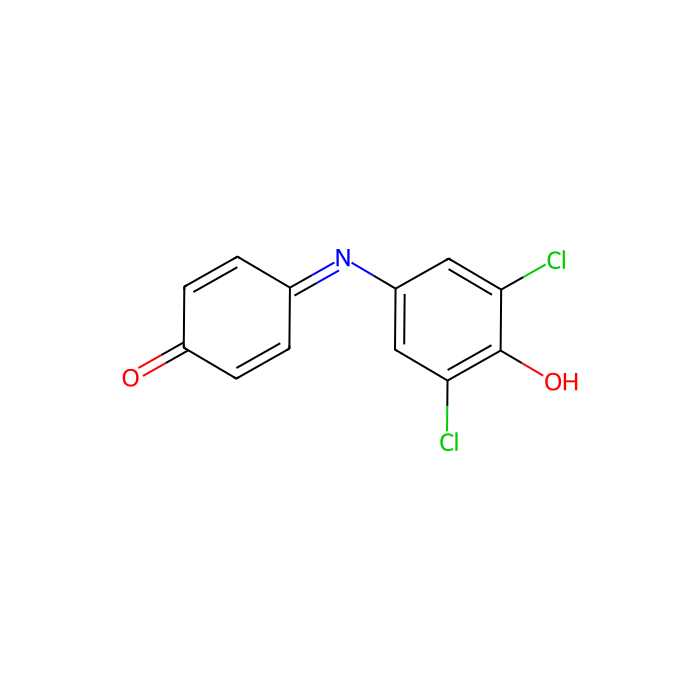
This compound belongs to the class of organic compounds known as dichlorobenzenes. These are compounds containing a benzene with exactly two chlorine atoms attached to it.
External Descriptors
dichlorobenzene - quinone imine
1. Djoumbou Feunang Y, Eisner R, Knox C, Chepelev L, Hastings J, Owen G, Fahy E, Steinbeck C, Subramanian S, Bolton E, Greiner R, and Wishart DS. ClassyFire: Automated Chemical Classification With A Comprehensive, Computable Taxonomy. Journal of Cheminformatics, 2016, 8:61.
Determine the necessary mass, volume, or concentration for preparing a solution.
Dilution Calculator
Determine the dilution needed to prepare a stock solution.
Reconstitution Calculator
レビュー
顧客レビュー
Application Protocols
No manufacturer-validated application protocols are provided in the Product Data for this SKU. Below are generalized, literature-style guidelines to help design assays; adapt and validate for your system.
Prepare buffer (e.g., 50 mM phosphate, pH 7.4). Protect all dye solutions from light.
Dissolve the dye in buffer (or in minimal ethanol then dilute into buffer) to a micromolar–millimolar working stock; filter (0.2 μm) if needed.
Equilibrate cuvette or microplate at assay temperature. Zero instrument with buffer blank.
Initiate reaction by adding enzyme and substrate/cofactor. Mix rapidly and begin monitoring A600 in kinetic mode.
Calculate rates from the initial linear region; include controls lacking enzyme or substrate to correct for background reduction/oxidation.
Example: Photosynthetic electron transport assay (general/literature)
Suspend thylakoid/chloroplast prep in suitable buffer; add the dye as an external electron acceptor.
Illuminate under controlled light intensity; monitor decrease in A600 as a function of time.
Note: Exact concentrations, ε values, and λmax should be verified for the specific lot and instrument pathlength. For regulated work, follow a validated SOP.
Biological Roles
This compound is not a natural metabolite; its role in biology is as a tool compound (artificial electron acceptor/indicator) rather than a native cofactor.
Tool functions in biology (general/literature):
Artificial electron acceptor: Intercepts electrons from enzymes or photosynthetic electron transport, enabling quantification of activity by spectrophotometric loss of blue color upon reduction.
Reporter of reducing equivalents: Couples metabolic reactions (e.g., NAD(P)H generation via dehydrogenases) to a convenient visible readout.
Membrane/organellar assays: Used to probe electron flux in chloroplasts and mitochondria under controlled conditions.
Interference considerations:
May interact with protein surfaces or membranes; adsorption can reduce apparent activity in low-volume formats—pre-block surfaces or optimize detergents as needed.
Competes with endogenous acceptors; use carefully in mechanistic studies to avoid perturbing native pathways.
Note: No medical or physiological claims are made. Usage is strictly for research applications as stated in the Product Data (For research use only).
Buffer Applications
This product is a redox indicator, not a buffering agent. It does not constitute a standalone buffer system.
Practical note (general/literature):
Commonly used within standard buffers (e.g., phosphate, Tris, HEPES) at neutral to slightly alkaline pH to stabilize the oxidized, colored form and maintain consistent spectra.
Buffer composition can influence ionization and λmax; verify spectra in the final matrix.
If you require buffer formulations, refer instead to dedicated buffering reagents; use this dye as an additive within those systems for redox monitoring.
Green Alternatives
While this halogenated indophenol dye is entrenched in redox assays for its robust optical transition, greener choices may be considered depending on the analytical need.
Aqueous use: When feasible, formulate and use in water to minimize organic solvent consumption.
Potential alternatives and tradeoffs (general/literature):
Alternative indicator | Pros | Cons
--- | --- | ---
Resazurin/Resorufin systems | Lower halogen load; strong fluorogenic readout (high sensitivity) | Requires fluorimetry; different redox potential and assay design
Potassium ferricyanide | Aqueous, well-characterized redox couple | Toxicity and cyanide handling concerns under improper conditions
Methylene blue | Aqueous, visible readout; photosensitizer properties exploitable | Photobleaching/phototoxicity; different midpoint potential
DCIP sodium salt (if this item is free acid) | Improved aqueous solubility; less need for organic cosolvent | Similar environmental profile; still halogenated
Process intensification:
Use microplate formats to reduce reagent mass and waste.
Implement photometric endpoints instead of solvent-intensive titrations where appropriate.
Select alternatives based on redox potential, spectral compatibility, and matrix effects. Validate any replacement with control experiments.
Pharmaceutical Uses
No excipient or pharmacopeial role is specified for this item. This dye is intended for research and laboratory use only, as stated in the Product Data.
Context (general):
Indophenol dyes are occasionally used in analytical quality control workflows (e.g., redox titrations, assay development) but are not typical formulation excipients.
Any application in regulated environments would require qualification of identity, purity, and performance suited to the specific method.
No therapeutic or clinical uses are claimed or implied.
Physical Properties
Item-specific numeric specifications are not provided in the Product Data. Where helpful, general literature characteristics are summarized and clearly labeled as such.
Appearance: Not specified for this item; refer to CoA/Spec Sheet.
Melting point, boiling point, density, refractive index: Not specified for this item; refer to CoA/Spec Sheet.
Solubility (general/literature):
Frequently handled as the sodium salt in water-based assays due to improved aqueous solubility; the neutral (acid) form is less water-soluble but dissolves in polar organic solvents (e.g., ethanol, methanol) and alkaline aqueous media.
Solubility increases with pH as the phenolic group deprotonates, favoring the colored, oxidized anionic form.
Spectral properties (general/literature):
Oxidized form shows a strong visible absorption band in the red region (blue color), commonly monitored near ~600 nm; the reduced form is nearly colorless, enabling use as a photometric redox indicator in enzyme and photosynthetic assays.
Partitioning/ionization (general/literature):
Exhibits acid–base behavior associated with the phenolic moiety; exact pKa and logP/logD are formulation- and counterion-dependent and should be verified for the specific form supplied.
For exact numerical specifications applicable to SKU D196076, please consult the product CoA/Spec Sheet.
Quality and Grades
Item-specific grade/purity: Not specified for this item; refer to CoA/Spec Sheet.
Interpretation and considerations for this dye (general guidance):
Dyes used in analytical/biochemical assays are commonly offered in grades emphasizing low inorganic/organic impurities and consistent chromophore content. Key quality markers may include:
UV–Vis profile (oxidized vs reduced), residual moisture, inorganic salts, and trace metal content (for redox-sensitive assays).
Lot-to-lot consistency of extinction coefficient or assay performance verification.
If labeled as analytical reagent (AR) or assay grade (general definitions):
AR/Analytical grade: Intended for analytical work; impurity levels controlled to typical reagent standards.
Assay/biochemical grade: Additional emphasis on spectroscopic purity and performance in defined biochemical assays (e.g., dehydrogenase or photosystem assays).
Stabilizers: Not specified for this item; refer to CoA/Spec Sheet. In practice, many users prepare fresh solutions to minimize photolysis or slow redox drift rather than rely on stabilizers.
Recommendation: Review the CoA for spectroscopic identity checks (λmax, absorbance ratios), loss on drying, and any functional assay data relevant to your application.
Reaction and Applications
This compound is a classic redox indicator and artificial electron acceptor widely used in analytical chemistry and biochemistry.
Key applications (general/literature):
Redox indicator: Visibly blue in the oxidized state and colorless when reduced. Used for qualitative redox titrations and end-point visualization, and for spectrophotometric monitoring at ~600 nm.
Enzyme-coupled assays: Serves as a terminal electron acceptor for dehydrogenases and oxidoreductases. Enzyme-generated reducing equivalents convert the dye to its leuco form, enabling continuous kinetic readouts (decrease in A600).
Photosynthesis research: Acts as an artificial electron acceptor in photosystem II/ETC assays to quantify photochemical activity via dye reduction.
Microsomal/mitochondrial assays: Reports electron transport capacity in membrane preparations under controlled conditions.
Practical tips:
Prepare fresh working solutions; protect from light to limit photoreduction and drift.
Calibrate the spectrophotometer with a blank matching the matrix (buffer + any cosolvent). Confirm λmax and linearity at assay temperature.
Avoid excess reductants (e.g., DTT, β-mercaptoethanol) unless integral to the assay design; they can reduce the dye non-specifically.
Oxygen and light can slowly reoxidize the leuco form; minimize headspace and ambient exposure when monitoring kinetics.
Note: Manufacturer-supplied application text for this SKU is not provided. The above reflects common literature practices for indophenol dyes.
Reaction Conditions
Conditions below reflect common literature practices for using this dye as a redox indicator/electron acceptor. They are general guidelines and should be optimized for each system.
Solvent and pH (general):
Buffers: Phosphate, Tris, or HEPES at pH ~6.5–8.0 are typical to stabilize the oxidized chromophore and ensure predictable spectra.
Cosolvents: If needed for initial dissolution, small percentages of ethanol or methanol can be used; minimize organic content for enzyme assays.
Temperature and light:
Ambient temperature (20–25 °C) is commonly used for kinetic assays; protect from strong light to reduce photoreactions.
Concentration ranges (general):
Micromolar to low-millimolar dye concentrations are typical for spectrophotometric monitoring; select concentration to balance sensitivity (A600 within the linear range) and minimal perturbation of the biological system.
Controls and calibration:
Record full-visible spectra to verify λmax and absence of interfering peaks from matrix components.
Include no-enzyme and no-substrate controls to quantify non-enzymatic reduction/oxidation drift.
Degassing can be considered if oxygen reoxidation of the leuco form confounds kinetics.
Reaction times and endpoints:
Kinetics often occur over seconds to minutes; acquire data at appropriate sampling rates for Michaelis–Menten analysis.
Always validate extinction coefficients and pathlength for your exact setup and lot; consult the CoA/Spec Sheet for any lot-specific spectroscopic checks.
Safety and Handling
Follow standard laboratory practices when handling dyed organic reagents and redox indicators. The authoritative source is the SDS for this specific SKU.
GHS classification and pictograms: Not specified for this item; refer to SDS.
Signal word and H-statements: Not specified for this item; refer to SDS.
General laboratory guidance (not a substitute for SDS):
Potential hazards (general/literature): May cause skin/eye irritation and staining; avoid inhalation of dusts and ingestion. Dyes can adsorb to surfaces and PPE.
PPE: Safety glasses, lab coat, and suitable chemical-resistant gloves. Handle powders in a fume hood or with local exhaust to minimize dust.
Handling tips:
Prepare solutions using clean glassware; filter if particulate is present.
Protect solutions from strong light to minimize photobleaching and unintended redox changes.
Incompatibilities (general): Strong oxidizers/reductants (uncontrolled reactions), strong bases/acids (may alter chromophore and stability), and reactive metals in wet systems.
First aid (overview):
Skin/eye contact: Rinse with water for several minutes; remove contaminated clothing. Seek medical advice if irritation persists.
Inhalation: Move to fresh air; seek medical attention if symptoms occur.
Ingestion: Rinse mouth with water; do not induce vomiting; seek medical attention.
Spills/waste: Avoid dust generation; collect with inert absorbent. Dispose according to institutional and local regulations.
Always defer to the SDS for definitive hazard, first aid, and disposal instructions.
Solvent Selection
As a conjugated phenolic indophenol dye, solvent choice impacts solubility, ionization state, and spectral properties.
Practical guidance (general/literature):
Aqueous systems: Common for biochemical assays. The oxidized anionic form is stabilized in neutral-to-alkaline buffers (e.g., phosphate, Tris). Avoid strong acids that suppress ionization and alter spectra.
Alcohols (MeOH, EtOH): Useful for stock solutions when the neutral form is supplied or when water solubility is limited. Dilute into buffered aqueous media immediately before use.
Aprotic polar solvents (DMSO, DMF): Can dissolve many organic dyes; use sparingly and confirm compatibility with downstream bioassays.
Nonpolar solvents: Generally unsuitable.
Miscibility/profile (general): Water-miscible co-solvents (MeOH, EtOH) assist dissolution; maintain final organic content at low percentages to avoid perturbing enzymes or membranes.
Choosing among options:
Prefer water or buffered aqueous solutions when using the sodium salt form; consider mild base (e.g., small aliquot of NaOH) to aid dissolution of the free acid.
Filter (0.2 μm) to remove particulates; verify λmax and baseline prior to kinetic assays.
Note: Exact solubility for SKU D196076 is not specified; consult the CoA/Spec Sheet and confirm empirically at the working pH.
Storage and Reconstitution
Storage (from Product Data): Protected from light, Room temperature.
Keep the container tightly closed and stored in a dry, well-ventilated place. Minimize headspace to limit atmospheric moisture/oxygen effects.
For solution storage, use amber glass or foil-wrap containers; refrigerate short-term solutions if compatible with your assay, and discard if spectral drift or precipitate is observed.
Reconstitution (general):
Dissolve directly in water or buffer if adequate solubility is observed; otherwise dissolve in a small volume of ethanol or methanol, then dilute into buffer at the final working concentration.
Adjust pH as needed (slightly alkaline conditions enhance solubility and stabilize the oxidized chromophore). Filter if particulate remains.
Prepare fresh working solutions on the day of use for sensitive kinetic assays.
Item-specific stabilizers, concentration limits, and exact solubility: Not specified for this item; refer to CoA/Spec Sheet.
Structure and Identity
A halogenated indophenol redox dye widely used as an artificial electron acceptor and visual/photometric redox indicator in biochemical assays.
Item-specific identifiers (from Product Data):
CAS: 956-48-9
CID (PubChem): 13726
InChIKey: 78679 (as provided)
SMILES: Not specified for this item; refer to CoA/Spec Sheet.
Molecular formula: Not specified for this item; refer to CoA/Spec Sheet.
Molecular weight: Not specified for this item; refer to CoA/Spec Sheet.
Class: Indophenol dye (quinone-imine/phenoxyl-type redox chromophore) bearing 2,6-dichloro substituents on the phenolic ring.
Key functional elements: A conjugated system linking a phenolic ring and an anilide/quinone-imine fragment; the oxidized form is highly colored (blue), while the reduced leuco form is colorless.
2D structure in words: Two aromatic rings connected through an imine/phenolate-type linkage; one ring is a 2,6-dichlorophenyl bearing a phenolic oxygen capable of ionization, conjugated to an anilidic/quinonoid segment responsible for the characteristic charge-transfer color.
Redox states: Reversible two-electron, two-proton interconversion between an oxidized, intensely colored form and a reduced, colorless leuco form (general literature).
Synthetic Utility
Although primarily a biochemical/analytical dye, it can serve as a mild outer-sphere oxidant/electron acceptor in certain research contexts.
Roles in chemical synthesis (general/literature):
Redox mediator: Accepts electrons from reduced substrates or catalysts, enabling visible endpoints or driving redox cycles under mild conditions.
Colorimetric monitor: Facilitates rapid screening/optimization by coupling reaction progress to a visible color change (blue to colorless upon reduction).
Kinetic probe: In mechanistic studies, can be used to estimate rates of electron transfer from donors under defined conditions.
Limitations:
Not a stoichiometric reagent for precise synthetic oxidation/reduction in complex matrices due to potential side reactions and pH/spectral dependencies.
Halogenated aromatic structure can complicate workup if used on preparative scale; intended primarily for micro/milligram-scale analytical applications.
For targeted synthetic transformations, dedicated oxidants/reductants (e.g., TEMPO/bleach systems, ceric ammonium nitrate, or transfer hydrogenation donors) generally offer better selectivity and scalability.
Target Specificity
Not an antibody, probe, or targeted biological ligand; target specificity parameters (antigen, clone, isotype, species reactivity) do not apply to this product.
Functional scope (general): Acts as a non-specific artificial electron acceptor interacting with a wide range of redox-active enzymes and donors under assay conditions.
よくある質問
What is the purity of this product?
This product is supplied at ≥97% purity (chemical assay). Lot-specific values are stated on the Certificate of Analysis.
How should this product be stored?
Store at room temperature, protected from light. The material is light-sensitive — keep it in its original opaque or amber container.
How is this product shipped?
This product ships under standard ambient conditions. No temperature-controlled packaging is required.
What are the CAS number, molecular formula and molecular weight?
The CAS Number is 956-48-9, the molecular formula is C12H7Cl2NO2, and the molecular weight is 268.1 g/mol. InChIKey FBWADIKARMIWNM-UHFFFAOYSA-N.
What documentation is provided?
Available product documentation, including Certificates of Analysis (COA), Safety Data Sheets (SDS), and specification sheets, is shown in the product document area. Document availability and access follow the current site policy.
Products are supplied to verified businesses, institutions, and qualified professionals for research and development use only. Not for use in humans, animals, diagnosis, or therapy.

 L2511632