2-Ethyl-3-methylpyrazine has been identified as a volatile flavor component in roasted cocoa beans, potato chips, roasted sesame seed and roasted parsley. This odor-active pyrazine compound is typically found in roasted foods due to Maillard reaction and pyrolysis of serine and threonine.
This compound belongs to the class of organic compounds known as pyrazines. These are compounds containing a pyrazine ring, which is a six-member aromatic heterocycle, that consists of two nitrogen atoms (at positions 1 and 4) and four carbon atoms.
External Descriptors
Not available
1. Djoumbou Feunang Y, Eisner R, Knox C, Chepelev L, Hastings J, Owen G, Fahy E, Steinbeck C, Subramanian S, Bolton E, Greiner R, and Wishart DS. ClassyFire: Automated Chemical Classification With A Comprehensive, Computable Taxonomy. Journal of Cheminformatics, 2016, 8:61.
Determine the necessary mass, volume, or concentration for preparing a solution.
Dilution Calculator
Determine the dilution needed to prepare a stock solution.
Reconstitution Calculator
レビュー
顧客レビュー
Application Protocols
No item-specific tested applications are provided. General guidance for two common research uses:
GC/GC–MS reference standard (research use):
Prepare a 1.00 mg/mL stock in pentane, DCM, or EtOAc using gravimetric addition.
Store in crimped, PTFE-lined amber vials at 2–8 °C or room temperature (as allowed by your QA plan); minimize headspace.
Prepare working standards (0.1–100 µg/mL) freshly; verify by response factor calibration.
Synthetic reagent handling:
For moisture-sensitive sequences (e.g., lithiation), predry over 3Å/4Å sieves for ≥12 h.
Use gas-tight syringes or cannula transfer to limit odor and exposure.
These are general, literature-style protocols and not validated methods for this specific item. Always adapt to your laboratory’s SOPs.
Biological Roles
No item-specific biological annotations are provided. The following reflects general/literature context for alkylpyrazines (biochemistry/analytical):
Origin and occurrence: Alkylpyrazines are prominent volatile constituents formed via Maillard chemistry and thermal processing of amino acids and sugars. 2-Ethyl-3-methylpyrazine is commonly detected in headspace analyses of roasted or fermented materials.
Biotransformation: Pyrazines exhibit limited metabolic activation in mammals; ring N-oxidation (flavin monooxygenases) and side-chain oxidation (cytochrome P450s) have been reported in literature for related structures, followed by conjugation and excretion.
Receptor interaction: As odorants, alkylpyrazines bind broadly to olfactory receptors with structure–odor relationships influenced by ring substitution; specificity varies by OR subtype (qualitative, not target-specific).
Toxicology perspective (literature, non-clinical): Generally low acute toxicity at analytical exposure levels; irritancy possible due to volatility. Always consult the SDS for hazard classifications and exposure limits.
Note: This product is for research use only (per Product Data). No claims are made regarding nutritional, diagnostic, or therapeutic utility.
Buffer Applications
Not typically applicable. 2-Ethyl-3-methylpyrazine is not a buffering reagent and lacks defined acid/base pairs in the physiological pH range suitable for buffering capacity. For aqueous analytical work, prepare solutions in appropriate buffer systems (e.g., phosphate, acetate) and spike this compound as an analyte or internal standard as needed.
Green Alternatives
Green chemistry considerations relate primarily to solvent choice, energy input, and waste minimization when using 2-ethyl-3-methylpyrazine. The compound itself is a stable, non-halogenated heteroaromatic; greener practice focuses on process conditions.
Greener choices (literature/general):
Solvents:
Replace THF with 2-methyltetrahydrofuran (2-MeTHF) from renewable feedstocks for metalation or nucleophilic steps; similar coordination, higher bp, easier phase separation.
Prefer ethyl acetate or dimethyl carbonate (DMC) over chlorinated solvents for extractions and workups.
Use cyclopentyl methyl ether (CPME) as a greener ether alternative with low peroxide formation and good water immiscibility.
Oxidations: choose catalytic, O2-based or H2O2-based methods (e.g., TEMPO/O2, Mn-catalyzed H2O2) for side-chain oxidation over stoichiometric Cr(VI)/Mn(VII) reagents.
Energy: exploit flow microreactors for exothermic metalations and rapid quenching at low temperature to reduce solvent volume and improve safety.
Comparison (literature context):
Conventional vs greener media for typical steps
Lithiation: THF (conventional) → 2-MeTHF/CPME (greener), similar yields, improved EHS
Trade-offs: Greener solvents can alter solubility or coordination; re-optimize base equivalents, temperature, and catalyst loadings accordingly.
Pharmaceutical Uses
No item-specific pharmacopeial status or excipient grade is provided. In general (literature/contextual):
Role in pharma development: heteroaromatic reference analyte for method development (e.g., GC headspace method qualification) and as a potential process impurity/volatile marker in stability studies.
Formulation use: not a common pharmaceutical excipient. If used as an analytical standard, prepare gravimetric stock in a volatile, pharmacopeia-compliant solvent (e.g., ethanol) and validate purities by GC.
Important: This product is for research use only and is not intended for use in humans or for clinical applications.
Physical Properties
Item-specific physicochemical specifications (e.g., exact purity, density, UV cutoff) are not provided in the Product Data. Refer to the CoA/Spec Sheet for definitive values.
Representative literature/computed properties for 2-ethyl-3-methylpyrazine (for method development and planning only):
Phase/appearance (literature): colorless to pale yellow liquid with characteristic pyrazine odor
Boiling point (literature): typically reported in the ~165–175 °C range at 1 atm
Melting point (literature): low-melting; often below −30 °C (liquid at room temperature)
Density (literature): commonly near 0.95–1.02 g/mL at 20–25 °C
Refractive index n20 D (literature): typically ~1.48–1.50
LogP (estimated, literature): moderately low; expected in the ~0.5–1.2 range due to diazine nitrogens
pKa (literature): very weak ring basicity; conjugate acid pKa commonly ~0–1 for pyrazines (strongly deactivated vs pyridine)
Solubility profile (literature):
Miscible with many organic solvents (alcohols, ethers, esters, aromatics)
Moderate water solubility expected (tens of g/L) due to two ring nitrogens; exact value varies by source
Important: These literature values are general references and are not specifications for this item. Use the product’s CoA for acceptance criteria in regulated or quantitative work.
Quality and Grades
Item-specific grade/purity: Not specified for this item; refer to CoA/Spec Sheet.
Guidance on typical grades for heteroaromatic building blocks:
Neat/technical grade: suitable for general synthesis; may contain residual solvents or closely related alkylpyrazines detectable by GC. Verify by GC–MS or 1H NMR before use in sensitive steps.
High-purity (>98–99%, literature context): preferred for analytical reference purposes (e.g., flavor/aroma standardization) and for late-stage synthetic steps where minor isomers can affect outcomes.
Stabilizers: Alkylpyrazines typically do not require stabilizers. If present (rare), they should be declared on the CoA; remove by distillation or chromatography if they could interfere.
Quality control recommendations:
Identity: confirm by GC–MS (m/z 122 molecular ion commonly observed), 1H/13C NMR (diagnostic ring protons ~8–9 ppm; benzylic/alkyl resonances 1–3 ppm), and IR (ring stretches ~1500–1600 cm−1).
Purity profiling: capillary GC with FID is effective to resolve isomeric pyrazines; consider headspace GC for volatile profiling.
Water/volatile content: Karl Fischer or GC headspace as needed (not specified for this item).
Reaction and Applications
Without item-specific application notes, the following summarizes established chemistry of alkylpyrazines (literature/general):
Analytical chemistry:
Frequently used as an aroma/volatile reference in GC/GC–MS method development for Maillard reaction and roasted/nutty flavor profiles (research/analytical use only).
Heteroaromatic transformations:
N-oxidation: mCPBA or H2O2/acetic acid affords pyrazine N-oxides; useful for reactivity tuning and subsequent rearrangements.
Quaternization: alkylation (e.g., MeI, BnBr) at ring nitrogens forms pyrazinium salts, enabling ionic liquid or phase-transfer motifs.
Directed metalation: strong bases (n-BuLi, s-BuLi/TMEDA) can deprotonate certain ring positions (often C-5/C-6) under cryogenic conditions; subsequent trapping with electrophiles introduces functionality.
Side-chain functionalization: benzylic oxidation (KMnO4, SeO2, or MnO2 variants) converts ethyl to acyl/aldehyde groups; radical halogenation (NBS/NCS) enables further elaboration.
Cross-coupling via halogenated derivatives: installing Br/Cl on the ring (via N-oxide activation then substitution) enables Suzuki, Negishi, or Buchwald–Hartwig couplings.
Coordination chemistry: weak base yet effective ligand/solvent modifier in certain transition-metal catalyses (comparable to pyridazine/pyrazine), sometimes influencing selectivity.
Practical tips:
Drying: if water-sensitive steps (e.g., lithiation) are planned, dry over molecular sieves (3Å/4Å) or distill from CaH2; verify water by KF.
Odor management: use sealed vials and PTFE-lined caps; conduct transfers in a fume hood.
For analytical use: prepare standards gravimetrically; store in amber autosampler vials to minimize volatilization and adsorption.
Reaction Conditions
Representative literature conditions for common transformations of alkylpyrazines (for planning; adjust based on your system):
Directed metalation and electrophile trapping:
Base: s-BuLi or n-BuLi (1.1–1.5 equiv) with TMEDA (1–2 equiv)
Solvent: dry THF or 2-MeTHF; −78 to −40 °C; 0.5–2 h
Electrophiles: CO2 (to carboxylates), alkyl halides, DMF (formylation)
Benzylic bromination:
NBS (1.1–1.5 equiv), AIBN (cat.), CCl4 or (greener) PhMe/MeCN; hv or 80–90 °C; 2–6 h
Provides mono- or dibrominated side chains for further substitution
Side-chain oxidation to aldehyde/acid:
MnO2 (excess) in CH2Cl2/EtOAc at rt–reflux for aldehyde formation; or
KMnO4 (aq., basic) or catalytic TEMPO/O2 in toluene/MeCN to reach acids; 0–24 h
N-oxidation:
mCPBA (1.1–2.0 equiv) in DCM, 0 °C to rt, 1–4 h; monitor by TLC/LC–MS
Quaternization:
MeI or BnBr (1.5–3 equiv) in MeCN or acetone, rt to reflux, 2–16 h; isolate pyrazinium salts by crystallization
Notes:
Dry, oxygen-free conditions improve yields in base-sensitive steps. Verify site-selectivity by 1H/13C NMR and HMBC/NOE when needed.
Catalyst compatibility: ring nitrogens can coordinate; adjust ligand loadings in Pd-catalyzed couplings accordingly.
All figures are literature-style guidance, not specifications for this item.
Safety and Handling
Item-specific GHS classification and hazard statements are not provided in the Product Data. Always consult the SDS for authoritative safety information before use.
General safety guidance for alkylpyrazines (literature/typical):
Likely hazards: combustible liquid; may cause skin/eye/respiratory irritation; strong odor may be noticeable at low levels.
PPE: lab coat, safety glasses or splash goggles, and suitable chemical-resistant gloves (e.g., nitrile). Use in a fume hood to control vapors/odors.
Handling:
Avoid inhalation of vapors and contact with skin/eyes.
Prevent ignition sources; keep containers tightly closed to limit volatilization and odor.
Storage (item-specific from Product Data): store at room temperature; ship normal. Protect from heat and direct sunlight. Segregate from strong oxidizers and strong acids.
Incompatibilities (general): strong oxidizing agents (may cause exothermic reactions/oxidation); powerful electrophiles; strong acids/bases may lead to N-protonation or side reactions.
First aid (overview; defer to SDS):
Inhalation: move to fresh air; seek medical attention if symptoms persist.
Skin: wash with soap and water; remove contaminated clothing.
Eyes: rinse cautiously with water for several minutes; remove contact lenses if present and easy to do; seek medical attention for persistent irritation.
Ingestion: rinse mouth; do not induce vomiting; seek medical advice.
Spill/Disposal: absorb with inert material, ventilate area. Dispose of in accordance with local regulations. Avoid release to the environment.
Note: Peroxide formation is not a typical concern for pyrazines (unlike ethers), but periodic inspection of stored material is good practice.
Solvent Selection
This compound is a moderately polar, nitrogen-containing aromatic liquid. It dissolves readily in most organic media and shows appreciable water affinity relative to hydrocarbons.
Polarity class (general): polar aprotic heteroaromatic; capable of hydrogen-bond acceptance (two ring nitrogens), no donation.
Dielectric behavior (literature analogs): intermediate; comparable to pyridine/pyrazine derivatives. Facilitates dissolution in ethers, esters, alcohols, and aromatics.
Miscibility profile (literature):
High solubility in alcohols (MeOH, EtOH), ethers (THF, MTBE), esters (EtOAc), chlorinated solvents (DCM), and aromatics (toluene).
Partial to moderate solubility in water; exact miscibility depends on temperature and ionic strength.
When to choose vs alternatives:
As analyte/standard: use low-odor, low-bleed solvents (e.g., pentane, hexane, DCM, or EtOAc) compatible with GC or GC–MS.
In synthesis: THF or 2-MeTHF support lithiation/metalation at low temperature; toluene offers higher bp for thermal steps with reduced polarity.
Small comparison (literature context):
Versus pyridine: lower basicity (fewer coordination issues with metals) and often less disruptive to acid-sensitive steps.
Versus alkylbenzenes: higher polarity and coordinating ability, aiding catalyst solubilization but with potential to coordinate Lewis acids.
Storage and Reconstitution
Item-specific storage: Room temperature (per Product Data). Ship normal conditions.
Container: Store tightly closed in amber glass to minimize volatilization and light exposure; use PTFE-lined caps to contain odor.
In-use stability (general): Stable under ambient, dry conditions. Avoid prolonged exposure to air/heat. For long-term analytical stocks, consider refrigerated storage (2–8 °C) to minimize gradual loss via volatilization.
Reconstitution/solution preparation (general):
Soluble in common organic solvents (EtOH, MeOH, THF, EtOAc, toluene, DCM). Prepare solutions gravimetrically for quantitative work.
For aqueous systems, prepare co-solvent mixtures (e.g., 5–50% alcohol or acetonitrile in water) to achieve target concentrations.
Freeze–thaw: Not typically required; if frozen, allow to equilibrate to room temperature before opening to prevent moisture ingress/condensation.
Note: Where specific acceptance criteria (purity, water, inhibitors) are critical, consult the product’s CoA/Spec Sheet. This product is for research use only.
Structure and Identity
A small, alkyl-substituted diazine used as a heteroaromatic building block and aroma reference standard in analytical chemistry.
Item-specific identifiers (from Product Data):
SKU: E105685
Product Name: 2-Ethyl-3-methylpyrazine
CAS: 15707-23-0
CID: 27457 (PubChem)
InChIKey: 204140 (as provided)
Storage Conditions: Room temperature; Shipped: Normal
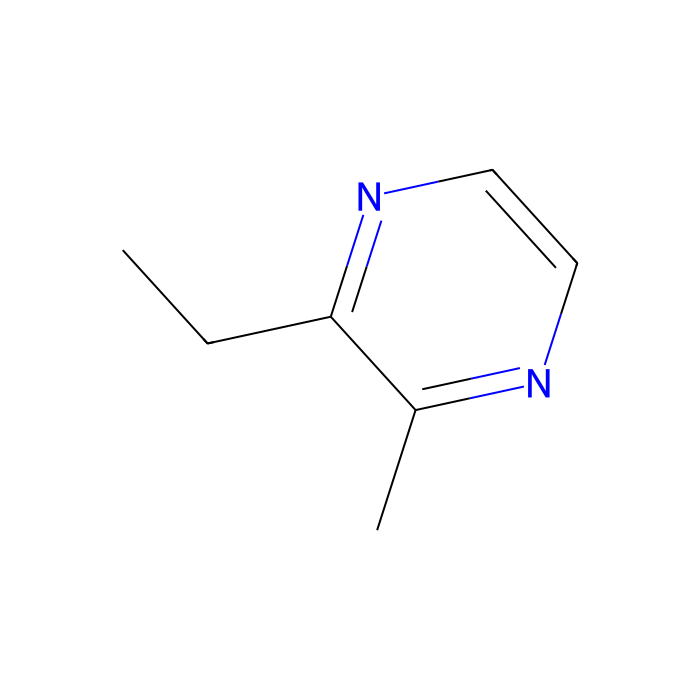
Structural class: Pyrazine (1,4-diazine) bearing an ethyl substituent at C-2 and a methyl substituent at C-3.
Functional groups/features (general chemistry):
Aromatic N-heterocycle (pyrazine ring, two ring nitrogens para to each other)
Two benzylic (ring-adjacent) alkyl substituents: ethyl (C-2) and methyl (C-3)
No stereocenters; planar heteroaromatic core
Literature structure descriptors (for reference; not item-specific specs):
Molecular formula (literature): C7H10N2
Molecular weight (literature): ~122.17 g/mol
Canonical SMILES (literature): CCc1nccnc1C
2D description in words: A six-membered aromatic ring with N atoms at positions 1 and 4; an ethyl group attached to C-2 and a methyl group attached to C-3; remaining ring carbons bear aromatic C–H.
Notes: Where item-specific identifiers differ or are not listed, consult the CoA/Spec Sheet for definitive identity confirmation (e.g., GC/MS, NMR).
Synthetic Utility
2-Ethyl-3-methylpyrazine offers a versatile heteroaromatic scaffold combining a deactivated diazine ring with functionalizable benzylic side chains.
Key reactivity modes (literature/general):
Electrophilic aromatic substitution: strongly deactivated by two ring nitrogens; harsh conditions typically required. N-oxide activation can increase ring reactivity for subsequent substitution.
Nucleophilic aromatic substitution (SNAr): feasible on halogenated pyrazines at activated positions; prerequisites include an electron-withdrawing pattern or N-oxide assistance. Starting material can be converted to halogenated analogs via directed strategies.
Directed ortho metalation/ring metalation: with s-BuLi or n-BuLi/TMEDA at −78 to −40 °C, enabling trapping with electrophiles (CO2, MeI, aldehydes). Site selectivity depends on substitution and coordinating additives.
Benzylic/side-chain chemistry: radical bromination (NBS, AIBN) at the ethyl/methyl groups; oxidation to aldehydes/acids; cross-aldol and acylation handles following oxidation.
Quaternization/coordination: alkylation of ring nitrogens forms salts (phase-transfer or ionic liquid applications); coordination to metals as a weak neutral ligand can modulate catalysis.
Retrosynthesis/value: serves as a node for building more complex pyrazine-derived ligands, odorants, or bioactive heteroaromatics by leveraging orthogonal functionalization at the ring versus side chains.
Target Specificity
Not applicable. This product is a small-molecule heteroaromatic, not a biological targeting reagent (e.g., antibody, enzyme inhibitor with defined target, or probe). No item-specific target data are provided.
よくある質問
What is the purity of this product?
This product is supplied at ≥99% purity (chemical assay). Lot-specific values are stated on the Certificate of Analysis.
How should this product be stored?
Store at room temperature.
How is this product shipped?
This product ships under standard ambient conditions. No temperature-controlled packaging is required.
What are the CAS number, molecular formula and molecular weight?
The CAS Number is 15707-23-0, the molecular formula is C7H10N2, and the molecular weight is 122.17 g/mol. InChIKey LNIMMWYNSBZESE-UHFFFAOYSA-N.
What documentation is provided?
Available product documentation, including Certificates of Analysis (COA), Safety Data Sheets (SDS), and specification sheets, is shown in the product document area. Document availability and access follow the current site policy.
Products are supplied to verified businesses, institutions, and qualified professionals for research and development use only. Not for use in humans, animals, diagnosis, or therapy.

 G2203232