This compound belongs to the class of organic compounds known as alkyl-phenylketones. These are aromatic compounds containing a ketone substituted by one alkyl group, and a phenyl group.
External Descriptors
carboxylic ester
1. Djoumbou Feunang Y, Eisner R, Knox C, Chepelev L, Hastings J, Owen G, Fahy E, Steinbeck C, Subramanian S, Bolton E, Greiner R, and Wishart DS. ClassyFire: Automated Chemical Classification With A Comprehensive, Computable Taxonomy. Journal of Cheminformatics, 2016, 8:61.
Determine the necessary mass, volume, or concentration for preparing a solution.
Dilution Calculator
Determine the dilution needed to prepare a stock solution.
Reconstitution Calculator
レビュー
顧客レビュー
Application Protocols
No tested biological assay protocols are provided for this small-molecule reagent. Typical laboratory uses are in organic synthesis and method development (see Reaction & Applications and Reaction Conditions tabs). If using in biochemical assays, prepare concentrated stocks in DMSO or ethanol, filter-sterilize if required by your workflow, and perform appropriate vehicle controls.
Biological Roles
This product is provided strictly for research use. No medical or clinical claims are made.
General biochemical context (literature):
Structural motif: o-Hydroxyacetophenones are common fragments in plant polyketides and serve as precursors to flavonoids, aurones, and related natural product families. The 4,6-dimethoxy substitution attenuates phenolic acidity and modulates redox behavior.
Metal chelation: The salicyl-type o-hydroxy–ketone motif can chelate metal ions in a six-membered fashion (O,O′-chelation). Such binding underlies applications as analytical ligands and models for enzymatic active sites in fundamental studies.
Photophysics: Aryl ketones exhibit π–π* transitions and, depending on substitution, n–π* states; intramolecular H-bonding between the phenol and carbonyl can influence excited-state intramolecular proton transfer (ESIPT) behavior (reported for related salicyl ketones, literature).
Metabolic considerations: In biological systems, O-demethylation (to catechol-like phenols) and Phase II conjugation (glucuronidation/sulfation) are typical for methoxylated phenolic aromatics; this is provided as general information only and not specific to this item.
If your research involves biochemical assays or metal-binding studies, verify purity and counterion/solvent content by CoA and perform your own suitability testing.
Buffer Applications
This compound is not a buffering agent and is not typically used to prepare biological or chromatography buffers. It lacks a conjugate acid/base pair in the physiological pH range suitable for robust buffering. For practical work, dissolve it in an appropriate organic solvent (e.g., DMSO, ethanol) before addition to assay media if required by your protocol.
Green Alternatives
While this SKU is a solid reagent rather than a solvent, many of its transformations can be run in greener media or under milder conditions. Consider the following greener choices (literature):
Solvent substitution:
Replace chlorinated solvents (DCM) with ethyl acetate or 2-MeTHF for acylations/extractions when feasible.
Use ethanol or isopropanol as reaction media for Claisen–Schmidt condensations instead of DMF/DMSO.
Employ water/ethanol biphasic systems with phase-transfer catalysts for O-alkylations to reduce dipolar aprotic solvent use.
Catalysis and conditions:
Solid base catalysts (KF/alumina, hydrotalcites) can promote O-alkylations under solvent-minimized conditions.
Organocatalytic or micellar catalysis (TPGS-750-M in water) has been reported to enable aldol-type condensations and SN2 reactions with reduced solvent impact.
Use boron-based demethylations (BBr3) at lower stoichiometry and low temperature; alternatively, consider greener demethylations (e.g., AlCl3/thiourea or catalytic iodide in sulfone media) where compatible.
Workup/waste minimization:
Crystallization-driven purifications from ethanol/IPA can replace silica chromatography in many condensations.
Telescoping O-acylation → Baker–Venkataraman steps in a single pot reduces solvent usage and handling.
Trade-offs: Greener solvents may alter rates/selectivity (e.g., ethanol slows some SN2 O-alkylations). Ensure equivalent yields/purity via small-scale screening before scale-up.
Pharmaceutical Uses
No pharmacopeial/excipient status is indicated for this item. Not specified for this item; refer to CoA/Spec Sheet.
General formulation/manufacturing context (non-clinical, literature):
Role as an intermediate: o-Hydroxyacetophenones with 4,6-dimethoxy patterns are common intermediates in the synthesis of flavonoid-like scaffolds and other small molecules during drug discovery route scouting.
Solid-state handling: If used in process R&D, attention to polymorphism and solvate formation may be warranted; confirm with DSC/PXRD as needed.
Analytical control: Due to UV activity, HPLC/UPLC with diode-array detection (254–320 nm) provides sensitive in-process control. Residual boron/halides should be monitored after demethylation steps if applicable.
This material is supplied strictly for research use only and is not intended for use in humans or diagnostic applications.
Physical Properties
Item-specific physical specifications are not provided in the Product Data. The following values are literature-based general information for 2'-hydroxy-4',6'-dimethoxyacetophenone; do not treat as specifications for this SKU.
Aggregate state/appearance: Not specified for this item; refer to CoA/Spec Sheet. (Compounds of this class are typically crystalline solids, literature.)
Density: Not specified for this item; refer to CoA/Spec Sheet.
Melting point: Not specified for this item; refer to CoA/Spec Sheet.
Boiling point / decomposition: Not specified for this item; refer to CoA/Spec Sheet. (Phenolic acetophenones commonly decompose before boiling at atmospheric pressure, literature.)
Solubility (qualitative, literature):
Organic solvents: generally soluble in polar organics (methanol, ethanol, acetone, acetonitrile, ethyl acetate, DMSO); moderate in dichloromethane; low in alkanes.
Water: sparingly soluble to practically insoluble (typical for aryl ketone anisoles with one phenol).
LogP/logD: Not specified for this item; refer to CoA/Spec Sheet. (Aryl ketone with two methoxy groups expected to be moderately lipophilic, literature.)
pKa (phenolic OH, literature, qualitative): expected ~9–10 for anisole-substituted phenols; actual value not specified for this item.
UV-Vis (qualitative, literature): aromatic ketone shows π–π* absorption in near-UV; methoxy substituents bathochromically shift bands; exact cutoff not specified for this item.
Always consult the item-specific CoA for definitive physical property data and use an on-site qualification if properties are critical to your application.
Quality and Grades
Grade/Purity: Not specified for this item; refer to CoA/Spec Sheet.
Guidance on typical grades for small-molecule research reagents (general):
Research grade: Suitable for most synthetic/analytical uses. Purity often ≥95% by HPLC/GC/NMR, but acceptance criteria vary by supplier.
AR/ACS grade: Defined impurity limits meeting analytical reagent standards; often unnecessary for routine synthesis unless specified.
HPLC grade (for solvents) or low-UV grade: Not directly applicable to this solid; however, low-UV absorbing impurities can be important if using as an analytical standard.
Considerations specific to phenolic acetophenones:
Stabilizers: Typically none required; if present, would be disclosed on the CoA. Not specified for this item; refer to CoA/Spec Sheet.
Identity/purity verification: 1H/13C NMR in DMSO‑d6 or CD3OD, HRMS, and HPLC/UPLC (UV 254–280 nm) are standard. Phenolic OH may appear as a broad, exchangeable signal.
Impurities of interest (general): O-demethylated analogs (catechols/phenols), over-oxidation products, residual solvents. If your application is sensitive (e.g., photophysics, coordination studies), request detailed impurity profiling.
Always consult the lot-specific CoA for actual grade, purity assay method, and impurity limits for SKU H113418.
Reaction and Applications
Without manufacturer application notes for this SKU, the following outlines common synthetic applications of o-hydroxyacetophenones bearing 4,6-dimethoxy substitution (literature/general):
Chalcone synthesis (Claisen–Schmidt condensation): The methyl ketone undergoes base-catalyzed aldol condensation with aromatic aldehydes to form 2′-hydroxychalcones. The ortho-phenol can subsequently cyclize (acid/base or oxidative conditions) to benzoflavanone/aurone frameworks.
Baker–Venkataraman rearrangement: After O-acylation of the phenolic OH, base-induced acyl transfer affords 1,3-diketones that cyclize to flavones/flavonols. The 4,6-dimethoxy pattern is common in polyketide/flavonoid syntheses.
Directed ortho chemistry: The phenolic OH (or its O-protecting groups) direct electrophilic substitution and metalation. Methoxy groups are ortho/para directors, enabling regioselective further elaboration.
O-Functionalization: Alkylation, acylation, or sulfonylation at the phenolic oxygen provides protected derivatives or pro-electrophiles for subsequent rearrangements.
Demethylation (selective): BBr3, BCl3, or AlCl3/thiols can convert methoxy to phenolic OHs, enabling access to polyphenolic acetophenones and enhanced chelation/cyclization.
Chelation and complexation: The o-hydroxy–ketone motif forms stable six-membered chelates with metals (e.g., Al, Ti, Zn), useful in analytical and catalytic contexts (e.g., ligand precursors), though this item is provided for research use only.
Practical tips (general):
Drying: For moisture-sensitive steps (acylation, rearrangements), dry the solid in vacuo (ambient to 40–50 °C) and use anhydrous solvents.
Protecting groups: Convert the phenol to methyl/benzyl/THP ethers to prevent undesired O-acylation or polymerization during strong base steps.
Monitoring: UV 254–320 nm HPLC/UPLC tracks transformations efficiently due to the aryl ketone chromophore.
Reaction Conditions
Typical literature conditions involving 2′-hydroxyacetophenone derivatives with 4,6-dimethoxy substitution are summarized below; adapt to your substrate/scope screening. These are general guidelines, not specifications for this SKU.
Claisen–Schmidt (chalcone formation):
Reagents: aromatic aldehyde (1.0 equiv), this ketone (1.0–1.5 equiv), KOH or NaOH (10–40 mol%).
Solvent: ethanol or ethanol/water (95:5 to 80:20).
Conditions: 0–25 °C addition, then 2–24 h at rt to 50 °C. Monitor by TLC/HPLC (254–320 nm).
Workup: neutralize, isolate by filtration/crystallization; typical literature yields 60–90% depending on partners.
O-Acylation → Baker–Venkataraman rearrangement:
Step 1: Phenol + acyl chloride/anhydride (1.1–1.5 equiv), base (pyridine/Et3N), DCM/MeCN, 0 °C → rt, 1–3 h, giving aryl ester.
Step 2: Rearrangement with KOtBu or K2CO3 in pyridine/DMF, 60–100 °C, 2–16 h to 1,3-diketone; cyclize under acidic conditions to flavone.
O-Alkylation (ether formation):
Reagents: alkyl halide (1.1–2.0 equiv), K2CO3 or Cs2CO3 (2–3 equiv).
Solvent: acetone, MeCN, or DMF.
Conditions: reflux (acetone) 2–8 h or rt–60 °C (MeCN/DMF), typical yields 70–95% (literature, substrate-dependent).
Demethylation of methoxy groups (if desired):
BBr3 (1.0–3.0 equiv per OMe) in DCM, −78 to 0 °C, 1–6 h; quench cautiously with MeOH/H2O. Alternative: AlCl3/thiol or TMSI.
Metal chelation/complex prep (analytical studies):
Form complexes by mixing with metal salts in EtOH/MeOH at rt; monitor by UV-Vis; exact stoichiometry depends on metal/ligand ratio (general literature practice).
Always perform small-scale scouting; optimize base strength, temperature, and solvent to balance O- vs C-functionalization and prevent overreaction.
Safety and Handling
GHS/CLP classification: Not specified for this item; refer to SDS.
Signal word / H-statements / pictograms: Not specified for this item; refer to SDS.
General safety considerations for aryl phenolic ketones (literature/good practice):
Hazards: May cause skin/eye irritation; dust may irritate respiratory tract. Phenolic compounds can cause defatting/irritation on contact. Avoid inhalation of powders.
PPE: Wear lab coat, safety glasses or splash goggles, and chemical-resistant gloves (e.g., nitrile). Handle powders in a fume hood or with local exhaust.
Handling: Avoid dust generation. Prevent contact with strong oxidizers and strong bases (which may promote O- or C-alkylation/condensation). Keep containers tightly closed to limit moisture uptake and oxidative discoloration.
Incompatibilities (literature): strong oxidizing agents; strong bases/acids (may induce side reactions such as demethylation, esterification, or aldol condensations under forcing conditions).
First aid (overview; refer to SDS for details):
Skin/eye contact: Rinse with copious water for ≥15 min; remove contaminated clothing; seek medical advice if irritation persists.
Inhalation: Move to fresh air; assist breathing if necessary; seek medical attention if symptoms occur.
Ingestion: Rinse mouth; do not induce vomiting; seek medical attention.
Fire: Likely combustible organic solid. Use CO2, dry chemical, or foam. Combustion may produce CO/CO2 and irritant fumes.
Spill response: Avoid dust; collect mechanically; place in suitable container for disposal. Wash spill area with appropriate solvent, observing compatibility.
Definitive hazard classification and exposure limits must be taken from the item-specific SDS supplied with the product.
Solvent Selection
This product is an aromatic ketone with one phenolic OH and two methoxy groups; it is typically processed and used in polar organic media.
Polarity/miscibility profile (literature):
Preferred solvents: methanol, ethanol, isopropanol, acetone, acetonitrile, ethyl acetate, dichloromethane, THF, and DMSO (high solubility). Sparingly soluble in water.
For base-catalyzed condensations (e.g., Claisen–Schmidt): ethanol or mixed ethanol/water with alkali hydroxide is typical.
For electrophilic aromatic substitutions or O-alkylations: aprotic solvents (DMF, DMSO, acetone, MeCN) often used with inorganic bases/phase-transfer catalysts.
Selection tips (general):
Choose protic alcohols (MeOH/EtOH) to facilitate enolate formation and ease workup for aldol-type reactions.
Choose DCM/EtOAc/MeCN for acylations or coupling steps to minimize competing transesterification.
Use DMSO/DMF when high polarity is essential (e.g., SN2 O-alkylations), balancing with challenging removal.
Quick comparison (literature):
Ethanol: green, inexpensive, good for base-catalyzed condensations; limited solubility for hydrophobic reagents.
Acetonitrile: broad compatibility, low nucleophilicity; good for oxidations and couplings.
DMSO: excellent solvency; consider odor, removal, and potential base-promoted side reactions.
Note: Optimize solvent choice based on the specific transformation and downstream isolation needs. No item-specific solvent specs are provided for this SKU.
Storage and Reconstitution
Storage (item-specific): Room temperature (per Product Data). Protect from moisture and strong light. Keep container tightly closed.
Shipping: Shipped at ambient temperature (Normal).
Stability: Not specified for this item; refer to CoA/Spec Sheet. Phenolic aryl ketones are generally stable under dry, ambient conditions; gradual discoloration can occur upon prolonged light/air exposure (literature).
Reconstitution/dissolution (general guidance):
Prepare stock solutions in dry organic solvents such as DMSO, DMF, methanol, ethanol, acetone, acetonitrile, or ethyl acetate. Typical stock concentrations: 10–100 mM depending on solubility and intended use.
For aqueous work: dissolve first in a miscible organic solvent (e.g., DMSO or ethanol), then dilute into buffer with vigorous mixing; final cosolvent content often kept ≤1–2% v/v in biochemical assays (if applicable).
Filter solutions (0.22 µm PTFE) for analytical applications.
Freeze–thaw: If storing solutions, aliquot to avoid repeated freeze–thaw cycles. Solid material should be kept tightly sealed with desiccant.
Compatibility: Avoid prolonged contact with strong bases/acids unless intended for reaction; these conditions can induce O-/C-transformations.
For any critical application, confirm material integrity by NMR/HPLC upon receipt and at defined intervals during storage.
Structure and Identity
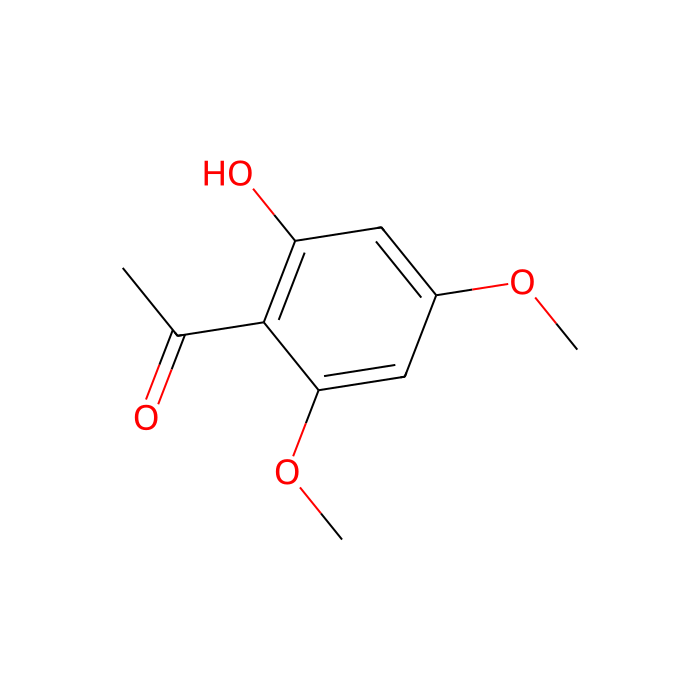
Overview: 2'-Hydroxy-4',6'-dimethoxyacetophenone is an o-hydroxyacetophenone bearing two additional methoxy substituents on the aromatic ring (para and ortho relative to the acetyl), giving a 1,2,4,6-substitution pattern on the phenyl.
Item-specific registry data (from Product Data)
CAS: 90-24-4
CID: 66654
InChIKey: Not specified for this item; refer to CoA/Spec Sheet.
SMILES: Not specified for this item; refer to CoA/Spec Sheet.
Structural features (general/literature description)
Core scaffold: acetophenone (aryl ketone) with an ortho-phenolic OH and two anisole-type methoxy groups.
Substitution pattern (descriptive 2D): the acetyl carbonyl is at ring position 1; hydroxyl at 2-position (ortho to the carbonyl); methoxy groups at 4- (para) and 6- (ortho) positions. Remaining ring hydrogens at 3 and 5 positions.
Stereochemistry: achiral; no stereocenters.
Empirical identifiers (literature/computed; for reference only)
Molecular formula (literature): C10H12O4
Molecular weight (literature): ~196.20 g/mol
Example canonical SMILES (literature): COc1cc(OC)c(O)c(C(=O)C)c1
Note: Where item-specific identifiers are required for quality or regulatory purposes, rely on the CoA/Spec Sheet for the exact SMILES/InChIKey used for this SKU.
Synthetic Utility
Key reactivity derives from the combination of an activated methyl ketone, an ortho-phenolic OH, and two electron-donating methoxy groups.
Functional group behavior (literature):
Enolizable methyl ketone enables aldol condensations (Claisen–Schmidt) to chalcones; methoxy groups enhance ring activation and stabilize intermediates.
Phenolic OH acts as a nucleophile (O-alkylation/acylation) and as a directing/chelating group for electrophilic substitutions and metalations.
Methoxy groups are removable (BBr3/BCl3) to access polyphenols; they also direct EAS and can stabilize carbocations.
Named reactions/applications:
Baker–Venkataraman rearrangement to 1,3-diketones → cyclization to flavones/flavonols.
Pechmann/Knoevenagel-type condensations with β-ketoesters/aldehydes to assemble benzofuran/aurone motifs after cyclization.
Fries-type acyl migration from phenyl esters (after O-acylation) for regioselective acyl placement (advanced use).
Retrosynthetic value:
Serves as a convergent node where the phenol can be protected/manipulated independently of the ketone side chain; allows orthogonal strategies (e.g., first install chalcone, then demethylate; or invert sequence as needed).
Practical notes:
Protect phenolic OH to prevent competitive O-acylation during intended C-acylations.
For regioselective further substitution, leverage directing effects of phenol/methoxy and consider transient silyl ethers to direct lithiation.
The intramolecular H-bond (o-OH···O=C) can influence NMR chemical shifts and reactivity; confirm assignment by D2O exchange.
Target Specificity
Not applicable. This SKU is a small-molecule research reagent, not a biological macromolecule or affinity reagent. No antigen/epitope, species reactivity, clone, or isotype information applies.
Products are supplied to verified businesses, institutions, and qualified professionals for research and development use only. Not for use in humans, animals, diagnosis, or therapy.

 A2226031