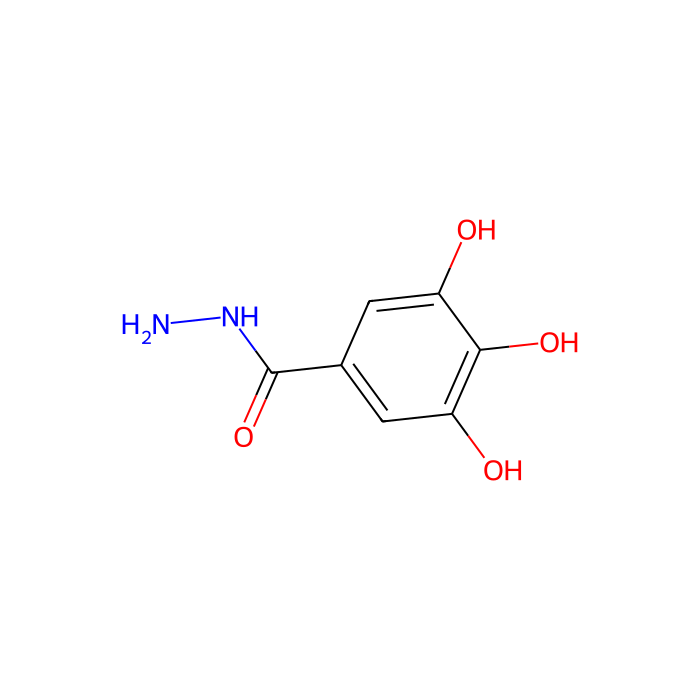
3,4,5-Trihydroxybenzhydrazide - ≥95% , CAS No.5782-85-4

CAS: 5782-85-4 Cat. No.: T332434 分子式: C7H8N2O4 分子量: 184.15 EC番号: 673-702-3 PubChem CID: 592744
注文可能
GRADE & PURITY ≥95%
Synonyms
3,4,5-tris(oxidanyl)benzohydrazide | BDBM65301 | E77181 | gallic hydrazide | 3,4,5-Trihydroxybenzhydrazide | 3,4,5-Trihydroxybenzohydrazide | FBCVSPDPLQWYJV-UHFFFAOYSA-N | FT-0682187 | MLS000713290 | AKOS000525982 | SB85903 | 3,4,5-Trihydroxybenzohydrazid
Storage
Store at 2-8°C,Protected from light,Argon charged
Shipped In
Wet ice
★
Size
USA
ドイツ (EU)*
Price
Qty
5g
T332434-5g
受注生産 · 8~12週間
$11.90
25g
T332434-25g
受注生産 · 8~12週間
$36.90
100g
T332434-100g
受注生産 · 8~12週間
$112.90
500g
T332434-500g
受注生産 · 8~12週間
$402.90
Enter a quantity for the sizes you want to add.
🧪
Why this grade

≥95% for sensitive chromatographic and analytical workflows requiring minimal baseline interference.

🌡

Storage & shipping

Store at 2-8°C,Protected from light,Argon charged Ships Wet ice Check lot-specific COA for exact specifications.

📋

Quality documents

SDS, COA, datasheet, and spec sheet available for download. Lot-specific COA accessible via lot number lookup.

📚

Literature proof

Cited in 0 peer-reviewed publications across chromatography, organic synthesis, and cross-coupling reactions.

Specifications

同義語
3,4,5-tris(oxidanyl)benzohydrazide | BDBM65301 | E77181 | gallic hydrazide | 3,4,5-Trihydroxybenzhydrazide | 3,4,5-Trihydroxybenzohydrazide | FBCVSPDPLQWYJV-UHFFFAOYSA-N | FT-0682187 | MLS000713290 | AKOS000525982 | SB85903 | 3,4,5-Trihydroxybenzohydrazid
仕様と純度
≥95%
保管条件
Store at 2-8°C,Protected from light,Argon charged
入荷
Wet ice
この製品は冷冷この冷このこの製品の運送が必要です。地上およびその他の経済サービスは利用できません。
純度
≥95%
製品の性質
pKa
pKa: 8.29 (Predicted), pKa: 3.19 (Predicted)
名前と識別子
カノニカル・スマイル
C1=C(C=C(C(=C1O)O)O)C(=O)NN
IUPAC Name
3,4,5-trihydroxybenzohydrazide
InChIKey
FBCVSPDPLQWYJV-UHFFFAOYSA-N
INCHI
1S/C7H8N2O4/c8-9-7(13)3-1-4(10)6(12)5(11)2-3/h1-2,10-12H,8H2,(H,9,13)
異性体SMILES
C1=C(C=C(C(=C1O)O)O)C(=O)NN
PubChem CID
592744
UN番号
3335
包装グループ
III
分子量
184.15

Documentation

📋 Safety Data Sheet (SDS)

Comprehensive hazard, handling, storage, and regulatory compliance document.

Download SDS →

✅ Certificate of Analysis (COA)

Lot-specific quality data. Enter your lot number to retrieve the exact COA.

Look up COA →

📊 Datasheet

Quick-reference summary of product specifications and applications.

View datasheet →

🔬 Specification Sheet

Full quality attributes and acceptance criteria for this grade.

View spec sheet →

Advanced Data

Taxonomic Classification

Taxonomy Tree

KingdomOrganic compounds
SuperclassBenzenoids
分類Phenols
SubclassBenzenetriols and derivatives
Intermediate Tree Nodes Not available
Direct ParentPyrogallols and derivatives
Alternative Parents Benzoic acids and derivatives  Benzoyl derivatives  1-hydroxy-4-unsubstituted benzenoids  1-hydroxy-2-unsubstituted benzenoids  Carboxylic acid hydrazides  Polyols  Organopnictogen compounds  Organonitrogen compounds  Organic oxides  Hydrocarbon derivatives  
Molecular FrameworkAromatic homomonocyclic compounds
Substituents Benzoic acid or derivatives - Pyrogallol derivative - Benzoyl - 1-hydroxy-4-unsubstituted benzenoid - 1-hydroxy-2-unsubstituted benzenoid - Monocyclic benzene moiety - Carboxylic acid hydrazide - Carboxylic acid derivative - Polyol - Organooxygen compound - Organonitrogen compound - Organic oxide - Organopnictogen compound - Organic oxygen compound - Organic nitrogen compound - Hydrocarbon derivative - Aromatic homomonocyclic compound
説明This compound belongs to the class of organic compounds known as pyrogallols and derivatives. These are compounds containing a 1,2,3-trihydroxybenzene moiety.
External Descriptors Not available
3 D構造
インタラクティブ化学構造モデル


関連ターゲット(人間)
POLB Tchem DNA polymerase beta (23632 Activities)
Activity TypeRelationActivity valueUnitsAction TypeJournalPubMed IddoiAssay Aladdin ID
PLK1 Tchem Serine/threonine-protein kinase PLK1 (28605 Activities)
Activity TypeRelationActivity valueUnitsAction TypeJournalPubMed IddoiAssay Aladdin ID
GAA Tclin Lysosomal alpha-glucosidase (35701 Activities)
Activity TypeRelationActivity valueUnitsAction TypeJournalPubMed IddoiAssay Aladdin ID
ALDH1A1 Tchem Aldehyde dehydrogenase 1A1 (77053 Activities)
Activity TypeRelationActivity valueUnitsAction TypeJournalPubMed IddoiAssay Aladdin ID
GLP1R Tclin Glucagon-like peptide 1 receptor (111429 Activities)
Activity TypeRelationActivity valueUnitsAction TypeJournalPubMed IddoiAssay Aladdin ID
ALPG Tchem Alkaline phosphatase placental-like (1197 Activities)
Activity TypeRelationActivity valueUnitsAction TypeJournalPubMed IddoiAssay Aladdin ID
CASP6 Tchem Caspase-6 (1213 Activities)
Activity TypeRelationActivity valueUnitsAction TypeJournalPubMed IddoiAssay Aladdin ID
PIN1 Tchem Peptidyl-prolyl cis-trans isomerase NIMA-interacting 1 (36611 Activities)
Activity TypeRelationActivity valueUnitsAction TypeJournalPubMed IddoiAssay Aladdin ID
FEN1 Tchem Flap endonuclease 1 (12055 Activities)
Activity TypeRelationActivity valueUnitsAction TypeJournalPubMed IddoiAssay Aladdin ID
POLK Tbio DNA polymerase kappa (8653 Activities)
Activity TypeRelationActivity valueUnitsAction TypeJournalPubMed IddoiAssay Aladdin ID
POLI Tchem DNA polymerase iota (116820 Activities)
Activity TypeRelationActivity valueUnitsAction TypeJournalPubMed IddoiAssay Aladdin ID
HTT Tchem Huntingtin (19182 Activities)
Activity TypeRelationActivity valueUnitsAction TypeJournalPubMed IddoiAssay Aladdin ID
KDM4A Tchem Lysine-specific demethylase 4A (52245 Activities)
Activity TypeRelationActivity valueUnitsAction TypeJournalPubMed IddoiAssay Aladdin ID
APEX1 Tchem DNA-(apurinic or apyrimidinic site) lyase (38016 Activities)
Activity TypeRelationActivity valueUnitsAction TypeJournalPubMed IddoiAssay Aladdin ID
ALPL Tchem Alkaline phosphatase, tissue-nonspecific isozyme (1551 Activities)
Activity TypeRelationActivity valueUnitsAction TypeJournalPubMed IddoiAssay Aladdin ID
EHMT2 Tchem Histone-lysine N-methyltransferase, H3 lysine-9 specific 3 (93046 Activities)
Activity TypeRelationActivity valueUnitsAction TypeJournalPubMed IddoiAssay Aladdin ID
TDP1 Tchem Tyrosyl-DNA phosphodiesterase 1 (345557 Activities)
Activity TypeRelationActivity valueUnitsAction TypeJournalPubMed IddoiAssay Aladdin ID
L3MBTL1 Tchem Lethal(3)malignant brain tumor-like protein 1 (14536 Activities)
Activity TypeRelationActivity valueUnitsAction TypeJournalPubMed IddoiAssay Aladdin ID
KDM4E Tchem Lysine-specific demethylase 4D-like (40243 Activities)
Activity TypeRelationActivity valueUnitsAction TypeJournalPubMed IddoiAssay Aladdin ID
LMNA Tbio Prelamin-A/C (36751 Activities)
Activity TypeRelationActivity valueUnitsAction TypeJournalPubMed IddoiAssay Aladdin ID
RECQL Tbio ATP-dependent DNA helicase Q1 (5575 Activities)
Activity TypeRelationActivity valueUnitsAction TypeJournalPubMed IddoiAssay Aladdin ID
BLM Tchem Bloom syndrome protein (4248 Activities)
Activity TypeRelationActivity valueUnitsAction TypeJournalPubMed IddoiAssay Aladdin ID
SMAD3 Tchem Mothers against decapentaplegic homolog 3 (68039 Activities)
Activity TypeRelationActivity valueUnitsAction TypeJournalPubMed IddoiAssay Aladdin ID
CBX1 Tbio Chromobox protein homolog 1 (92434 Activities)
Activity TypeRelationActivity valueUnitsAction TypeJournalPubMed IddoiAssay Aladdin ID
BAZ2B Tchem Bromodomain adjacent to zinc finger domain protein 2B (56204 Activities)
Activity TypeRelationActivity valueUnitsAction TypeJournalPubMed IddoiAssay Aladdin ID
RGS4 Tchem Regulator of G-protein signaling 4 (13867 Activities)
Activity TypeRelationActivity valueUnitsAction TypeJournalPubMed IddoiAssay Aladdin ID
NSD2 Tchem Histone-lysine N-methyltransferase NSD2 (803 Activities)
Activity TypeRelationActivity valueUnitsAction TypeJournalPubMed IddoiAssay Aladdin ID
関連ターゲット(非人間)
Iap Intestinal alkaline phosphatase (419 Activities)
Activity TypeRelationActivity valueUnitsAction TypeJournalPubMed IddoiAssay Aladdin ID
Acinetobacter baumannii (41033 Activities)
Activity TypeRelationActivity valueUnitsAction TypeJournalPubMed IddoiAssay Aladdin ID
Plasmodium falciparum (966862 Activities)
Activity TypeRelationActivity valueUnitsAction TypeJournalPubMed IddoiAssay Aladdin ID
RAW264.7 (28094 Activities)
Activity TypeRelationActivity valueUnitsAction TypeJournalPubMed IddoiAssay Aladdin ID
Luciferin 4-monooxygenase (66902 Activities)
Activity TypeRelationActivity valueUnitsAction TypeJournalPubMed IddoiAssay Aladdin ID
ddn Putative uncharacterized protein (49 Activities)
Activity TypeRelationActivity valueUnitsAction TypeJournalPubMed IddoiAssay Aladdin ID
Mapt Microtubule-associated protein tau (6 Activities)
Activity TypeRelationActivity valueUnitsAction TypeJournalPubMed IddoiAssay Aladdin ID
Nfe2l2 Nuclear factor erythroid 2-related factor 2 (214 Activities)
Activity TypeRelationActivity valueUnitsAction TypeJournalPubMed IddoiAssay Aladdin ID
fba Putative fructose-1,6-bisphosphate aldolase (15559 Activities)
Activity TypeRelationActivity valueUnitsAction TypeJournalPubMed IddoiAssay Aladdin ID
ffp 4'-phosphopantetheinyl transferase ffp (24982 Activities)
Activity TypeRelationActivity valueUnitsAction TypeJournalPubMed IddoiAssay Aladdin ID
ATP-dependent molecular chaperone HSP82 (2186 Activities)
Activity TypeRelationActivity valueUnitsAction TypeJournalPubMed IddoiAssay Aladdin ID
作用メカニズム
証明書(CoA、COO、BSE/TSEと分析図)
C of A & Other Certificates(BSE/TSE, COO):
Analytical Chart:

Find and download the COA for your product by matching the lot number on the packaging.

4 results found

Lot NumberCertificate Type日付商品
B2609034Certificate of AnalysisJan 24, 2026 T332434
B2609035Certificate of AnalysisJan 24, 2026 T332434
B2609040Certificate of AnalysisJan 24, 2026 T332434
B2609044Certificate of AnalysisJan 24, 2026 T332434
化学的性質と物理的性質
感度Light sensitive
屈折率n20D1.72
融点(°C)295 - 298° C
分子量184.150 g/mol
XLogP3-0.300
Hydrogen Bond Donor Count5
Hydrogen Bond Acceptor Count5
Rotatable Bond Count1
Exact Mass184.048 Da
Monoisotopic Mass184.048 Da
Topological Polar Surface Area116.000 Ų
Heavy Atom Count13
Formal Charge0
Complexity187.000
Isotope Atom Count0
Defined Atom Stereocenter Count0
Undefined Atom Stereocenter Count0
Defined Bond Stereocenter Count0
Undefined Bond Stereocenter Count0
The total count of all stereochemical bonds0
Covalently-Bonded Unit Count1
ソリューション計算機
レビュー

顧客レビュー

Application Protocols

No item-specific, validated application protocols are provided for this reagent. Not specified for this item; refer to CoA/Spec Sheet.

General procedural outlines (literature; for research use):

  • Hydrazone coupling to an aldehyde-bearing substrate:

    1. Dissolve 3,4,5-trihydroxybenzhydrazide (0.5–1.0 equiv) in EtOH (or DMF for solubility) at ~0.05–0.2 M.
    2. Add the aldehyde/ketone (1.0–1.5 equiv). Add AcOH (10–50 mol%) or aniline (10 mol%) as catalyst.
    3. Stir at RT–40 °C for 2–12 h; add 3Å molecular sieves if needed.
    4. Concentrate; triturate with water and collect product by filtration; recrystallize if necessary.
  • Preparation of a 1,3,4-oxadiazole derivative (two-step outline):

    1. Form a diacyl hydrazide by coupling a carboxylic acid (1.0–1.2 equiv) using CDI or EDC/HOBt in DMF at 0–25 °C, then warm to complete.
    2. Cyclodehydrate with POCl3 (excess) at 60–90 °C for 1–4 h; quench cautiously onto ice and neutralize; extract and purify.
  • Metal-complexation assay (qualitative):

    1. Prepare 0.5–1.0 mM solution in 50% EtOH/H2O.
    2. Titrate with Fe(III) in dilute acid; monitor UV–Vis for ligand-to-metal charge transfer band development; adjust pH to modulate complexation.

Adjust parameters to your substrates/equipment; validate on small scale before scale-up.

Biological Roles

No item-specific bioactivity data is provided. The following reflects general, literature-based roles of phenolic acyl hydrazides and the 3,4,5-trihydroxybenzoyl (gallic) scaffold; these points are for research context only and do not imply clinical use:

  • Chemical biology handle:

    • The hydrazide group reacts selectively with aldehydes/ketones, enabling covalent capture of oxidized glycans, metabolite-derived carbonyls, and carbonylated biomolecules in proteomics workflows (via hydrazone formation). Conditions are typically mildly acidic and can be accelerated by aniline catalysis.
  • Phenolic motif behavior:

    • The 3,4,5-trihydroxy (pyrogallol) arrangement is strongly H-bonding and can chelate hard metal ions (e.g., Fe3+, Al3+), which may be exploited in metal-binding studies, colorimetric assays, or in designing redox-active conjugates. The phenolic groups can undergo oxidation to quinonoid forms under certain conditions.
  • Scaffold in inhibitor design (literature):

    • Aryl hydrazides and related acyl hydrazones are frequently explored as reversible covalent ligands against carbonyl-containing cofactors or as linkers in fragment-based assembly. The electron-rich ring can modulate binding via π–π and H-bond interactions.
  • Conjugation/immobilization:

    • Surface aldehydes (generated by periodate oxidation of polysaccharides or on oxidized carbon materials) can be coupled to hydrazides to immobilize ligands/biomolecules; subsequent reduction can stabilize the linkage.

Note: These are general biochemical utilities for research labs. This product is supplied strictly for research use only and is not intended for diagnostic, therapeutic, or other clinical applications.

Buffer Applications

This compound is not a conventional buffering agent. It lacks a well-defined, narrow pKa window suitable for maintaining constant pH in typical biological or analytical buffer systems.

  • Practical guidance (research context):
    • If used in aqueous experiments (e.g., hydrazone formation with oxidized glycans), dissolve first in a miscible co-solvent (DMSO or EtOH), then add to a pre-selected buffer (e.g., acetate, citrate, or phosphate) appropriate for your target pH.
    • Maintain mildly acidic conditions (commonly pH 4–6 for hydrazone formation) to favor carbonyl condensation; aniline catalysis can be employed to accelerate reactions in buffered media.
    • Avoid buffers containing metal ions if metal-chelation or redox side reactions are a concern; use metal-free reagents and plastics/glassware.

For routine pH control, select a standard buffer system (acetate, MES, phosphate, HEPES) matched to your required pH range. This product itself is not recommended as a primary buffering component.

Green Alternatives

As a solid building block/derivatization reagent, the compound itself is the active substrate; “greener” choices primarily concern solvent and reagent selection in its use.

Greener practice options (literature/general):

  • Solvent substitution:

    • Replace DMF/NMP with bio-based or lower-toxicity solvents when feasible: EtOH, i-PrOH, MeCN, 2-MeTHF, CPME. For hydrazone formation, aqueous ethanol or ethanol alone (with catalytic AcOH) is often effective and readily recoverable.
    • For phenolic acylations/etherifications, consider Me-THF or CPME with catalytic bases; maintain low E-factors by telescoping steps.
  • Catalysis and milder reagents:

    • Use acid catalysis (AcOH, citric acid) instead of stoichiometric mineral acids for hydrazone formation.
    • For cyclodehydrations to oxadiazoles, explore greener dehydrating systems (e.g., triphosgene alternatives, polymer-supported carbodiimides) and solvent recycling.
  • Energy and waste minimization:

    • Conduct reactions at ambient temperature when kinetics allow (hydrazone formation is often fast at RT).
    • Employ Dean–Stark only when necessary; otherwise, molecular sieves can scavenge water with less energy input.

Comparison snapshot (general; not item-specific):

  • EtOH vs DMF in hydrazone formation
    • Pros (EtOH): renewable, low toxicity, easy removal, often sufficient with catalytic acid.
    • Cons (EtOH): lower solubility for hydrophobic partners; may need heat.
  • 2-MeTHF vs DCM for acylations
    • Pros (2-MeTHF): bio-derived, higher boiling point, reduced halogenated waste.
    • Cons (2-MeTHF): different polarity; reaction rates/selectivity may shift—reoptimize.

Implement solvent selection matrices (e.g., CHEM21/ACS GCI guides) to align with sustainability goals.

Pharmaceutical Uses

No item-specific pharmacopeial status, grade, or excipient designation is provided. Not specified for this item; refer to CoA/Spec Sheet.

General R&D context (non-clinical; for research use only):

  • Synthetic intermediate: 3,4,5-trihydroxybenzhydrazide can serve as a building block toward heterocycles (e.g., oxadiazoles) and hydrazone-linked scaffolds in early discovery chemistry.
  • Carbonyl-capturing auxiliary: Used to derivatize aldehydes/ketones in analytical method development (e.g., improving detection/retention in LC methods) during preformulation or impurity profiling studies.
  • Probing/attachment point: The hydrazide can be used to append the gallic motif to aldehyde-bearing substrates, potentially modulating solubility and binding characteristics in screening libraries.

Important restrictions:

  • This product is not produced or qualified under cGMP and is not intended for use as an API, excipient, or in finished dosage forms.
  • If translation into regulated environments is contemplated, re-synthesis under appropriate GMP controls and full impurity/elemental profiling would be required.

Consult your quality unit for material qualification requirements if any pharmaceutical-development use (non-clinical) is envisioned.

Physical Properties

Item-specific specifications (exact BP/MP/density/UV cutoffs, etc.) are Not specified for this item; refer to CoA/Spec Sheet.

Literature/general properties for 3,4,5-trihydroxybenzhydrazide (for context; not product specifications):

  • Molecular formula: C7H8N2O4 (literature)
  • Molecular weight: ~184.15 g/mol (literature)
  • Appearance: typically a tan to off-white solid (literature; may vary with purity and hydration)
  • Acid–base behavior: multiple hydrogen-bond donors/acceptors; phenolic OH groups are weakly acidic; the acyl hydrazide NH is also weakly acidic. Overall, the compound is polar and capable of extensive intra/intermolecular H-bonding (literature qualitative description).
  • Solubility profile (qualitative, literature):
    • Good solubility in highly polar aprotic solvents (DMSO, DMF, NMP); sparing-to-moderate in lower alcohols (MeOH, EtOH), especially when warmed.
    • Poor solubility in nonpolar solvents (hexanes, toluene) and water at neutral pH; aqueous solubility increases at basic pH due to phenolate formation.
  • Partitioning: expected low logP and high polarity owing to three phenols and one hydrazide (literature qualitative assessment).
  • Thermal behavior: lacks a well-defined boiling point (decomposes before boiling); melting/decomposition temperature reported variably in literature; consult CoA for item-specific MP.
  • UV–Vis: phenolic/aromatic chromophore with expected absorbance in the UV region; exact UV cutoff or epsilon values are Not specified for this item; refer to CoA/Spec Sheet.

Always confirm method-specific properties (e.g., solubility in an intended solvent system, extinction coefficients) experimentally under your lab conditions.

Quality and Grades
  • Item-specific grade/purity: Not specified for this item; refer to CoA/Spec Sheet.

Interpretation and implications (general guidance for professional users):

  • Research use note: For research use only. This denotes suitability for laboratory R&D; no certification for clinical/diagnostic or GMP manufacturing use.
  • Typical considerations for acyl hydrazides and polyphenolic solids:
    • Trace moisture: hydrogen-bonding solids may retain adsorbed water; verify Karl Fischer if water content is critical. For sensitive couplings, pre-dry under vacuum.
    • Inorganic/metal content and residual solvents: If downstream catalysis (e.g., cross-coupling) or bioassays are planned, review CoA impurity profile. Absent explicit limits, assume general research-grade.
    • Stabilizers: None indicated in Product Data. If stabilization is needed against oxidation, maintain under inert gas and protect from light as specified.
  • Documentation:
    • Lot-specific CoA will provide assay (if determined), appearance, identification tests (e.g., IR/NMR/HPLC), and residual solvent/moisture levels where applicable.
  • Practical tip: If you require low-UV or LCMS-ready material (e.g., for analytical derivatization of carbonyls), request a CoA with chromatographic purity and UV background data, or consider pre-purification in-house.

Summary: Use as a standard research-grade building block/derivatization reagent. For critical applications, qualify the lot via your internal specifications (identity, purity, water, residual solvents) before use.

Reaction and Applications

Without item-specific application data provided, the following summarizes established uses of 3,4,5-trihydroxybenzhydrazide (literature/general):

  • Hydrazone formation and derivatization:

    • The terminal –NHNH2 condenses with aldehydes and ketones to form hydrazones or azines (for dialdehydes), useful for carbonyl capture, purification, or analytical tagging. Catalysis by AcOH or p-toluenesulfonic acid accelerates the process in EtOH/MeOH/MeCN.
    • Reversibility under acidic aqueous conditions enables dynamic covalent chemistry, with the electron-rich ring modulating hydrazone stability.
  • Heterocycle synthesis:

    • Cyclodehydration with appropriate diacyl species or carboxyl derivatives can yield 1,3,4-oxadiazoles; reagent systems include POCl3, SOCl2, or carbonyldiimidazole (CDI) with dehydrating conditions (literature examples).
    • Reaction with CS2 and base followed by oxidative cyclization can provide 1,3,4-oxadiazole-2-thione derivatives from aroyl hydrazides.
  • Phenolic functionalization:

    • The 3,4,5-trihydroxy motif allows selective O-alkylation or O-acylation strategies to tune solubility/electronics while keeping or masking the hydrazide for stepwise synthesis.
    • Chelation of hard metals (e.g., Fe3+, Al3+) via catechol/pyrogallol-like binding can be exploited in colorimetric sensing or materials coordination studies (control pH to manage phenolate formation).
  • Crosslinking/bioconjugation context:

    • As a carbonyl-reactive handle, it can capture reducing sugars (after mild oxidation), aldehyde-bearing biomolecules, or oxidized polysaccharides to form hydrazone linkages (typically stabilized by aniline catalysis or NaBH3CN reduction to hydrazides/alkyl hydrazines if permanence is needed).

Note: Optimize conditions to balance phenolic reactivity and hydrazide selectivity; competitive O-acylation/N-acylation pathways may require protecting groups.

Reaction Conditions

General literature guidance for typical transformations involving 3,4,5-trihydroxybenzhydrazide (not product specifications):

  • Hydrazone formation with aldehydes/ketones:

    • Solvent: EtOH or MeOH (common); for poorly soluble partners, DMF/DMSO.
    • Catalyst: AcOH (0.1–1.0 equiv) or aniline (5–20 mol%) to accelerate kinetics in aqueous/EtOH media.
    • Temperature/time: RT to 50 °C; 1–16 h depending on substrates. Remove water azeotropically or add 3Å molecular sieves for equilibrium drive.
    • Workup: Dilute with water and filter/precipitate or extract; purify by recrystallization or silica (use base-deactivated silica to avoid decomposition).
  • 1,3,4-Oxadiazole formation (from diacyl hydrazide intermediates):

    • Form the diacyl hydrazide (e.g., with acyl chloride or CDI-activated acid) then cyclodehydrate with POCl3 or SOCl2 (3–10 equiv) in refluxing chlorinated solvent (DCM to DCE) or neat reagent; 1–6 h typical.
    • Alternative milder approach: CDI in DMF/THF with heating (60–100 °C) can effect cyclodehydration for some substrates.
  • O-Acylation/O-alkylation of phenols:

    • Base: K2CO3, Cs2CO3, or NaH (careful) in DMF/acetone/MeCN; 0–25 °C to minimize over-alkylation; 1–12 h.
    • Protect hydrazide (e.g., Boc on terminal nitrogen or temporary acylation) to enforce chemoselectivity.
  • Reduction of hydrazones:

    • Reagents: NaBH3CN or NaBH(OAc)3 in MeOH/AcOH or DCE/AcOH; 0–25 °C; 1–6 h providing stabilized linkages.

Notes:

  • Monitor by TLC/HPLC; UV at 210–280 nm generally detects both starting material and products.
  • Avoid strong oxidants and prolonged high-temperature exposure to limit phenolic oxidation or decomposition.
Safety and Handling

Item-specific GHS classification, pictograms, signal word, and H-statements: Not specified for this item; refer to SDS.

General safety considerations for aromatic acyl hydrazides and polyphenols (literature/good practice; not a substitute for SDS):

  • Hazards (typical for class): may cause skin/eye/respiratory irritation; hydrazide-containing compounds can be harmful if swallowed or inhaled and may cause sensitization in susceptible individuals. Avoid dust formation and aerosol generation.
  • PPE: wear appropriate lab coat, safety glasses or goggles, and chemically resistant gloves (e.g., nitrile). Handle in a fume hood to limit exposure.
  • Handling: minimize exposure to air and light to reduce oxidative discoloration of phenolic groups. Use clean, dry tools; promptly recap under inert gas if possible.
  • Incompatibilities: strong oxidizing agents (phenolic oxidation), strong acids/bases (can lead to hydrolysis or undesired salt formation), and acid chlorides/anhydrides (may acylate the hydrazide). Avoid contact with reactive carbonyl electrophiles unless intended, as hydrazides form hydrazones readily.
  • First aid (overview):
    • Skin/eye contact: rinse cautiously with water for several minutes; remove contaminated clothing; seek medical attention as needed.
    • Inhalation: move to fresh air; monitor for symptoms; seek medical attention if discomfort persists.
    • Ingestion: rinse mouth; do not induce vomiting; seek medical attention.
  • Fire response: use water spray, CO2, dry chemical, or foam; combustion may produce nitrogen oxides and carbon oxides. Firefighters should wear self-contained breathing apparatus.

Always defer to the product-specific SDS for authoritative hazard classification and response guidance.

Solvent Selection

This compound is a highly polar, hydrogen-bonding aromatic acyl hydrazide with three phenolic OH groups.

  • Polarity and miscibility (literature/general):

    • Preferred solvents: DMSO, DMF, NMP (excellent solubility); hot MeOH/EtOH or MeCN with small amounts of base can aid dissolution.
    • Limited/poor in: nonpolar solvents (hexanes, cyclohexane, toluene). A co-solvent strategy (e.g., DMSO spike into aqueous buffers or alcohols) is often effective.
    • Aqueous systems: low solubility at neutral pH; solubility increases under mildly basic conditions (formation of phenolates). Avoid strong base if hydrazide integrity is critical.
  • Practical choices by application:

    • Hydrazone formation with aldehydes/ketones: EtOH, MeOH, or MeCN with catalytic AcOH; for poorly soluble substrates, switch to DMF or DMSO and perform aqueous workup.
    • Metal chelation/complexation studies: aqueous ethanolic media at controlled pH to tune phenolate formation; use buffers with minimal metal contamination.
    • Acylation/etherification of phenols: anhydrous polar aprotic solvents (DMF, DCM with base) to promote clean conversions while managing competing hydrazide acylation.
  • Comparison (literature; general):

    • DMSO vs DMF: DMSO offers higher solvating power; DMF simplifies workup and is less hygroscopic. Both support nucleophilic reactivity of the hydrazide.
    • Alcohols vs aprotics: Alcohols facilitate hydrazone formation and easy removal; aprotics improve solubility for less polar partners but may require more elaborate purification.

Always confirm solubility and compatibility at your target scale; small-scale solvent screening (0.5–1 mL) is recommended.

Storage and Reconstitution
  • Storage conditions (from Product Data):

    • Store at 2–8 °C.
    • Protect from light.
    • Argon charged (maintain under inert atmosphere when possible).
    • Shipped on wet ice.
  • Rationale and handling tips:

    • The 3,4,5-trihydroxy motif can oxidize/discolor upon exposure to air and light; inert, cool storage helps maintain quality.
    • Keep container tightly closed. After each use, purge headspace with argon or nitrogen and recap promptly.
  • Reconstitution/dissolution (general guidance; not a specification):

    • Recommended solvents: DMSO or DMF for stock solutions (10–100 mM typical), or warm EtOH/MeOH for immediate use. Filter if particulates persist.
    • Aqueous use: Prepare a concentrated stock in DMSO/EtOH and dilute into buffer immediately before use. For higher aqueous solubility, adjust to mildly basic pH, but avoid strong base if hydrazide integrity is critical.
    • Minimize freeze–thaw and light exposure; aliquot stock solutions into amber vials, flush with inert gas, and store refrigerated.
  • Stability checks:

    • Inspect solids for discoloration or clumping; assess purity by HPLC/LCMS if material has been stored long-term or outside recommended conditions.
  • Disposal: Follow institutional and local regulations for organic nitrogen-containing compounds; avoid release into the environment.

For any item-specific shelf life or solution stability, Not specified for this item; refer to CoA/Spec Sheet.

Structure and Identity

Research-grade aromatic acyl hydrazide bearing a 3,4,5-trihydroxy (gallic) substitution pattern on the benzene ring; often referred to as gallic hydrazide.

  • Item identifiers (from Product Data)

    • SKU: T332434
    • CAS: 5782-85-4
    • PubChem CID: 592744 (catalog reference)
    • InChIKey (as provided): 78074 (note: appears truncated; consult CoA/SDS for full identifier)
  • Structural description (literature/general)

    • Core: benzamide (acyl hydrazide) framework bearing a terminal –CONH–NH2 group para to the carbonyl.
    • Substitution: phenyl ring carries three phenolic hydroxyls at positions 3, 4, and 5 (relative to the carbonyl), forming a 1,2,3-tris-phenol pattern around the amide carbonyl.
    • Functional groups: acyl hydrazide (–CONH–NH2), three phenolic –OH groups, aromatic ring; no stereocenters.
    • Typical molecular formula: C7H8N2O4 (literature)
    • Typical molecular weight: ~184.15 g/mol (literature)
    • Representative SMILES (literature): O=C(NN)c1cc(O)c(O)c(O)c1
  • 2D structure in words

    • A benzene ring with the amide carbonyl at C1 (benzoyl position); directly attached to the carbonyl is –NH–NH2 (hydrazide). The ring bears hydroxyls at C3, C4, and C5, creating a highly hydrogen-bonding, electron-rich aromatic system capable of metal chelation and further derivatization through either the phenolic oxygens or the terminal hydrazide nitrogen.

Notes

  • Item-specific identity elements not explicitly listed above are Not specified for this item; refer to CoA/Spec Sheet.
Synthetic Utility

Functional group ensemble and opportunities (literature/general):

  • Hydrazide (–CONH–NH2):

    • Condenses with aldehydes/ketones to form hydrazones/azines; these can be reduced (NaBH3CN, NaBH(OAc)3) to give alkylated hydrazides/hydrazines, or transformed into heterocycles.
    • Route to 1,3,4-oxadiazoles via cyclodehydration with carboxylic derivatives under dehydrating conditions (e.g., POCl3, SOCl2, CDI systems).
    • N-acylation gives diacyl hydrazides, enabling further cyclizations (e.g., to 1,3,4-oxadiazolinones under specific protocols).
  • Phenolic triad (3,4,5-tri-OH):

    • Orthogonal O-alkylation/O-acylation for solubility tuning or protecting-group strategies (e.g., selective benzylation/acetylation).
    • Metal-binding/templating to assemble coordination complexes or assist in oxidative couplings (controlled conditions).
  • Aromatic core:

    • Electrophilic substitution is deactivated by the strong –I/–M effects of the acyl hydrazide and phenols; however, diazotization of appropriately protected derivatives and cross-coupling after aryl activation (e.g., via triflates from phenols) provide diversification routes.

Retrosynthetic value:

  • Serves as a bifunctional node connecting carbonyl-bearing fragments (via hydrazone linkage) while the phenolic array allows subsequent derivatization. This enables convergent assembly of libraries where polarity and H-bonding capacity are tunable.

Practical notes:

  • Competing O- vs N-acylation is common; employ protecting groups or chemoselective conditions. Use dry, oxygen-limited conditions to minimize phenolic oxidation during multi-step sequences.
Target Specificity

Not applicable. This product is a small-molecule reagent/building block, not a biological targeting reagent (e.g., antibody, enzyme, nucleic acid). No antigen/epitope, species reactivity, clone, or isotype information applies.

よくある質問

What is the purity of this product?
This product is supplied at ≥95% purity (chemical assay). Lot-specific values are stated on the Certificate of Analysis.
How should this product be stored?
Store at 2–8 °C, protected from light, under argon. It is supplied under an argon blanket; reseal under inert gas after each use.
How is this product shipped?
This product ships chilled on wet ice. Unpack on arrival and transfer it to the storage condition stated above.
What are the CAS number, molecular formula and molecular weight?
The CAS Number is 5782-85-4, the molecular formula is C7H8N2O4, and the molecular weight is 184.15 g/mol. InChIKey FBCVSPDPLQWYJV-UHFFFAOYSA-N.
What documentation is provided?
Available product documentation, including Certificates of Analysis (COA), Safety Data Sheets (SDS), and specification sheets, is shown in the product document area. Document availability and access follow the current site policy.

Shall we send you a message when we have discounts available?

Remind me later

Thank you! Please check your email inbox to confirm.

Oops! Notifications are disabled.