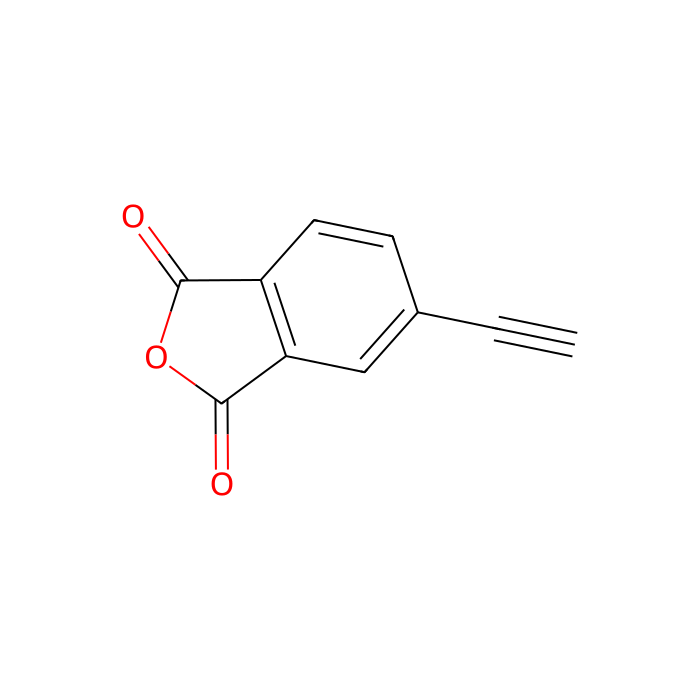
This compound belongs to the class of organic compounds known as phthalic anhydrides. These are compounds containing a phthalic anhydride moiety (or a derivative thereof), which consists of a benzene fused to a furan-1,3-dione.
External Descriptors
Not available
1. Djoumbou Feunang Y, Eisner R, Knox C, Chepelev L, Hastings J, Owen G, Fahy E, Steinbeck C, Subramanian S, Bolton E, Greiner R, and Wishart DS. ClassyFire: Automated Chemical Classification With A Comprehensive, Computable Taxonomy. Journal of Cheminformatics, 2016, 8:61.
Determine the necessary mass, volume, or concentration for preparing a solution.
Dilution Calculator
Determine the dilution needed to prepare a stock solution.
Reconstitution Calculator
レビュー
顧客レビュー
Application Protocols
No vendor-tested biological application protocols are provided for this item. For synthetic use, consider the generalized procedures outlined under Reaction Conditions for:
Aminolysis/Imidization to form imide derivatives
CuAAC ligations on the terminal alkyne under anhydrous conditions
Sonogashira couplings to elaborate the alkyne
For lot-specific handling or method notes (e.g., recommended solvents or drying), consult the CoA/Spec Sheet.
Biological Roles
This product is intended for chemical synthesis and materials research. It does not have intrinsic biological roles in cells or organisms.
General chemical/biochemical considerations (literature):
Hydrolysis: In aqueous environments, cyclic anhydrides hydrolyze to the corresponding dicarboxylic acids, which may participate in general acid–base chemistry but lack specific signaling functions.
Reactivity toward biomolecules: Anhydrides acylate nucleophilic residues (amines, alcohols) under suitable conditions; in biological matrices this nonspecific reactivity leads to protein modification and is typically undesirable unless deliberately harnessed in bioconjugation ex vivo.
Terminal alkyne handle: Commonly used as a bioorthogonal handle for azide–alkyne cycloadditions in chemical biology; however, because the anhydride is moisture-labile, derivatization is usually performed after converting to a more stable imide/ester prior to any biological context.
No medical, diagnostic, or therapeutic use is implied. For any bioorthogonal ligations or conjugations, implement rigorous purification to remove acidic/byproduct species and confirm absence of residual anhydride by IR/NMR.
Buffer Applications
Not typically applicable. 4-Ethynylphthalic anhydride is moisture-sensitive and reacts with water to form the corresponding diacid; it is not used to prepare aqueous buffer systems. If your workflow requires aqueous conditions, first convert the anhydride to a more stable derivative (e.g., imide or ester), or isolate the diacid and then consider buffering with standard systems (phosphate, HEPES, acetate) appropriate to your target pH.
Green Alternatives
While 4-ethynylphthalic anhydride is a specialized building block, greener choices can be made in solvent, reagent, and process design.
Solvent choices (literature/general):
Prefer ethyl acetate, 2-MeTHF, CPME, or propylene carbonate over chlorinated solvents when solubility and selectivity allow.
For couplings/click chemistry, MeCN or 2-MeTHF can substitute DMF/NMP in many cases, improving EHS profiles.
Process intensification:
Use solid-supported catalysts/ligands for CuAAC or Sonogashira to ease separation and reduce metal residues.
Flow chemistry under anhydrous conditions can minimize hold times and hydrolysis.
Reagent alternatives:
If anhydride hydrolysis is problematic, consider the corresponding diacid with dehydrative coupling agents (e.g., CDI) as a milder route to amides/esters; note trade-off in atom economy.
Organocatalytic dehydrations or azeotropic water removal reduce reliance on acetic anhydride/POCl3 for imidization.
Trade-offs (summary)
DCM vs EtOAc: DCM offers inertness and solvency but higher environmental impact; EtOAc is greener yet can slowly transesterify/ alcoholyze under basic conditions.
DMF/NMP vs MeCN/2-MeTHF: DMF/NMP provide superior solvency for polar intermediates but pose reproductive/biodegradability concerns; MeCN/2-MeTHF are greener but may require higher temperatures/longer times.
Greener workups: Use minimal aqueous processing to limit anhydride hydrolysis; employ non-aqueous quench or immediate conversion to imide to lock in structure.
Pharmaceutical Uses
No direct pharmaceutical or clinical use is claimed for this product. In a research and development context, related aryl anhydrides and imides may serve as:
Intermediates in synthesizing functionalized imides for materials (e.g., polyimides) or for exploratory medicinal chemistry scaffolds.
Handles for conjugation: The terminal alkyne can be used for CuAAC-based attachment of tags, linkers, or labels to small molecules or polymers after the anhydride has been transformed to a more stable motif (e.g., imide or amide) to withstand formulation conditions.
Probing excipient compatibility (R&D only): The reactive anhydride can assess nucleophile content in excipient streams via ring-opening tests, though it is not itself an excipient.
Regulatory status, pharmacopeial monographs, and excipient grades are not applicable to this specific item unless explicitly stated. For any use near GMP settings, ensure appropriate impurity control (residual metals, solvents, hydrolysis products) and consult internal quality systems; lot-specific specifications are available on the CoA by request.
Physical Properties
Item-specific specifications
Appearance: Not specified for this item; refer to CoA/Spec Sheet.
Grade/Purity: Not specified for this item; refer to CoA/Spec Sheet.
General/literature expectations (non-binding, for context only)
Physical state: Typically a crystalline solid for phthalic anhydride derivatives; color can range from off-white to light tan depending on impurity profile.
Hydrolysis: The anhydride ring hydrolyzes in moist air or water to the corresponding 4-ethynylphthalic acid; rate increases with heat/base.
Solubility profile: Low in water (anhydrides react to hydrolyze); soluble in common aprotic organic solvents such as dichloromethane (DCM), tetrahydrofuran (THF), acetone, acetonitrile, ethyl acetate, and aromatic solvents; limited solubility in alkanes.
Reactivity considerations: Terminal alkyne proton (pKa ~25, literature for generic terminal alkynes) can be deprotonated with strong bases (e.g., NaNH2) in anhydrous media. The anhydride carbonyls are strongly electrophilic toward amines/alcohols.
Partitioning/polarity: Moderately polar aromatic anhydride; expected to have moderate logP due to aromatic ring counterbalanced by two carbonyls (literature trend for aryl anhydrides).
Thermal behavior: Many aryl anhydrides melt in the 80–140 °C range (literature, class trend). Exact melting point/boiling point for this substance is not specified for this item.
For method development or handling limits (bp, mp, density, refractive index), please consult the lot-specific CoA or measure under your conditions.
Quality and Grades
Item-specific
Grade/Purity: Not specified for this item; refer to CoA/Spec Sheet.
What to expect from quality documentation
Lot-specific CoA typically includes assays for identity (NMR/IR), purity by HPLC/GC, and residual solvent. For moisture/reactive impurities in anhydrides, Karl Fischer may be provided.
Stabilizers: Not specified for this item. If present in a given lot, the CoA will disclose any stabilizer or inhibitor.
Interpreting common grades (general guidance)
Research grade: Suited for general synthesis and method development.
High-purity or HPLC grade (if offered): Tight cuts on non-volatile residue and low-UV background, advantageous for photochemical or analytical applications.
Electronic/polymer grade (if offered): Emphasis on trace metals/ions and particulates for materials applications.
Fit-for-purpose tips
For coupling/cycloaddition (“click”) chemistry or imide formation, prioritize low water content to suppress anhydride hydrolysis and Glaser-type side reactions of the alkyne.
Request current CoA for target specifications (water content, UV cutoff, metals) if your application is sensitive. If a specific value is not provided, it is not controlled for this item.
Reaction and Applications
4-Ethynylphthalic anhydride combines an activated cyclic anhydride with a terminal alkyne, offering orthogonal handles for diverse transformations and materials synthesis.
Key application families (literature/general):
Anhydride ring opening and imidization: Rapid acylation of amines yields amic acids, which cyclodehydrate to imides (thermal ≥150–200 °C or via acetic anhydride/imidazole). Useful for functional polyimides bearing pendant alkynes for post-curing or click modification.
Alcoholysis/aminolysis: Controlled formation of mono-esters or mono-amides using sub-stoichiometric nucleophile at low temperature; acylation is chemoselective toward more nucleophilic partners.
Click chemistry: The terminal alkyne enables Cu(I)-catalyzed azide–alkyne cycloaddition (CuAAC) to install 1,4-triazoles on preformed imides/esters, allowing modular ligation onto polymers or small molecules. Avoid water to protect the anhydride.
Metal-catalyzed couplings: Sonogashira coupling (Pd/Cu) extends the aryl–alkynyl motif; Glaser–Hay oxidative homocoupling forms diynes from the terminal alkyne (requires oxygen/Cu).
Cycloadditions and additions: Hydroboration, hydrosilylation, and Pauson–Khand chemistry at the alkyne; Diels–Alder reactivity at the anhydride core with suitable dienes is also documented for related anhydrides.
Practical tips:
Keep all operations anhydrous; brief exposure to moisture leads to diacid formation and reduced yields in coupling steps.
Sequence planning: Often ring-open/imidize first (robust imide), then perform CuAAC/Sonogashira on the alkyne to minimize hydrolysis risk.
Monitor by IR: Strong anhydride bands (~1850/1780 cm⁻¹, literature) disappear on ring opening; alkyne C≡C and C–H stretches (~2100–3300 cm⁻¹) track alkyne integrity.
Reaction Conditions
Typical conditions (literature/general guidance; optimize for your system):
Aminolysis to amic acid:
Solvent: Dry DCM, THF, MeCN, or EtOAc.
Temperature: 0–25 °C; exothermic. Add amine slowly to control heat.
Stoichiometry: 1.0–1.1 equiv anhydride per amine functionality; base (Et3N, 0–1 equiv) as needed to capture acid.
Imidization (cyclodehydration):
Thermal: 150–200 °C neat or in high-boiling aprotics (NMP, DMAc, m-cresol); hours to completion.
Chemical: Acetic anhydride (3–5 equiv) with catalytic imidazole, 80–120 °C; removes water as acetate.
CuAAC (azide–alkyne):
Catalyst: CuSO4 (1–5 mol%) + sodium ascorbate (reducing agent) to generate Cu(I), or preformed Cu(I) sources.
Solvent: Anhydrous t-BuOH/DMF/MeCN; minimize water to avoid anhydride hydrolysis.
Temp/time: 25–60 °C, 1–16 h. Add TBTA or THPTA ligands to stabilize Cu(I) when needed.
Sonogashira coupling:
Catalyst: Pd(PPh3)2Cl2 (1–3 mol%) + CuI (2–5 mol%).
Base: i-Pr2NH, Et3N, or K2CO3 (anhydrous).
Solvent: THF, toluene, or DMF (dry); 25–80 °C, 2–24 h.
Glaser–Hay coupling (diynes):
Catalyst: CuI/CuCl (5–10 mol%) with TMEDA under O2.
Solvent: THF or toluene (dry); 25–60 °C.
Monitoring: IR disappearance of anhydride bands and emergence of imide bands; 1H/13C NMR for alkyne chemical shifts; LC/MS for late-stage functionalizations.
Note: Values above are literature norms for the reaction classes; adapt to substrate sensitivity and scale.
Safety and Handling
GHS classification and statements
Signal word, H-statements, pictograms: Not specified for this item; refer to the SDS.
General hazards for aryl carboxylic anhydrides (literature/chemical class guidance)
Corrosive/irritant: Carboxylic anhydrides are corrosive to eyes/skin and cause respiratory irritation; they can be potent sensitizers in some cases.
Hydrolysis: Reacts with moisture to generate acidic species; avoid inhalation of dust/fumes and contact with wet skin.
Terminal alkyne: Flammable organic functionality; avoid ignition sources when handling dust or solvent slurries.
PPE and engineering controls (best practice)
Use in a chemical fume hood with local exhaust.
Wear safety glasses or splash goggles, lab coat, and appropriate chemical-resistant gloves (e.g., nitrile). For bulk handling, consider face shield and forearm protection.
Avoid breathing dust; use dust control and respiratory protection per risk assessment.
Incompatibilities and precautions
Avoid: Water, alcohols, amines, strong bases, and nucleophiles (will open the anhydride). Avoid strong oxidizers and strong reducing agents.
Dry, inert atmosphere handling recommended (argon or nitrogen); this product is supplied argon charged.
First aid (overview; defer to SDS)
Skin/eye contact: Immediate decontamination with copious water for ≥15 minutes; remove contaminated clothing.
Inhalation: Move to fresh air; support respiration; seek medical attention.
Ingestion: Rinse mouth; do not induce vomiting; seek medical attention.
Always consult the Aladdin SDS for authoritative hazard, exposure limits, and response procedures.
Solvent Selection
This compound is a moisture-sensitive aryl anhydride with a terminal alkyne. Solvent choice should protect the anhydride from hydrolysis while supporting the intended transformation.
Polarity and miscibility (general): Prefers dry, aprotic organic solvents. Good solubility in dichloromethane (DCM), chloroform, THF, acetone, acetonitrile, ethyl acetate, and aromatic solvents (toluene). Poor solubility in alkanes; reacts in aqueous media.
Base compatibility: For alkyne deprotonation or Sonogashira couplings, use dry amine bases (i-Pr2NH, Et3N) in DMF, DMAc, MeCN, THF, or toluene; strictly exclude water.
Imide formation/polyimide processing: High-boiling polar aprotics (NMP, DMAc) or aromatic solvents (o-xylene) enable solution imidization; azeotropic removal of water (Dean–Stark) when starting from the diacid.
Click chemistry: Mixed aqueous systems will hydrolyze the anhydride; prefer anhydrous t-BuOH/DMF/MeCN with Cu(I) sources and minimal adventitious water.
Comparison (general)
DCM vs EtOAc: DCM offers higher solubility and inertness; EtOAc is greener but can slowly alcoholyze anhydrides under base.
THF vs 2-MeTHF: 2-MeTHF provides greener profile and often similar solubility; both must be dry to protect the anhydride.
DMF/NMP: Excellent solvency for couplings/imidizations, but consider greener alternatives (MeCN, propylene carbonate, CPME) when feasible.
Storage and Reconstitution
Item-specific storage (from Product Data)
Store at room temperature under an inert atmosphere (argon charged). Keep container tightly closed. Shipped under normal conditions.
General handling guidance
Moisture protection: The anhydride is moisture sensitive; store in a desiccator or under dry inert gas. Open only in a dry box or quickly cap under argon/nitrogen.
Light/air: Normal laboratory lighting is acceptable; minimize prolonged air exposure to limit hydrolysis and oxidative processes at the alkyne.
Containers: Use amber glass with PTFE-lined caps. For long-term storage, consider subdivision into small aliquots to reduce headspace cycling.
Reconstitution/Preparation
This solid does not require “reconstitution” in the biophysical sense. To prepare solutions, dissolve in dry, aprotic solvents (e.g., DCM, THF, MeCN, toluene). Use molecular sieves or freshly dried solvents.
If a solution must be stored, keep under inert gas at low temperature and use within days to minimize hydrolysis.
If specific shelf-life, allowable water content, or stability-indicating assays are required, these are not specified for this item; refer to the current CoA/Spec Sheet and the SDS.
Storage: Room temperature, argon charged; shipped under normal conditions
Research use: For research use only
Identifiers
SMILES: Not specified for this item; refer to CoA/Spec Sheet.
InChIKey: Not specified for this item; refer to CoA/Spec Sheet.
Structure & functional groups (general/literature description)
Core scaffold: A benzene ring bearing a fused cyclic anhydride (phthalic anhydride) functionality.
Substitution pattern: A terminal ethynyl (–C≡CH) substituent at the 4-position of the aromatic ring relative to the anhydride bridge.
Functional groups: Cyclic carboxylic anhydride (highly electrophilic, hydrolytically sensitive), terminal alkyne (acidic sp C–H, engages in coupling/cycloaddition chemistry), and an aromatic ring.
2D description: A 5-membered anhydride ring fused to an ortho-dicarboxylate motif on benzene; at the para position to the anhydride bridge, a linear –C≡CH extends from the ring.
Empirical data (literature/computed, not item-specific)
Molecular formula (literature): C10H4O3
Molecular weight (literature): ~172.13 g/mol
Note: Where exact identifiers (SMILES, InChIKey) or spectroscopic details are required for your lot, consult the Aladdin CoA/Spec Sheet.
Synthetic Utility
4-Ethynylphthalic anhydride is a bifunctional synthon with orthogonal reactivity, enabling convergent routes to advanced intermediates and materials.
Strategic features (literature/general):
Electrophilic anhydride: Rapidly forms amic acids with amines; subsequent cyclodehydration gives imides. This enables installation of a robust imide core while preserving the alkyne for late-stage diversification.
Terminal alkyne: Amenable to CuAAC (azide partners), Sonogashira couplings (aryl/vinyl halides), hydrofunctionalizations (hydrosilylation, hydroboration), and oxidative couplings (Glaser–Hay). The acidic C(sp)–H also allows formation of metal acetylides for nucleophilic additions.
Aromatic ring: Further electrophilic aromatic substitutions can be tuned by the deactivating anhydride/imide; the ethynyl substituent can modulate electronics and provide a handle for extended conjugation.
Retrosynthetic logic:
Target imide–triazole motifs: Build the imide first from the anhydride and the desired amine, then perform CuAAC with the pendant terminal alkyne.
Extended π-systems: Employ Sonogashira to append aryl iodides/bromides, forming aryl–C≡C–aryl linkages while the anhydride remains intact under carefully controlled, anhydrous conditions.
Functional polymers: Copolymerize via dianhydride/diamine chemistry to polyimides featuring alkyne sites for post-polymer crosslinking or grafting (UV-cure via thiol–yne, or CuAAC with azido-additives).
Orthogonality: Sequence transformations to exploit the stability hierarchy: imide > ester/amide > anhydride in water; protect the anhydride or transform it early if aqueous steps are unavoidable.
Target Specificity
Not applicable. This product is a small-molecule building block (aryl anhydride with a terminal alkyne) and is not an antibody, enzyme, or biologic. No target, antigen, clone, or isotype information applies.
Products are supplied to verified businesses, institutions, and qualified professionals for research and development use only. Not for use in humans, animals, diagnosis, or therapy.

 L1829054