This compound belongs to the class of organic compounds known as pyridinecarboxylic acids. These are compounds containing a pyridine ring bearing a carboxylic acid group.
External Descriptors
Not available
1. Djoumbou Feunang Y, Eisner R, Knox C, Chepelev L, Hastings J, Owen G, Fahy E, Steinbeck C, Subramanian S, Bolton E, Greiner R, and Wishart DS. ClassyFire: Automated Chemical Classification With A Comprehensive, Computable Taxonomy. Journal of Cheminformatics, 2016, 8:61.
Determine the necessary mass, volume, or concentration for preparing a solution.
Dilution Calculator
Determine the dilution needed to prepare a stock solution.
Reconstitution Calculator
レビュー
顧客レビュー
Application Protocols
Not applicable. No antibody/assay protocols are associated with this chemical building block. For synthetic use, refer to the Reaction Conditions and Synthetic Utility sections for general literature guidance.
Biological Roles
Item-specific biological data: Not specified for this item; refer to primary literature if needed for particular assays.
General/biochemical context (literature):
Picolinic acid derivatives are common motifs in medicinal chemistry due to their capacity for hydrogen bonding, metal chelation, and tunable electronics; they serve as fragments or scaffolds in target discovery campaigns.
The 2‑picolinic acid framework can chelate metal ions via pyridine N and carboxylate O, a feature sometimes exploited in metalloenzyme probe design and coordination complexes for biochemical studies.
Halogen substitution (F, Cl) modulates lipophilicity, metabolic stability, and binding profiles in heteroaromatic systems; such substituents are often used to tune pKa and electronic distribution across the ring (general medicinal chemistry principle).
Note: No biological activity or clinical utility is claimed for this specific product. For research use only.
Buffer Applications
This compound is not a standard laboratory buffer component. As a heteroaromatic monocarboxylic acid, it lacks the defined buffering range and solubility characteristics desired for routine buffer systems.
Practical note:
If used, it would act as a weak buffer only near its carboxylic acid pKa (expected in the ~4.5–5.5 range for picolinic acids; literature), but low aqueous solubility at neutral pH and lack of established recipes make it unsuitable.
For pH control, choose established systems (acetate, MES, MOPS, phosphate) instead.
Green Alternatives
While the compound itself is a fixed building block, several greener choices can be made around its use.
Solvent and media choices (literature/general):
Replace DMF/NMP with greener polar aprotics where feasible: Cyrene, propylene carbonate, or ethyl acetate; or use ethanol/water with surfactant-enabled micellar catalysis for couplings.
Employ water or aqueous ethanol for SNAr with amines using carbonate bases; phase-transfer or micellar systems can enhance rates.
Coupling chemistry:
Suzuki–Miyaura in water/ethanol with Pd/C or supported Pd and green bases (K2CO3) under micellar conditions reduces solvent impact and simplifies workup.
Use organic bases like BTMG or DBU catalytically in greener solvents to limit inorganic waste.
Activation and derivatization:
Favor direct amide couplings with T3P (atom-economical byproduct) over carbodiimides when appropriate.
Consider decarboxylative couplings via electrochemistry or photoredox under mild conditions to avoid stoichiometric metal reagents.
Greener: ethanol/water or 2-MeTHF, supported Pd with bulky biaryl ligands, micellar catalysis, T3P or enzymatic esterifications.
Trade-offs: Greener solvents may reduce substrate solubility; modest heating or co-solvents can compensate. Ligand/catalyst optimization is often required to match yields achieved in legacy media.
Pharmaceutical Uses
Item-specific pharmacopeial/excipient status: Not specified for this item; refer to CoA/Spec Sheet.
General notes (non-clinical):
This material is best viewed as a heteroaryl building block/intermediate for research and process development in small-molecule synthesis.
Potential roles include incorporation into API candidates during SAR, linker or warhead installation via the carboxylic acid, and scaffold diversification via C–Cl coupling and C–F substitution (general medicinal chemistry practice).
No therapeutic or clinical claims are made. For research use only.
Physical Properties
Item-specific specifications: Not specified for this item; refer to CoA/Spec Sheet.
Literature/computed values (reference only; not Aladdin specifications):
Molecular formula (computed from name): C6H3ClFNO2
Molecular weight (calculated): ~175.54 g/mol
Acid functionality: monoprotic carboxylic acid; pKa for picolinic acid CO2H is typically ~5.4 (literature). Electron-withdrawing F/Cl substituents may modestly lower the pKa (qualitative expectation).
Expected solubility profile: polar aprotic solvents (DMSO, DMF, NMP) high; alcohols moderate; water low at neutral pH but high under basic conditions as the carboxylate salt (literature/general behavior of pyridine-2-carboxylic acids).
Volatility: non-volatile solid (literature expectation for heteroaromatic acids).
UV/Vis: heteroaromatic π→π* absorbance in the near-UV; exact cutoff not specified for this item.
Note: Exact melting point, boiling point, density, refractive index, and solubility constants are not provided for this SKU.
Quality and Grades
Item-specific grade/purity: Not specified for this item; refer to CoA/Spec Sheet.
Discussion of typical grades for heteroaromatic building blocks (general):
Research grade: suitable for general synthesis and screening workflows; may not include low-metal or low-UV certification.
High-purity/99%+ grade: reduces impurity background in SAR and process development; beneficial when impurities interfere with cross-couplings or amide formations.
Low-water/anhydrous offerings (when applicable): useful to avoid hydrolysis during acid chloride formation or moisture-sensitive couplings.
Stabilizers: None indicated in Product Data. If present in a specific lot, the CoA will specify.
What to check on receipt:
Identity (HNMR/LC–MS match to expected), assay/purity by HPLC/GC, and residual solvent profile.
Halide content confirmation (for 6‑Cl) and fluorine position (3‑F) by NMR (19F, 13C) or HRMS as appropriate.
Documentation: For assay, trace metals, residual solvents, and detailed impurity profile, consult the lot-specific CoA/Specification Sheet.
Reaction and Applications
As a doubly halogenated picolinic acid, this molecule is a versatile heteroaryl building block enabling orthogonal functionalization.
Orthogonal halogen handles:
C–Cl at C‑6 is amenable to Pd-catalyzed cross-couplings (Suzuki–Miyaura, Buchwald–Hartwig amination, Negishi, Stille, Sonogashira). The aryl chloride typically couples under modern ligand sets (e.g., XPhos, SPhos, BrettPhos) with suitable bases.
C–F at C‑3 can participate in nucleophilic aromatic substitution (SNAr) with amines, thiols, or alkoxides under basic conditions, aided by the ring N and the ortho carboxyl as activating groups.
Carboxylic acid handle:
Standard amide coupling to furnish 2‑carboxamide analogs (HATU/HBTU/EDCI/T3P with DIPEA or similar).
Conversion to acid chloride (SOCl2 or oxalyl chloride) for acylation chemistry (esterification, Friedel–Crafts acylation of activated arenes).
Decarboxylative transformations: via in situ NHPI redox-active esters or electrochemical protocols to forge C–C, C–N, and C–S bonds at C‑2 (literature).
Ligand/chelation features:
The picolinic motif (ring N + carbonyl O) supports bidentate chelation; derivatives are useful as directing groups or ligands in catalysis (general literature role).
Applications in discovery chemistry (general):
Rapid generation of 3,6-disubstituted 2‑picolinamide libraries by selective coupling at C‑6 followed by SNAr at C‑3 (or vice versa), enabling SAR scans of heteroaryl fragments.
Practical tips:
Sequence planning: perform Pd-catalyzed coupling at C‑6 first (to avoid amine-induced Pd poisoning), then SNAr at C‑3 with excess nucleophile; protect the acid as a methyl/tert‑butyl ester if required for base-sensitive steps.
Reaction Conditions
General literature guidance for analogous substrates; optimize per substrate and scale. These are not specifications for this item.
Tip: Add TBAB or micellar media (TPGS-750-M) for greener conditions.
Buchwald–Hartwig amination at C‑6:
Catalyst/ligand: Pd2(dba)3 (1 mol%) with XPhos/BrettPhos (2–3 mol%).
Base: NaOtBu or Cs2CO3 (2 equiv).
Solvent: toluene or dioxane; 80–110 °C.
SNAr at C‑3 (displace F):
Nucleophile: amines/thiols; Base: K2CO3, Cs2CO3, or DBU (1.5–2 equiv).
Solvent: DMSO or DMF; 60–120 °C; 2–18 h. Water/ethanol with PTC or micelles possible.
Amide coupling (CO2H → CONR2):
Reagents: HATU or EDCI/HOBt (or Oxyma)/DIPEA; 0–25 °C to RT, 1–12 h.
Greener option: T3P in EtOAc or 2-MeTHF; mild heating if needed.
Acid chloride formation:
SOCl2 (3–5 equiv) with DMF catalytic; reflux 1–3 h; solvent removal under reduced pressure followed by use in situ.
Decarboxylative coupling (via NHPI ester):
Photoredox/Ni dual catalysis, blue LEDs, DMAc or MeCN, 25–40 °C; coupling partners: aryl/alkyl zincs, boronates (with additive); consult specific literature for loadings.
Reported yields across these classes typically range from moderate to high (50–90%) after optimization on related substrates.
Safety and Handling
GHS/Signal word/pictograms for this specific item: Not specified for this item; refer to the product SDS for authoritative hazard classification.
General hazards for halogenated heteroaromatic acids (literature/general):
May cause skin/eye irritation and respiratory tract irritation. Avoid dust generation and inhalation.
Carboxylic acids can be corrosive to some metals when moist (via acidity); avoid contact with reactive metals and strong bases/acids unless intended.
Incompatibilities (general): strong oxidizers or strong bases (can cause exothermic neutralization); reagents forming acid chlorides (e.g., SOCl2, oxalyl chloride) will react.
PPE recommendations (good laboratory practice): lab coat, safety glasses or splash goggles, appropriate chemically resistant gloves (e.g., nitrile), and use in a fume hood to minimize inhalation of dust.
First-aid overview (general guidance):
Inhalation: move to fresh air; seek medical attention if symptoms persist.
Skin contact: wash with soap and water; remove contaminated clothing.
Eye contact: rinse cautiously with water for several minutes; seek medical attention if irritation persists.
Ingestion: rinse mouth; do not induce vomiting; seek medical attention.
Spill/cleanup: avoid dust; sweep up with minimal dust generation and place in appropriate waste.
Always consult the SDS for this SKU for definitive hazard statements, exposure limits, and transport classification.
Solvent Selection
This compound is a polar, heteroaromatic carboxylic acid solid. Solubility and reaction media choice strongly influence performance in couplings and substitutions.
Moderately soluble: methanol, ethanol, acetonitrile, acetone, ethyl acetate (often improved by mild heating or base).
Low at neutral pH: water; readily soluble as the carboxylate in basic aqueous media (e.g., Na2CO3, NaOH).
Polarity and behavior:
Contains a basic heteroaromatic N (weak base) and an acidic CO2H. In aprotic solvents, remains largely as neutral acid; in presence of base, forms carboxylate salts with enhanced aqueous solubility.
Selection by transformation:
Amide couplings: DMF, NMP, or DCM (via acid chloride) are typical; add base (DIPEA) as needed.
Cross-couplings at C–Cl: polar aprotic solvents (dioxane, toluene with co-solvent DMF) under Pd catalysis.
SNAr at C–F: DMSO/DMF with amine nucleophiles and base; aqueous ethanol or water/THF possible under phase-transfer or micellar conditions.
Small comparison (literature):
DMSO vs DMF: DMSO dissolves salts better; DMF easier to remove. For high-throughput or LC-MS compatibility, ACN/DMSO mixtures are common.
Drying/conditioning:
For moisture-sensitive steps (acid chloride formation, C–N couplings), dry solvents (molecular sieves) are recommended.
Storage and Reconstitution
Item-specific storage and shipping:
Storage Conditions: Room temperature, Argon charged (as provided). Keep container tightly closed under an inert atmosphere.
Shipped In: Normal.
General handling recommendations:
Store dry and protect from moisture to preserve purity and prevent hydrolysis during long-term storage.
If frequent access is expected, consider subdividing into aliquots under inert gas to minimize air/moisture exposure.
Reconstitution and stock solutions (general guidance for small-molecule solids):
Prepare concentrated stocks in dry DMSO or DMF (e.g., 10–100 mM) for screening or parallel synthesis. Filter if particulates are present (0.2 µm PTFE).
For aqueous work, dissolve under basic conditions to form the carboxylate salt, then adjust pH if needed.
Avoid repeated freeze–thaw of solutions; store working solutions in tightly sealed vials at 2–8 °C or −20 °C depending on solvent stability. Label with preparation date and solvent.
Stability notes:
No stabilizer information is provided for this item; refer to CoA/SDS for any lot-specific notes. Inspect periodically for discoloration or precipitation before use.
Structure and Identity
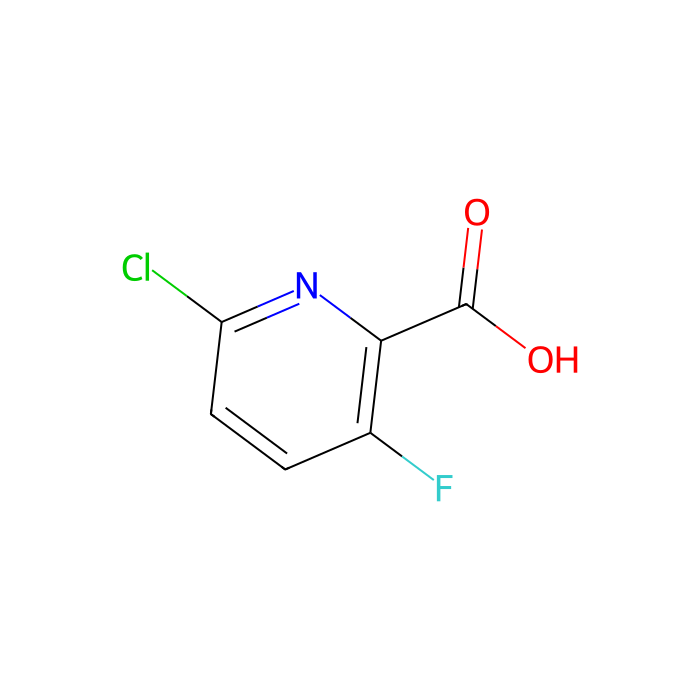
A halogenated, heteroaromatic carboxylic acid derived from picolinic acid (pyridine‑2‑carboxylic acid) bearing chlorine at C‑6 and fluorine at C‑3.
Item-specific identifiers (from Product Data):
CAS: 884494-76-2
CID: 44754787
InChIKey: 436477 (as provided; appears truncated; full key not specified)
SMILES: Not specified for this item; refer to CoA/Spec Sheet.
A six-membered aromatic ring containing one ring nitrogen at position 1. The carboxyl group (–C(=O)OH) is attached at C‑2 (ortho to N). A fluorine is attached at C‑3 (adjacent to the carboxyl), and a chlorine is attached at C‑6 (para to C‑3 and ortho to the ring nitrogen).
Synthetic Utility
Functional handles and reactivity:
Carboxylic acid at C‑2: enables amide/ester formation, activation to acid chloride or mixed anhydrides, and modern decarboxylative couplings (radical or electrochemical) at C‑2.
Aryl chloride at C‑6: competent in Pd-catalyzed C–C (Suzuki/Negishi/Stille), C–N (Buchwald–Hartwig), and C–O (Ullmann-type with Cu) couplings under optimized ligands.
Aryl fluoride at C‑3: activated toward SNAr with amines/thiols/alkoxides given the heteroaromatic N and ortho-CO2H.
Strategy and selectivity:
Orthogonal derivatization allows stepwise diversification. Typical order: (1) Pd-catalyzed coupling at C‑6; (2) SNAr displacement at C‑3; (3) carboxylate derivatization. Protecting the acid as a methyl/tert‑butyl ester can simplify steps 1–2.
Regiochemical verification by 19F NMR and HMBC is recommended after SNAr.
Transformations (literature examples/guidance):
Suzuki at C‑6 with aryl/heteroaryl boronates to access 6‑aryl picolinates.
Buchwald–Hartwig amination at C‑6 with primary/secondary amines (XPhos/SPhos systems).
SNAr at C‑3 using amines (Na2CO3, K3PO4, or DBU) in DMSO/DMF, 60–120 °C.
Acid to amide using HATU/DIPEA in DMF or T3P in EtOAc/EtOH for greener profiles.
Formation of N‑hydroxyphthalimide (NHPI) ester, followed by photoredox/Ni dual catalysis for decarboxylative arylation/alkylation at C‑2.
Target Specificity
Not applicable. This product is a small-molecule building block, not a biological targeting reagent. No antigen/epitope, clone, isotype, or species reactivity information applies.
We use cookies to ensure the website functions properly and, where permitted, to improve your experience. You can manage your preferences at any time in Settings. Learn more in our Cookie Policy.
Shall we send you a message when we have discounts available?
Remind me later
Thank you! Please check your email inbox to confirm.
Products are supplied to verified businesses, institutions, and qualified professionals for research and development use only. Not for use in humans, animals, diagnosis, or therapy.

 K2520143