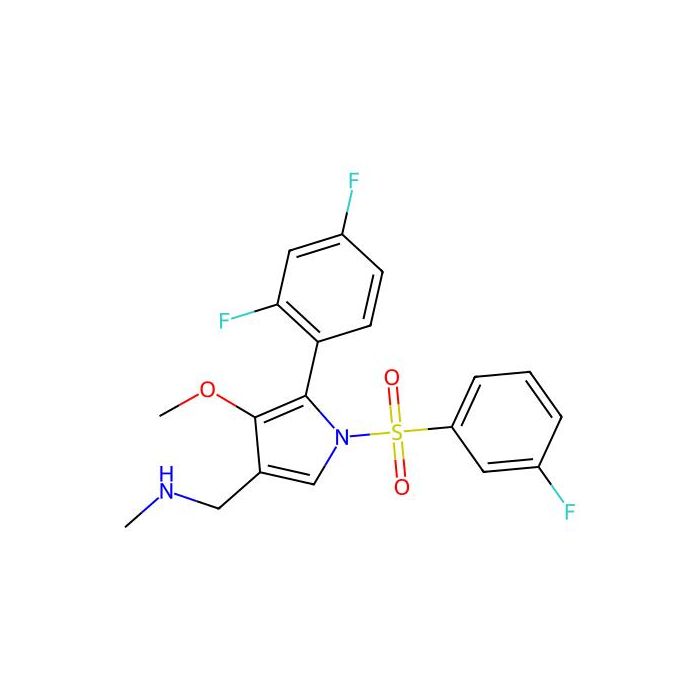
Abeprazan (DWP14012) is a potassium-competitive acid blocker. Abeprazan inhibits H + , K + - ATPase by reversible potassium-competitive ionic binding with no acid activation required. Abeprazan is developed as a potential alternative to proton pump inhibitor for the treatment of acid-related diseases.
In Vitro
The mechanism of action of Abeprazan is reversibly binding to H + , K + ‐ATPase, and, unlike that of PPIs, does not require acidic environment for drug activation. MCE has not independently confirmed the accuracy of these methods. They are for reference only.
In Vivo
Abeprazan inhibits acid secretion in a dose-dependent manner and the inhibition of gastric acid secretion was equal to or greater than that of vonoprazan, a previously approved P-CAB, in various in vivo studies using pylorus-ligated rats, lumen-perfused rat models and heidenhain pouch dog models . MCE has not independently confirmed the accuracy of these methods. They are for reference only.
Abeprazan (DWP14012) is a potassium-competitive acid blocker. Abeprazan inhibits H + , K + - ATPase by reversible potassium-competitive ionic binding with no acid activation required. Abeprazan is developed as a potential alternative to proton pump inhibi
This compound belongs to the class of organic compounds known as phenylpyrroles. These are polycyclic aromatic compounds containing a benzene ring linked to a pyrrole ring through a CC or CN bond.
External Descriptors
Not available
1. Djoumbou Feunang Y, Eisner R, Knox C, Chepelev L, Hastings J, Owen G, Fahy E, Steinbeck C, Subramanian S, Bolton E, Greiner R, and Wishart DS. ClassyFire: Automated Chemical Classification With A Comprehensive, Computable Taxonomy. Journal of Cheminformatics, 2016, 8:61.
Products are supplied to verified businesses, institutions, and qualified professionals for research and development use only. Not for use in humans, animals, diagnosis, or therapy.