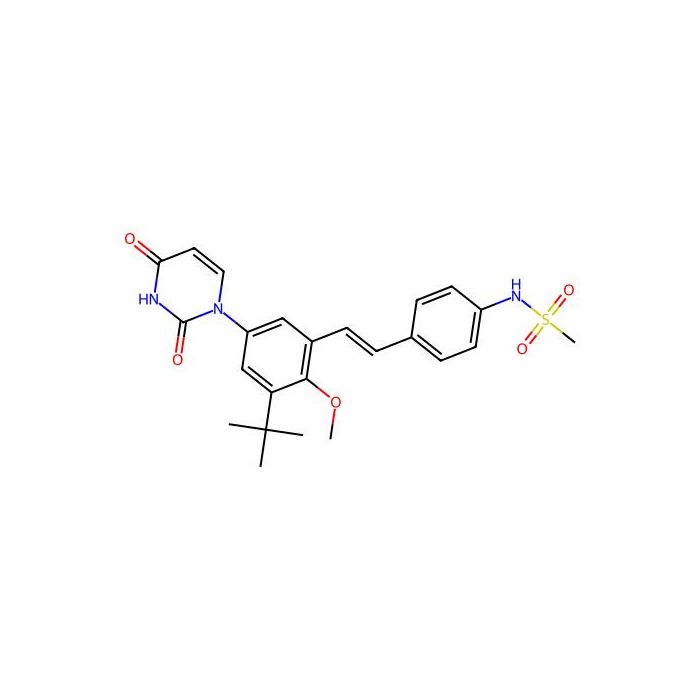
ABT-072 is an orally active and potent non-nucleoside HCV NS5B polymerase inhibitor (HCV GT1a EC 50 =1 nM; HCV GT1b EC 50 =0.3 nM)
In Vitro
ABT-072 is a non-nucleoside NS5B polymerase inhibitor with nanomolar potency in vitro against genotype 1a and 1b hepatitis C virus polymerases. MCE has not independently confirmed the accuracy of these methods. They are for reference only.
In Vivo
ABT-072 (5 and/or 30 mg/kg; i.v. or p.o.) shows good PK properties. ABT-072 (2.5 and/or 30 mg/kg; i.v. or p.o.) shows low plasma clearance and high oral bioavailability. MCE has not independently confirmed the accuracy of these methods. They are for reference only. Animal Model: RatsDosage: 5 and/or 30 mg/kg (Pharmacokinetic Analysis) Administration: I.v. or p.o. Result: Showed good PK properties. Animal Model: DogDosage: 2.5 or 30 mg/kg (Pharmacokinetic Analysis) Administration: I.v. or p.o. Result: Showed low plasma clearance and high oral bioavailability.
IC50& Target:NS5B polymerase
仕様
仕様と純度
10mM in DMSO
生化学的・生理学的メカニズム
ABT-072 is an orally active and potent non-nucleoside HCV NS5B polymerase inhibitor (HCV GT1a EC 50 =1 nM; HCV GT1b EC 50 =0.3 nM).
保管条件
Store at -80°C
入荷
Dry ice packs + Cold packs
この製品は冷冷この冷このこの製品の運送が必要です。地上およびその他の経済サービスは利用できません。
アクションタイプ
INHIBITOR
作用メカニズム
Hepatitis C virus NS5B RNA-dependent RNA polymerase inhibitor
Determine the necessary mass, volume, or concentration for preparing a solution.
Dilution Calculator
Determine the dilution needed to prepare a stock solution.
Reconstitution Calculator
レビュー
顧客レビュー
Application Protocols
No vendor-validated application protocols are provided for this item.
General starting points for small-molecule tool compounds
Stock preparation: Prepare a 10–50 mM stock in anhydrous DMSO under dry conditions. Filter through a 0.22 μm PTFE membrane if particulate is observed. Record exact concentration by gravimetry or qNMR.
Aliquoting: Dispense into single-use, low-bind vials or 96/384-well plates; flush with inert gas if feasible; store at deep-freeze.
Enzymatic assays: Titrate across a broad concentration range (e.g., 11-point, 3-fold serial dilutions) to capture full dose–response; include vehicle controls.
Cell-based assays: Verify cytotoxicity of vehicle and compound separately; check for precipitation by visual inspection or light-scattering where possible.
LC–MS analysis: Optimize ionization mode (ESI+/ESI−) empirically; begin with 0.1% formic acid in water/acetonitrile. Monitor for in-source fragmentation and adducts.
Please adapt to your SOPs and consult the SDS and CoA/Spec Sheet for any item-specific constraints.
Biological Roles
Item-specific biological claims are not provided with this listing; use strictly for research applications.
Literature context (for background only; not a product specification or claim)
ABT-072 has been reported in the medicinal chemistry literature as a small-molecule inhibitor investigated against hepatitis C virus (HCV) RNA-dependent RNA polymerase (NS5B). Such compounds are typically categorized as non-nucleoside inhibitors that bind allosteric sites of NS5B and modulate polymerase function. Researchers have used related molecules to probe viral replication mechanisms and to develop structure–activity relationships (SAR) around allosteric binding pockets.
Practical research considerations
When used as a tool compound in enzyme or replicon assays, ensure accurate compound quantitation (qNMR or LC–MS) and confirm target engagement via orthogonal readouts where possible.
Implement selectivity profiling (across related viral polymerases or human off-targets) to contextualize observed phenotypes; results are highly assay- and series-dependent and should not be generalized without direct data.
Important note
No medical, diagnostic, or therapeutic use is intended or implied. Any biological activity mentioned above is provided as literature background and must be verified experimentally under your conditions.
Buffer Applications
This item is not a buffering agent and does not constitute a defined buffer system.
Practical notes for assay buffers (general guidance)
When preparing assay solutions containing hydrophobic small molecules, select a buffer (e.g., HEPES, Tris, phosphate) appropriate for the biological target and maintain a low final percentage of organic cosolvent (commonly ≤1% DMSO).
To reduce compound adsorption and precipitation, consider adding low levels of non-ionic surfactant (e.g., 0.01–0.05% Tween 20) if compatible with the assay, and pre-wet plasticware.
Confirm compound stability across relevant pH and ionic strengths, as hydrolysis or aggregation can be pH-dependent for many scaffolds.
Green Alternatives
Given ABT-072 is a research tool compound rather than a process solvent or bulk reagent, green chemistry considerations primarily concern solvent choice and sample handling rather than substituting the compound itself.
Greener practice suggestions (general)
Prefer lower-toxicity, lower-HAP solvents where possible for work-up and analytics (e.g., ethanol or isopropanol over chlorinated solvents) while acknowledging solubility constraints.
Minimize DMSO volumes in biological assays by using concentrated stocks and low final vehicle percentages (<1%), reducing solvent burden.
Employ microscale assays and miniaturized LC (UHPLC) to cut solvent consumption.
Use aqueous mobile phases with volatile buffers (e.g., ammonium formate/acetate) instead of non-volatile salts to reduce waste impact and facilitate solvent recycling.
Implement closed-vial thaw/weigh workflows and cold blocks to reduce losses and rework.
Trade-offs
While greener alcohols are preferable to DMF/NMP from a safety perspective, they may not dissolve highly lipophilic compounds as effectively. Validate solubility and assay performance when substituting solvents.
Waste and lifecycle
Segregate halogenated from non-halogenated waste streams to enable appropriate treatment.
For solid waste (weigh boats, pipette tips), use minimal consumables and consider solvent-rinsing to recover material before disposal when compliant with your safety protocols.
Pharmaceutical Uses
No excipient or pharmacopeial status is provided for this item; it is supplied strictly for laboratory research use only.
Research/formulation context (general guidance)
Tool compounds like ABT-072 are often prepared as DMSO stock solutions (e.g., 10–50 mM) for screening and stored as single-use aliquots at deep-freeze temperatures.
For in vitro ADME studies (e.g., microsomal stability, plasma protein binding, permeability), prepare solutions in assay-compatible vehicles and verify solubility and stability under the test conditions.
If salt formation or solid-form screening is pursued for pre-formulation research, document the exact counter-ion and stoichiometry; such attributes can markedly affect solubility and stability but are not specified for this item.
Compliance note
Not for use in humans or animals. Not produced to GMP standards; no claims are made regarding clinical suitability or regulatory monographs.
Physical Properties
Item-specific specifications
Appearance: Not specified for this item; refer to CoA/Spec Sheet.
Melting point: Not specified for this item; refer to CoA/Spec Sheet.
Boiling point: Not specified for this item; refer to CoA/Spec Sheet.
Density: Not specified for this item; refer to CoA/Spec Sheet.
Refractive index: Not specified for this item; refer to CoA/Spec Sheet.
pKa/logP: Not specified for this item; refer to CoA/Spec Sheet.
UV-Vis characteristics: Not specified for this item; refer to CoA/Spec Sheet.
Solubility: Not specified for this item; refer to CoA/Spec Sheet.
General guidance (literature/practice; not item-specific)
Small-molecule screening compounds similar to ABT-072 are commonly supplied as solids with good solubility in high-boiling polar aprotic solvents such as DMSO; aqueous solubility typically depends on ionizable functionality. Verify your lot’s solubility experimentally.
If preparing analytical standards, determine extinction coefficients and chromatographic retention empirically under your method to avoid assuming literature properties.
Practical notes
For pre-formulation or assay use, establish a solvent compatibility matrix (e.g., DMSO, DMF, acetonitrile, methanol, buffers) and record any precipitation upon dilution into aqueous media.
Always rely on the CoA/Spec Sheet for any property needed as a specification in QC or method validation.
Quality and Grades
Item-specific status
Grade/Purity: Not specified for this item; refer to CoA/Spec Sheet.
How to interpret grade (general guidance)
Research-grade small molecules are typically qualified by identity (NMR/MS/HRMS), purity by HPLC/UPLC (area%), and residual solvent limits. Where applicable, water content (Karl Fischer) and counter-ion/stoichiometry are reported. Always confirm the acceptance criteria on the CoA for your specific lot.
Stabilizers and form
Stabilizer: Not specified for this item; refer to CoA/Spec Sheet.
Appearance and solid form (free base vs. salt, polymorph): Not specified for this item; refer to CoA/Spec Sheet. These factors can influence solubility, hygroscopicity, and handling.
Analytical verification recommendations
Identity: Verify by LC–MS (accurate mass) and 1H NMR in a deuterated solvent suitable for the compound’s solubility.
Purity: Check by gradient RP-HPLC with dual-wavelength detection; note any late-eluting non-UV impurities.
Stability: Perform a short-term isothermal stability study at ambient and refrigerated conditions in the intended formulation solvent (e.g., DMSO) to establish working solution shelf-life for assays.
Documentation
For regulated work or method validation, request full analytical package (chromatograms, spectra) corresponding to your lot.
Reaction and Applications
This product is offered as a small-molecule research compound (library member/reference standard) rather than as a synthetic reagent or catalyst.
Research usage (general guidance)
Biochemical/biophysical assays: Commonly used to generate dose–response curves, determine IC50/EC50 values, or serve as a control compound in target-centric enzyme or binding assays. Prepare accurately quantified stock solutions (gravimetric or qNMR) to minimize potency error.
Cell-based studies: May be applied as a tool compound to interrogate pathway modulation. Optimize vehicle (e.g., DMSO) and monitor solubility/precipitation upon media addition. Include vehicle controls and solubility checks (light scattering or visual).
Analytical reference: Useful as a system suitability or retention marker in LC–MS method development for related chemical series; can support metabolite ID or stability-indicating method design.
Not typically applicable
Named organic reactions, catalysis, or stoichiometric transformations are not typical applications for this item. For those needs, consult our catalog of reagents and catalysts.
Practical tips
Establish a compound management workflow: controlled thaw, rapid weighing in low-humidity conditions, preparation of single-use aliquots, and immediate return to deep-freeze to limit freeze–thaw cycles.
Record exact lot identifiers and preparation details (solvent, concentration, date) to ensure reproducibility across experiments and screens.
Reaction Conditions
Not typically applicable. ABT-072 is supplied as a research compound rather than a reagent or catalyst; there are no standard “reaction conditions” associated with its use.
General laboratory handling (applicable to solution preparation)
Dissolution: Start with an anhydrous organic solvent such as DMSO; warm gently (ambient to 37°C) and sonicate if needed. Avoid prolonged heating.
Dilution into assay media: Add organic stock slowly to vigorously mixed aqueous buffer to minimize precipitation; maintain low final organic content.
Stability checks: Use short pilot studies (e.g., LC–MS at 0, 4, 24 h) to assess chemical stability in your intended solvent and temperature.
If synthetic modification is intended, consult primary literature on the compound’s scaffold for condition-specific guidance after confirming the exact structure.
Safety and Handling
Authoritative safety source: Always consult the product’s SDS for definitive hazard classification and first-aid measures.
GHS/label information (item-specific)
Signal word: Not specified for this item; refer to SDS.
Hazard statements (H-phrases): Not specified for this item; refer to SDS.
GHS classification/pictograms: Not specified for this item; refer to SDS.
Good laboratory practice (general guidance)
PPE: Wear lab coat, appropriate chemical-resistant gloves, and safety glasses or splash goggles. Handle powders in a fume hood to minimize inhalation of particulates.
Avoid: Inhalation, ingestion, and skin/eye contact. Prevent dust generation and aerosol formation during weighing and transfers.
Storage incompatibilities: Keep separate from strong oxidizers and strong acids/bases unless compatibility is known; avoid moisture exposure until formulation/solution preparation.
First aid (overview): In case of skin or eye contact, rinse with water for at least 15 minutes; remove contaminated clothing. If inhaled, move to fresh air. If ingested or upon significant exposure, seek medical attention. Show SDS to the physician.
Spill response: For small spills, absorb with inert material, collect in suitable container for disposal, and decontaminate area. For powders, gently dampen to avoid dust before cleanup.
Waste disposal: Dispose of in accordance with institutional and local regulations for organic laboratory chemicals; do not discharge to drains.
Special notes
Shipment/receipt: Shipped on dry ice and cold packs; allow controlled warming to recommended storage to avoid condensation and thermal shocks.
Research use only: Not for human or animal therapeutic use.
Solvent Selection
Item-specific solubility is not provided for this listing; confirm with small-scale tests and the CoA/Spec Sheet.
General solvent guidance for screening compounds
Primary stock solvent: DMSO is typically preferred for hydrophobic discovery compounds due to broad solvating power and compatibility with biological assays at low final DMSO percentages.
Secondary solvents: DMF, NMP, acetonitrile, methanol, ethanol, and isopropanol are common. If the compound contains ionizable groups, aqueous buffers adjusted to appropriate pH may enhance solubility once diluted from an organic stock.
Aqueous dilution: To reduce precipitation on dilution, add compound-in-DMSO stocks into vigorously mixing buffer, targeting ≤0.5–1.0% final DMSO (v/v) where assay-tolerated.
Chromatography: For analytical LC, reversed-phase systems (C18) with water/acetonitrile or water/methanol plus 0.1% formic acid or ammonium acetate are typical starting points. Adjust pH and organic composition to manage retention and peak shape.
Selection considerations
If high lipophilicity is suspected, prioritize DMSO, DMF, or NMP for stock solutions; screen for precipitation upon cooling or prolonged storage.
For salt forms, solubility and pH stability may differ from the free base/acid; document the exact form on the vial and in LIMS.
Small comparison (general)
DMSO: maximum solvency; assay-compatible at low %; hygroscopic, oxidizes slowly—use fresh, dry solvent.
MeOH/EtOH: greener, volatile; limited capacity for very hydrophobic scaffolds; better for analytical sample prep where volatility is desired.
Storage and Reconstitution
Item-specific storage and shipping
Storage conditions: Store at −80°C (per product data).
Shipping: Shipped on dry ice packs + cold packs to maintain frozen/cold chain.
Handling upon receipt
Inspect packaging integrity and confirm the item remains frozen. Record lot number and receipt date.
Equilibrate briefly to a cold, dry environment before opening to prevent condensation on the solid.
Reconstitution (general guidance; not item-specific specs)
Solvent: Use anhydrous DMSO as a primary stock solvent unless your internal data indicate superior solubility elsewhere. Start at 10–50 mM.
Technique: Weigh quickly in a low-humidity environment; dissolve with gentle vortexing and, if needed, brief sonication. Avoid heating above ambient–37°C.
Aliquoting: Prepare single-use aliquots in low-bind tubes or plates; minimize headspace, optionally blanket with inert gas. Label with concentration, solvent, date.
Storage of solutions
Store aliquots at −80°C. Avoid repeated freeze–thaw; thaw once, use immediately, and discard leftovers.
Conduct a short-term stability assessment (e.g., LC–MS after 1–2 freeze–thaw cycles and after defined bench times) to establish working practices.
Expiry and documentation
Follow any lot-specific retest/expiry guidance on the CoA/Spec Sheet. Maintain full chain-of-custody and preparation records in your LIMS.
Research use only
For research use only. Not for human or animal therapeutic use.
Structure and Identity
Product name: ABT-072 (SKU: A656133)
CAS: 1132936-00-5
PubChem CID: 57775240
InChIKey: Not specified for this item; refer to CoA/Spec Sheet.
SMILES: Not specified for this item; refer to CoA/Spec Sheet.
Molecular formula: Not specified for this item; refer to CoA/Spec Sheet.
Molecular weight: Not specified for this item; refer to CoA/Spec Sheet.
Structural description
Item-specific structural features: Not specified for this item; refer to CoA/Spec Sheet.
General note (literature): ABT-072 is described in the medicinal chemistry literature as a small-molecule antiviral research compound developed in the HCV space. Detailed functional groups, ring systems, and stereochemistry should be confirmed from primary references or the CoA/Spec Sheet.
Identification guidance
Use the CAS and CID above for cross-referencing in databases and for sourcing spectral data (NMR, MS) from literature. Always verify against the certificate of analysis (CoA) accompanying your lot.
Synthetic Utility
This product is provided as a finished small-molecule research compound and is not typically employed as a synthetic building block or reagent.
General considerations
If derivatization is desired for SAR or probe development, standard late-stage functionalization strategies (e.g., amide coupling, heteroaryl cross-coupling, or selective halogenation/oxidation) would depend entirely on the functional groups present in the scaffold, which are not specified for this item. Consult the CoA/Spec Sheet or primary literature for the exact structure before planning transformations.
For analytical method development, ABT-072 may serve as a reference analyte to optimize LC–MS parameters (ionization mode, source conditions, collision energies) for related series.
Recommendation
For projects requiring synthetic precursors or analog-friendly scaffolds, consider sourcing the corresponding building blocks or intermediates from our reagents catalog, where structures and functional handles are explicitly defined.
Target Specificity
Item-specific target, epitope, clone/isotype, or species reactivity data are not applicable to this small-molecule product and are not provided for this item.
Note
If used as a tool compound in target-based assays, any selectivity or off-target profiling must be established experimentally under your conditions. No target specificity data are specified for this catalog item.
よくある質問
How should this product be stored?
Store at ?80 °C. Ultra-low temperature storage is required to maintain the specified shelf life.
How is this product shipped?
This product ships frozen with dry ice and cold packs. Unpack on arrival and transfer it to the storage condition stated above; handle dry ice with insulated gloves in a ventilated area.
What are the CAS number, molecular formula and molecular weight?
The CAS Number is 1132936-00-5, the molecular formula is C24H27N3O5S, and the molecular weight is 469.55 g/mol.
What documentation is provided?
Available product documentation, including Certificates of Analysis (COA), Safety Data Sheets (SDS), and specification sheets, is shown in the product document area. Document availability and access follow the current site policy.
Products are supplied to verified businesses, institutions, and qualified professionals for research and development use only. Not for use in humans, animals, diagnosis, or therapy.