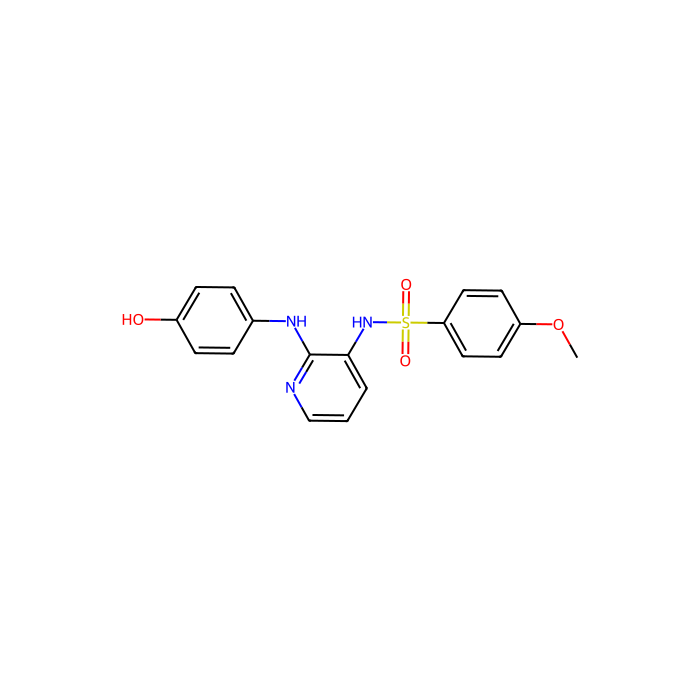
ABT-751 (E7010) - 10mM in DMSO , Tubulin beta inhibitor, CAS No.141430-65-1, Tubulin beta inhibitor

CAS: 141430-65-1 Cat. No.: A407784 分子式: C18H17N3O4S 分子量: 371.41 EC番号: 689-192-0
注文可能
グレード&純度 10mM in DMSO
Synonyms
N-(2-(4-hydroxyphenylamino)pyridin-3-yl)-4-methoxybenzenesulfonamide
Storage
Store at -80°C
Shipped In
Dry ice packs + Cold packs
★
サイズ
USA
ドイツ (EU)*
価格
個数
1ml
A407784-1ml
2 在庫あり
—

$125.90

$147.90
保存 $22.00 (14.87%)
Enter a quantity for the sizes you want to add.

概要

Information

ABT-751 (E7010) ABT-751 (E7010) binds to the colchicine site on β-tubulin and inhibits polymerization of microtubules, not a substrate for the MDR transporter and is active against cell lines resistant to vincristine, doxorubicin, and cisplatin. Phase 1
In vitro

In vitro, ABT-751 shows the selective cytotoxicity with IC50 of 0.6–2.6 μM in neuroblastoma and 0.7–4.6 μM in other solid tumor cell lines. Furthermore, ABT-751 also exhibits a selective effect on dynamic microtubules and spares stable microtubules, accounting for the persistence of acetylated and detyrosinated α-tubulin positive polymerized tubules at the IC90 concentration of ABT-751.

In vivo

In this Calu-6 xenograft model, ABT-751 as a single agent at 100 and 75 mg/kg/day shows significant antitumor activity, while in combination with cisplatin, ABT-751 shows a dose-dependent enhancement in growth delay. In the HT-29 colon xenograft model, ABT-751 also shows significant antitumor activity as a single agent and produced a dose-dependent enhancement in growth delay In combination with 5-FU. In dogs with lymphoma, ABT-751 exhibits the dose-limiting toxicities that included vomiting, diarrhea, anorexia, or some combination of these with a maximum tolerated dose (MTD) of 350 mg/m2 PO q24h. Furthermore, the mean AUC and Cmax for ABT-751 at the MTD of 350 mg/m2 is 5.55 μg-hour/mL and 0.9 μg/mL, respectively.
Cell Data

cell lines:Tumor cell lines including multiple myeloma, ewing\'s sarcoma, askin\'s tumor, colon, breast, anaplastic large cell lymphoma, lung, cervix, head and neck, prostate and ovary.

Concentrations:0 to 100 μM

Incubation Time:72 hours

Powder Purity:≥99%

仕様

同義語
N-(2-(4-hydroxyphenylamino)pyridin-3-yl)-4-methoxybenzenesulfonamide
仕様と純度
10mM in DMSO
生化学的・生理学的メカニズム
ABT-751 (E7010) binds to the colchicine site on β-tubulin and inhibits polymerization of microtubules, not a substrate for the MDR transporter and is active against cell lines resistant to vincristine, doxorubicin, and cisplatin. Phase 1/2.
保管条件
Store at -80°C
入荷
Dry ice packs + Cold packs
この製品は冷冷この冷このこの製品の運送が必要です。地上およびその他の経済サービスは利用できません。
アクションタイプ
INHIBITOR
作用メカニズム
Tubulin beta inhibitor
製品の性質
ALogP
2.8
名前と識別子
異性体SMILES
COC1=CC=C(C=C1)S(=O)(=O)NC2=C(N=CC=C2)NC3=CC=C(C=C3)O
代替CAS番号
141430-65-1
分子量
371.41
Reaxys
5455834
Reaxys-RN_link_address
https://www.reaxys.com/reaxys/secured/hopinto.do?context=S&query=IDE.XRN=5455834&ln=

詳細データ

証明書(CoA、COO、BSE/TSEと分析図)
C of A & Other Certificates(BSE/TSE, COO):
Analytical Chart:

Find and download the COA for your product by matching the lot number on the packaging.

1 results found

Lot NumberCertificate Type日付商品
H2419013H2419013Certificate of AnalysisJul 10, 2026 A407784
化学的性質と物理的性質
融点(°C)162 °C(dec.)
安全と危険(GHS)
ピクトグラム(s)
信号
Warning
危険表示

H227:Combustible liquid

注意表示

P210:Keep away from heat, hot surface, sparks, open flames and other ignition sources. - No smoking.

P280:Wear protective gloves/protective clothing/eye protection/face protection.

P370+P378:In case of fire: Use ... to extinguish.

P403+P235:Store in a well-ventilated place. Keep cool.

P501:Dispose of contents/container to an approved waste disposal plant.

Reaxys
5455834
Reaxys-RN_link_address
https://www.reaxys.com/reaxys/secured/hopinto.do?context=S&query=IDE.XRN=5455834&ln=
ソリューション計算機
レビュー

顧客レビュー

Application Protocols
  • Tested applications, recommended dilutions, and positive controls: Not specified for this item; refer to CoA/Spec Sheet.
  • General recommendation: When establishing protocols, perform pilot titrations to determine active concentration ranges, and include appropriate vehicle controls and orthogonal assay confirmation.
Biological Roles
  • Research context (literature):
    • ABT‑751 (E7010) is widely cited as a small‑molecule microtubule polymerization inhibitor that binds at the colchicine site on β‑tubulin, disrupting tubulin dynamics.
    • In cell-based systems, such agents typically induce G2/M arrest and perturb spindle formation, enabling mechanistic studies of mitosis and cytoskeletal regulation.
  • Use cases in basic research (for research use only):
    • Probe of tubulin dynamics, microtubule stability, and trafficking processes dependent on intact microtubules.
    • Tool for chemical genetics and phenotypic screening, distinguishing microtubule-dependent phenotypes from off-target effects via orthogonal ligands.
    • Benchmark compound in tubulin polymerization assays (turbidity, fluorescence-based) and imaging assays assessing microtubule architecture.
  • Selectivity and resistance (literature, general):
    • Colchicine-site ligands can show isoform- and mutation-dependent sensitivity; comparative profiling against other tubulin sites (taxane, vinca) helps rule out alternate mechanisms.
    • Efflux transporters (e.g., P‑gp) may influence intracellular exposure; consider transporter inhibitors or engineered lines when dissecting mechanism.
  • Important note: No medical or clinical claims are made. This product is intended strictly for laboratory research use.
Buffer Applications
  • Not typically applicable. ABT‑751 (E7010) is a bioactive small molecule rather than a buffering agent.
  • Practical note: When used in biological assays, it is commonly introduced from a DMSO stock into existing buffer or culture media systems (e.g., PBS-, HEPES-, or bicarbonate‑buffered media). Maintain a consistent final DMSO percentage across samples and controls to avoid confounding effects.
Green Alternatives
  • Context: As a research tool compound, the principal environmental considerations concern the choice of solvents and work-up procedures during handling and analysis rather than substituting the active itself.
  • Greener solvent choices (general guidance):
    • Prefer DMSO and ethanol over higher-toxicity aprotic dipolar solvents when compatible with assay biology.
    • Minimize or avoid DMF/NMP due to reproductive toxicity classifications; if necessary, use closed systems and recover solvents.
  • Operational best practices:
    • Use microscale assays to reduce solvent and compound usage.
    • Implement closed, low-evaporation plates to limit VOC emissions when using ACN/MeOH in analytical workflows.
    • Collect all organic waste for appropriate disposal; segregate halogenated from non-halogenated waste streams.
  • Comparison (general):
    • DMSO vs DMF: DMSO has a better health/environmental profile but may interfere with some redox assays; DMF offers similar solvency with higher EHS burden.
    • Ethanol vs acetonitrile: Ethanol is greener but may be less effective for dissolving hydrophobic sulfonamides; ACN provides analytical performance at the cost of higher environmental impact.
  • Note: No direct “green substitute” exists for ABT‑751’s biological activity; greening efforts focus on solvent selection, scale reduction, and waste minimization.
Pharmaceutical Uses
  • This product is offered strictly for research use only.
  • Formulation/excipient status: Not applicable; no pharmacopeial monograph or excipient role is provided for this item.
  • Laboratory formulation guidance (research context only):
    • For in vitro studies, prepare concentrated stocks in DMSO and dilute into assay media, keeping the final DMSO fraction within cell‑tolerated limits (often ≤0.1–0.5%, application‑dependent).
    • For preclinical formulation method development (non-clinical), solubilization strategies may include co‑solvent systems (e.g., DMSO/PEG400/saline) or cyclodextrin vehicles; optimize empirically and adhere to institutional approvals.
  • No therapeutic, diagnostic, or clinical claims are made for this compound.
Physical Properties
  • Item-specific specifications (this listing):
    • Appearance: Not specified for this item; refer to CoA/Spec Sheet.
    • Grade/Purity: Not specified for this item; refer to CoA/Spec Sheet.
    • Melting point, boiling point, density, refractive index, water content, residual solvents: Not specified for this item; refer to CoA/Spec Sheet.
  • Solubility (general/literature expectations for aryl sulfonamide inhibitors):
    • Frequently soluble in DMSO at millimolar concentrations; limited aqueous solubility without co-solvent.
    • Aqueous media may require co-solvents (DMSO, DMF) or surfactants for higher working concentrations; always determine empirically.
  • Partitioning and ionization (general):
    • Aryl sulfonamides are usually weakly acidic at the sulfonamide NH (pKa often ~9–10, literature for related scaffolds), largely neutral at physiological pH, and exhibit moderate to high logP depending on substitution. Exact values for ABT‑751 are not provided here.
  • Thermal behavior and stability (general):
    • Many aromatic sulfonamides are thermally stable solids with decomposition above 150–200 °C; however, exact MP/thermal profile for ABT‑751 is not provided. Protect from moisture and light to minimize degradation of aromatic systems; avoid prolonged heating in solution.
  • Note: For definitive physical constants and acceptance criteria, consult the product CoA/Specification Sheet for this specific batch.
Quality and Grades
  • Item-specific quality information:
    • Grade/Purity: Not specified for this item; refer to CoA/Spec Sheet.
  • Interpreting common grades (general guidance for small-molecule research compounds):
    • Research grade: Suitable for discovery biology/chemistry; purity typically supported by HPLC/LC–MS and NMR. Trace impurity limits, residual solvent, and water are batch-dependent.
    • HPLC grade/assay ≥98% (when provided): Indicates high chromatographic purity with low UV background; often accompanied by single main peak in analytical HPLC.
    • Salt form vs free base/neutral form: Confirm the exact form on CoA; solubility and MW calculations depend on counterions if any.
  • What to verify on receipt:
    • Confirm identity by LC–MS and check HPLC purity report.
    • Review limits/specs for residual solvents, ash, and water if critical for your application.
    • Ensure the form (solid vs pre-dissolved; polymorph) matches your method needs.
  • Documentation:
    • For lot-specific analytical data (HPLC chromatogram, NMR, MS), consult the CoA/Specification Sheet accompanying the shipment or request from technical support.
Reaction and Applications
  • This product is supplied as a finished bioactive small molecule and is not typically employed as a synthetic reagent.
  • Laboratory applications (research use only; literature-based):
    • Used as a tool compound to modulate microtubule dynamics in cell biology, chemical biology, and mechanistic studies of mitotic arrest.
    • Serves as a reference inhibitor in tubulin polymerization assays (biochemical) and in phenotypic screens focused on cytoskeletal function.
  • Practical notes for assay deployment:
    • Prepare fresh working solutions from frozen DMSO stocks immediately before use to reduce degradation and adsorption losses.
    • Include vehicle controls (matching DMSO%) and positive controls (orthogonal tubulin ligands) to benchmark activity.
    • Confirm compound engagement using orthogonal readouts (e.g., immunofluorescence of tubulin networks, cell-cycle profiling) where appropriate.
  • Synthetic chemistry relevance:
    • If used in SAR studies, ABT‑751 can serve as a benchmark ligand for potency/efficacy comparisons across new analog series targeting the colchicine site.
Reaction Conditions
  • Not primarily applicable: This compound is not intended as a reagent for synthetic transformations.
  • Assay deployment conditions (research context, literature-based guidance):
    • Stock preparation: 10–50 mM in anhydrous DMSO; store aliquots at ≤−20 to −80 °C. Avoid repeated freeze–thaw.
    • Cell-based assays: Typical working concentrations can span low‑nanomolar to micromolar ranges, depending on cell line and readout. Establish dose–response curves and include DMSO-matched controls.
    • Biochemical tubulin assays: Perform at 37 °C in polymerization buffer; include time‑course monitoring (turbidity at 340 nm or fluorescence‑based reporters). Optimize Mg2+, GTP, and protein concentration per assay kit or literature protocol.
  • Analytical conditions:
    • LC–MS: ESI+ or ESI− can be explored; mobile phases of ACN/H2O with 0.1% FA (or ammonium acetate for MS-friendly buffering). Keep DMSO ≤2% in the injection plug to preserve peak shape.
  • Note: The above are general literature practices for microtubule inhibitors; optimize empirically for your system.
Safety and Handling
  • GHS classification and hazard statements (for this item): Not specified for this item; refer to SDS.
  • Signal word, pictograms: Not specified for this item; refer to SDS.
  • General hazards (class-based, literature):
    • Small-molecule aryl sulfonamides and tubulin-binding research compounds may present hazards typical of organic solids: harmful if swallowed/inhaled, skin/eye irritation. Handle as a toxic laboratory chemical with no established exposure limits.
  • PPE and engineering controls:
    • Wear lab coat, safety glasses, and nitrile gloves; handle powders in a fume hood or containment to avoid dust/aerosol.
    • Avoid inhalation and skin contact; prevent environmental release.
  • First aid (general):
    • Inhalation: Move to fresh air; seek medical attention if symptoms persist.
    • Skin/eyes: Rinse with water for at least 15 minutes; remove contaminated clothing; obtain medical advice.
    • Ingestion: Rinse mouth; do not induce vomiting; seek medical attention.
  • Incompatibilities and stability (general):
    • Store away from strong oxidizers and strong bases/acids that could affect sulfonamide integrity.
    • Protect from light; avoid prolonged exposure to elevated temperatures in solution.
  • Waste disposal:
    • Treat as hazardous organic waste. Follow institutional and local regulations.
  • Authoritative source: Always consult the product SDS for definitive safety and regulatory information.
Solvent Selection
  • Intended use profile:
    • ABT‑751 (E7010) is a bioactive small molecule typically handled as concentrated DMSO stocks for cell-based assays and biochemical studies.
  • Solvent compatibility (general/literature for aryl sulfonamides):
    • High solubility: DMSO, DMF, NMP.
    • Moderate solubility: Acetonitrile, ethyl acetate, methanol/ethanol (often improved by gentle warming or sonication).
    • Low aqueous solubility: buffers without co-solvent; consider ≤0.1–1% DMSO in final assay, depending on cell tolerance.
  • Practical guidance:
    • Prepare a 10–50 mM stock in anhydrous DMSO, aliquot, and store frozen to minimize freeze–thaw.
    • For aqueous applications, pre-dilute the DMSO stock into warm media with vigorous mixing to avoid precipitation. Filter (0.22 µm) if particulate forms and filtration is compatible with your assay.
  • When to choose alternatives:
    • Use DMF when DMSO interference with redox- or sulfur-sensitive readouts is a concern.
    • Use acetonitrile for LC method development or when volatile, lower-boiling co-solvents are needed; be mindful of lower solubility.
  • Analytical considerations:
    • For LC–MS, ACN/H2O with 0.1% FA or NH4OAc is common; confirm ionization mode by trial (ESI±). Avoid excessive DMSO in injection plugs to preserve peak shape.
Storage and Reconstitution
  • Storage (item-specific):
    • Store at −80 °C (provided).
    • Shipped on dry ice packs + cold packs (provided). Inspect upon arrival and return to −80 °C promptly.
  • Handling:
    • Allow containers to equilibrate to room temperature in a desiccator before opening to prevent condensation.
    • Minimize exposure to ambient moisture and light. Reseal promptly; purge headspace with inert gas if feasible for long-term storage.
  • Reconstitution (general guidance for small-molecule inhibitors):
    • Dissolve in anhydrous DMSO to prepare a concentrated stock (e.g., 10–50 mM). Mix gently and, if needed, warm slightly (≤40 °C) or sonicate briefly to aid dissolution.
    • Aliquot into single‑use vials to avoid repeated freeze–thaw cycles; store aliquots at −80 °C.
    • For aqueous applications, dilute the DMSO stock into pre-warmed buffer/media with vigorous mixing. Maintain consistent final DMSO% across samples.
  • Stability monitoring:
    • Visually inspect for precipitation or discoloration; verify by HPLC/LC–MS if critical to the experiment.
    • For long studies, periodically confirm potency via a reference assay or analytical check.
  • Note: For lot-specific stability and solubility data, consult the CoA/Spec Sheet and SDS.
Structure and Identity
  • Item-specific identifiers (for this catalog entry):
    • CAS: 141430-65-1 (provided)
    • SKU: A407784 (provided)
    • Product Name: ABT-751 (E7010) (provided)
    • InChIKey: Not specified for this item; refer to CoA/Spec Sheet.
    • SMILES: Not specified for this item; refer to CoA/Spec Sheet.
    • Molecular Formula: Not specified for this item; refer to CoA/Spec Sheet.
    • Molecular Weight: Not specified for this item; refer to CoA/Spec Sheet.
  • Structural features (general/literature description):
    • ABT-751 (also known as E7010) is a small-molecule sulfonamide reported in the literature to act at the tubulin colchicine site. As a class, such molecules typically feature an aryl–sulfonamide motif connected to additional aromatic/heteroaromatic elements that support tubulin binding.
    • 2D structure (literature, descriptive): aromatic rings bearing a sulfonyl (–SO2–) group bound to a nitrogen atom (–SO2–NH–) and additional substituents that tune polarity and binding affinity.
  • Identity confirmation guidance (general best practice):
    • Confirm identity by 1H/13C NMR, LC–MS (ESI or APCI), and HRMS where available. Compare retention time and fragmentation to a qualified reference standard.
    • If available, verify HPLC purity and UV spectrum (literature for colchicine-site ligands often shows strong absorbance in the near-UV due to aromatic systems).
Synthetic Utility
  • Role in synthesis: ABT‑751 is supplied as a finished reference compound and is not generally employed as a building block or reagent.
  • Context for chemists:
    • In medicinal chemistry, ABT‑751 can serve as a benchmark ligand for SAR comparisons within the colchicine‑site inhibitor class, guiding substituent effects that influence potency, permeability, and solubility.
    • It may be used as an analytical standard in LC–MS or HPLC method development for related series (retention/UV response calibration), provided a certified reference is available.
  • If pursuing analog synthesis (general, literature-based):
    • Key transformations for aryl sulfonamide scaffolds often include sulfonyl chloride couplings, aryl/heteroaryl substitutions, and late‑stage amide/sulfonamide formation under mild conditions to preserve sensitive motifs.
    • Purification typically relies on reversed‑phase preparative HPLC or silica gel with gradient eluents due to polarity from the sulfonamide.
Target Specificity
  • Item-specific target details are not provided in the product data for this listing. Not specified for this item; refer to CoA/Spec Sheet.
  • General note: Publications commonly describe ABT‑751 as a colchicine‑site tubulin ligand; however, target specificity claims for this catalog entry should be verified from primary sources and lot-specific documentation.

Shall we send you a message when we have discounts available?

Remind me later

Thank you! Please check your email inbox to confirm.

Oops! Notifications are disabled.