Determine the necessary mass, volume, or concentration for preparing a solution.
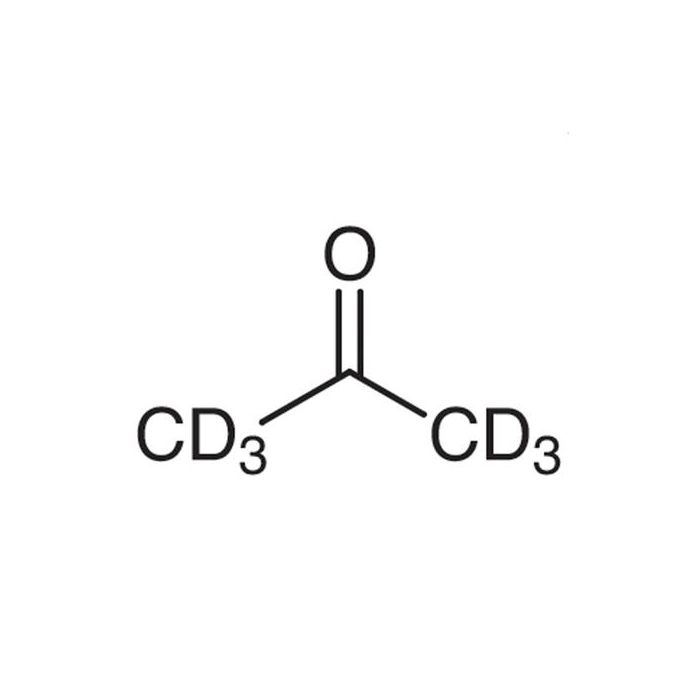
Acetone-d6 is a deuterated NMR solvent useful in NMR-based research and analyses. Its Infrared and Raman spectra have been analyzed. Pyrolysis and photolysis of acetone-d6 and methane mixtures have been investigated as a function of temperature. It has been reported to be prepared by reacting heavy water with propyne-d4 in the presence of mercury catalyst.
Taxonomy Tree
| Kingdom | Organic compounds |
|---|---|
| Superclass | Organic oxygen compounds |
| 分類 | Organooxygen compounds |
| Subclass | Carbonyl compounds |
| Intermediate Tree Nodes | Not available |
| Direct Parent | Ketones |
| Alternative Parents | Organic oxides Hydrocarbon derivatives |
| Molecular Framework | Aliphatic acyclic compounds |
| Substituents | Ketone - Organic oxide - Hydrocarbon derivative - Aliphatic acyclic compound |
| 説明 | This compound belongs to the class of organic compounds known as ketones. These are organic compounds in which a carbonyl group is bonded to two carbon atoms R2C=O (neither R may be a hydrogen atom). Ketones that have one or more alpha-hydrogen atoms undergo keto-enol tautomerization, the tautomer being an enol. |
| External Descriptors | propanone - deuterated compound |
Find and download the COA for your product by matching the lot number on the packaging.
| Lot Number | Certificate Type | 日付 | 商品 |
|---|---|---|---|
| Certificate of Analysis | Jun 17, 2026 | A100965 | |
| Certificate of Analysis | Jun 17, 2026 | A100965 | |
| Certificate of Analysis | Jun 17, 2026 | A100965 | |
| Certificate of Analysis | Jun 17, 2026 | A100965 | |
| Certificate of Analysis | Jun 17, 2026 | A100965 | |
| Certificate of Analysis | Jan 05, 2026 | A100965 | |
| Certificate of Analysis | Dec 30, 2025 | A100965 | |
| Certificate of Analysis | Jun 09, 2025 | A100965 | |
| Certificate of Analysis | Jun 09, 2025 | A100965 | |
| Certificate of Analysis | Jun 09, 2025 | A100965 | |
| Certificate of Analysis | Jun 09, 2025 | A100965 | |
| Certificate of Analysis | May 12, 2023 | A100965 | |
| Certificate of Analysis | May 12, 2023 | A100965 | |
| Certificate of Analysis | May 12, 2023 | A100965 | |
| Certificate of Analysis | Sep 19, 2022 | A100965 | |
| Certificate of Analysis | Jul 30, 2022 | A100965 | |
| Certificate of Analysis | Jul 30, 2022 | A100965 | |
| Certificate of Analysis | Jul 30, 2022 | A100965 | |
| Certificate of Analysis | Jul 30, 2022 | A100965 | |
| Certificate of Analysis | Jan 12, 2022 | A100965 | |
| Certificate of Analysis | Jan 12, 2022 | A100965 |
| 溶解度 | Soluble in water. |
|---|---|
| 感度 | Moisture sensitive |
| 屈折率 | 1.36 |
| 引火点(°F) | -2.2 °F |
| 引火点(°C) | -19°C |
| 沸点(°C) | 55.5 °C |
| 融点(°C) | −93.8 °C |
| 分子量 | 64.12 |
| XLogP3 | -0.100 |
| Hydrogen Bond Donor Count | 0 |
| Hydrogen Bond Acceptor Count | 1 |
| Rotatable Bond Count | 0 |
| Exact Mass | 64.0795 Da |
| Monoisotopic Mass | 64.0795 Da |
| Topological Polar Surface Area | 17.100 Ų |
| Heavy Atom Count | 4 |
| Formal Charge | 0 |
| Complexity | 26.300 |
| Isotope Atom Count | 6 |
| Defined Atom Stereocenter Count | 0 |
| Undefined Atom Stereocenter Count | 0 |
| Defined Bond Stereocenter Count | 0 |
| Undefined Bond Stereocenter Count | 0 |
| The total count of all stereochemical bonds | 0 |
| Covalently-Bonded Unit Count | 1 |
H225:Highly Flammable liquid and vapor
H319:Causes serious eye irritation
H336:May cause drowsiness or dizziness
P210:Keep away from heat, hot surface, sparks, open flames and other ignition sources. - No smoking.
P233:Keep container tightly closed.
P240:Ground/bond container and receiving equipment.
P241:Use explosion-proof [electrical/ventilating/lighting/.../] equipment.
P242:Use only non-sparking tools.
P243:Take precautionary measures against static discharge.
P261:Avoid breathing dust/fume/gas/mist/vapors/spray.
P271:Use only outdoors or in a well-ventilated area.
P280:Wear protective gloves/protective clothing/eye protection/face protection.
P303+P361+P353:IF ON SKIN (or hair): Take off Immediately all contaminated clothing. Rinse SKIN with water [or shower].
P304+P340:IF INHALED: Remove person to fresh air and keep comfortable for breathing.
P305+P351+P338:IF IN EYES: Rinse cautiously with water for several minutes. Remove contact lenses if present and easy to do - continue rinsing.
P370+P378:In case of fire: Use ... to extinguish.
P405:Store locked up.
P403+P233:Store in a well-ventilated place. Keep container tightly closed.
P403+P235:Store in a well-ventilated place. Keep cool.
P501:Dispose of contents/container to an approved waste disposal plant.
P264+P265:Wash hands [and …] thoroughly after handling. Do not touch eyes.
P337+P317:If eye irritation persists: Get medical help.
P319:Get medical help if you feel unwell.
No item-specific tested application data were provided. The following generic NMR sample preparation workflow can be adapted to acetone-d6:
These steps are general guidance. For validated methods and acceptance criteria, follow your laboratory SOPs.
No item-specific biological data are provided. The following reflects general biochemical context for acetone (literature); the deuterated isotopologue has analogous chemistry but no distinct biological role beyond use as a tracer.
Research-use only note
Acetone-d6 is not a buffering agent and is not typically used to prepare aqueous buffer systems. For solution-phase NMR of aqueous samples, deuterium oxide (D2O) or H2O/D2O mixtures with appropriate buffer salts (e.g., phosphate, HEPES) are preferred. Use this section only as a reminder:
Acetone is generally viewed as one of the greener organic solvents due to low toxicity, high biodegradability, and favorable environmental profile compared with chlorinated solvents. For deuterated NMR work, selection balances safety, performance, and spectral needs.
Comparison (literature-based, general):
Green practice tips
No item-specific pharmacopeial status or excipient grade is provided for this product. The following are general, non-clinical notes relevant to pharmaceutical R&D labs.
Note: No medical or therapeutic claims are made. This product is for research use only.
Note: No item-specific specifications were provided. Values below are literature/typical for acetone/acetone‑d6 and should be used as guidance only. For exact specifications of this item, refer to CoA/Spec Sheet.
Important: These are general/literature values. Not specified for this item; refer to CoA/Spec Sheet for any assured specifications (water, residual proton content, metals, UV cut-off, etc.).
Beyond its primary role as an NMR solvent, acetone-d6 is a useful isotopic reagent.
General literature guidance for using acetone-d6 as solvent or isotopic reagent (not item-specific specifications):
Always validate with small-scale trials and consult primary literature for substrate-specific conditions.
Safety details specific to this item were not provided. Always consult the SDS for authoritative information. The notes below reflect typical GHS classifications for acetone/acetone-d6 reported by major suppliers (literature) and general best practices.
Acetone-d6 is a polar aprotic, mid-volatility deuterated solvent offering good solubility for many organic analytes and supporting a stable NMR deuterium lock.
A fully deuterated analog of acetone (propanone) used primarily as an NMR solvent and isotopic labeling reagent.
While acetone-d6 is primarily a spectroscopic solvent, it also functions as an isotopically labeled building block and reagent.
These are literature-based generalities; optimize conditions for each substrate and verify deuterium incorporation by NMR/MS.
Not applicable. This product is a small-molecule solvent/reagent, not a biological targeting reagent (e.g., antibody, ligand, or inhibitor). No antigen/epitope specificity, species reactivity, clone, or isotype information applies.