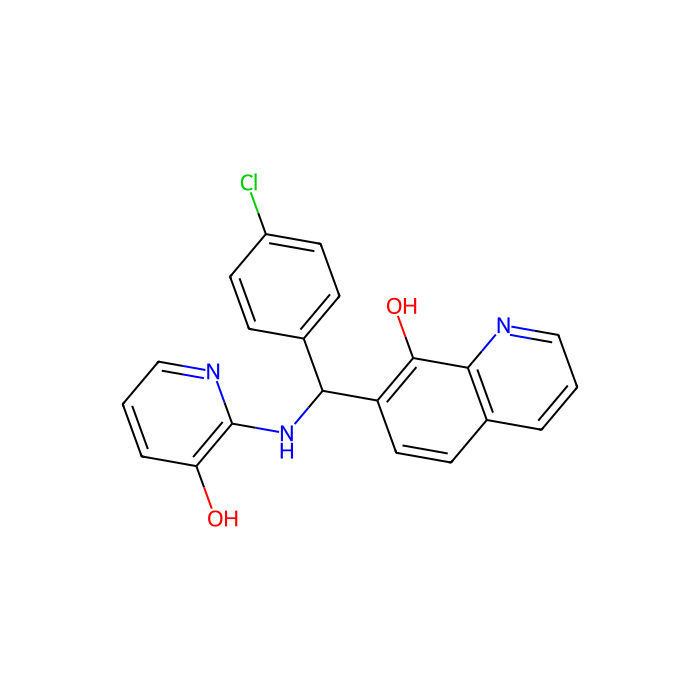
A cell-permeable, hydroxyquinoline HIF Prolyl Hydroxylase (PHD) inhibitor that displays an IC50 = 2 µM in a cell-based assay using a reporter produced by fusing HIF-1α oxygen degradable domain (ODD) to luciferase. This compound (5 µM) is shown to significantly stabilize HIF-1α in vitro and upregulate known HIF target genes, Epo and VEGF, in SH-SY5Y human neuroblastoma cell lines. It also exerts a neuroprotective effect (IC50 = 0.25 µM in an oxidative stress model using cortical neurons.
HIF-prolyl hydroxylase-2 (PHD2) inhibitor. Blocks glutamate induced ROS production in HT-22 cells, independent of MnSOD. Exhibits neuroprotective effects and enhances functional recovery in rodent intracerebral hemorrhage models, via inhibition of ATF4 dependent genes. Brain penetrant. Also antioxidant.
This compound belongs to the class of organic compounds known as 8-hydroxyquinolines. These are compounds containing a quinoline moiety, which carries a hydroxy group at the 8-position. Quinoline consists of a benzene ring fused to a pyrimidine ring to form benzo[b]azabenzene.
External Descriptors
Not available
1. Djoumbou Feunang Y, Eisner R, Knox C, Chepelev L, Hastings J, Owen G, Fahy E, Steinbeck C, Subramanian S, Bolton E, Greiner R, and Wishart DS. ClassyFire: Automated Chemical Classification With A Comprehensive, Computable Taxonomy. Journal of Cheminformatics, 2016, 8:61.
Products are supplied to verified businesses, institutions, and qualified professionals for research and development use only. Not for use in humans, animals, diagnosis, or therapy.

 H2205667