グレード&純度Electronic grade?Electronic grade — ultra-low metallic and particulate impurities for microelectronics. Use in semiconductor and electronics processes intolerant of contamination.MOS grade?MOS grade — high purity for metal-oxide-semiconductor processing. Use in MOS device fabrication sensitive to mobile-ion contamination.≥99.5%
Storage
Protected from light,Room temperature,Argon charged
This compound belongs to the class of organic compounds known as vinyl chlorides. These are vinyl halides in which a chlorine atom is bonded to an sp2-hybridised carbon atom.
External Descriptors
a small molecule
1. Djoumbou Feunang Y, Eisner R, Knox C, Chepelev L, Hastings J, Owen G, Fahy E, Steinbeck C, Subramanian S, Bolton E, Greiner R, and Wishart DS. ClassyFire: Automated Chemical Classification With A Comprehensive, Computable Taxonomy. Journal of Cheminformatics, 2016, 8:61.
Determine the necessary mass, volume, or concentration for preparing a solution.
Dilution Calculator
Determine the dilution needed to prepare a stock solution.
Reconstitution Calculator
レビュー
顧客レビュー
Application Protocols
No assay-specific protocols (e.g., WB, IHC, IF, FC) apply to this solvent. For cleaning or processing use, follow institutional SOPs for chlorinated solvent handling in fume hoods, solvent exchange/drying procedures, and waste management. For electronics applications, consult your process-of-record (POR) for solvent purity, filtration, and rinse/dry parameters.
Biological Roles
Trichloroethylene is not a biological buffer or metabolite used in routine biochemistry workflows. The following points are literature context only and not application recommendations:
Environmental toxicology (literature): TCE is a widely studied environmental contaminant; biotransformation in organisms often proceeds via oxidation to chloral hydrate and further to trichloroacetic acid and dichloroacetic acid, as well as glutathione-conjugation pathways.
Enzymatic interactions (literature): Metabolism is primarily through cytochrome P450-mediated oxidation in mammalian systems; metabolic flux depends on dose and species.
Laboratory relevance: Due to volatility and potential toxicity, it is generally avoided for biological sample preparation unless strictly required for specific extraction/cleaning roles remote from biological matrices.
For most biochemical and cell-based research, prefer non-chlorinated solvents with established biocompatibility when solvent exposure is possible.
Buffer Applications
This compound is a non-protic organic solvent and is not used to prepare aqueous buffer systems. For buffer preparation, see dedicated buffering agents (e.g., phosphate, Tris, HEPES). If solvent cleaning is needed in conjunction with buffered workflows, ensure complete removal of trichloroethylene and verify by suitable analytical methods (e.g., GC).
Green Alternatives
While trichloroethylene is effective, it carries environmental and health concerns typical of chlorinated solvents (literature). Consider the following alternatives where technically feasible:
Potential substitutes (literature)
Ethyl acetate: biodegradable, low toxicity profile; good for extractions and cleaning of some organics; lower density may reduce phase separation convenience.
2-Methyltetrahydrofuran (2-MeTHF): biorenewable, good solvent power for many organics; forms peroxides—manage accordingly; immiscible with water facilitates extractions.
Propylene carbonate: high bp, polar aprotic, low volatility; useful for cleaning and some electrolytic processes; slower drying and high viscosity.
d-Limonene or terpene blends: effective degreasers from renewable sources; strong odor and potential material-compatibility issues with some elastomers.
Comparison snapshot (literature)
TCE (bp ~87–88 °C, dense, chlorinated): excellent solvency for hydrophobes; regulatory restrictions and toxicological concerns.
DCE (bp ~84 °C) and DCM (bp ~40 °C): similar application space but also chlorinated; may not deliver a greener profile.
Ethyl acetate (bp 77 °C) and isopropanol (bp 82 °C): non-chlorinated, better EHS profile; may be less effective on silicones and fluorinated greases.
Practical approach
Pilot alternative solvents on representative soils/substrates; verify residue levels by IC/ICP for ionic contamination if used in electronic contexts. Balance EHS benefits against process efficacy, drying time, and materials compatibility.
Pharmaceutical Uses
Trichloroethylene is not an excipient or active ingredient in modern pharmaceutical formulations. Historically, chlorinated solvents have been used as processing solvents or cleaning agents in manufacturing; current good manufacturing practice favors non-chlorinated, lower-toxicity alternatives wherever feasible.
Role today (literature/general): Potential use as an industrial cleaning solvent for equipment or as a processing aid, subject to stringent controls and residual solvent guidelines. Verification by validated analytical methods (e.g., headspace GC) is required if used in any GMP context.
Regulatory note: Residual solvent limits and classifications are governed by pharmacopeial and ICH guidance; selection of solvents should consider tighter toxicological limits for chlorinated hydrocarbons. Consult site-specific quality systems.
No item-specific pharmacopeial compliance or specifications have been provided for this product.
Physical Properties
Note: No item-specific physical specifications were provided. Values below are general literature data for trichloroethylene and should not be construed as specifications for this lot.
Appearance: Not specified for this item; refer to CoA/Spec Sheet.
Molecular formula and weight: C2HCl3; 131.39 g/mol (literature)
Boiling point: ~87–88 °C at 1 atm (literature)
Melting point: ~−86 to −87 °C (literature)
Density: ~1.46 g/mL at 20 °C (literature)
Vapor pressure: ~58–74 mmHg at 20 °C (literature range, source-dependent)
Refractive index: n20 D ~1.477 (literature)
Water solubility: ~1–1.2 g/L at 25 °C (literature; sparingly soluble)
Log Kow: ~2.4–2.6 (literature)
Dielectric constant: ~3.4 at 20 °C (literature)
UV cutoff/absorbance profile: Not specified for this item; refer to CoA/Spec Sheet.
Residual stabilizers/inhibitors: Not specified for this item; refer to CoA/Spec Sheet.
Practical notes (general)
Volatile, dense liquid. Limited water miscibility; miscible with many organic solvents (ethers, aromatics, chlorinated solvents).
Quality and Grades
Item-specific grade (from Product Data)
Electronic grade, MOS grade.
Research use note: For research use only.
What these grades generally imply (context; not specifications)
Electronic/MOS grade trichloroethylene is selected for low levels of ionic contaminants (Na+, K+, Ca2+, Mg2+, Cl−, SO4 2−), trace metals, and particulates that can interfere with microfabrication and MOS device performance. It is typically filtered and packaged to minimize extractables and maintain low conductivity/TOC. Exact impurity limits are supplier- and lot-specific.
Stabilizers/inhibitors: Not specified for this item; refer to CoA/Spec Sheet.
Water, peroxide, nonvolatile residue, and UV-absorbance specs: Not specified for this item; refer to CoA/Spec Sheet.
Why choose this item
Argon-charged, light-protected packaging supports long-term solvent integrity by limiting oxidative and photolytic degradation pathways.
For semiconductor cleaning, precision degreasing, and materials processing where residual ionic contamination and particulates are critical, electronic/MOS grades reduce risk of device yield loss compared with commodity solvent grades.
Reaction and Applications
This product is primarily a high-purity solvent for research, materials processing, and electronics. The following points summarize literature-reported uses; they are not item-specific performance claims.
As a reaction medium (literature)
Non-protic, relatively non-coordinating environment suitable for electrophilic substitutions, certain radical reactions, and cationic polymerizations when a chlorinated solvent with moderate bp is advantageous.
Employed in some Lewis-acid-mediated transformations (e.g., Friedel–Crafts alkylation/acylation) where non-donor solvents are preferred.
In materials/processing (general practice)
Precision degreasing and removal of silicone oils, photoresist residues, and organic films from substrates; electronic/MOS grades help mitigate ionic contamination in wafer processing.
Reactivity considerations (literature)
TCE is more resistant to nucleophilic attack than DCE/DCM due to the vinyl C–Cl bond arrangement but can undergo reductive dechlorination and addition under strongly reducing or radical conditions.
Thermal/photolytic decomposition can produce HCl and phosgene; avoid high-temperature or UV-driven processes unless properly engineered.
Workup advantages (literature)
High density facilitates separations in liquid–liquid extractions of nonpolar residues from aqueous phases; bp near 87–88 °C enables relatively rapid removal compared with PCE.
Note: Always verify compatibility of TCE with catalysts, reagents, and polymers; strong bases and nucleophiles can induce dehydrohalogenation or other side reactions.
Reaction Conditions
General guidance for using trichloroethylene as a solvent (literature; not specifications):
Atmosphere: Inert gas recommended for air/moisture-sensitive reactions. Product is supplied argon charged and light-protected per Product Data.
Temperature: 0 °C to reflux (~87–88 °C). Monitor for exotherms with Lewis acids and electrophilic reagents.
Water control: Use anhydrous grades or dry over suitable agents if required. Water content for this item is not specified; refer to CoA/Spec Sheet.
Catalysts/reagents compatibility: Often compatible with Lewis acids (AlCl3, FeCl3) and some transition-metal catalysts in halogenated solvent regimes. Avoid strong bases (alkoxides, amides) and highly nucleophilic reagents that can react with the solvent.
Concentration: Typical 0.05–1 M, depending on heat management and mass transfer needs.
Workup: Quench reactive reagents before phase separations. Take advantage of high density for biphasic separations; remove solvent under reduced pressure with adequate cold-trap capacity due to volatility and toxicity.
Analytical monitoring: GC/GC–MS, HPLC (if analyte UV properties allow), or TLC with appropriate eluent systems.
Safety
Avoid UV irradiation and high-temperature contact with metals to minimize risk of phosgene/HCl formation. Maintain effective ventilation and scrubbing if heating near reflux.
Safety and Handling
Item-specific hazard fields were not supplied. Always consult the product SDS for authoritative, current safety information for this SKU.
General (literature-based) GHS guidance for trichloroethylene
Likely classification: may include Carcinogenicity (Cat. 1B), Skin/Eye Irritation (Cat. 2), STOT SE 3 (drowsiness/dizziness). Signal word commonly “Danger.” Actual classifications vary by jurisdiction and supplier; defer to SDS.
Key hazards: harmful if inhaled; central nervous system effects at high vapor concentrations; suspected/known carcinogen by long-term exposure (literature). Not flammable under normal conditions but decomposes to phosgene and HCl on hot surfaces/combustion.
Handling and PPE
Use in a well-ventilated fume hood; avoid inhalation and skin contact.
Recommended PPE: chemical-resistant gloves (e.g., Viton, laminate; check permeation charts), lab coat, splash goggles. Consider respirator only if engineering controls are inadequate and as permitted by your institution’s program.
Storage and incompatibilities
Product Data: Store protected from light, at room temperature, under argon.
Keep tightly closed. Segregate from strong bases, strong nucleophiles, reactive metals, and strong oxidizers. Avoid heating and UV exposure that could promote decomposition.
First-aid (overview; consult SDS)
Inhalation: move to fresh air; seek medical attention if symptoms persist.
Skin/eye contact: rinse with water for at least 15 minutes; remove contaminated clothing; seek medical attention if irritation persists.
Ingestion: do not induce vomiting; seek immediate medical attention.
Waste
Halogenated solvent waste stream; collect in appropriate, clearly labeled containers and follow institutional hazardous waste procedures.
Solvent Selection
Solvent class and polarity (literature)
Type: Non-protic, chlorinated hydrocarbon solvent; medium polarizability; low donor/acceptor numbers.
Dielectric constant: ~3.4 at 20 °C (literature) — lower than DCM (~9.1), higher than hexanes (~1.9).
Miscibility profile (literature)
Miscible with many organics (aromatics, ethers, ketones, chlorinated solvents); sparingly soluble in water (~1 g/L at 25 °C).
When to choose trichloroethylene (TCE)
When a relatively high-boiling (87–88 °C) chlorinated solvent is desired for extraction, cleaning, or reactions requiring a non-coordinating medium more robust than DCM but with lower boiling point than perchloroethylene.
Effective for precision degreasing and removal of non-polar residues and silicones; electronic/MOS grade is suited for microfabrication cleaning steps where low ionic background is important.
Alternatives and comparison (literature)
Dichloromethane (DCM, bp 40 °C): lower bp for easy removal; higher polarity; more volatile and often preferred for room-temperature extractions.
1,2-Dichloroethane (DCE, bp 84 °C): similar bp; higher polarity than TCE; more widely used as reaction solvent for SN1 and cationic chemistry.
Perchloroethylene (PCE, bp 121 °C): higher bp for hotter processes; lower polarity; slower drying.
Non-chlorinated options (ethyl acetate, 2-MeTHF, IPA) for greener profiles when compatible with the process.
Practical tips
Use dry, oxygen-limited conditions for moisture/oxygen-sensitive chemistry; the product is supplied argon-charged and light-protected to help maintain quality.
Storage and Reconstitution
Storage (from Product Data)
Protected from light.
Room temperature.
Argon charged.
Container and headspace
Keep tightly closed in compatible containers (e.g., amber glass with PTFE-lined cap) to maintain argon blanket and exclude moisture/air.
Stability considerations (general)
Avoid prolonged exposure to heat or UV to minimize decomposition to HCl/phosgene (literature). Minimize contact with reactive metals and strong bases.
Reconstitution: Not applicable; supplied as a ready-to-use liquid solvent.
Before use
If low moisture is critical, verify water content by Karl Fischer (spec for this item is not provided; refer to CoA/Spec Sheet) or pass through appropriate drying media.
Shipping
Shipped via FedEx DG Service per Product Data. Inspect upon receipt; if seal/argon blanket is compromised, assess quality before use.
For lot-specific quality attributes (water, metals, ionic content, nonvolatile residue), consult the CoA/Spec Sheet for this SKU.
Structure and Identity
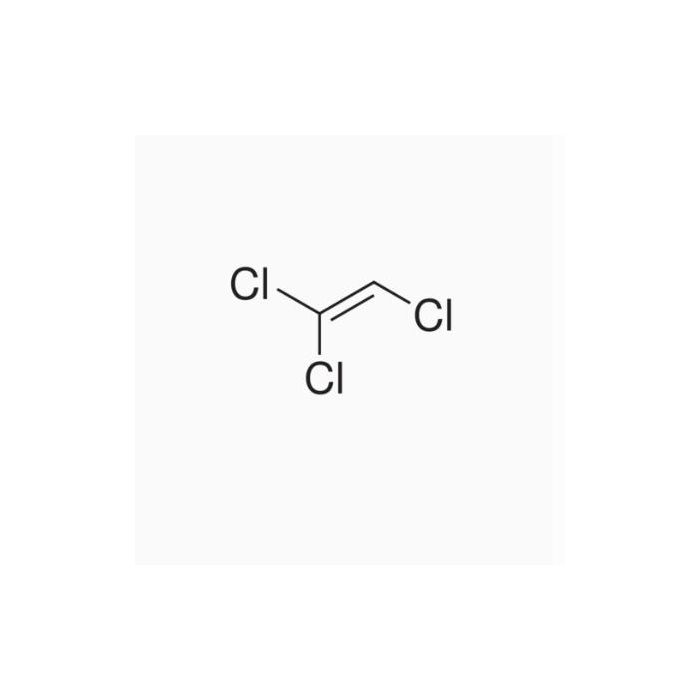
Trichloroethylene is a chlorinated ethene (vinyl chloride analog) commonly used as a high-purity, non-protic, chlorinated solvent.
Item-specific identifiers (from Product Data)
SKU: T1523636
Product name: Trichloroethylene
CAS: 79-01-6
PubChem CID: 6575
InChIKey: 426317 (as provided)
SMILES: Not specified for this item; refer to CoA/Spec Sheet.
Literature identity (for reference; not item-specific specs)
Molecular formula: C2HCl3 (literature)
Molecular weight: 131.39 g/mol (literature)
Common SMILES: C(=CCl)ClCl (literature representations include C(=CCl)ClCl or ClC(=CCl)Cl)
Typical InChIKey: not specified here; consult literature databases (literature)
Structural features (general description)
Contains a C=C double bond substituted with three chlorine atoms (1,1,2-trichloroethene framework).
Planar alkene core; no stereogenic centers. Electron-withdrawing chlorines reduce electron density of the double bond, increasing resistance toward nucleophilic addition and enhancing stability as a solvent under many electrophilic conditions.
As a solvent, trichloroethylene contributes a non-coordinating, moderately high-boiling medium that can stabilize carbocationic intermediates while resisting many nucleophiles (literature). While less common than DCE or DCM in academic synthesis, TCE is useful where slightly higher temperature and lower polarity are desired.
Functional context (literature)
Suitable for Lewis-acid-catalyzed reactions (e.g., certain Friedel–Crafts transformations) where donor solvents inhibit catalysis.
Employed in some radical and halogenation chemistries where a chlorinated, non-flammable medium is advantageous.
High density benefits biphasic catalysis and extraction/workup of heavy organic fractions.
Limitations (literature)
Strong bases/nucleophiles can promote dehydrohalogenation or addition; avoid use with reactive alkoxides/organolithiums.
Photolysis or hot metal contact can produce phosgene/HCl—avoid UV irradiation and overheating.
Process engineering
Electronic/MOS grade supports applications where trace ionic content must be minimized (e.g., polymer electronics, microfabrication), reducing risk of catalyst poisoning or device contamination.
Target Specificity
Not applicable. This product is a small-molecule solvent and does not possess antigen/epitope specificity. No antibody/biological target information is associated with this item.
Products are supplied to verified businesses, institutions, and qualified professionals for research and development use only. Not for use in humans, animals, diagnosis, or therapy.