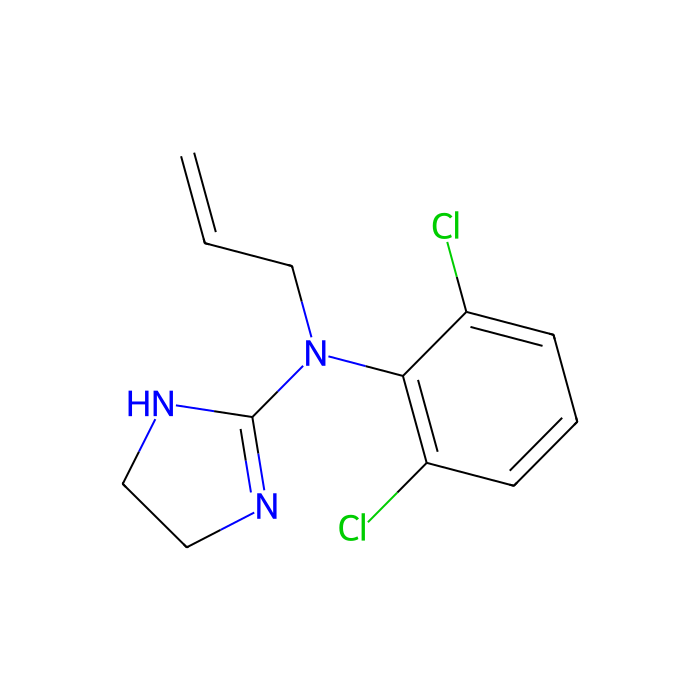
Alinidine is an HCN Channel blocker of neuronal Ih, related cardiac If channels and ATP-sensitive Kir channels. It is an analog of clonidine; bradycardic and antiarrhythmic agent (sinus tachyarrhythmias). Alinidine affects physiological markers in conscious dogs. Alinidine in four intravenous (i.v.) injections of 0.5, 0.5, 1, and 2 mg/kg, decreased sinus rate (< or = 43%) and ventricular rate (< or = 44%), but increased atrial rate (< or = 31%). It lengthened CSRT (< or = 71%) at the two highest doses and increased AERP (< or = 33%) and decreased WP (< or = 33%) at all doses. Alinidine did not modify mean blood pressure at any dose in either group. These results indicate that alinidine exhibits electrophysiologic effects in conscious dogs that reflect the marked antiarrhythmic potential of this agent, apart from its assumed antiischemic properties.
This compound belongs to the class of organic compounds known as dichlorobenzenes. These are compounds containing a benzene with exactly two chlorine atoms attached to it.
External Descriptors
Not available
1. Djoumbou Feunang Y, Eisner R, Knox C, Chepelev L, Hastings J, Owen G, Fahy E, Steinbeck C, Subramanian S, Bolton E, Greiner R, and Wishart DS. ClassyFire: Automated Chemical Classification With A Comprehensive, Computable Taxonomy. Journal of Cheminformatics, 2016, 8:61.
Products are supplied to verified businesses, institutions, and qualified professionals for research and development use only. Not for use in humans, animals, diagnosis, or therapy.