AN-9 is an HDAC inhibitor with antimetastic and antiangiogenic properties. AN-9 is theorized to reduce vascularization and the expression of bFGF and HIF-1
Pivanex (AN-9), a derivative of Butyric acid, is an orally active HDAC inhibitor. Pivanex down-regulates bcr-abl protein and enhances apoptosis. Pivanex has antimetastic and antiangiogenic properties.
This compound belongs to the class of organic compounds known as fatty acid esters. These are carboxylic ester derivatives of a fatty acid.
External Descriptors
Not available
1. Djoumbou Feunang Y, Eisner R, Knox C, Chepelev L, Hastings J, Owen G, Fahy E, Steinbeck C, Subramanian S, Bolton E, Greiner R, and Wishart DS. ClassyFire: Automated Chemical Classification With A Comprehensive, Computable Taxonomy. Journal of Cheminformatics, 2016, 8:61.
Determine the necessary mass, volume, or concentration for preparing a solution.
Dilution Calculator
Determine the dilution needed to prepare a stock solution.
Reconstitution Calculator
レビュー
顧客レビュー
Application Protocols
No item-specific, validated application protocols are provided for this SKU. For general laboratory use of AN-9 in research:
Stock solution preparation: Dissolve in anhydrous DMSO or ethanol to prepare 10–100 mM stocks; filter if necessary through PTFE (0.2 µm). Use immediately or aliquot and freeze.
Hydrolysis assay (illustrative, literature-style): Dilute stock into pre-equilibrated buffer (e.g., 50 mM phosphate, pH 7.4) to desired concentration; incubate at controlled temperature; withdraw aliquots at intervals, quench with acidified ACN, and analyze by HPLC.
Extraction/partitioning studies: Shake with octanol/water (or surrogate phases) to assess distribution; analyze phases by GC/HPLC.
These are general suggestions for trained chemists and are not validated SOPs for this specific product.
Biological Roles
Item-specific biological testing data: Not specified for this item; for research use only.
Literature/general context:
AN-9 is a pivaloyloxymethyl (POM) ester of butyric acid. In biological milieus, esterases and/or hydrolytic conditions can convert AN-9 to butyric acid and pivalic acid (via stepwise cleavage). Butyrate is a short-chain fatty acid involved in cellular metabolism and epigenetic regulation in vitro; however, no clinical or therapeutic claims are made here.
The POM group enhances lipophilicity and membrane permeability in model systems, a common strategy in pro-moiety design for carboxylates and phosphates.
In vitro studies may examine uptake, hydrolysis rates, and downstream cellular responses to liberated butyrate under controlled conditions.
Caveats:
Kinetics and biological outcomes are highly system-dependent (enzyme expression, pH, protein binding). Users should validate conditions for their specific assay.
This product is supplied for research use only and is not intended for diagnostic or therapeutic use.
Buffer Applications
This compound is a neutral, hydrophobic ester and is not itself used as a pH buffer. In aqueous buffers it can undergo hydrolysis influenced by pH and ionic strength. For experiments involving AN-9 in buffered systems:
Choose buffers that minimize catalytic hydrolysis if stability is needed (near-neutral pH, avoid strong acid/base catalysis).
Common assay buffers (PBS, HEPES, phosphate) may be used as media for hydrolysis kinetics; prepare AN-9 stock in dry organic solvent (e.g., DMSO) and dilute immediately before use.
Avoid prolonged incubation in basic buffers which accelerate ester cleavage and possible transesterification with buffer components containing alcohols under basic conditions.
Green Alternatives
Context: AN-9 is an aliphatic ester used as a research reagent/model pro-moiety. Greener considerations pertain to solvent choice and process design rather than replacing the active structure.
Greener handling options (literature/general):
Prefer greener solvents for workup/analysis when compatible with stability: ethyl acetate, 2-MeTHF, CPME in place of dichloromethane or chloroform.
Use ethanol or isopropanol instead of acetonitrile for stock solutions if assay allows and hydrolysis risk is controlled (dry, time-limited exposure).
Minimize halogenated solvent use by optimizing chromatographic conditions (e.g., heptane/EtOAc gradients).
Illustrative comparison (literature/general):
DCM vs. 2-MeTHF: 2-MeTHF offers lower toxicity and renewable sourcing; however, it may retain more moisture, which can accelerate AN-9 hydrolysis. Use molecular sieves with 2-MeTHF when needed.
ACN vs. EtOH: Ethanol is greener but can participate in transesterification under basic conditions; ACN is inert but less green and can be more hazardous. Choose based on reaction/assay constraints.
Operational greening:
Employ microscale kinetic assays to reduce solvent consumption.
Store and dispense under inert gas to extend shelf life and reduce waste from degraded material.
Pharmaceutical Uses
No pharmacopeial/compendial status or excipient role is specified for this item; refer to CoA/Spec Sheet.
General/literature context for formulation science (non-clinical, research only):
AN-9 is a representative POM-ester used in research on pro-moiety strategies to modulate solubility, permeability, and chemical stability of carboxylate-bearing molecules in preformulation studies.
It may serve as a model substrate for esterase-mediated cleavage in in vitro ADME method development. Any such use must remain within non-clinical research settings.
No therapeutic or clinical claims are made. This product is for research use only.
Physical Properties
Item-specific specs (this SKU): Not specified for this item; refer to CoA/Spec Sheet.
Literature/computed expectations for AN-9 (pivaloyloxymethyl butyrate):
Molecular weight: ~202.24 g/mol (from formula C10H18O4, literature)
Physical state: typically a colorless to pale liquid or low-melting solid (literature, ester of medium volatility)
Solubility:
Organic: expected to be miscible or highly soluble in common organic solvents (e.g., dichloromethane, ethyl acetate). Soluble in DMSO and ethanol (literature/general for aliphatic esters).
Aqueous: low solubility; slowly hydrolyzes in water (literature trend for dialkoxycarbonyl-like esters).
Partitioning: lipophilic due to tert‑butyl and butyl groups; logP expected in the positive range (literature expectation; numeric value not provided here).
Volatility/boiling: moderate; exact bp/mp and density not provided here (consult primary data).
Refractive index, pKa: Not applicable or not customary for neutral aliphatic esters; not specified here.
Notes:
Values above are general literature expectations for this structure and are not product specifications for SKU A338044.
Quality and Grades
Item-specific grade/purity for SKU A338044: Not specified for this item; refer to CoA/Spec Sheet.
General guidance on grades (context for this compound type):
Research grade: sufficient for most discovery chemistry, screening, and non-GLP experiments; typical assays verify identity (NMR/GC/LC-MS) and purity by chromatography. If UV transparency or trace impurities are critical (e.g., analytical chromatography), HPLC/spectrophotometric grades are preferred.
Stabilizers: None specified for this item; refer to CoA/Spec Sheet. Many aliphatic esters do not require added inhibitors, but dryness and minimal headspace moisture help maintain integrity.
Trace specifications (water content, residual solvents, metal content, acid number): Not specified for this item; refer to CoA/Spec Sheet.
What to request if your application is sensitive:
Provide target purity basis (area% vs. weight%), residual solvent limits, and acceptance criteria for acid value (indicator of hydrolysis). Ask for lot-specific CoA with chromatographic trace and NMR identity confirmation.
Reaction and Applications
Manufacturer application text: Not provided for this item.
Literature/general research uses for AN-9 (pivaloyloxymethyl butyrate):
Pro-moiety chemistry: AN-9 is a masked butyrate, liberating butyric acid via chemical or enzymatic cleavage. It serves as a model compound in prodrug hydrolysis kinetics and in studying steric/electronic effects of pivaloyloxymethyl (POM) protection.
Stability studies: Used in examining ester vs. carbonate stability under buffered aqueous conditions; pH-rate profiles (acid/base-catalyzed hydrolysis) and solvent effects can be quantified by HPLC.
Synthetic intermediate context: The POM group is a recognized protecting/transporting group for carboxylates and phosphates. AN-9 illustrates installation and removal strategies of POM in methodology development.
Partitioning/permeation models: Due to increased lipophilicity relative to butyrate, AN-9 is used in in vitro partition experiments (e.g., logD determinations) and membrane model systems.
Practical tips (general):
Avoid base- or acid-catalyzed conditions unless controlled hydrolysis is intended; trace base in silica can promote cleavage—precondition columns with neutral alumina or add 0.1% acid to mobile phase for analytical HPLC.
For kinetic studies, prepare fresh solutions in dry solvent; initiate hydrolysis by adding buffer at defined pH and ionic strength; quench by rapid acidification/cooling and analyze promptly.
Reaction Conditions
Item-specific, validated conditions are not provided. The following are literature/general conditions for transformations relevant to AN-9:
Hydrolysis (cleavage to butyrate and/or pivalate fragments):
Acidic: Aqueous HCl (0.01–1 M), rt to 50 °C; faster at higher acidity. Monitor by HPLC; quench by neutralization/cooling. Selectivity between butyrate vs. pivalate cleavage can vary; the acetal-like –O–CH2–O– linkage can be acid-labile.
Basic: Aqueous NaOH/KOH (0.01–0.5 M), rt; rapid ester saponification to the corresponding acids. Organic cosolvent (MeOH/THF/ACN) improves solubility. Work up by acidification and extraction.
Enzymatic: Porcine liver esterase or lipases in phosphate buffer (pH 7–8), 25–37 °C; rates depend on enzyme and substrate loading (typical 0.1–5 mg/mL enzyme).
Analytical monitoring:
Reverse-phase HPLC with acidified aqueous/ACN or MeOH; detect at low UV (200–220 nm) where esters absorb weakly. Consider ELSD/RI if UV sensitivity is insufficient.
Stability handling:
Prepare stock in anhydrous DMSO, ACN, or EtOH; use within hours once diluted into aqueous buffers. Store samples cold and protected from moisture during longer kinetic runs.
These are general literature practices and not specifications for SKU A338044.
Safety and Handling
Item-specific GHS/hazard data for this SKU: Not specified for this item; refer to SDS.
General safety considerations for aliphatic di-oxygenated esters (literature/general):
Likely to be combustible; avoid ignition sources. Work in a fume hood to minimize inhalation of vapors or aerosols.
May cause skin/eye irritation; wear appropriate PPE: lab coat, safety glasses/goggles, and nitrile gloves.
Hydrolysis products include butyric acid and pivalic acid, which are irritants with strong odor (butyric acid). Prevent contact and promptly clean spills.
Incompatibilities: strong acids/bases (accelerate hydrolysis/transesterification); strong oxidizers; moisture may promote slow degradation. Store in tightly closed container under dry, inert conditions when feasible.
First aid (general guidance; defer to SDS):
Skin: wash with soap and water; remove contaminated clothing.
Eyes: rinse cautiously with water for several minutes; remove contact lenses if present and easy to do; continue rinsing; seek medical attention if irritation persists.
Inhalation: move to fresh air; seek medical attention if symptoms occur.
Ingestion: rinse mouth; do not induce vomiting; seek medical advice.
Waste: dispose according to local regulations for organic solvent/ester waste; segregate from oxidizers.
Always consult the product’s SDS for authoritative hazard classification, pictograms, and response statements.
Solvent Selection
Chemical type: neutral, moderately lipophilic aliphatic di-ester (butyrate–pivalate architecture).
Polarity/miscibility (literature/general):
Best solvents: dichloromethane, chloroform, ethyl acetate, toluene, MTBE, CPME; soluble in polar aprotic solvents (acetonitrile, DMF, DMSO) and lower alcohols (ethanol, isopropanol).
Water: low solubility; subject to slow hydrolysis in aqueous media, accelerated by extremes of pH.
Selection guidance:
For handling/stock solutions: anhydrous DMSO or ethanol for biochemical screening; DCM/EtOAc for synthetic manipulations and extractions.
For storage solutions: use dry, oxygen-excluded solvents (e.g., anhydrous toluene, DCM) in amber vials when long-term stability is needed. Avoid prolonged exposure to moist alcohols/water.
Comparison notes (literature/general):
Versus short-chain esters (e.g., ethyl acetate): AN-9 is less volatile and more hydrophobic; better partitioning into organic layers, slower evaporation.
Versus higher-boiling polar aprotics (DMF/DMSO): AN-9 dissolves well but may hydrolyze if water is present; choose anhydrous grades and minimize time in solution if hydrolysis is a concern.
Additional handling guidance (general best practice for aliphatic esters):
Keep tightly closed in original container. Protect from moisture; consider storing under inert atmosphere (argon/nitrogen) to limit hydrolytic degradation.
If preparing stock solutions, use dry, oxygen-free solvents (e.g., anhydrous DMSO, ACN, EtOH), aliquot into amber vials, and store at −20 °C. Avoid repeated freeze–thaw; use single-use aliquots.
Before use, allow vial to warm in a desiccator to avoid condensation. Inspect for odor indicative of butyric acid or for changes in chromatography that could suggest hydrolysis.
Reconstitution: Not applicable to solids-only formulations; if the item arrives as a solid/semi-solid, dissolve in a suitable dry organic solvent as required for your application. For any uncertainties, refer to the lot-specific CoA/Spec Sheet.
Structure and Identity
Item-specific identifiers provided: CAS 122110-53-6; InChIKey: 114812 (as listed). Other fields not specified for this item; refer to CoA/Spec Sheet.
Literature/general identity (for AN-9, commonly known as pivaloyloxymethyl butyrate; also “Pivanex”):
Molecular formula (literature): C10H18O4
Molecular weight (literature): ~202.24 g/mol
Preferred IUPAC name (literature): butyric acid pivaloyloxymethyl ester
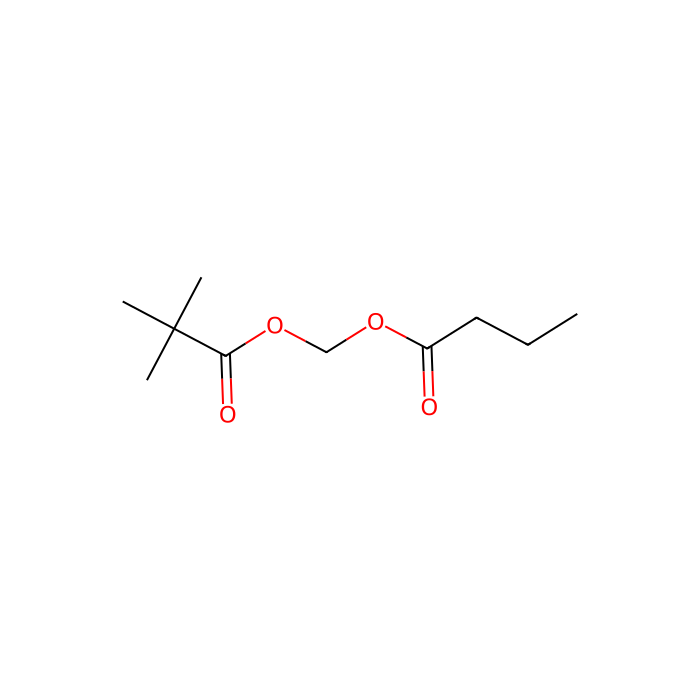
SMILES (literature): CCCC(=O)OCOC(=O)C(C)(C)C
InChIKey (literature): Not specified here; consult authoritative databases (e.g., PubChem for CID 60748).
Structural features (literature description):
Contains two ester carbonyls: a butyrate ester and a pivalate (tert‑butyl carbonate-like) linkage as –O–CH2–O–C(=O)–C(CH3)3.
Aliphatic chain (butyryl, C4) confers moderate hydrophobicity; tert‑butyl group increases steric bulk and lipophilicity.
No rings, no heteroatoms beyond oxygen; no stereocenters (achiral).
2D description: a straight C4 acyl chain linked via an ester oxygen to a methylene spacer (–O–CH2–), then an acyl-oxygen to a pivaloyl group terminating in a tert‑butyl substituent.
Synthetic Utility
As an isolated molecule, AN-9 is typically a target/standard rather than a general reagent; however, it exemplifies several useful functional elements (literature/general):
Protected carboxylate mimic: The butyrate is masked as an ester, allowing studies on deprotection/hydrolysis without free acid reactivity.
Activated carbonate-like linkage: The –O–CH2–O–C(=O)–C(CH3)3 motif can undergo cleavage under acidic, basic, or enzymatic conditions, providing a benchmark for POM deprotection.
Steric effects: The tert‑butyl group provides a handle to study steric hindrance on acyl-transfer reactions and on chromatographic behavior.
Transformations/strategies:
Controlled hydrolysis to generate butyric acid (acidic, basic, or enzymatic conditions; monitor by HPLC/GC).
Transesterification under basic/alcoholic conditions to exchange the butyrate or pivalate component (method development, not typically synthetic scale due to selectivity challenges).
Oxidative stability testing: probe susceptibility to peracids or radical conditions (establishing “no-reaction” windows for ester-containing scaffolds).
Retrosynthetic note: AN-9 is commonly prepared by coupling butyric acid (or butyryl chloride) to pivaloyloxymethanol (POM alcohol) or by sequential formation of the POM carbonate followed by esterification.
Target Specificity
Not applicable. This product is a small-molecule chemical reagent, not a biological targeting agent (e.g., antibody, ligand with defined target panel). No antigen/epitope or species reactivity is associated with this item.
Products are supplied to verified businesses, institutions, and qualified professionals for research and development use only. Not for use in humans, animals, diagnosis, or therapy.

 C2321239