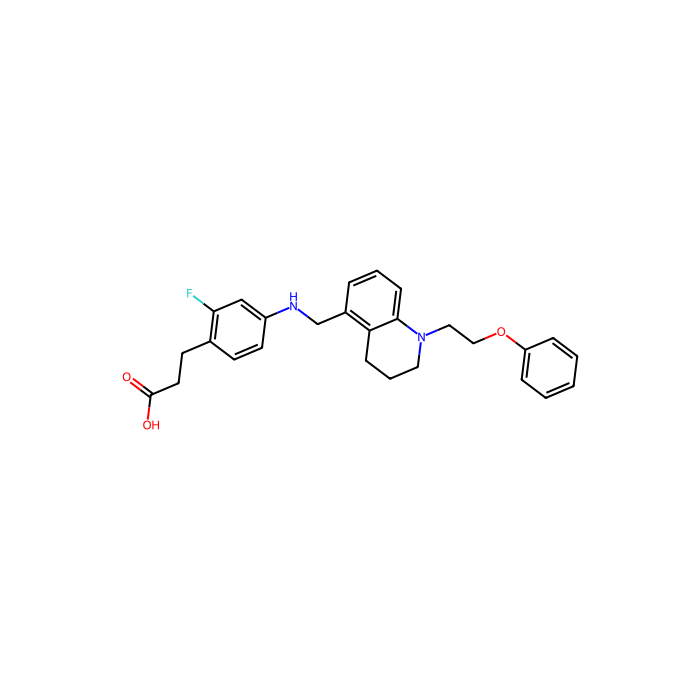
Selective free fatty acid receptor 1 (FFA1/GPR40) agonist. Exhibits selectivity for GPR40 over GPR41, GPR43, GPR119, GPR120 and PPARγ. Induces glucose-dependent insulin secretion in pancreatic MIN6 cells andin vivo. Enhances insulin sensitivity in a type
This compound belongs to the class of organic compounds known as phenylpropanoic acids. These are compounds with a structure containing a benzene ring conjugated to a propanoic acid.
External Descriptors
Not available
1. Djoumbou Feunang Y, Eisner R, Knox C, Chepelev L, Hastings J, Owen G, Fahy E, Steinbeck C, Subramanian S, Bolton E, Greiner R, and Wishart DS. ClassyFire: Automated Chemical Classification With A Comprehensive, Computable Taxonomy. Journal of Cheminformatics, 2016, 8:61.
Solvent:DMSO, Max Conc. mg/mL: 22.43, Max Conc. mM: 50; Solvent:ethanol, Max Conc. mg/mL: 8.97, Max Conc. mM: 20
分子量
448.500 g/mol
XLogP3
5.400
Hydrogen Bond Donor Count
2
Hydrogen Bond Acceptor Count
6
Rotatable Bond Count
10
Exact Mass
448.216 Da
Monoisotopic Mass
448.216 Da
Topological Polar Surface Area
61.800 Ų
Heavy Atom Count
33
Formal Charge
0
Complexity
600.000
Isotope Atom Count
0
Defined Atom Stereocenter Count
0
Undefined Atom Stereocenter Count
0
Defined Bond Stereocenter Count
0
Undefined Bond Stereocenter Count
0
The total count of all stereochemical bonds
0
Covalently-Bonded Unit Count
1
ソリューション計算機
Molarity Calculator
Determine the necessary mass, volume, or concentration for preparing a solution.
Dilution Calculator
Determine the dilution needed to prepare a stock solution.
Reconstitution Calculator
レビュー
顧客レビュー
Application Protocols
Item-specific validated protocols are not provided in the Product Data. The following are general best practices for handling small-molecule library compounds.
Stock solution preparation
Weigh accurately (preferably gravimetrically dispense) and dissolve in anhydrous DMSO to 10–50 mM. Vortex and, if needed, brief sonication. Record exact concentration.
Aliquoting and storage
Dispense into low-bind, amber vials or plate wells (e.g., 10–50 µL aliquots) to avoid repeated freeze–thaw. Seal with cap mats or Parafilm.
Working solutions
Dilute stocks into assay buffer or media with thorough mixing; keep final DMSO ≤0.5–1% unless your system tolerates more. Check for precipitation visually and by light scattering (A600).
LC–MS/HPLC analysis
Prepare standards across the expected range; use volatile buffers for MS. Confirm identity by exact mass/adduct patterns and retention time.
Plate-based screening
Equilibrate plates to room temperature before lid removal to minimize condensation. Centrifuge briefly to collect contents. Include vehicle controls matched for DMSO.
Stability checks
Monitor potency/response drift across freeze–thaw cycles. Re-quantify stock concentration periodically by UV or quantitative NMR if an extinction coefficient is unavailable.
For item-specific assay conditions or control concentrations, consult the CoA/Spec Sheet or contact Technical Support.
Biological Roles
Item-specific biological/target information
Not specified for this item; no validated biological target, pathway, or mechanism of action is provided in the Product Data. Refer to CoA/Spec Sheet or contact Aladdin Scientific if target information is available under your screening agreement.
General considerations for small-molecule library members (non–item-specific)
Role in discovery: Such compounds are commonly used as tool molecules in phenotypic or target-based assays to discover activity, followed by orthogonal confirmation.
ADME profiling: If moving beyond primary screening, assess solubility, permeability (e.g., PAMPA or Caco-2), microsomal stability, and plasma protein binding to contextualize biological readouts.
Aggregation/artifacts: Evaluate colloidal aggregation (e.g., with low Triton X-100 controls) and redox interference in assay systems to mitigate false positives.
Phototoxicity/reactivity: Unknown for this item. Use amberware and limit light exposure until stability is established.
Ethical and regulatory note
For research use only. Not intended for diagnostic, therapeutic, or clinical use. No medical claims are made or implied for this product.
Buffer Applications
This section is not typically applicable because the product is a small-molecule library compound rather than a buffering agent. No intrinsic pKa or buffer capacity data are provided for this item.
General guidance for preparing aqueous working solutions (non–item-specific)
Choose buffer based on assay biology (e.g., PBS pH 7.4, HEPES pH 7.2–7.6, acetate pH 4–5.5) and compound ionization state if known.
Dilution from DMSO stocks: Add stock slowly into vigorously mixed buffer to minimize precipitation; maintain final DMSO ≤0.5–1% when required by cells/enzymes.
Filtration: If sterile conditions are needed, filter the final aqueous solution through a 0.22 µm PVDF or PES membrane; avoid prolonged exposure to aqueous media if hydrolytic instability is suspected.
Volatile buffers (LC–MS): Ammonium acetate/formate (2–20 mM) with formic acid or ammonia can aid MS compatibility during quantitative analysis.
For item-specific buffer or pKa information, consult the CoA/Spec Sheet once structure and ionization data are disclosed.
Green Alternatives
Because the specific structure and intended use of this small-molecule library item are not disclosed, green chemistry guidance focuses on solvent and process choices around handling and analysis rather than compound substitution.
Greener handling choices (general)
Stock preparation: Prefer DMSO for concentrated stocks over DMF/NMP when feasible; DMSO has a better environmental and EHS profile.
Workup/extractions (if applicable): Substitute 2-MeTHF or ethyl acetate for chlorinated solvents when compatible with the compound’s polarity.
Chromatography: Use ethanol or isopropanol modifiers in place of acetonitrile when LC resolution permits; consider supercritical CO2 for prep separations if available.
Energy: Store at 2–8 °C as specified; avoid unnecessary ultra-cold storage. Thaw only what is needed to reduce freeze–thaw waste.
Illustrative comparison (general; not item-specific)
DMSO vs DMF/NMP: DMSO is less problematic toxicologically and typically adequate for screening stocks; DMF/NMP may be avoided unless required by solubility.
2-MeTHF vs THF/CH2Cl2: 2-MeTHF is bio-derived and less volatile; often effective for extractions or non-aqueous manipulations but not miscible with water.
Implementation tips
Start with the least hazardous solvent that achieves your objective; escalate only if performance dictates.
Document solvent volumes and recovery; consider microscale workflows to minimize waste for screening operations.
Pharmaceutical Uses
No pharmacopeial status or excipient role is provided for this item. This product is supplied strictly for research use as a member of a small-molecule/compound library.
General, non–item-specific context
Discovery/development workflows: Library compounds may be used as analytical reference materials, internal standards (once identity is verified), or as tool compounds during hit validation and lead optimization.
Formulation screening (preclinical research only): For in vivo enabling studies (outside the scope of this catalog listing), researchers often assess solubilizers (Captisol, PEG-400, Tween 80), pH adjustment, or nano-suspensions—such activities require complete structural and safety disclosure and institutional approvals.
Regulatory note: Not an approved drug substance or excipient. Not for human or veterinary use. Any GMP-related or IND-enabling use would require separate sourcing and comprehensive CMC documentation.
For item-specific pharmaceutical information (salt form, polymorph, residual solvents), refer to the CoA/Spec Sheet or contact Aladdin Scientific.
Physical Properties
Item-specific properties
Appearance: Not specified for this item; refer to CoA/Spec Sheet.
Molecular weight: Not specified for this item; refer to CoA/Spec Sheet.
Molecular formula: Not specified for this item; refer to CoA/Spec Sheet.
Melting point, boiling point, density, refractive index, pKa/logP, UV cutoffs: Not specified for this item; refer to CoA/Spec Sheet.
General/literature guidance for small-molecule library compounds (non–item-specific)
Physical state: Library compounds are commonly supplied as solids or as DMSO concentrates (typically 10–50 mM). If received as a film or powder, assess hygroscopicity by mass change on exposure to ambient humidity.
Solubility screening: Begin with dry DMSO at 10–50 mg/mL, then dilute into assay media with ≤1% final DMSO. If precipitation occurs, evaluate co-solvents (MeCN, ethanol) or adjust pH if an ionizable functional group is known.
Spectral characterization: Many drug-like molecules show diagnostic UV absorbance between 200–350 nm. For quantification, prefer mass-based preparation or extinction coefficient from the CoA if available.
Solid handling: Minimize atmospheric moisture uptake and light exposure until properties are known. Use amber vials if chromophore/light sensitivity is suspected.
Notes
Without a disclosed structure, predictive properties (e.g., logP, HBD/HBA counts) are not reported here. Consult the CoA/Spec Sheet or contact Aladdin Scientific for the most recent analytical data for this exact lot.
Quality and Grades
Item-specific quality information
Grade/Purity: Not specified for this item; refer to CoA/Spec Sheet.
Context and guidance
Library compounds are typically supplied at high chemical purity (often ≥95% by LC–UV or LC–MS), but acceptance criteria can vary by collection. The definitive source for this item is the CoA/Spec Sheet for the specific lot you receive.
If HPLC or GC purity is reported on the CoA, also review residual solvent levels, counter-ion content (if a salt), and water content (Karl Fischer) when available.
UV suitability: If intended for HPLC assay development, ensure low baseline absorbance/consistent UV response in your eluent system. “HPLC grade” is a solvent designation, not generally applicable to solids; for analytes, look for a certified purity method and chromophore information when applicable.
Salt form vs. free base/acid: If the item is shipped as a salt, confirm counter-ion stoichiometry. This affects molecular weight for solution prep and assay dosing.
Stability: Review any vendor stability notes (thermal/light/hydrolytic). If none are provided, perform a small-sample stress check (e.g., 40 °C, light exposure, aqueous media) and assess by LC–MS for degradation.
Recommendations
Request the latest CoA before critical work (SAR, bioassays, or standards preparation).
Upon receipt, verify identity/purity via LC–MS/1H NMR if the compound will be used as a reference standard.
Reaction and Applications
Item-specific reactivity is not disclosed; this catalog entry is positioned within a small-molecule/compound library and is typically used as a screening or reference compound rather than as a general-purpose reagent.
Screening libraries: Suitable for target-agnostic phenotypic or biochemical screening when identity/purity are confirmed.
Analytical standards: Can be used to develop/validate LC–MS or HPLC methods where the compound is the analyte of interest (purity confirmed by CoA and in-house QC).
Mechanistic probes: With structure in hand, may serve in SAR, off-target profiling, or stability/metabolism experiments (microsomes/S9), pending availability of the structure and safety profile.
Good laboratory practice for library compounds
Prepare concentrated DMSO stocks (e.g., 10–50 mM) gravimetrically to minimize uncertainty, then aliquot to avoid freeze–thaw cycles.
Verify identity by LC–MS prior to biological testing; run stability checks in relevant media (e.g., 24–72 h at 4 °C and 37 °C) and monitor for degradation peaks.
If the compound will be modified or conjugated, obtain the SMILES/InChI and confirm available functional handles.
Not applicable here
Named-reaction reactivity (e.g., cross-coupling, nucleophilicity) cannot be provided without structural information. If you intend to use this item as a building block, request the structural disclosure and full analytical package.
Reaction Conditions
Not applicable: This product is offered as a small-molecule library compound rather than a synthetic reagent, and no structure or functional-group information is disclosed in the Product Data.
General, non–item-specific advice (only if you intend to use it synthetically after structure disclosure)
Solvent and temperature: Select based on known functionality (e.g., polar aprotic solvents for substitutions; toluene/2-MeTHF for hydrophobic couplings). Start with mild temperatures and escalate as needed.
Catalysts/bases: Choose palladium systems for cross-couplings (e.g., Pd2(dba)3/XPhos) or copper for Ullmann-type reactions if appropriate to the functional groups. Use non-nucleophilic bases (DIPEA, Cs2CO3) when selectivity is a concern.
Atmosphere: Employ inert gas (N2/Ar) for air/moisture-sensitive transformations.
Workup: Favor greener solvents and minimal chromatography when possible; verify purity by LC–MS and NMR.
For concrete conditions, obtain the compound’s structure and consult primary literature or Aladdin Technical Support.
Safety and Handling
Item-specific hazard information
Signal word: Not specified for this item; refer to SDS.
H-statements: Not specified for this item; refer to SDS.
GHS classification/pictograms: Not specified for this item; refer to SDS.
General laboratory safety (non–item-specific)
For research use only. Not for human or veterinary use.
Until specific hazards are known, handle as a potentially harmful organic compound.
PPE: Lab coat, safety glasses, and appropriate chemically resistant gloves (e.g., nitrile). Work in a certified fume hood when weighing powders, preparing stock solutions, or handling volatile solvents.
Incompatibilities: Unknown for this item. As a precaution, avoid strong oxidizers and strong acids/bases until functional groups are confirmed.
First aid (overview; defer to SDS):
Inhalation: Move to fresh air; seek medical advice if symptoms persist.
Skin/eye contact: Rinse with water for ≥15 minutes; remove contaminated clothing; seek medical attention if irritation persists.
Ingestion: Rinse mouth; do not induce vomiting; seek medical attention.
Spill/accidental release: Contain with inert absorbent, avoid dust formation, collect in a sealable container for disposal per institutional and local regulations.
Waste: Dispose as organic chemical waste following your EHS guidance.
Special notes
Unknown photolability: Store protected from light until stability is established.
Unknown dust explosivity: Avoid creating dust/air mixtures; ground equipment during transfer if handling bulk solids.
Always consult the product SDS for authoritative hazard, toxicology, and exposure control information once provided for your lot.
Solvent Selection
Item-specific solubility data are not provided for this listing. The following is practical, non–item-specific guidance for small-molecule library compounds.
Primary stock solvent
DMSO (anhydrous) is the default for bioassay stocks due to broad solvency and biocompatibility at ≤1% v/v in most assays.
Secondary solvents/co-solvents
Acetonitrile and ethanol as miscible co-solvents for LC-MS or when DMSO needs to be limited.
For non-aqueous chemistry uses, consider DMF, DMAc, or NMP when higher polarity is needed; EtOAc, toluene, or 2-MeTHF for less polar compounds.
Aqueous work-up/dilution
Dilute DMSO stocks into buffer or media slowly with vortexing/sonication to minimize precipitation. Keep final DMSO ≤0.5–1.0% where biology requires.
pH management (if ionizable)
Weak acids: improve solubility in basic buffers; weak bases: improve in acidic buffers. Use volatile buffers (ammonium formate/acetate) for LC–MS compatibility.
Quick solubility screen (recommended)
Test at 1 mg in 100 µL of: DMSO, MeCN, EtOH, DMF. If soluble, try 10 µL of that stock into 990 µL aqueous buffer (PBS, pH 7.4) and inspect for turbidity after 10–30 minutes.
Comparison (general)
DMSO: highest solvency, good for freezing; can affect some assays.
MeCN: LC–MS friendly; lower solvency than DMSO.
EtOH: biocompatible in many systems; may precipitate hydrophobes on dilution.
2-MeTHF/EtOAc: greener for extractions/organic reactions but limited aqueous miscibility.
Storage and Reconstitution
Item-specific instructions (from Product Data)
Storage conditions: Store at 2–8 °C.
Shipped in: Wet ice.
General guidance (non–item-specific)
Light/moisture protection: Until stability is known, store in tightly sealed, amber containers with desiccant. Minimize headspace and moisture ingress.
Reconstitution for stocks
Preferred solvent: Anhydrous DMSO unless otherwise noted on the CoA.
Typical stock concentration: 10–50 mM based on intended assay range; prepare gravimetrically when possible.
Mixing: Vortex thoroughly; brief sonication can assist dissolution. If insoluble, screen MeCN or EtOH as co-solvents.
Aliquoting and freeze–thaw
Prepare single-use aliquots to avoid multiple freeze–thaw events. Store aliquots at 2–8 °C for short term; for longer-term storage, many compounds remain stable at −20 °C to −80 °C, but this is not specified for this item—verify by stability testing.
Aqueous working solutions
Prepare immediately before use. If sterility is required, sterile-filter through 0.22 µm membranes. Discard if precipitation or discoloration occurs.
Stability monitoring
Periodically check by LC–MS/HPLC for degradation. Document storage times/temperatures for reproducibility.
For definitive, lot-specific instructions on concentration limits, solvent choice, and stability, refer to the CoA/Spec Sheet.
Structure and Identity
Brief overview: This listing is part of Aladdin Scientific’s small-molecule/compound library. Item-specific structural identifiers are limited in the Product Data and no structure is disclosed.
Item-specific (from Product Data)
SKU: A288780
Product Name: AS 2034178
CAS: 1030846-42-4
PubChem CID: 24808572
InChIKey: 376992 (as provided)
SMILES: Not specified for this item; refer to CoA/Spec Sheet.
Molecular formula: Not specified for this item; refer to CoA/Spec Sheet.
Molecular weight: Not specified for this item; refer to CoA/Spec Sheet.
Structural features (general note)
No structural diagram or functional-group annotation is provided for this specific catalog entry. Without a disclosed SMILES/InChI, ring systems, heteroatoms, and stereochemistry cannot be detailed.
Descriptive 2D structure (general note)
Not available for this item. If you require the exact 2D depiction, please request the current CoA/Spec Sheet or structure disclosure under your screening agreement.
Identity control suggestions (general guidance)
If you receive this as part of a screening plate or library tube, confirm identity by LC–MS (single ion monitoring against CID if available), and verify purity by LC–UV/ELSD. If a reference spectrum is supplied on the CoA, match retention time and mass adducts (e.g., [M+H]+,[M+Na]+).
For structure-enabled work (SAR, docking), obtain the vendor SMILES/InChI and confirm with NMR (1H, 13C) where feasible.
Synthetic Utility
This catalog entry is intended as a screening/collection compound. Without a disclosed structure or functional-group information, specific synthetic transformations, named-reaction participation, or building-block roles cannot be detailed.
General guidance (non–item-specific)
If used as a synthetic intermediate: Obtain the SMILES/InChI and confirm functional handles (e.g., aryl halide, boronate, amine, acid) by NMR/IR/MS. Plan protection/deprotection and compatibility based on those groups.
Derivatization for SAR: Once structure is known, consider rapid analoging via amide coupling, SNAr/cross-coupling (Suzuki–Miyaura, Buchwald–Hartwig), or late-stage diversification as appropriate.
Stability and scale: Before scale-up, run small-sample stress tests (acid/base, oxidative, photolytic) and monitor by LC–MS to map liabilities.
Not applicable here
Reaction selectivity, reagent compatibility, and yields are inherently structure-dependent and therefore are not provided for this item. Request the structural disclosure/CoA for concrete planning.
Target Specificity
Item-specific biological target information is not provided for this product.
Target/epitope: Not specified for this item; refer to CoA/Spec Sheet.
Species selectivity: Not specified for this item; refer to CoA/Spec Sheet.
Assay-validated activity: Not specified for this item; refer to CoA/Spec Sheet.
General note
As a library compound, any target specificity must be experimentally determined by the end user through biochemical, biophysical (e.g., DSF, SPR), or cellular assays, followed by orthogonal confirmation. Contact Aladdin Scientific if additional dossier information is available for your program under confidentiality.
We use cookies to ensure the website functions properly and, where permitted, to improve your experience. You can manage your preferences at any time in Settings. Learn more in our Cookie Policy.
Shall we send you a message when we have discounts available?
Remind me later
Thank you! Please check your email inbox to confirm.
Products are supplied to verified businesses, institutions, and qualified professionals for research and development use only. Not for use in humans, animals, diagnosis, or therapy.