GRADE & PURITYMoligand™?Moligand™ — Aladdin's line of ligands and bioactive small molecules. Use for receptor, pathway, and binding studies needing defined small-molecule tools.10 mM in DMSO
Determine the necessary mass, volume, or concentration for preparing a solution.
Dilution Calculator
Determine the dilution needed to prepare a stock solution.
Reconstitution Calculator
レビュー
顧客レビュー
Application Protocols
No item-specific, validated protocols are provided for this product. The following are general protocol frameworks for using small-molecule CDK inhibitors in research. Adapt and optimize for your system.
Stock preparation (general):
Warm the sealed vial to ambient temperature before opening to prevent condensation. Dissolve the solid in anhydrous DMSO to prepare a 10–50 mM stock (as solubility allows). Vortex, sonicate briefly if needed, and pass through a 0.22 µm PTFE filter if particulate persists. Aliquot and store at −80°C.
Prepare assay buffer (e.g., 25 mM HEPES pH 7.5, 10 mM MgCl2, 0.01% Tween-20, 1 mM DTT). Add enzyme at a concentration giving linear initial rates. Preincubate inhibitor (serially diluted in DMSO) with enzyme for 15 min. Initiate with ATP at Km and peptide substrate. Incubate 30–60 min at 25–30°C. Quantify ADP formation via ADP-Glo or equivalent. Fit dose–response to obtain IC50; evaluate at multiple ATP concentrations to infer Ki/competition.
Cellular target engagement and PD readout:
Treat cells with a dilution series (vehicle ≤0.1–0.5% DMSO) for 1–6 h. Harvest lysates and probe phospho-biomarkers (e.g., pRb, Pol II CTD) by Western blot/ELISA. Normalize to total protein and vehicle controls. Assess viability to exclude cytotoxic confounds.
These outlines are provided as general guidance only. Verify compatibility with your proteins, cell models, and detection methods.
Biological Roles
CDK-IN-6 is designated as a cyclin-dependent kinase (CDK) inhibitor tool compound for research use (catalog annotation). Detailed target potency and binding mode for this exact structure are not provided here; consult the literature and CoA for definitive data.
Context (literature, general):
CDKs are Ser/Thr kinases that regulate cell-cycle transitions (CDK1/2/4/6) and transcriptional control (CDK7/8/9/12/13). They function as holoenzymes with cyclins and often require Mg2+ and ATP.
ATP-competitive CDK inhibitors typically engage the hinge region via one or more H-bonds and occupy the adenine pocket; selectivity arises from interactions with the gatekeeper vicinity, front pocket, and solvent-exposed regions.
Modulating CDK activity in cells impacts phosphorylation of substrates such as Rb (CDK4/6), histone H1 (CDK2), and RNA Pol II CTD (CDK7/9), which can be quantified as pharmacodynamic biomarkers in research.
Off-target considerations include other CMGC kinases (e.g., GSK3, CLK, DYRK) and broader kinome interactions for less selective scaffolds.
Use considerations:
Validate on-target effects using genetic orthogonals (siRNA/CRISPR) and chemical orthogonals (structurally distinct inhibitors).
Profile time- and concentration-dependence, assess reversibility, and verify effects in both biochemical and cellular contexts.
No medical or therapeutic claims are made or implied. This product is intended strictly for laboratory research.
Buffer Applications
This item is not a buffer reagent. However, buffer choice is critical for biochemical assays of CDK activity and inhibition.
General buffer systems for kinase assays (literature guidance; not item-specific):
HEPES or Tris buffers (20–50 mM) at pH 7.4–7.8 are commonly used due to minimal metal chelation and good pH control near physiological conditions.
Essential components: MgCl2 (5–10 mM) to support ATP binding and catalysis; ATP at or near the kinase Km to discern competitive inhibition; DTT or TCEP (0.5–2 mM) to maintain reducing conditions if disulfide-sensitive proteins are present.
Additives: 0.01–0.1% Tween-20 or Brij to reduce nonspecific adsorption and aggregation; BSA (0.01–0.1%) to stabilize proteins and sequester adventitious hydrophobes.
Detergent and protein concentrations should be optimized to mitigate colloidal aggregation artifacts.
Practical tips:
Keep final DMSO ≤0.5% v/v to minimize solvent effects; match DMSO across controls and treated wells.
Pre-incubate inhibitor with enzyme before initiating with ATP to assess time-dependent effects.
Include counter-screens (e.g., off-target kinases, detection-coupling enzymes) to identify assay interference.
For electrophoresis and Western blotting to monitor phosphorylation endpoints, standard Laemmli/SDS-PAGE and PVDF transfer buffers apply; these are routine and not specific to this compound.
Green Alternatives
Green chemistry considerations for this item center on solvent and assay design, since the compound itself is a fixed structure.
Prefer greener solvents for cleaning and sample prep when feasible (e.g., ethanol, isopropanol, water) while keeping the analytical integrity of the assay.
Minimize DMSO carryover in biological assays to ≤0.1–0.5% v/v where possible to reduce solvent burden on cells and the environment.
Consider co-formulation strategies that avoid high-boiling dipolar aprotic solvents: hydroxypropyl-β-cyclodextrin (HP-β-CD) aqueous vehicles or PEG-400/water blends can substitute in certain contexts (general guidance; verify compatibility).
Comparison of common vehicles (general, not item-specific):
DMSO: excellent solvency; biodegradable but contributes to solvent load; aim for minimal use and proper waste segregation.
PEG-400/water: greener profile; may enable higher aqueous content; viscosity and assay interference must be checked.
HP-β-CD aqueous: enhances apparent solubility for hydrophobics; requires concentration optimization and appropriate controls.
2-Pyrrolidone or NMP: strong solvency but less desirable EHS profiles; restrict use to necessary steps and contain waste.
Operational tips:
Aliquot concentrates to avoid freeze–thaw waste.
Use microscale assay formats (384/1536-well) to reduce chemical consumption.
Employ solid-phase dispensing (acoustic transfer) to limit solvent volumes.
These are general sustainability practices; specific performance with CDK-IN-6 must be established experimentally.
Pharmaceutical Uses
This product is provided strictly for research use only and is not intended for human or veterinary applications. No pharmacopoeial status is indicated.
Formulation roles in research settings (general, not item-specific):
As a bioactive reference standard or tool compound, CDK-IN-6 may be formulated into DMSO stock solutions for screening and mechanistic studies.
For in vitro experiments, co-solvent systems (DMSO in assay buffer) are typical. When higher aqueous compatibility is needed, HP-β-cyclodextrin or PEG-400/water vehicles can be explored with appropriate controls.
For ex vivo tissue or enzyme assays, ensure solvent compatibility with biological matrices and maintain constant vehicle concentrations across all conditions.
Documentation and compliance:
No claims are made regarding GMP, clinical-grade, or excipient suitability. If your workflow requires defined excipient profiles, impurity limits, or elemental analysis, obtain and review the item’s CoA/SDS and consider additional qualification in-house.
Note: Any mention of formulation strategies here is provided solely to support laboratory research workflows and not for therapeutic development or administration.
Physical Properties
Item-specific physicochemical specifications are not provided in the Product Data. Do not treat general statements below as product specifications.
Appearance: Not specified for this item; refer to CoA/Spec Sheet.
Melting point: Not specified for this item; refer to CoA/Spec Sheet.
Boiling point: Not applicable/rarely reported for complex bioactive solids; not specified for this item.
Density, refractive index: Not applicable for a solid; not specified for this item.
Solubility: Not specified for this item; refer to CoA/Spec Sheet.
General literature guidance for small-molecule kinase inhibitors (not item-specific):
Many CDK inhibitors are supplied as solids with good solubility in polar aprotic organic solvents (e.g., DMSO) and limited aqueous solubility at neutral pH without cosolvents or solubilizers.
Aqueous solubility may be improved by adjusting pH if ionizable groups are present, or by using co-solvents (DMSO, DMF), cyclodextrins, or surfactants for assay use (literature, general).
Typical logP/logD values for ATP-competitive kinase inhibitors span moderate lipophilicity ranges to balance cell permeability with target engagement; specific values for CDK-IN-6 are not provided here (literature, general).
Always confirm any required physicochemical parameters for your application using the item’s CoA/SDS or by performing in-house measurements.
Quality and Grades
Grade/Purity: Moligand™ (Aladdin). This designation indicates inclusion in a curated collection of bioactive small molecules and ligands intended for screening, target validation, and chemical biology research.
What Moligand™ implies (general description; not item-specific specifications):
Emphasis on structural identity confirmation by orthogonal methods typical for discovery libraries (e.g., LC–MS, NMR), and impurity profiling appropriate for biological screening. For this item, exact identity/purity methods and acceptance criteria are not specified; refer to CoA/Spec Sheet.
Packaging suitable for low-mass dispensing and high-throughput operations (e.g., small vials or plated formats) may be available depending on SKU and order size.
Documentation: CoA and SDS provide lot-specific details (identity confirmation, purity assessment technique, and storage guidance). Always verify if your workflow demands threshold values (e.g., >95% by HPLC); these are not specified here and must be confirmed on the CoA.
Stabilizers and additives:
No stabilizer information is provided for this item. If stabilizers or counterions are present, they will be disclosed on the CoA/SDS.
Bottom line: Use the Moligand™ grade as an indicator that the compound is selected for ligand/assay use. For chromatography-sensitive or in vivo exploratory work, request the latest CoA to confirm that the quality metrics meet your internal criteria.
Reaction and Applications
This product is a bioactive screening compound rather than a synthetic reagent. As such, its primary applications are in chemical biology and assay development rather than as a substrate, catalyst, or solvent.
Representative research applications (general, literature context for CDK inhibitors):
Biochemical kinase assays: Determine inhibitory potency against CDK family members using ATP-competitive formats (radiometric, ADP-coupled, TR-FRET, FP). Assess ATP-dependence and mechanism (competitive, time-dependent).
Cellular assays: Evaluate effects on cell-cycle markers (e.g., pRb phosphorylation, CDK substrate readouts) in relevant cell models at non-toxic concentrations; include DMSO controls and counter-screens.
Target validation: Employ in orthogonal assays (thermal shift/CPM, CETSA, NanoBRET target engagement) to confirm on-target binding in cells or lysates.
Selectivity profiling: Run kinase panels to gauge off-target activity across CMGC and AGC families; build selectivity trees and Gini coefficients (general best practice).
Chemoproteomics (if handles permit): Use immobilization or photoaffinity derivatives for pull-down studies; CDK-IN-6 itself may not be derivatized—this is conceptual guidance.
Note: No reaction chemistry use cases (e.g., cross-coupling, Grignard) are typically applicable for this item. If you require derivatization or conjugation, consult structural data from the CoA and plan accordingly.
Reaction Conditions
Classical organic reaction conditions are not applicable, as this item is a bioactive inhibitor rather than a reagent. Instead, below are general assay-condition considerations for evaluating kinase inhibition (literature-based, not item-specific):
Biochemical enzyme assays:
Buffer: 20–50 mM HEPES or Tris, pH 7.4–7.8; 5–10 mM MgCl2; 0.01–0.05% Tween-20; 1 mM DTT (if compatible).
Substrate: peptide or protein substrate at ≤Km to ensure sensitivity to inhibition; ATP at or near Km for ATP-competitive inhibitors.
Enzyme concentration: kept below substrate concentration and within linear initial-rate regime; typically low nM to sub-nM active enzyme depending on assay.
Temperature: 25–30°C for biochemical assays; 37°C for cellular work. Equilibrate inhibitor with enzyme (e.g., 10–30 min preincubation) before initiating reactions.
Detection: ADP-Glo, radiometric 33P, TR-FRET, HTRF, or LC–MS endpoint; select to minimize interference.
Cellular assays:
Vehicle: DMSO matched across wells (≤0.1–0.5% v/v).
Time course: 1–24 h exposures depending on endpoint; monitor cytotoxicity in parallel.
Readouts: Western blots/ELISA for phospho-substrates (e.g., pRb for CDK4/6, Pol II pSer2 for CDK9), cell-cycle analysis by flow cytometry (PI/DAPI), or live-cell target engagement (NanoBRET), as applicable.
Expected potencies, selectivity profiles, and detailed kinetic mechanisms for CDK-IN-6 are not specified and should be determined experimentally.
Safety and Handling
Safety data specific to this item are not provided in the Product Data and may vary by lot and form. The following are general laboratory precautions for small-molecule research chemicals.
GHS classification, signal word, pictograms, and H-statements: Not specified for this item; refer to SDS.
Research Use: For research use only. Not for human or veterinary use.
General handling recommendations:
Use in a chemical fume hood and avoid inhalation, ingestion, and skin/eye contact. Wear appropriate PPE: lab coat, safety glasses, and chemical-resistant gloves.
Many bioactive small molecules may be harmful if swallowed, inhaled, or absorbed through skin. Treat as potentially hazardous.
Avoid generating dust or aerosols; handle solids gently. For solutions, cap tightly to minimize evaporation and contamination.
Incompatibilities: Avoid strong oxidizers and strong acids/bases unless supported by stability data. Do not mix with unknown reagents.
First aid (general): In case of skin contact, wash with soap and water. For eye exposure, rinse cautiously with water for several minutes and seek medical attention. If inhaled, move to fresh air. If swallowed, rinse mouth; do not induce vomiting; seek medical assistance. Always follow SDS instructions.
Waste disposal: Collect as organic hazardous waste per institutional and regulatory guidelines.
Always consult the product’s Safety Data Sheet (SDS) for authoritative hazard classification and response guidance.
Solvent Selection
Because CDK-IN-6 is a bioactive small molecule supplied for screening, solvent selection typically focuses on preparing concentrated stocks for biological assays rather than process-scale chemistry.
General guidance (not item-specific):
Primary solvent: DMSO is the default for kinase inhibitors due to broad solvency and assay compatibility up to 0.1–1% v/v in most biochemical/cell assays. Start with 10–50 mM stock solutions, adjusting as solubility permits.
Alternative organic solvents for intermediate concentrates: DMF, NMP, or 2-pyrrolidone can increase solubility, but check assay and cell tolerance if these carry over.
Aqueous work: Many kinase inhibitors show poor aqueous solubility at neutral pH. Improve apparent solubility using co-solvents (DMSO ≤1%), cosolubilizers (hydroxypropyl-β-cyclodextrin), or surfactants (Tween-80, Pluronic F-68) in small amounts. Buffer selection should consider target stability (e.g., HEPES/Tris with Mg2+ for kinase assays).
pH adjustments: If the compound possesses ionizable groups (unknown for this item), mild pH shifts can improve solubility; avoid extreme pH unless stability is established.
Quick comparison (general):
DMSO: excellent solvency/assay-friendly at low %; hygroscopic—use dry, aliquoted stocks.
DMF/NMP: stronger solvency; evaluate cytotoxicity if used in cell assays.
Aqueous + cyclodextrin: enables saline buffers; requires optimization and controls.
Always verify solubility and stability empirically for your lot and application. Do not assume compatibility without testing.
Storage and Reconstitution
Storage and logistics (item-specific where provided):
Storage Conditions: Store at −80°C.
Shipped In: Dry ice packs + Cold packs.
General reconstitution and handling guidance (not item-specific):
Before opening, allow the container to equilibrate to room temperature in a desiccator to minimize moisture condensation.
Reconstitute in an appropriate dry, high-solvency vehicle (commonly anhydrous DMSO for kinase inhibitors). The exact solvent choice and achievable concentration for CDK-IN-6 are not specified; determine empirically.
Prepare single-use aliquots to avoid repeated freeze–thaw cycles. Store aliquots tightly sealed at −80°C. Record lot number, concentration, solvent, and date.
Protect from prolonged exposure to ambient light and humidity as a general precaution for aromatic/heteroaromatic small molecules unless stability data indicate otherwise.
Thaw aliquots quickly at room temperature or 25–37°C water bath (sealed), mix gently, and keep on ice during setup. Do not refreeze thawed working solutions; discard per hazardous waste procedures.
Expiration and stability:
Shelf-life and solution stability are not specified for this item; refer to the CoA/SDS or perform in-house stability indicating assays (e.g., LC–MS) under your storage conditions.
Structure and Identity
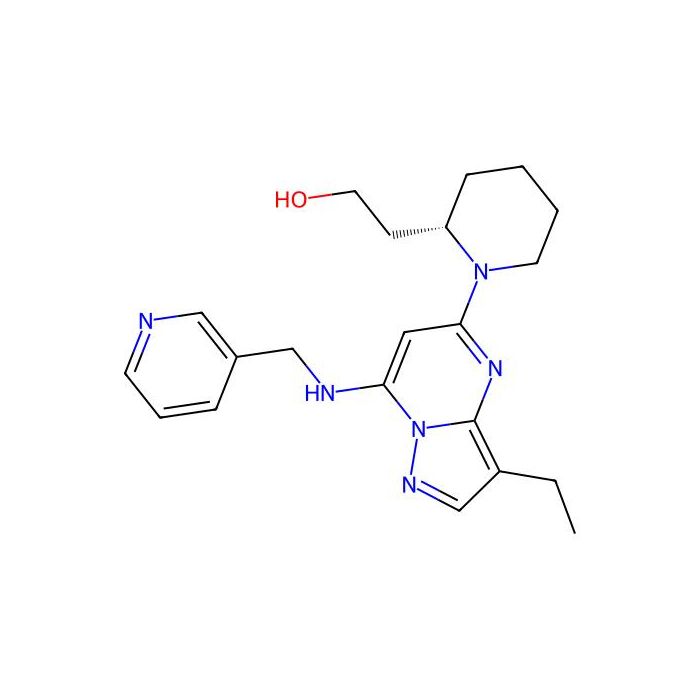
Brief description: CDK-IN-6 is a cataloged small-molecule tool compound annotated as a cyclin-dependent kinase (CDK) inhibitor for research and screening applications.
InChIKey: Not specified for this item; refer to CoA/Spec Sheet.
SMILES: Not specified for this item; refer to CoA/Spec Sheet.
Molecular formula: Not specified for this item; refer to CoA/Spec Sheet.
Molecular weight: Not specified for this item; refer to CoA/Spec Sheet.
Structural features (general, literature context for CDK inhibitors; not item-specific):
Many CDK inhibitors are heteroaromatic, planar to moderately three-dimensional scaffolds containing one or more hydrogen-bond acceptors to engage the kinase hinge, plus substituents occupying hydrophobic pockets (literature, general).
Typical functional elements include: aromatic/heteroaromatic cores, amide/urea/aza-heterocycles for hinge binding, and solubilizing side chains (literature, general).
2D structure description: Not specified for this item. For definitive atom connectivity and stereochemistry, please consult the Certificate of Analysis (CoA) or authoritative databases for CAS 779353-02-5.
Synthetic Utility
CDK-IN-6 is listed as a finalized bioactive small molecule and is not primarily intended as a synthetic building block.
Potential uses in synthesis/analysis (general guidance; not item-specific):
Reference standard: Serve as a comparator in analytical method development (LC–MS/UPLC) for kinase-inhibitor profiling, stability-indicating methods, and impurity tracking.
Derivatization for probes: If the scaffold tolerates modification (unknown for this item), medicinal chemists may design analogs (e.g., photoaffinity tags, biotinylation, click handles) to enable chemoproteomics or cellular target engagement. Such modifications require knowledge of the exact structure and SAR to avoid loss of potency.
Crystallography/NMR: Use as a ligand in protein–ligand complex studies to elucidate binding modes (subject to solubility and affinity). Conditions and buffers must be optimized case-by-case.
Limitations:
Without structural details (SMILES/InChI) provided here, retrosynthetic or reaction-planning guidance cannot be given for this exact compound.
For synthetic exploitation or probe design, obtain the structural record from the CoA or literature associated with CAS 779353-02-5 and verify IP/freedom-to-operate where relevant.
Target Specificity
Item-specific target panel, KD/IC50 values, and selectivity data are not provided in the Product Data.
Catalog annotation and literature context (general):
CDK-IN-6 is described as a cyclin-dependent kinase (CDK) inhibitor tool compound. The CDK family includes CDK1/2/4/6 (cell cycle) and CDK7/8/9/12/13 (transcriptional control), among others.
Without quantitative data, users should not assume specificity toward any single CDK isoform. Cross-screening across a representative kinome panel is recommended to assess off-target liabilities.
Recommendations for establishing specificity (general, not item-specific):
Perform biochemical profiling across multiple CDKs at matched ATP concentrations relative to each kinase’s Km.
Use cellular biomarkers specific to each CDK axis (e.g., pRb for CDK4/6, pHistone H1 for CDK2, Pol II CTD phosphorylation for CDK7/9) with genetic controls.
Build selectivity metrics (e.g., S-score, Gini coefficient) from panel data and confirm in orthogonal formats (thermal shift, CETSA, NanoBRET).
Conclusion: Treat CDK-IN-6 as a putative CDK pathway tool pending verification. Obtain and review any available CoA and literature for CAS 779353-02-5 for definitive target details.
Need help choosing the grade?
Our grade selection guide covers purity, stabilizer status, and application suitability for all variants in our catalog.
We use cookies to ensure the website functions properly and, where permitted, to improve your experience. You can manage your preferences at any time in Settings. Learn more in our Cookie Policy.
Shall we send you a message when we have discounts available?
Remind me later
Thank you! Please check your email inbox to confirm.
Products are supplied to verified businesses, institutions, and qualified professionals for research and development use only. Not for use in humans, animals, diagnosis, or therapy.