
Determine the necessary mass, volume, or concentration for preparing a solution.
| Activity Type | Relation | Activity value | Units | Action Type | Journal | PubMed Id | doi | Assay Aladdin ID |
|---|
94% ベースライン干渉を最小限に抑える必要がある、感度の高いクロマトグラフィーおよび分析ワークフロー向け。
Protected from light,Store at -20°C Ice chest + Ice pads に出荷。正確な仕様については、ロット固有の COA をご確認ください。
SDS、COA、データシート、仕様書をダウンロードできます。ロット固有の COA はロット番号検索で入手可能です。
クロマトグラフィー、有機合成、クロスカップリング反応に関する 67 件の査読済み論文で引用されています。
危険性、取扱い、保管、および規制遵守を網羅した包括的な文書。
<<<<<<< HEAD SDS をダウンロード → ======= SDS をダウンロード → >>>>>>> release248-p3Taxonomy Tree
| Kingdom | Organic compounds |
|---|---|
| Superclass | Organoheterocyclic compounds |
| 分類 | Tetrapyrroles and derivatives |
| Subclass | Chlorins |
| Intermediate Tree Nodes | Not available |
| Direct Parent | Chlorins |
| Alternative Parents | Tricarboxylic acids and derivatives Pyrrole carboxylic acids Substituted pyrroles Heteroaromatic compounds Carboxylic acids Azacyclic compounds Organopnictogen compounds Organonitrogen compounds Organic oxides Hydrocarbon derivatives Carbonyl compounds |
| Molecular Framework | Aromatic heteropolycyclic compounds |
| Substituents | Chlorin - Tricarboxylic acid or derivatives - Pyrrole-3-carboxylic acid - Pyrrole-3-carboxylic acid or derivatives - Substituted pyrrole - Pyrrole - Heteroaromatic compound - Carboxylic acid - Carboxylic acid derivative - Azacycle - Hydrocarbon derivative - Organic oxide - Organopnictogen compound - Organic oxygen compound - Organooxygen compound - Organonitrogen compound - Organic nitrogen compound - Carbonyl group - Aromatic heteropolycyclic compound |
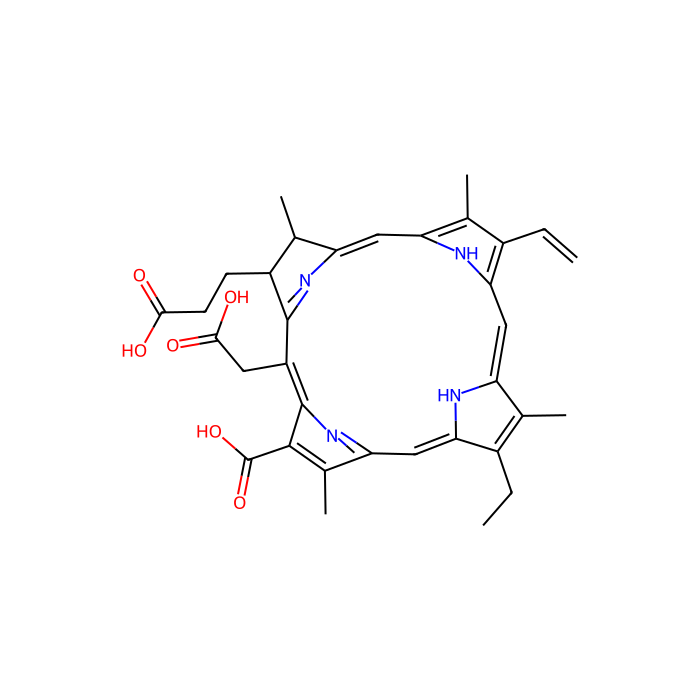
| 説明 | This compound belongs to the class of organic compounds known as chlorins. These are large heterocyclic aromatic ring systems consisting, at the core, of three pyrroles and one pyrroline coupled through four methine linkages. |
| External Descriptors | Not available |
| Activity Type | Relation | Activity value | Units | Action Type | Journal | PubMed Id | doi | Assay Aladdin ID |
|---|
| Activity Type | Relation | Activity value | Units | Action Type | Journal | PubMed Id | doi | Assay Aladdin ID |
|---|
| Activity Type | Relation | Activity value | Units | Action Type | Journal | PubMed Id | doi | Assay Aladdin ID |
|---|
| Activity Type | Relation | Activity value | Units | Action Type | Journal | PubMed Id | doi | Assay Aladdin ID |
|---|
| Activity Type | Relation | Activity value | Units | Action Type | Journal | PubMed Id | doi | Assay Aladdin ID |
|---|
| Activity Type | Relation | Activity value | Units | Action Type | Journal | PubMed Id | doi | Assay Aladdin ID |
|---|
Find and download the COA for your product by matching the lot number on the packaging.
| Lot Number | Certificate Type | 日付 | 商品 |
|---|---|---|---|
 D23061408 | Certificate of Analysis | Jan 21, 2026 | C302680 |
| D23061412 | Certificate of Analysis | Jan 21, 2026 | C302680 |
| D23061419 | Certificate of Analysis | Jan 21, 2026 | C302680 |
| D23061407 | Certificate of Analysis | Mar 21, 2023 | C302680 |
| D23061409 | Certificate of Analysis | Mar 21, 2023 | C302680 |
| D23061410 | Certificate of Analysis | Mar 21, 2023 | C302680 |
| G2312120 | Certificate of Analysis | Mar 21, 2023 | C302680 |
| 感度 | Light sensitive |
|---|---|
| 分子量 | 596.700 g/mol |
| XLogP3 | 4.600 |
| Hydrogen Bond Donor Count | 5 |
| Hydrogen Bond Acceptor Count | 8 |
| Rotatable Bond Count | 8 |
| Exact Mass | 596.263 Da |
| Monoisotopic Mass | 596.263 Da |
| Topological Polar Surface Area | 169.000 Ų |
| Heavy Atom Count | 44 |
| Formal Charge | 0 |
| Complexity | 1090.000 |
| Isotope Atom Count | 0 |
| Defined Atom Stereocenter Count | 2 |
| Undefined Atom Stereocenter Count | 0 |
| Defined Bond Stereocenter Count | 0 |
| Undefined Bond Stereocenter Count | 0 |
| The total count of all stereochemical bonds | 0 |
| Covalently-Bonded Unit Count | 1 |
Item-specific, validated protocols (WB, IHC, IF, FC, etc.) are not provided for this product.
General guidance for preparing working solutions for photochemical experiments (literature; not item-specific):
For assay- or instrument-specific protocols (e.g., fluorescence quantum yield, ROS quantification by DPBF or SOSG), consult peer-reviewed literature and validate under your exact solvent, pH, and pathlength conditions.
General biochemical context (literature; not item-specific or clinical):
Note: This product is for research use only and not intended for diagnostic or therapeutic applications.
Chlorin e6 is not a buffering agent and is not used to set or maintain pH. However, its behavior is strongly influenced by buffer composition (general guidance):
Item-specific buffer recipes, pKa values, and stock solution instructions are not provided for this product; refer to literature protocols and validate for your application.
Assessment relative to greener principles (general literature guidance):
Strengths of chlorin e6:
Considerations:
Alternative photosensitizers (trade-offs, literature):
Comparison snapshot (literature):
Select based on wavelength, medium (water vs organic), and desired pathway (energy transfer vs SET). Dispose of dye-containing waste responsibly.
No pharmacopeial grade or excipient role is specified for this item. This product is supplied strictly for research and laboratory use.
General formulation context (non-clinical, literature/prototyping):
Compliance notes:
For any regulated application, obtain a detailed CoA/Spec Sheet and perform internal qualification (identity, purity, residual solvents, endotoxin/bioburden if relevant to your lab setting).
Item-specific specifications (this lot):
General/literature values (for reference only; not item-specific):
Notes for practical work (general): Dissolve first in dry DMSO or DMF to prepare a concentrated stock, then dilute into the working medium while minimizing light exposure to avoid photobleaching.
Context and implications (general guidance for chlorin e6):
Recommendation: For quantitative photochemistry or materials work, pre-filter solutions (0.2 µm PTFE) and perform a quick HPLC/UV–Vis check to confirm monomeric state before critical experiments.
This compound is primarily used as a visible-light photosensitizer. Under red light (~660 nm) and oxygen, chlorin e6 transfers energy to form singlet oxygen (1O2) and other ROS.
Key application areas (literature/general; not item-specific):
Practical tips:
Note: Avoid medical/clinical uses; this listing is for research/lab photochemistry only.
General conditions for photochemical applications of chlorin e6 (literature guidance; not item-specific specs):
Expected outcomes vary with substrate; literature yields for 1O2 ene oxidations and sulfide oxidations commonly range from moderate to high under optimized conditions.
Item-specific safety information:
General safety considerations for chlorin photosensitizers (literature/practice; not item-specific):
Always consult the current SDS before use.
Chlorin e6 is amphiphilic with three carboxylates and a hydrophobic macrocycle; it exhibits strong solvent-dependent aggregation and photophysics.
Note: Item-specific solubility data are not provided; verify empirically for your matrix.
Item-specific storage and shipping:
General best practices for handling chlorin e6 (not item-specific requirements):
For definitive stability and reconstitution guidance for this lot, consult the CoA/Spec Sheet and SDS.
Chlorin e6 is a chlorophyll-derived chlorin macrocycle bearing three carboxylic acid substituents; widely used as a red-light photosensitizer for singlet-oxygen generation.
Item-specific identifiers (from Product Data):
Research use: For research use only
Storage note (item-specific): Protect from light; store at −20°C
Literature identity data (general reference; not item-specific specs):
SMILES/InChI (literature): Not specified here to avoid inconsistency; consult trusted databases (PubChem CID 5479494) or the CoA/Spec Sheet.
Chlorin e6 provides a versatile platform combining a red-light-harvesting macrocycle with three peripheral carboxylic acids suitable for derivatization and conjugation (literature/general):
Notes:
Not applicable. This product is a small-molecule photosensitizer, not an antibody or affinity reagent.