
Determine the necessary mass, volume, or concentration for preparing a solution.
| Activity Type | Relation | Activity value | Units | Action Type | Journal | PubMed Id | doi | Assay Aladdin ID |
|---|
≥97% for sensitive chromatographic and analytical workflows requiring minimal baseline interference.
Store at -20°C Ships Ice chest + Ice pads Check lot-specific COA for exact specifications.
SDS, COA, datasheet, and spec sheet available for download. Lot-specific COA accessible via lot number lookup.
Cited in 0 peer-reviewed publications across chromatography, organic synthesis, and cross-coupling reactions.
Information
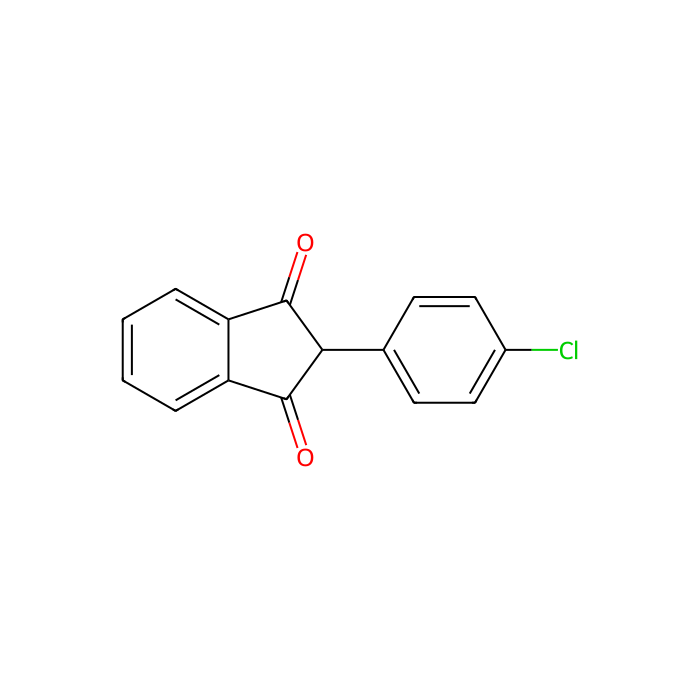
Chlorindione Chlorindione is an antagonist of vitamin K.
Comprehensive hazard, handling, storage, and regulatory compliance document.
Download SDS →Lot-specific quality data. Enter your lot number to retrieve the exact COA.
Look up COA →Full quality attributes and acceptance criteria for this grade.
View spec sheet →Taxonomy Tree
| Kingdom | Organic compounds |
|---|---|
| Superclass | Benzenoids |
| 分類 | Indanes |
| Subclass | Indanones |
| Intermediate Tree Nodes | Not available |
| Direct Parent | Indanediones |
| Alternative Parents | Aryl alkyl ketones Chlorobenzenes Beta-diketones Aryl chlorides Organochlorides Organic oxides Hydrocarbon derivatives |
| Molecular Framework | Aromatic homopolycyclic compounds |
| Substituents | Indanedione - Aryl ketone - Aryl alkyl ketone - Chlorobenzene - Halobenzene - 1,3-diketone - 1,3-dicarbonyl compound - Aryl chloride - Monocyclic benzene moiety - Aryl halide - Ketone - Organooxygen compound - Organochloride - Organohalogen compound - Organic oxygen compound - Organic oxide - Hydrocarbon derivative - Aromatic homopolycyclic compound |
| 説明 | This compound belongs to the class of organic compounds known as indanediones. These are compounds containing an indane ring bearing two ketone groups. |
| External Descriptors | Not available |
| Activity Type | Relation | Activity value | Units | Action Type | Journal | PubMed Id | doi | Assay Aladdin ID |
|---|
| Activity Type | Relation | Activity value | Units | Action Type | Journal | PubMed Id | doi | Assay Aladdin ID |
|---|
| Activity Type | Relation | Activity value | Units | Action Type | Journal | PubMed Id | doi | Assay Aladdin ID |
|---|
| Activity Type | Relation | Activity value | Units | Action Type | Journal | PubMed Id | doi | Assay Aladdin ID |
|---|
| Activity Type | Relation | Activity value | Units | Action Type | Journal | PubMed Id | doi | Assay Aladdin ID |
|---|
| Activity Type | Relation | Activity value | Units | Action Type | Journal | PubMed Id | doi | Assay Aladdin ID |
|---|
| Activity Type | Relation | Activity value | Units | Action Type | Journal | PubMed Id | doi | Assay Aladdin ID |
|---|
| Activity Type | Relation | Activity value | Units | Action Type | Journal | PubMed Id | doi | Assay Aladdin ID |
|---|
| Activity Type | Relation | Activity value | Units | Action Type | Journal | PubMed Id | doi | Assay Aladdin ID |
|---|
| Activity Type | Relation | Activity value | Units | Action Type | Journal | PubMed Id | doi | Assay Aladdin ID |
|---|
| Activity Type | Relation | Activity value | Units | Action Type | Journal | PubMed Id | doi | Assay Aladdin ID |
|---|
| Activity Type | Relation | Activity value | Units | Action Type | Journal | PubMed Id | doi | Assay Aladdin ID |
|---|
| Activity Type | Relation | Activity value | Units | Action Type | Journal | PubMed Id | doi | Assay Aladdin ID |
|---|
| Activity Type | Relation | Activity value | Units | Action Type | Journal | PubMed Id | doi | Assay Aladdin ID |
|---|
| Activity Type | Relation | Activity value | Units | Action Type | Journal | PubMed Id | doi | Assay Aladdin ID |
|---|
Find and download the COA for your product by matching the lot number on the packaging.
| Lot Number | Certificate Type | 日付 | 商品 |
|---|---|---|---|
 G2303352 | Certificate of Analysis | Jun 09, 2023 | C413309 |
| G2303363 | Certificate of Analysis | Jun 09, 2023 | C413309 |
| G2303364 | Certificate of Analysis | Jun 09, 2023 | C413309 |
| G2303382 | Certificate of Analysis | Jun 09, 2023 | C413309 |
| 溶解度 | Solubility (25°C) In vitro |
|---|---|
| 分子量 | 256.680 g/mol |
| XLogP3 | 3.500 |
| Hydrogen Bond Donor Count | 0 |
| Hydrogen Bond Acceptor Count | 2 |
| Rotatable Bond Count | 1 |
| Exact Mass | 256.029 Da |
| Monoisotopic Mass | 256.029 Da |
| Topological Polar Surface Area | 34.100 Ų |
| Heavy Atom Count | 18 |
| Formal Charge | 0 |
| Complexity | 334.000 |
| Isotope Atom Count | 0 |
| Defined Atom Stereocenter Count | 0 |
| Undefined Atom Stereocenter Count | 0 |
| Defined Bond Stereocenter Count | 0 |
| Undefined Bond Stereocenter Count | 0 |
| The total count of all stereochemical bonds | 0 |
| Covalently-Bonded Unit Count | 1 |
No tested or validated application protocols (e.g., specific assay formats, recommended dilutions, or analytical methods) are provided for this item in the Product Data.
General laboratory guidance (literature/general):
For detailed, validated protocols tailored to your application, perform preliminary solubility/stability testing and consult the primary literature on indandione‑based tool compounds.
Note: The following describes mechanistic/biochemical context only. This product is for research use only and is not for clinical or diagnostic use.
Vitamin K cycle interference (literature/general): Chlorindione belongs to the indandione class of vitamin K antagonists. Compounds in this class are used as tool molecules to probe the vitamin K epoxide/quinone reduction pathway catalyzed by vitamin K epoxide reductase (VKOR). Inhibition of VKOR decreases regeneration of reduced vitamin K, thereby suppressing γ‑glutamyl carboxylation in model systems.
Protein post‑translational modification studies: By limiting reduced vitamin K availability, chlorindione can be employed to modulate the enzymatic γ‑carboxylation of glutamate residues in in vitro assays, enabling investigation of cofactor dependence, enzyme kinetics, and structure–activity relationships.
ADME‑relevant traits (literature/general): The aromatic/halogenated scaffold implies moderate lipophilicity and potential plasma protein affinity in biochemical milieu; these features affect in vitro binding assays and partitioning in cell‑free systems. Such properties should be characterized empirically for a given assay format (e.g., nonspecific binding to plastics vs. serum proteins).
Off‑target considerations: Indandione scaffolds can interact with other redox or carbonyl‑binding proteins in biochemical panels. Orthogonal controls and counter‑screens are recommended in chemical biology experiments.
Always implement appropriate controls (vehicle, inactive analogs) and confirm findings with complementary methods.
Chlorindione is not a buffering agent and is not used to prepare pH buffer systems. For biochemical assays where chlorindione is evaluated as a tool compound:
For buffer recipes, pKa values, and capacity calculations, refer to the documentation of the chosen buffering agent; these parameters are not intrinsic to chlorindione.
This section is primarily relevant to solvents and high‑volume auxiliaries. Chlorindione is a research compound (solid) rather than a process solvent or reagent used in bulk quantities, so “green substitution” typically focuses on the solvent system chosen to dissolve or process it.
Greener handling strategies (literature/general):
Trade‑offs
Conclusion
This product is supplied strictly for research use only and is not intended for human or veterinary use.
Research/formulation context (literature/general):
No pharmacopeial monograph or compendial excipient role is claimed in this listing. Any development‑oriented work should be confined to nonclinical laboratory experiments.
Item-specific physicochemical specifications (BP, MP, density, UV cutoff, water/peroxide/metal limits, etc.): Not specified for this item; refer to CoA/Spec Sheet.
General/literature expectations for chlorindione and related 2‑aryl‑1,3‑indandiones (for informational context only):
Notes
How to interpret grades and documentation (general guidance):
Documentation to request/consult:
Applications emphasized for this catalog item: Manufacturer applications were not provided; content below reflects general/literature uses of chlorindione in research chemistry.
Chemical biology tool compound (literature/general): Chlorindione is a member of the vitamin K antagonist class (indandiones), widely used as a reference inhibitor for studying the vitamin K cycle (e.g., enzymology of vitamin K epoxide reductase, VKOR) and post‑translational γ‑carboxylation of glutamate residues in model systems.
Coordination/chelation chemistry: The 1,3‑diketone motif can engage in keto–enol tautomerism and chelate certain metal ions in model complexes, enabling spectroscopic probes or crystallographic standards. Aryl substitution modulates acidity and binding.
Materials/dye chemistry (by analogy to indandione scaffolds): Although many dye syntheses employ unsubstituted 1,3‑indandione as a Michael donor/acceptor in push–pull chromophores, chlorindione’s para‑chloroaryl substituent tunes electron distribution and has been explored in structure–property studies of conjugated systems (literature/general). Suitability should be assessed case‑by‑case due to reduced reactivity at C‑2.
Analytics and standards: Serves as a small‑molecule reference in chromatographic and spectroscopic method development for indandione‑type chemotypes.
Practical notes
No item‑specific reaction condition data are provided for this catalog entry. The following general literature guidance may assist in planning transformations involving chlorindione or its aryl chloride motif:
Cross‑coupling at the para‑chloro aryl group (literature/general):
Enolate/O‑alkylation on the 1,3‑diketone (literature/general):
Crystallization and purification:
All parameters above are general literature starting points; optimize for your substrate and scale. Always consult primary literature and conduct small‑scale trials.
Safety designations specific to this catalog entry:
General handling guidance for indandione‑type aromatic diketones (literature/general; not a substitute for SDS):
Chlorindione is a neutral aromatic 1,3‑diketone solid. Solvent choice is driven by the need to dissolve it efficiently for synthesis or biochemical assays while maintaining stability.
Polarity/miscibility (literature/general):
Typical use scenarios
When to choose alternatives
Practical tips
Solid handling (general):
Reconstitution (general/literature guidance):
Stability
Brief description: Chlorindione is a 1,3‑indandione derivative bearing a para‑chlorophenyl substituent at the 2‑position; it belongs to the vitamin K antagonist chemotype (indanedione class) and is supplied for research use only.
Product identifiers (from Product Data)
Molecular descriptors
Structural features (general/literature description)
Chlorindione offers a 1,3‑indandione core appended with a para‑chlorophenyl group, providing a well‑defined chromophore and a platform for structure–activity or materials studies.
Key reactivity considerations (literature/general):
Use cases
Purification/analysis tips
This section is typically applicable to biologics (e.g., antibodies) or target‑validated tool compounds with documented binding data provided by the supplier. For this listing, no target specificity, binding constants, or selectivity panels are provided in the Product Data.
General note (literature/context): Chlorindione is widely recognized in the literature as a vitamin K cycle antagonist scaffold used to probe VKOR activity in biochemical systems. However, this catalog entry does not include item‑specific affinity data, selectivity profiles, or validated targets. Please consult primary literature and perform in‑house assays to establish specificity in your system.