グレード&純度Carrier Free?Carrier-free — supplied without added carrier protein/stabilizer. Use when carriers (e.g. BSA) would interfere with conjugation or sensitive assays.ExactAb™?ExactAb™ — Aladdin's antibody line emphasizing precision and validated quality. Use for reliable, specificity-validated antibody applications.Validated?Validated grade — performance confirmed in defined applications before release. Use when you want documented assurance the reagent works as stated.1.0 mg/mL
Rabbit anti Human CHST3 Antibody, Polyclonal, could be used for WB, IHC and so on. Application: WB: 1/500-1/1000 IHC: 1/50-1/100 Protein Function Catalyzes the transfer of sulfate to position 6 of the N-acetylgalactosamine (GalNAc) residue of chondroitin. Chondroitin sulfate constitutes the predominant proteoglycan present in cartilage and is distributed on the surfaces of many cells and extracellular matrices. Can also sulfate Gal residues of keratan sulfate, another glycosaminoglycan, and the Gal residues in sialyl N-acetyllactosamine (sialyl LacNAc) oligosaccharides. May play a role in the maintenance of naive T-lymphocytes in the spleen.
仕様
Product Name
CHST3 Antibody - 一次抗体, specific to CHST3, Rabbit IgG
A synthetic peptide derived from human CHST3 (AA 19-54).
ポジティブコントロール
WB: HEK293 and HeLa cell lysates. IHC: Human gastric cancer tissue. IF/ICC: HeLa cells.
活用
Unconjugated
等級
Carrier Free, ExactAb™, Validated
アイソタイプ
Rabbit IgG
SDS-PAGE
150 kDa
精製方法
Antigen affinity purified
集中
1.0 mg/mL
Product Line
生物製品
保管と配送
形状
Liquid
保管条件
Store at -20°C,Avoid repeated freezing and thawing
入荷
Ice chest + Ice pads
安定性と保管
Store at 4°C short term (1-2 weeks). Store at -20°C long term (24 months). Upon receipt, it is recommended to aliquot. Avoid freeze/thaw cycle.
画像
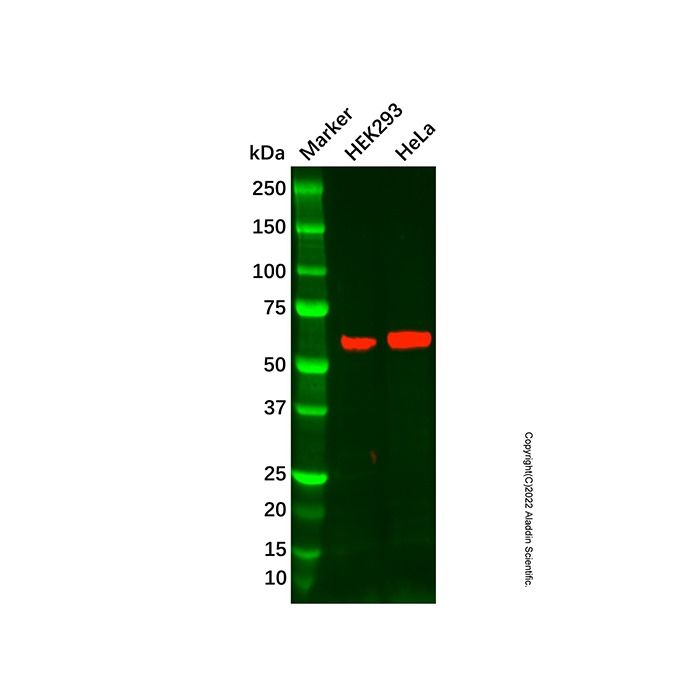
CHST3 Antibody (Ab096486) - Western Blot All lanes: CHST3 Antibody (Ab096486) at 1/1000 dilution Samples: Lysates at 20 µg per lane Secondary: Goat Anti-Rabbit IgG H&L (HRP) (Ab170144) at 1/20000 dilution Predicted band size: 55 kDa Observed band size: 59 kDa Exposure time: 204.0 s
CHST3 Antibody (Ab096486) - IHC Immunohistochemistry analysis of paraffin-embedded Human gastric cancer using CHST3 Antibody (Ab096486). High pressure and temperature Sodium Citrate pH 6.0 was used for antigen retrieval.
CHST3 Antibody (Ab096486) - IF/ICC IF analysis of CHST3 Antibody (Ab096486) in HeLa cells. The cells were fixed and permeabilized with 100% methanol for 5 minutes, and blocked with 5% BSA for 1 hour at room temperature. Cells were stained with CHST3 Antibody (Ab096486) at 1/200 dilution in blocking buffer overnight at 4°C, and then incubated with Goat Anti-Rabbit IgG H&L (AF488) (Ab181954) at a dilution of 1/1000 for 1 hour at room temperature in the dark (green). Cells were counterstained with DAPI (blue).
Determine the necessary mass, volume, or concentration for preparing a solution.
Dilution Calculator
Determine the dilution needed to prepare a stock solution.
Reconstitution Calculator
レビュー
顧客レビュー
Application Protocols
Tested/validated applications for this specific item: Not specified for this item; refer to CoA/Spec Sheet.
General starting-point protocols (to be optimized; not item-specific):
Western Blot (WB): Begin with 1:500–1:2000 primary dilution; adjust based on signal/noise. Use appropriate secondary matching the host/isotype (not specified for this item).
Immunocytochemistry/Immunohistochemistry (ICC/IHC): Start at 1–5 µg/mL or 1:100–1:500; permeabilize for Golgi luminal epitopes.
ELISA: 0.5–2 µg/mL as capture or detection when paired with a complementary antibody.
Immunoprecipitation: 1–5 µg antibody per mg total protein lysate; titrate as needed.
Controls:
Include positive controls (cells/tissues known to express CHST3) and negative controls (isotype control, knockout/knockdown if available). Exact controls for this item are not specified.
Biological Roles
Target overview (CHST3; literature/general):
Gene/protein: CHST3 (Carbohydrate Sulfotransferase 3), also known as chondroitin 6-O-sulfotransferase-1 (C6ST-1), is a type II transmembrane Golgi enzyme.
Function: Catalyzes transfer of sulfate from 3′-phosphoadenosine-5′-phosphosulfate (PAPS) to the 6-hydroxyl of N-acetylgalactosamine residues in chondroitin, generating chondroitin 6-sulfate.
Pathways: Glycosaminoglycan (GAG) biosynthesis and remodeling; influences extracellular matrix properties and cell signaling by modulating proteoglycan sulfation patterns.
Cellular localization: Predominantly Golgi lumen; luminal catalytic domain with a short cytosolic tail (literature).
Expression: Reported in cartilage, nervous system, and other tissues; specific expression levels and isoforms depend on developmental and tissue context (literature).
Relevance for antibody-based studies (general):
Antibodies to CHST3 can support studies of GAG sulfation dynamics, matrix biology, and enzyme localization.
Given the luminal orientation, detection in cells/tissues typically requires fixation and permeabilization; epitope exposure may be sensitive to fixation chemistry.
Note: The exact epitope, species reactivity, and cross-reactivity for this item are not specified; consult the CoA/Spec Sheet.
Buffer Applications
Not typically applicable. This product is an antibody reagent, not a buffering agent.
Practical note:
For optimal performance, select an appropriate assay buffer (e.g., PBS or TBS with or without detergent/blocking proteins) as required by the chosen application. Specific buffer composition for this item is not specified; refer to the CoA/Spec Sheet.
Green Alternatives
Context: Environmental impact with antibody reagents centers on cold-chain shipping, single-use plastics, and buffer/preservative choices rather than solvent hazards.
Greener practices (general recommendations):
Buffer selection: Use phosphate or Tris buffers prepared from concentrates/tablets to reduce packaging waste. Avoid azide where wastewater discharge is a concern; consider short-term storage at 4 °C or glycerol at −20 °C instead.
Cold chain optimization: Consolidate shipments and choose reusable ice packs; verify stability data to avoid unnecessary dry ice shipments. This item is shipped in an ice chest with ice pads per Product Data.
Waste minimization: Aliquot to reduce freeze–thaw-related losses; employ low-bind, recyclable plastics when compatible.
Energy use: Store at the warmest validated temperature (−20 °C for this item) rather than −80 °C when permissible.
Process alternatives: For labeling, use aqueous bioconjugation chemistries (NHS-ester, maleimide) that avoid organic solvents and heavy-metal catalysts.
Tradeoffs:
Preservative-free, carrier-free formulations enhance downstream compatibility but may reduce shelf stability, necessitating more frequent aliquoting and careful handling.
Glycerol addition improves stability at −20 °C but increases carbon footprint and viscosity; balance against reduced sample loss.
Pharmaceutical Uses
Not applicable for therapeutic or clinical use.
General formulation context (research/manufacturing perspective only):
Research-grade antibodies may serve as in-process controls, analytical standards, or critical reagents in bioassays supporting process development.
This item is labeled Carrier Free and Validated for research use; it is not manufactured under GMP, and no pharmacopeial monograph compliance is stated.
No excipient role or clinical formulation details are provided for this product. For any regulated use, procure appropriate GMP-grade materials.
Physical Properties
Item-specific properties from Product Data:
Appearance: Not specified for this item; refer to CoA/Spec Sheet.
Concentration/formulation: Not specified for this item; refer to CoA/Spec Sheet.
Exact molecular weight of the antibody preparation: Not specified for this item; refer to CoA/Spec Sheet.
General/literature properties of IgG-class antibodies (for reference only):
Approximate molecular mass: ~150 kDa for full-length IgG; Fab ~50 kDa; scFv ~25–30 kDa (literature).
Isoelectric point (pI): typically pH 6–9 depending on sequence and glycosylation (literature).
Solubility: readily soluble in aqueous buffers (e.g., PBS, TBS) across pH ~6.5–8.5; salting-out above ~1.5–2 M ammonium sulfate used for purification (literature).
Stability: improved by low temperature, neutral pH, isotonic salts; susceptible to denaturation at extremes of pH, high shear, and repeated freeze–thaw.
Thermal transitions: typical IgG unfolding Tm values ~60–75 °C depending on domain/buffer (literature).
Notes:
No biophysical lot-specific specs (e.g., extinction coefficient, aggregation state, endotoxin, buffer recipe) are provided for this item. Consult the CoA/Spec Sheet for item-specific values.
Quality and Grades
Item-specific quality statements from Product Data:
Grade/Purity: Carrier Free, ExactAb™, Validated.
What these designations generally imply (general explanations; consult CoA for lot-specific metrics):
Carrier Free: The antibody preparation lacks carrier proteins (e.g., BSA), gelatin, or other stabilizing additives. Benefits include improved performance in conjugation (e.g., HRP/fluorophore/biotin labeling), mass spectrometry, and cell-based assays sensitive to exogenous proteins. Tradeoff: potentially lower freeze–thaw stability; handle gently and consider aliquoting.
ExactAb™: Platform/branding indicating controlled recombinant or standardized antibody production and/or sequence-defined reagents for lot-to-lot consistency. Specific production details for this item are not specified; refer to CoA/Spec Sheet for sequence/clonality/host.
Validated: Indicates the antibody has undergone internal testing against defined criteria. The specific validated applications, species reactivity, and performance benchmarks are not specified for this item; refer to CoA/Spec Sheet.
Additional quality considerations (general):
Purity assessment may include SDS-PAGE and SEC for aggregation; binding checked by ELISA or antigen-immobilized methods. These data are not provided here.
Low endotoxin may be preferred for cell work; value not specified for this item.
UV/absorbance specs (A280), residual preservatives (e.g., azide), and buffer recipe are not specified for this item.
Reaction and Applications
Manufacturer Applications: Not specified for this item in the Product Data; see Application Protocols and CoA/Spec Sheet.
General research applications for target-specific antibodies (literature/practice):
Immunoblotting (WB): Detection of denatured antigen in lysates following SDS-PAGE and transfer.
Immunofluorescence/Immunocytochemistry (IF/ICC) and Immunohistochemistry (IHC): Localization of antigen in fixed cells or tissues; fixation/permeabilization method should be optimized for Golgi/transmembrane or luminal proteins if applicable to CHST3.
Immunoprecipitation (IP)/Co-IP: Enrichment of antigen from lysates using Protein A/G supports.
ELISA/αLISA: Quantification of antigen or antibody responses using plate-based capture/detection.
Flow cytometry (if antigen extracellular): Detection on intact or permeabilized cells depending on target topology.
CHST3 is a Golgi-resident sulfotransferase; epitopes may be luminal and often require permeabilization for detection in cells/tissues.
Overexpression or tag-fusion constructs can assist in method development when endogenous levels are low.
Practical tips:
Start with a dilution series to bracket the working range; include positive and negative controls (knockdown/knockout, peptide-blocking where appropriate).
Validate sample preparation (lysis buffer, detergents) to preserve epitope integrity, particularly for glycoproteins.
Reaction Conditions
There are no chemical reaction conditions specific to this item in the Product Data. The following general conditions pertain to antibody-based assays and bioconjugations (literature/practice):
Immunoblot (WB):
Sample: Denatured/reduced lysates (RIPA or SDS lysis). Transfer to PVDF/nitrocellulose.
Primary incubation: 1–16 h at 4–25 °C in blocking buffer (e.g., 5% milk/BSA). Optimize dilution empirically.
Detection: HRP- or fluorescent secondary. Washes in TBST/PBST.
IHC/IF:
Fixation: 4% paraformaldehyde or formalin; for Golgi-resident epitopes, permeabilize (0.1–0.5% Triton X-100 or saponin) and consider antigen retrieval if formalin-fixed paraffin-embedded (FFPE).
Incubations: 1–16 h primary; appropriate secondary with minimal cross-reactivity.
IP/Co-IP:
Lysis: Non-denaturing buffers (e.g., 1% NP-40 or Triton X-100, 150 mM NaCl, 50 mM Tris, pH 7.4).
Capture: Protein A/G beads; 1–4 h at 4 °C with rotation; stringent washes to reduce background.
Bioconjugation (NHS-ester labeling, general):
Buffer: Amine-free (e.g., 50–100 mM NaHCO3, pH 8.3). Avoid Tris/glycine.
Stoichiometry: 2–10 mol dye per mol IgG as a starting point; quench with Tris or ethanolamine; purify by desalting/SEC.
Note: Expected yields, precise dilutions, and validated conditions for this specific item are not provided. Optimize experimentally and consult the CoA/Spec Sheet.
Safety and Handling
Item-specific hazard information from Product Data:
Signal Word: Not specified for this item; refer to SDS.
H-Statements: Not specified for this item; refer to SDS.
GHS Classification/Pictograms: Not specified for this item; refer to SDS.
General safety guidance for laboratory antibodies (research use only):
Handling: Use standard laboratory PPE (lab coat, gloves, safety glasses). Avoid ingestion, inhalation of aerosols, and contact with skin/eyes.
Biosafety: Treat all biological materials as potentially biohazardous. Use aseptic technique to prevent contamination. If of animal origin, follow institutional biosafety procedures.
First aid (general): In case of eye/skin contact, rinse with water. If inhaled, move to fresh air. If ingested, rinse mouth. Seek medical attention if irritation persists. Always consult the SDS for authoritative instructions.
Incompatibilities: Avoid strong oxidizers and extreme pH conditions. Proteins may precipitate in high organic solvent content.
Special risks: Repeated freeze–thaw can cause aggregation and loss of activity; aliquot to minimize cycles.
Regulatory/use note:
For research use only. Not for human or veterinary diagnostic or therapeutic use.
Solvent Selection
Applicability: As a protein bioreagent, this product is intended for use in aqueous media rather than organic solvents.
General guidance (antibody handling; literature/practice):
Primary solvents: physiological buffers such as PBS (pH 7.2–7.4) or TBS (pH 7.4–7.6) support stability and activity.
Additives: For storage or low-concentration work, stabilizers such as 0.05–0.1% nonionic surfactant (Tween-20) and 5–50% glycerol are commonly used to reduce adsorption and freeze damage; avoid if they interfere with downstream assays. Not included in this carrier-free item unless stated on the CoA.
pH/ionic strength: Maintain near-neutral pH and isotonic salt (100–150 mM NaCl) to minimize aggregation.
Avoid: High concentrations of organic solvents (acetonitrile, methanol, DMSO) and extreme pH, which can denature antibodies. If conjugation chemistries require organic cosolvent, keep below ~10–20% and validate compatibility.
When to choose alternatives:
For bioconjugation: carrier-free antibody is preferred over formulations containing BSA/gelatin that compete for coupling sites.
For cell culture or in vivo-like assays (research only): ensure low endotoxin and absence of preservatives; values for this item are not specified—confirm via CoA.
Storage and Reconstitution
Item-specific instructions from Product Data:
Storage Conditions: Store at −20 °C. Avoid repeated freezing and thawing.
Shipped In: Ice chest + Ice pads.
General guidance (antibody handling; adapt to actual formulation on CoA):
Upon receipt: Inspect for container integrity and any visible particulates. Briefly centrifuge to collect liquid from the cap if in solution.
Aliquoting: Divide into single-use aliquots to minimize freeze–thaw cycles. Use low-bind tubes. Record aliquot concentrations.
Short-term storage: 2–8 °C for days to 1–2 weeks may be acceptable for many antibodies; verify on CoA. Avoid microbial contamination.
Frozen storage: −20 °C as specified. For many formulations, addition of 30–50% glycerol enables storage at −20 °C without freezing; not included in this carrier-free item unless stated—add only if compatible with your application.
Thawing: Thaw on ice; mix gently by inversion—do not vortex vigorously. Keep on ice during use.
Reconstitution (if supplied lyophilized; status not specified): Use sterile, neutral pH buffer (e.g., PBS) to the desired concentration. Allow to dissolve at room temperature with gentle agitation; avoid foam. Filter-sterilize (0.22 µm) if required for cell-based assays.
Stability: Working solutions are best prepared fresh. Discard if turbidity, precipitation, or microbial growth is observed.
Documentation:
For exact formulation, concentration, preservative content, and expiration dating, refer to the CoA/Spec Sheet.
Use restriction:
For research use only.
Structure and Identity
Item-specific identifiers from Product Data:
SKU: Ab096486
Product Name: CHST3 Antibody
Grade/Purity: Carrier Free, ExactAb™, Validated
CAS: Not specified for this item; refer to CoA/Spec Sheet.
Molecular Formula: Not specified for this item; refer to CoA/Spec Sheet.
Molecular Weight: Not specified for this item; refer to CoA/Spec Sheet.
SMILES / InChIKey / CID: Not applicable to antibodies; not provided for this item.
Typical research antibodies are immunoglobulins (commonly IgG) composed of two heavy and two light chains linked by disulfide bonds, forming a Y-shaped heterotetramer.
Domains: variable (V) regions that determine antigen specificity, and constant (C) regions that define isotype/effector functions.
Post-translational features: intrachain and interchain disulfides; variable glycosylation on Fc (N-linked at Asn297 for human IgG; literature).
Binding site: paratope formed by complementarity-determining regions (CDRs) located at the tips of the Fab arms.
Notes on CHST3 target (literature, not item-specific specs):
CHST3 encodes chondroitin 6-O-sulfotransferase-1, a Golgi-resident enzyme that transfers sulfate to chondroitin.
Cellular localization of the antigen is typically luminal Golgi; epitope recognized by this antibody is not specified for this item.
Synthetic Utility
Applicability: Antibodies are not synthetic building blocks; however, they are valuable scaffolds for bioconjugation and assay construction.
General utility in chemical biology (literature/practice):
Conjugation handles: Lysine ε-amines for NHS-ester labeling; cysteines (native or reduced/interchain) for maleimide/iodoacetamide chemistry; carbohydrate Fc glycans for periodate-mediated oxime/hydrazone ligation; engineered tags (AzF, Cys, aldehyde tags) for site-specific coupling.
Common payloads: Fluorophores, biotin, enzymes (HRP, AP), haptens, oligonucleotides (for CITE-seq, Proximity Ligation Assays), and drug-linkers (research ADC prototypes).
Immobilization: Capture via Protein A/G/L or covalent coupling to activated matrices (CNBr-agarose, epoxy, NHS resins) for IP/affinity chromatography.
Standards/controls: Use as capture/detection reagents in sandwich ELISA targeting CHST3 or related epitopes (subject to specificity).
Note: This item is Carrier Free, which is advantageous for conjugation because carrier proteins (BSA/gelatin) that compete for reactive chemistries are absent. Specific coupling degree (DOL), buffer composition, and preservative content are not specified for this item; adjust protocols accordingly.
Target Specificity
Item-specific data:
Antigen/epitope: Not specified for this item; refer to CoA/Spec Sheet.
Species reactivity: Not specified for this item; refer to CoA/Spec Sheet.
Clonality/host/isotype: Not specified for this item; refer to CoA/Spec Sheet.
Cross-reactivity/competition: Not specified for this item; refer to CoA/Spec Sheet.
General note (literature): CHST3 refers to chondroitin 6-O-sulfotransferase-1; however, the exact epitope, immunogen format (peptide vs. protein), and species validation for this product are not provided here.
Products are supplied to verified businesses, institutions, and qualified professionals for research and development use only. Not for use in humans, animals, diagnosis, or therapy.