Determine the necessary mass, volume, or concentration for preparing a solution.
Moligand™, 10 mM in Water Moligand™ for sensitive chromatographic and analytical workflows requiring minimal baseline interference.
Store at -80°C Ships Dry ice packs + Cold packs Check lot-specific COA for exact specifications.
SDS, COA, datasheet, and spec sheet available for download. Lot-specific COA accessible via lot number lookup.
Cited in 11 peer-reviewed publications across chromatography, organic synthesis, and cross-coupling reactions.
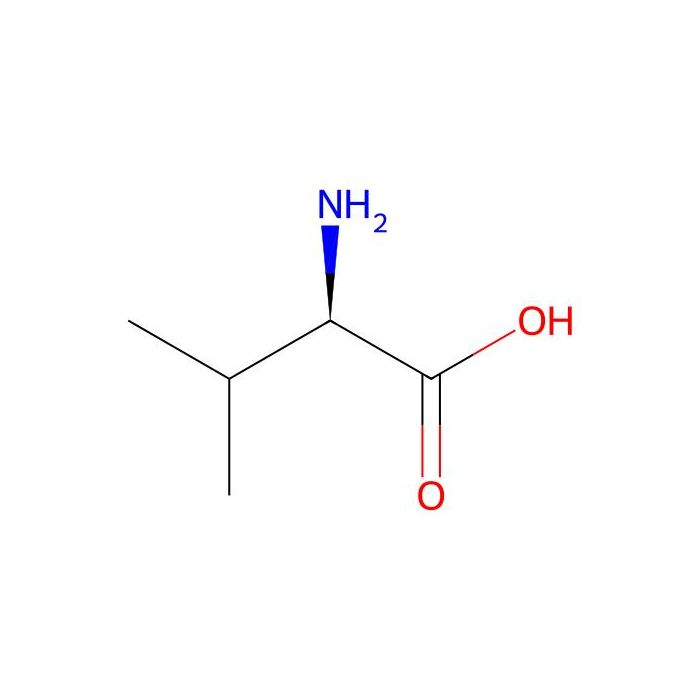
D-Valine is the enantiomer of L-Valine. L-Valine is one of 20 proteinogenic amino acids . L-Valine is an essential amino acid.
| 異性体SMILES | CC(C)[C@H](C(=O)O)N |
|---|---|
| WGKドイツ | 3 |
| RTECS | YV9360000 |
| 分子量 | 117.15 |
| Beilstein | 1721135 |
| Reaxy-Rn | 506689 |
| Reaxys-RN_link_address | https://www.reaxys.com/reaxys/secured/hopinto.do?context=S&query=IDE.XRN=506689&ln= |
Comprehensive hazard, handling, storage, and regulatory compliance document.
Download SDS →Lot-specific quality data. Enter your lot number to retrieve the exact COA.
Look up COA →Full quality attributes and acceptance criteria for this grade.
View spec sheet →| 比旋光度[α] | -27 ° (C=8, 6mol/L HCl) |
|---|---|
| 融点(°C) | 302-303°C |
| 1. Zhiyang Xu, Yinzhou Yan, Xingyuan Wang, Xiaolei Wang, Zhixiang Zhou, Xi Yang, Tianrui Zhai. (2023) Determination of Enantiomeric Excess by Optofluidic Microlaser near Exceptional Point. Advanced Science, [PMID:38072636] [10.1002/advs.202308362] |
| 2. Dan Zhao, Jingjing Huang, Juan Li, Xiao Ma, Fang Wang, Honglei Zhang, Jiaze Xie, Jian Sun, Chuanxia Chen. (2023) Ultrasensitive colorimetric and fluorescent dual-readout assay for D-penicillamine based on the chloride boosted oxidative ability of copper ions. MICROCHEMICAL JOURNAL, [PMID:] [10.1016/j.microc.2023.108535] |
| 3. Li Gao, Piao Xu, Jiaoyan Ren. (2023) A sensitive and economical method for simultaneous determination of D/L- amino acids profile in foods by HPLC-UV: Application in fermented and unfermented foods discrimination. FOOD CHEMISTRY, [PMID:36628920] [10.1016/j.foodchem.2022.135382] |
| 4. Shutong Yang, Liancheng Gu, Fangling Wu, Xinhua Dai, Fuxing Xu, Qiaoyu Li, Xiang Fang, Shaoning Yu, Chuan-Fan Ding. (2022) The chirality determination of amino acids by forming complexes with cyclodextrins and metal ions using ion mobility spectrometry, and a DFT calculation. TALANTA, [PMID:35272154] [10.1016/j.talanta.2022.123363] |
| 5. Jun Zhang, Tingyang Xing, Min Zhang, Yunlong Zhou. (2022) Facile preparation of Cu2-xS supernanoparticles with an unambiguous SERS enhancement mechanism. CHEMICAL ENGINEERING JOURNAL, [PMID:] [10.1016/j.cej.2021.134457] |
| 6. Deng Jun, Wu Sai, Yao Mengyun, Gao Changyou. (2016) Surface-anchored poly(acryloyl-L(D)-valine) with enhanced chirality-selective effect on cellular uptake of gold nanoparticles. Scientific Reports, 6 (1): (1-12). [PMID:27531648] [10.1038/srep31595] |
| 7. Jun Zhang, Kai Wu, Xiaoqing Gao, Min Zhang, Xin Zhou, Florian Bertram, Chen Shen, Yunlong Zhou. (2024) Achiral and chiral ligands synergistically harness chiral self-assembly of inorganics. Science Advances, 10 (42): [PMID:39423258] [10.1126/sciadv.ado5948] |
| 8. Ding Junfeng, Wang Tianran, Lin Zhiqiang, Li Zhenyu, Yang Jiaxuan, Li Fujiang, Rong Yan, Chen Xuesi, He Chaoliang. (2025) Chiral polypeptide hydrogels regulating local immune microenvironment and anti-tumor immune response. Nature Communications, 16 (1): (1-21). [PMID:39890820] [10.1038/s41467-025-56137-w] |
| 9. Lilan Tan, Wenrong Cai, Fangqin Wang, Junyao Li, Datong Wu, Yong Kong. (2024) Postsynthetic Modification Strategy for Constructing Electrochemiluminescence-Active Chiral Covalent Organic Frameworks Performing Efficient Enantioselective Sensing. ANALYTICAL CHEMISTRY, [PMID:38394220] [10.1021/acs.analchem.3c05887] |
| 10. Zhou Mengyan, Zhang Zhihui, Zheng Qi, Yu Mingdi, Si Mengxu, Wu Sirui, Zhang Yanan, Ding Shushu, Fu Ding-Yi. (2025) Ratiometric fluorescence quantification of folic acid utilizing D-penicillamine-based carbon dots in conjunction with glutathione S-transferase-Au nanoclusters. MICROCHIMICA ACTA, 192 (4): (1-13). [PMID:40080078] [10.1007/s00604-025-07062-8] |
| 11. Simin Zhang, Xiangfeng Chen, Yaping Shi, Xiangyu Zhu, Zongwei Cai. (2026) Soft-Chain-Induced Ultrahigh-Resolution Chiral Separation of Amino Acids via Bimetallic Immobilization in MALDI-TIMS-MS. ANALYTICAL CHEMISTRY, [PMID:41701523] [10.1021/acs.analchem.5c07869] |
No vendor-tested biological assay protocols are specified for this item. Typical laboratory uses are synthetic (e.g., peptide coupling after protection) or analytical (e.g., chiral standard preparation). For biochemical applications, users generally:
Item-specific validated protocols and recommended dilutions: Not specified for this item; refer to CoA/Spec Sheet or develop method-specific SOPs.
General literature information (not item-specific, no clinical claims):
These roles inform typical research uses of D‑valine as a stereochemical control, enzyme substrate/standard, and a module for tuning peptide properties.
D‑Valine is not a conventional buffering reagent. Its acid/base centers (pKa ~2.3 and ~9.6; literature) are far apart, and the zwitterionic species predominates near pI (~6.0), yielding weak buffering capacity compared with dedicated Good’s buffers.
Conclusion: D‑valine solutions can be prepared across a range of pH values for experimental needs, but it is not recommended as a primary buffering agent.
For a fundamental chiral building block like D‑valine, the “alternative” question is usually about greener processes and reagents rather than replacing the amino acid itself.
Comparison (general):
Note: Choice must balance EHS gains with solubility and performance of D‑valine derivatives.
No therapeutic claims are made. The following are formulation/manufacturing and synthesis contexts from general literature/practice:
Regulatory note: For research use only (per Product Data). Suitability for cGMP manufacturing or clinical applications is not implied and must be established independently.
Only literature/computed values are provided below; they are NOT specifications for this item.
Always consult the item’s CoA for definitive, lot-specific properties.
For regulated uses or quantitative work, always consult and retain the specific CoA for your lot.
D‑Valine is widely used as a chiral building block and reference standard. Key application families (general/literature):
General literature guidance for common operations with D‑valine and its derivatives (not item-specific specifications):
These conditions are representative starting points; optimize per substrate and scale. Always confirm stereochemical integrity post-reaction.
Always defer to the SDS for definitive hazard classification and response procedures.
D‑Valine is a zwitterionic, hydrophobic amino acid; solvent choice is driven by pH and intended transformation rather than classical polarity scales.
Always follow institutional SOPs and the product CoA/SDS for lot-specific stability and handling guidance.
Brief description: D‑Valine is the D-enantiomer of the branched-chain, aliphatic amino acid valine; a neutral, hydrophobic α‑amino acid used as a chiral building block and reference standard.
D‑Valine is a versatile chiral building block. Key reactivity and transformations (general/literature):
Practical notes:
Not applicable. This product is a small-molecule amino acid, not a biological targeting reagent (e.g., antibody/ligand with defined antigen specificity). No target, clone, or isotype information applies.
Our grade selection guide covers purity, stabilizer status, and application suitability for all variants in our catalog.
View Moligand™ grade guide →