Combine the iodide salt with a complementary cation salt in MeOH/ACN; stir at RT; isolate the desired salt by crystallization or precipitation.
These are generic, literature-style guides. Validate concentrations, timings, and thermal steps for your substrates and device stack.
Biological Roles
This product is intended for research and materials applications; it is not supplied for biological or clinical use.
General context (literature):
Alkylammonium salts can display surfactant-like behavior due to their amphiphilicity, forming micelles or interfacial films in aqueous/organic systems. Such behavior is used in templating and self-assembly rather than biological function.
Decaneammonium iodide has no established endogenous role; it is a synthetic organic salt used as a templating/passivation agent in materials chemistry.
In biochemical environments, primary ammonium salts can engage in electrostatic interactions with anionic biomolecules; however, application of this specific compound in biological systems is uncommon and not recommended without thorough safety and compatibility evaluations.
If a biological experiment is planned (e.g., surface functionalization), ensure:
Cytotoxicity and compatibility are explicitly assessed for the intended cell/tissue model.
Endotoxin and residual solvent levels are controlled where relevant.
No medical claims are made. For any biocompatibility or toxicology details, consult primary literature and conduct appropriate in-house testing.
Buffer Applications
Decaneammonium iodide is not typically used as a biological buffer component. Its amphiphilic, ionic nature and long alkyl chain make it more suitable for interfacial and materials applications than for maintaining physiological pH.
For pH control, choose established buffers (HEPES, PBS, Tris, MOPS, etc.).
If employed in aqueous media, expect surfactant-like effects rather than buffering.
Refer to sections on Solvent Selection and Reaction & Applications for use cases better aligned with this compound’s strengths.
Green Alternatives
Consider both solvent choice and cation/halide selection when designing greener processes.
Greener solvent swaps (literature perspective):
Prefer isopropanol or ethanol over high-boiling amide solvents (DMF) where feasible for film treatments. IPA/EtOH offer lower toxicity, easier recovery, and reduced environmental burden.
When high polarity is essential, acetonitrile can substitute for chlorinated solvents; ensure proper capture and recycling.
Comparison (illustrative, literature):
IPA vs. DMF: similar solvency for many alkylammonium iodides; IPA has lower toxicity and simpler waste handling; DMF provides higher polarity but with occupational health concerns.
Ethanol vs. Methanol: EtOH has a better safety profile; MeOH offers higher volatility but higher toxicity.
Cation/counterion considerations:
Iodide offers strong halide interaction for perovskites but is more prone to light/air oxidation. If your chemistry allows, bromide or chloride analogs may reduce iodine-related hazards, though device performance may differ.
Shorter-chain ammonium salts can reduce persistence and improve water compatibility, at the cost of hydrophobic passivation.
Process intensification:
Use low-solid content and ambient-temperature deposition to lower energy use; adopt closed spin-coating with solvent recovery.
Implement in-line filtration and right-first-time design-of-experiments to reduce rework and waste.
Trade-offs are system-specific; benchmark performance while tracking solvent use, emissions, and operator exposure.
Pharmaceutical Uses
No pharmacopeial status or excipient role is provided for this item. It is offered for research use only.
Context (general/literature):
Long-chain alkylammonium salts can function as phase-transfer agents or surfactants in formulation science, but quaternary ammonium species are more common in such roles. Primary alkylammonium iodides like decaneammonium iodide are mainly used in materials chemistry rather than pharmaceutical manufacturing.
If considering formulation experiments, assess compatibility with actives, counterions, and packaging. Control residual solvent levels and verify impurity profiles.
Conclusion: This product is not supplied or labeled for pharmaceutical or clinical use. Use strictly in research settings.
Physical Properties
Item-specific numeric specifications are not listed. For definitive values (mp/bp/assay/UV cutoff, etc.), consult the CoA/Spec Sheet for this SKU.
Appearance: Not specified for this item; refer to CoA/Spec Sheet.
Melting point, boiling point, density, refractive index: Not specified for this item; refer to CoA/Spec Sheet.
Solubility (general/literature trends):
Expected to be sparingly soluble to moderately soluble in water due to the long C10 chain, but typically soluble in polar organic solvents such as isopropanol, ethanol, methanol, acetonitrile, DMF, DMSO. Solubility increases with temperature and solvent polarity/hydrogen-bonding capability.
Limited solubility in nonpolar hydrocarbons (e.g., hexanes, toluene) because the ionic headgroup is poorly solvated in apolar media.
Hygroscopicity (literature): Many alkylammonium iodides show mild hygroscopic behavior; handle under dry conditions to maintain composition.
Thermal behavior (literature): Organic ammonium iodides may darken upon heating and prolonged air/light exposure due to iodide oxidation to I2; avoid overheating and light.
pKa/logP (context): The conjugate acid (R–NH3+) is a strong cationic species; speciation in solution is dominated by the ammonium salt form in neutral media. Apparent hydrophobicity is governed by the decyl chain, but the ionic character limits partitioning into nonpolar phases unless ion pairing occurs.
Important: Treat any numeric values sourced from secondary literature as context only; rely on your lot-specific documentation for specifications.
Quality and Grades
Grade/Purity: Not specified for this item; refer to CoA/Spec Sheet for assay, residual solvents, and trace metals where applicable.
Guidance for interpreting grades (general):
Research grade alkylammonium salts are typically suitable for synthetic and materials research, including thin-film fabrication and surface treatments.
If specified as electronic/OPV/perovskite grade (not stated here), this usually implies tighter control over metal/halide impurities, particle size, and moisture content to support optoelectronic device performance.
Stabilizers/Inhibitors: None indicated for this item. Some iodide salts are packaged with light protection and inert gas headspace (as here) to mitigate oxidation to iodine.
What is specific to this SKU:
Shipped under normal conditions yet stored protected from light and argon-charged, indicating baseline sensitivity of the iodide to air/light.
In the absence of a declared grade, best practice is to verify assay, water content, and halide identity via the CoA prior to critical uses (e.g., passivation treatments in perovskites).
Recommended incoming QC (user-side, as needed):
NMR (1H/13C) for cation verification; IC or potentiometric titration for iodide content; Karl Fischer for water (if relevant); UV–vis to check iodine background; ICP–MS for trace metals if used in sensitive devices.
Reaction and Applications
Materials-science oriented uses dominate for long-chain alkylammonium iodides.
Perovskite photovoltaics/LEDs (literature):
Serves as a surface passivation and 2D/ quasi-2D templating cation (RNH3+) forming layered phases of the type (RNH3)2PbI4 at interfaces and grain boundaries, reducing trap density and nonradiative recombination.
Post-deposition treatments of 3D perovskite films with alcoholic solutions can enhance open-circuit voltage, reduce hysteresis, and improve operational stability.
Interfacial engineering: The amphiphilic nature (C10 chain + ammonium headgroup) can modulate surface energy, crystallization kinetics, and moisture tolerance in hybrid films.
Colloids/nanocrystals (literature): Organic ammonium iodides can act as surface ligands or ion sources for halide exchange in lead halide perovskite nanocrystals, tuning emission and stability.
Ionic assembly: Useful in layer-by-layer assembly and self-assembled monolayers on halide-containing substrates where ionic binding is desirable.
General synthetic notes:
Keep solutions anhydrous to avoid unwanted hydrolysis or film disruption.
Light-protect during processing to minimize iodide oxidation; brown coloration indicates iodine formation—use fresh solutions.
For ion-exchange or salt metathesis, pair with non-nucleophilic bases/acids to maintain RNH3+ form as needed.
These applications are presented as literature guidance. Optimize concentration, solvent choice, and processing parameters for your specific device architecture.
Reaction Conditions
The following are literature-style starting points; optimize for your system. These are not product specifications.
Perovskite surface treatment (post-deposition):
Solvent: Isopropanol or ethanol.
Concentration: 1–10 mg/mL of decaneammonium iodide.
Application: Spin-coat 2000–4000 rpm for 20–40 s, or dynamic dispense during spinning; alternatively, brief dip-coating.
Anneal: 80–100 C for 5–10 min in dry air or N2 glovebox.
Expected outcome: Formation of a thin RNH3+ passivation layer; monitor via PL/QE and XPS.
Quasi-2D perovskite precursor blending:
Mix small molar fractions of RNH3+ I− into standard ABX3 precursor inks (e.g., FAI/MAI + PbI2) in DMF/DMSO or ACN systems; total solid content 0.8–1.4 M (as halide equivalents) with additive at 1–10 mol% relative to A-site cations. Spin parameters per device stack.
Nanocrystal surface treatment:
Solvent: ACN/IPA mixtures; add dropwise to nanocrystal dispersion under inert atmosphere.
Contact time: 10–120 s; quench and purify to avoid over-stripping.
Controls/analytics:
Monitor iodine evolution (UV–vis at ~290–360 nm for I3−) as an oxidation indicator; prepare fresh solutions as needed.
Verify film morphology via AFM/SEM; check phase formation with GIWAXS/XRD.
All conditions require system-specific tuning.
Safety and Handling
Follow prudent laboratory practices. This product is for research use only.
GHS/CLP: Not specified for this item; refer to SDS for authoritative classification, pictograms, and H-/P-statements.
General hazards (literature/context): Alkylammonium iodides are commonly classified as irritants. Iodide salts can liberate iodine upon oxidation, leading to brown discoloration.
Storage conditions (item-specific):
Protected from light
Room temperature
Argon charged (store under inert gas)
Incompatibilities: Strong oxidizers (risk of iodide → iodine), strong bases/acids may change speciation; moisture may cause caking and affect mass-by-weighing accuracy. Avoid contact with nitrites in acidic media (general amine precaution).
PPE: Lab coat, nitrile gloves, safety glasses. Use in a fume hood when weighing or preparing solutions to minimize dust/aerosol exposure.
Handling tips:
Open containers briefly and under inert atmosphere where possible.
Minimize light exposure; re-purge headspace with argon/nitrogen after use.
Use dry tools and pre-dried glassware to limit moisture uptake.
First aid (overview; defer to SDS):
Skin/eye contact: Rinse with water for ≥15 minutes; remove contaminated clothing; seek medical attention if irritation persists.
Inhalation: Move to fresh air; seek medical advice if symptoms occur.
Ingestion: Rinse mouth; do not induce vomiting; seek medical attention.
Waste: Collect iodide-containing waste in halide/amine-compatible containers; dispose per institutional and local regulations.
Solvent Selection
Decaneammonium iodide is an ionic organic salt with a hydrophobic C10 chain and a cationic headgroup.
Preferred solvents (literature): Isopropanol (IPA), ethanol, methanol, acetonitrile, DMF, DMSO. Solubility tends to increase in alcohols and dipolar aprotics; water solubility is reduced relative to short-chain analogs due to the decyl chain.
Limited/poor solvents: Alkanes, toluene, chlorinated hydrocarbons; the ionic headgroup is poorly solvated.
Film-processing contexts: In perovskite post-treatments, IPA or ethanol are often chosen for benign interaction with the underlying film; acetonitrile is also common for antisolvent-compatible processes (literature).
Small comparison (literature tendencies):
IPA (ε ≈ 18): Good solubility, gentle on perovskite films, slower evaporation aids uniformity.
Acetonitrile (ε ≈ 37): Good solubility, fast evaporation for rapid processing; can require antisolvent control.
Methanol/Ethanol: High solvating power; risk of over-interaction with some halide perovskites; requires optimization.
Practical tips:
Warm solvent (30–40 C) and mild sonication can aid dissolution.
Filter solutions (0.2 μm PTFE) before spin-coating or drop-casting.
Avoid aqueous media when hydrophobic assembly (e.g., 2D capping layers) is desired; water can disrupt film morphology.
Storage and Reconstitution
Item-specific storage guidance:
Protected from light
Room temperature
Argon charged
Shipped in: Normal conditions
Best practices:
Store tightly closed in the original light-protective container. After each use, re-purge headspace with inert gas (Ar/N2) to mitigate iodide oxidation.
Keep in a dry environment; use desiccant in secondary containment if ambient humidity is high.
Reconstitution and solution handling (general):
Prepare solutions in dry IPA, ethanol, acetonitrile, DMF, or DMSO as needed for your application.
Target concentrations commonly used in materials processing are 1–10 mg/mL (literature); filter through a 0.2 μm PTFE syringe filter before thin-film deposition.
Use freshly prepared solutions when possible; store working solutions in amber vials under inert gas at room temperature or 2–8 C and use within a few days, monitoring for discoloration (iodine formation).
Stability notes:
Brown/purple tint indicates iodine generation; discard and prepare fresh.
Avoid repeated freeze–thaw of solutions; split into aliquots if cold storage is required.
For definitive stability, shelf life, and any lot-specific instructions, consult the CoA and SDS provided with this product.
Structure and Identity
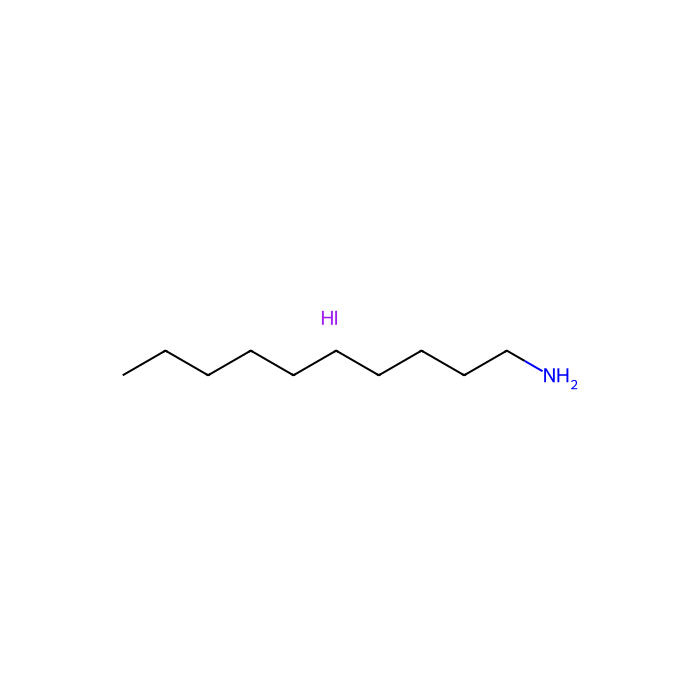
Decaneammonium iodide is an alkylammonium halide salt positioned for materials-science applications (e.g., organic–inorganic hybrid perovskites and interfacial engineering).
SKU: D292748
Product Name: Decaneammonium iodide
CAS: 60734-65-8
PubChem CID: 130406689
InChIKey (as provided): 9930
SMILES: Not specified for this item; refer to CoA/Spec Sheet.
Molecular Formula: Not specified for this item; refer to CoA/Spec Sheet.
Molecular Weight: Not specified for this item; refer to CoA/Spec Sheet.
Structural features (general/literature description):
Functional groups: Primary ammonium cation (–NH3+) paired with iodide (I−) as the counterion.
Alkyl chain: A linear C10 hydrocarbon chain (decyl-) attached to the ammonium nitrogen; the long chain imparts hydrophobic character and interfacial activity.
Ion pairing: Exists as a crystalline organic salt; degree of ion pairing depends on solvent polarity.
2D depiction in words: A straight decyl chain terminating at a positively charged ammonium headgroup (–CH2–NH3+), electrostatically associated with iodide (I−) in proximity.
Notes on identity (literature/computed context):
The name “decaneammonium iodide” is commonly used interchangeably with “decylammonium iodide” in materials chemistry to denote an alkylammonium (C10) iodide used as a templating/passivating cation. Exact stereochemistry is not applicable (no stereocenters). When absolute structural confirmation is required (e.g., NMR assignment of the cation), refer to the certificate of analysis (CoA) provided for this lot.
Synthetic Utility
Functional profile:
Cationic headgroup (R–NH3+): Provides strong ionic interactions with halide-containing solids and surfaces, enabling templating, passivation, and ion exchange.
C10 hydrophobic tail: Drives self-assembly and surface energy modification, useful for forming ordered interfacial layers.
Applications (literature):
2D/Quasi-2D perovskite formation: Reaction of RNH3+ I− with lead iodide-rich surfaces yields layered phases (RNH3)2PbI4 at film interfaces.
Ligand exchange on perovskite nanocrystals: Partial replacement of native ligands with RNH3+ I− can modulate optical properties and stability.
Salt metathesis: As an iodide source in organic or materials syntheses where iodide is required under mild conditions.
Retrosynthetic/value considerations:
The ammonium salt can be deprotonated (base) to afford the free amine (decylamine) in situ for coupling reactions (amide formation, urea/thiourea assembly), while the iodide counterion can participate in halide exchange chemistry. Control pH to drive the desired speciation.
Practical notes:
Maintain anhydrous, oxygen-low conditions to minimize iodide oxidation.
Use alcohols or acetonitrile for homogeneous processing; filter before thin-film applications.
For nanocrystal work, titrate carefully to avoid over-passivation and photoluminescence quenching.
Target Specificity
Not applicable. This product is a small-molecule/ionic reagent, not a biological targeting agent or antibody.
Antigen/epitope, species reactivity, clone, and isotype: Not applicable.
For application-oriented specificity within materials systems (e.g., perovskites), see Reaction & Applications and Synthetic Utility.
よくある質問
How should this product be stored?
Store at room temperature, protected from light, under argon. It is supplied under an argon blanket; reseal under inert gas after each use.
How is this product shipped?
This product ships under standard ambient conditions. No temperature-controlled packaging is required.
What are the CAS number, molecular formula and molecular weight?
The CAS Number is 60734-65-8, the molecular formula is C10H24IN, and the molecular weight is 285.21 g/mol. InChIKey ANGXTHKGHPNXFR-UHFFFAOYSA-N.
What documentation is provided?
Available product documentation, including Certificates of Analysis (COA), Safety Data Sheets (SDS), and specification sheets, is shown in the product document area. Document availability and access follow the current site policy.
Products are supplied to verified businesses, institutions, and qualified professionals for research and development use only. Not for use in humans, animals, diagnosis, or therapy.

 B2309841