グレード&純度Moligand™?Moligand™ — Aladdin's line of ligands and bioactive small molecules. Use for receptor, pathway, and binding studies needing defined small-molecule tools.10 mM in DMSO
Determine the necessary mass, volume, or concentration for preparing a solution.
Dilution Calculator
Determine the dilution needed to prepare a stock solution.
Reconstitution Calculator
レビュー
顧客レビュー
Application Protocols
Item-specific
No validated application protocols are provided for this item.
General research-use guidance (not product-validated; adapt as needed)
DMSO stock preparation: weigh compound quickly to minimize moisture uptake; dissolve in anhydrous DMSO to a convenient concentration (e.g., 10–50 mM). Vortex and, if needed, sonicate briefly.
Working solution: dilute stock into pre-warmed assay buffer or culture medium under mixing to the desired final concentration, matching DMSO content across controls. Filter through 0.2 µm if particulate forms.
Storage of aliquots: dispense single-use aliquots to avoid repeated freeze–thaw. Record preparation date, concentration, and solvent lot.
Note: Users should develop and validate protocols under their specific assay conditions; consult peer-reviewed literature for assay-specific parameters.
Biological Roles
Scope
The following summarizes general, literature-based context for benzimidazole probes like DMAT in biochemical research. It does not constitute medical or clinical guidance.
Literature context
CK2 pathway studies: DMAT is frequently referenced as a small-molecule inhibitor used to interrogate protein kinase CK2 signaling in vitro and in cell systems, supporting studies of phosphorylation networks, proteostasis, and transcriptional regulation.
Probe characteristics: as a polybrominated benzimidazole with a basic dimethylamino substituent, DMAT exhibits target engagement profiles influenced by halogen bonding, π–π stacking, and heteroatom H-bonding within kinase ATP-binding sites (general SAR rationale from benzimidazole chemotypes).
Selectivity considerations: literature reports note that benzimidazole-based CK2 probes can display off-target effects at higher concentrations; confirm target engagement with orthogonal methods (e.g., genetic knockdown, chemoproteomics) and include appropriate counter-screens.
Item-specific
No biological activity specifications are provided in the Product Data for this specific item. Performance and selectivity should be established under the user’s assay conditions.
Buffer Applications
Applicability
DMAT is not a buffering agent. However, it is commonly administered to biochemical or cell-based assays in buffered media.
Practical guidance (general)
Stock solutions: prepare in anhydrous DMSO. Immediately before use, dilute into assay buffer (e.g., PBS, HBSS, HEPES-buffered media) while maintaining a consistent final DMSO percentage across treatment and control wells.
Solubilization tips: add DMAT stock last, under mixing, to minimize precipitation. If needed, include a small amount of a permissible solubilizing excipient (e.g., 0.01–0.1% nonionic surfactant) consistent with your assay’s tolerance.
pH considerations: typical biological buffers at pH 7.2–7.6 are suitable; the compound is a weak base and is not expected to significantly perturb buffer capacity at working micromolar concentrations.
Item-specific
No buffer recipes or stability-in-buffer data are provided for this item; Not specified—determine stability/solubility empirically in your assay matrix.
Green Alternatives
Context
As a research probe/ligand candidate, DMAT itself is a target molecule rather than a process solvent. Green considerations primarily concern solvent selection and synthetic routes.
Greener choices (general guidance)
Solvent substitution for synthesis: replace DMF/DMAc/NMP with 2-methyltetrahydrofuran (2-MeTHF), cyclopentyl methyl ether (CPME), or propylene carbonate where catalysis permits.
Aryl bromide couplings: aqueous micellar catalysis (e.g., TPGS-750-M) or ethanol/water blends can reduce environmental footprint versus purely aprotic media, depending on solubility and catalyst system.
Base selection: inorganic bases with lower EHS concerns (K3PO4, K2CO3) may substitute for stronger/less green bases if reactivity is retained.
Trade-offs
High-halogen scaffolds like DMAT often have limited solubility in greener, low-polarity media; achieving reaction rates comparable to DMF/DMSO may require higher temperatures, specialized ligands, or surfactant systems.
Greener: 2-MeTHF, CPME, water/ethanol (reduced hazard; possible solubility and rate limitations).
Item-specific
No process route or solvent mandate is specified for this item; adapt green strategies to your catalyst/substrate set and verify performance experimentally.
Pharmaceutical Uses
Scope
This product is supplied strictly for research use only. No claims are made regarding therapeutic use, GMP status, or pharmacopeial compliance.
Formulation-related context (general)
As a discovery-stage small molecule, DMAT may be used to inform early SAR and ADME profiling. Any preformulation work is exploratory and non-clinical.
Typical research formulations: DMSO stock solutions for in vitro use; for non-clinical in vivo exploratory studies (if undertaken under institutional approval), co-solvent systems or nano-suspensions are often evaluated to address low aqueous solubility. Users must develop and validate their own vehicles.
Item-specific
No pharmacopeial monographs, excipient roles, or clinical formulation details are provided for this item; Not specified for this item.
Physical Properties
Item-specific specifications
Appearance: Not specified for this item; refer to CoA/Spec Sheet.
Molecular formula (item-specific): Not specified for this item; refer to CoA/Spec Sheet.
Molecular weight (item-specific): Not specified for this item; refer to CoA/Spec Sheet.
Literature/general reference values (for context; not product specifications)
Physical state: typically a solid aromatic heterocycle (literature).
Solubility: commonly soluble in polar aprotic organic solvents (e.g., DMSO, DMF) and sparingly soluble in water; working stocks for screening are routinely prepared in anhydrous DMSO (literature practice).
Acid/base: contains a benzimidazole N–H (weakly acidic) and a tertiary dimethylamino group (basic); overall behavior in water is that of a weak base with limited aqueous solubility unless protonated (literature).
Notes
No item-specific values for mp/bp, density, logP, refractive index, or UV cutoff are provided; Not specified for this item—consult the CoA/Spec Sheet for lot-specific data if available.
Quality and Grades
Item-specific
Grade: Moligand™. This designation indicates suitability for screening and ligand-discovery workflows in research settings. It does not imply pharmacopeial compliance.
What the grade means (general guidance)
Moligand™-type offerings are typically curated for small-molecule libraries, cheminformatics, and probe discovery, emphasizing structural integrity and compatibility with high-throughput screening (HTS) formats. Typical expectations include:
Verified identity (e.g., by MS/NMR) and high purity appropriate for research screening.
Packaging amenable to preparation of DMSO stock solutions.
No claim of GMP manufacture or clinical use.
Stabilizers/additives
None specified for this item; refer to CoA/Spec Sheet for any stabilizers or salt forms.
Analytical notes (general)
For assay reproducibility, users often verify purity by LC–MS or HPLC and confirm identity by HRMS/1H NMR upon receipt, especially for halogen-rich heteroaromatics that may present multiple isotopic patterns.
If UV transparency is relevant (e.g., photophysical studies), determine actual UV–Vis profile for your lot; Not specified for this item.
Reaction and Applications
Manufacturer applications
Not provided beyond classification as a small-molecule library member. This product is intended for research use only.
Literature research applications (context; non-clinical)
DMAT is widely cited as a research-grade chemical probe for studying protein kinase CK2 signaling in biochemical and cell-based assays, aiding target validation and pathway dissection.
Synthetic chemistry applications (general)
Diversification platform: the 4,5,6,7-tetrabrominated benzimidazole core offers multiple orthogonal C–Br sites for cross-coupling (Suzuki–Miyaura, Buchwald–Hartwig, Sonogashira, Stille). Sequential or selective couplings can furnish libraries of polyarylated/heteroarylated analogs for SAR.
N-Functionalization: benzimidazole N–H can be alkylated or protected; site-selective N-arylation is achievable under Cu or Pd catalysis with tailored ligands.
Late-stage modifications: halogen–lithium exchange or Ni-catalyzed activation can enable transformations where Pd is sluggish, though functional-group compatibility must be assessed.
Practical tips (general)
Use rigorously anhydrous conditions for organometallic steps; water suppresses cross-coupling efficiency.
Control temperature and ligand choice to balance chemoselectivity across the four C–Br positions; sterics/electronics often favor coupling at the most activated site first.
For assay use, minimize freeze–thaw of DMSO stocks and filter working solutions (0.2 µm) to avoid particulates.
Reaction Conditions
General conditions reported in literature for similar tetrabrominated benzimidazoles (guidance only; optimize per substrate):
Suzuki–Miyaura couplings
Catalyst: Pd(dppf)Cl2·DCM (1–3 mol%) or Pd2(dba)3 with SPhos/XPhos.
Base: K3PO4 or Cs2CO3 (2–3 equiv).
Solvent: 1,4-dioxane/H2O (3:1) or toluene/H2O; 80–110°C; 4–18 h.
Notes: sequential couplings possible; more activated positions typically react first.
Buchwald–Hartwig amination
Catalyst/ligand: Pd2(dba)3 (1–2 mol%) with BINAP/BrettPhos.
Base: NaOtBu or K3PO4.
Solvent: toluene, dioxane, or CPME; 80–110°C; 6–20 h.
Notes: benzimidazole N–H may require protection or bases that avoid N-deprotonation side pathways.
Sonogashira coupling
Catalyst: Pd(PPh3)2Cl2 (1–2 mol%) + CuI (5–10 mol%).
Base: Et3N or i-Pr2NEt.
Solvent: DMF, THF, or 2-MeTHF; rt–80°C; 4–16 h.
N-alkylation (benzimidazole)
Base: K2CO3 or Cs2CO3.
Electrophile: alkyl halide.
Solvent: DMF or acetonitrile; 25–60°C; 2–12 h.
Expected outcomes
Depending on substitution pattern and conditions, isolated yields for individual couplings typically range 50–90% in literature reports. Careful chromatography is often required due to closely related poly-substituted isomers.
Note: No item-specific reaction data are provided; treat the above as general literature guidance.
Safety and Handling
Item-specific hazard data
Signal word: Not specified for this item; refer to SDS.
H-statements: Not specified for this item; refer to SDS.
GHS classification/pictograms: Not specified for this item; refer to SDS.
General laboratory safety guidance (literature/good practice; defer to SDS)
PPE: wear lab coat, safety glasses, and appropriate chemically resistant gloves. Avoid inhalation of dust and contact with skin/eyes.
Handling: manipulate powders in a fume hood to prevent dust exposure. Use clean, dry tools. For biological assays, prepare stocks in anhydrous DMSO and dilute into buffered media immediately before use.
Incompatibilities: strong oxidizers and strong acids/bases may degrade heteroaromatic amines; avoid prolonged exposure to light/heat. Keep away from moisture to preserve integrity of aryl bromides.
First aid (overview): rinse skin/eyes with water for at least 15 minutes if contacted; move to fresh air if inhaled; seek medical attention as per SDS.
Waste: dispose of halogenated organic waste according to institutional and regulatory requirements.
Storage and transport (from Product Data)
Storage: Store at -80°C.
Shipping: Shipped on dry ice packs + cold packs to maintain low temperature and integrity.
Always consult the official SDS for authoritative hazard and first-aid information.
Solvent Selection
Applicability
DMAT is a neutral/weakly basic, halogenated benzimidazole with limited aqueous solubility. For biological assays and library screening, solvent choice is critical for reliable dosing.
Practical guidance (literature/general)
Stock preparation: anhydrous DMSO is the standard solvent to prepare concentrated stocks (e.g., 10–50 mM), followed by dilution into aqueous buffers with final DMSO typically ≤0.1–1% v/v depending on assay tolerance.
Solubility profile: expected good solubility in DMSO and DMF; moderate in NMP, acetonitrile, and alcohols; poor in water unless protonated. Cosolvent strategies (DMSO→buffer with surfactant/BSA) can mitigate precipitation.
For synthetic operations: aryl bromides on a benzimidazole core couple well in polar aprotic solvents (dioxane, toluene, DMF/DMAc) under Pd catalysis; base/solvent pairing controls chemoselectivity.
Comparison (general considerations)
DMSO: highest solvency, inert to bases; hygroscopic and high boiling.
DMF/DMAc/NMP: strong solvency, high boiling; regulatory considerations and worker exposure limits apply.
Acetonitrile/EtOH: greener, lower boiling, but may not fully dissolve high-halogen-content scaffolds at screening concentrations.
Item-specific
No item-specific solubility numbers are available; Not specified for this item—verify experimentally for your use case.
Storage and Reconstitution
Item-specific storage and shipping
Storage Conditions: Store at -80°C.
Shipped In: Dry ice packs + Cold packs.
General reconstitution guidance (user practice; not a product specification)
Solvent: dissolve in anhydrous DMSO to prepare concentrated stocks suitable for screening or biochemical assays.
Concentration: choose based on assay needs and solubility; prepare single-use aliquots to limit freeze–thaw.
Handling: allow vials to equilibrate to room temperature in a desiccator before opening to prevent condensation. Reseal promptly under dry, inert atmosphere if possible.
Stability: minimize exposure to light, heat, and moisture. For long-term storage, keep sealed at the recommended temperature. Verify integrity periodically by LC–MS or HPLC.
Not specified for this item
Appearance, water/peroxide content, stabilizers, and exact solubility limits are not provided; refer to CoA/Spec Sheet or assess experimentally for your use case.
Structure and Identity
Product Data (item-specific)
Product Name: DMAT (SKU: D1498081)
CAS: 749234-11-5
Grade: Moligand™
Category: Small molecule and compound library (小分子和化合物库)
InChIKey: Not specified for this item; refer to CoA/Spec Sheet.
SMILES: Not specified for this item; refer to CoA/Spec Sheet.
Literature/Reference identity (for background; not a certificate of analysis)
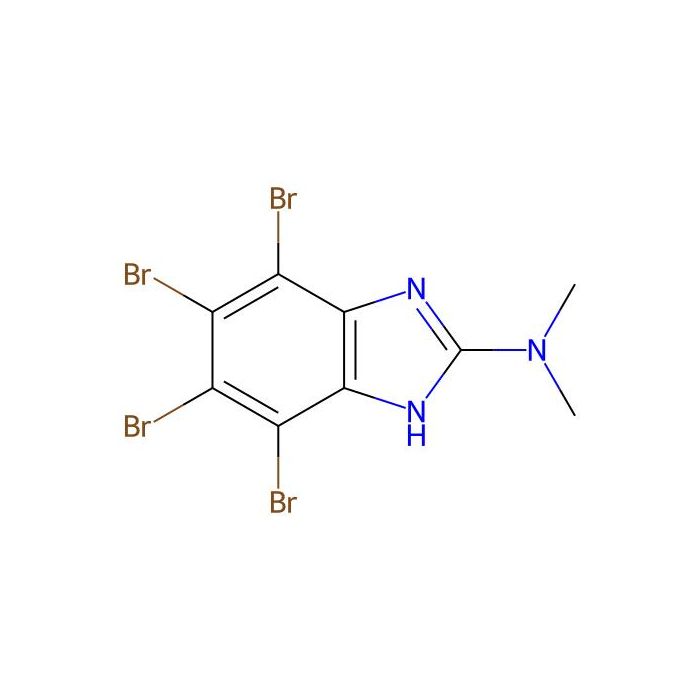
Common chemical name used in literature: 2-(Dimethylamino)-4,5,6,7-tetrabromo-1H-benzimidazole (widely abbreviated “DMAT”).
Substituents: four bromine atoms on the benzene ring (positions 4–7 in the benzimidazole numbering) and an exocyclic dimethylamino group at C2 of the imidazole ring.
2D structure (verbal): a benzimidazole ring system with the imidazole N–H retained; the benzene ring is perbrominated at four adjacent positions; the C2 of the imidazole bears an N,N-dimethylamino substituent. No stereocenters (achiral).
Synthetic Utility
Key reactive motifs (general)
Multiple aryl bromides (4,5,6,7-positions) on a benzimidazole ring furnish a versatile handle set for iterative cross-couplings:
Suzuki–Miyaura: install aryl/heteroaryl/alkenyl groups with boron partners.
Buchwald–Hartwig: form C–N bonds to generate anilines/diaryl amines.
Benzimidazole N–H: allows N-alkylation, N-acylation, or N-arylation for further diversification.
Dimethylamino at C2: can be leveraged for push–pull electronics; in some routes, it can serve as a leaving group after quaternization (Menschutkin) or be transformed via reductive pathways, though such transformations require optimization.
Strategic value (general)
Library expansion: orthogonal functionalization across the four bromides enables rapid generation of polysubstituted analog sets for SAR mapping around the CK2-targeted scaffold.
Late-stage editing: site-selective couplings guided by ligand and temperature allow introduction of solubilizing groups or pharmacophoric fragments without re-synthesizing the core.
Practical notes
Carefully choose ligand/base/solvent to steer regioselectivity; sterics and the benzimidazole’s directing effects are influential.
Monitor by LC–MS; heavy bromine isotopic patterns facilitate rapid verification of coupling progress and substitution count.
Target Specificity
Item-specific
Not specified for this item; refer to the product’s technical datasheet or published literature for any target-binding data established by end users.
Policy note
This section is restricted to product-specific, validated information. In the absence of such data, no claims are made regarding biochemical targets or selectivity for this lot.
よくある質問
How should this product be stored?
Store at ?80 °C. Ultra-low temperature storage is required to maintain the specified shelf life.
What is Moligand??
Moligand? is one of Aladdin Scientific's premium product lines, formulated for high-purity applications across multiple workflows. Compared to standard grades in the same workflow, Moligand? products typically offer tighter specifications, more rigorous QC, and stronger lot-to-lot consistency.
How is this product shipped?
This product ships frozen with dry ice and cold packs. Unpack on arrival and transfer it to the storage condition stated above; handle dry ice with insulated gloves in a ventilated area.
What are the CAS number, molecular formula and molecular weight?
The CAS Number is 749234-11-5, the molecular formula is C9H7Br4N3, and the molecular weight is 476.79 g/mol.
What documentation is provided?
Available product documentation, including Certificates of Analysis (COA), Safety Data Sheets (SDS), and specification sheets, is shown in the product document area. Document availability and access follow the current site policy.
Products are supplied to verified businesses, institutions, and qualified professionals for research and development use only. Not for use in humans, animals, diagnosis, or therapy.