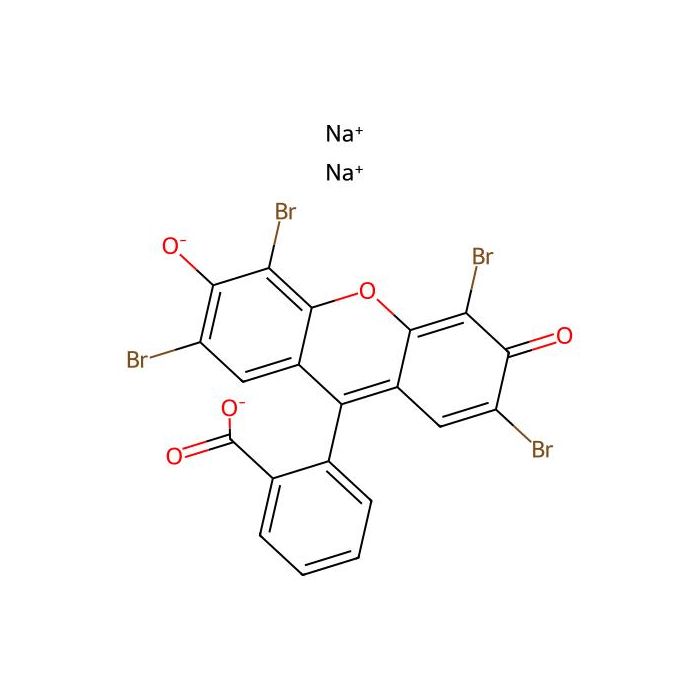
Eosin Y(water soluble) - Dye content 75% , CAS No.17372-87-1

CAS: 17372-87-1 Cat. No.: E299475 分子式: C20H6Br4Na2O5 分子量: 691.85 EC番号: 241-409-6
注文可能
グレード&純度 Dye content 75%
Synonyms
Eosine Extra Yellowish | Eosine Lake Red Y | Eosine Yellowish | Eosin Natricum | Fenazo Eosine XG | Phloxine Toner B | Bromo 4DL | C.I. Acid Red 87 | Bromo X-100 | Bromo 4D | Fluorescein, 2',4',5',7'-tetrabromo-, disodium salt | TDQ283MPCW | Tetrabromoflu
Storage
Room temperature
Shipped In
Normal
★
サイズ
USA
ドイツ (EU)*
価格
個数
100g
E299475-100g
3 在庫あり
—
$39.90
500g
E299475-500g
受注生産 · 8~12週間
$139.90
Enter a quantity for the sizes you want to add.
🧪
このグレードを選ぶ理由

Dye content 75% ベースライン干渉を最小限に抑える必要がある、感度の高いクロマトグラフィーおよび分析ワークフロー向け。

🌡

保管・配送

Room temperature Normal に出荷。正確な仕様については、ロット固有の COA をご確認ください。

📋

品質書類

SDS、COA、データシート、仕様書をダウンロードできます。ロット固有の COA はロット番号検索で入手可能です。

📚

文献的裏付け

クロマトグラフィー、有機合成、クロスカップリング反応に関する 112 件の査読済み論文で引用されています。

概要

Eosin Y, a red xanthene dye, has been noted to reduce the affinity of Mg2+-ATPase for ATP and increase the enzyme affinity for Mg2+ at concentrations of 10-50 μM. At higher concentrations near 100 μM the affinity for Mg2+-ATPase for the ion-activator has been shown to be reduced. This compound has also been reported to be a photosensitizer that works as a molecular photoelectrode via catalyzation of the visible-light-driven electron-transfer reaction. Eosin Y has been used to stain structures such as muscle, cytoplasm, and collagen. This agent also enhances fluorescent quenching abilities by forming a complex with polyvinulpyrrolidone.

仕様

同義語
Eosine Extra Yellowish | Eosine Lake Red Y | Eosine Yellowish | Eosin Natricum | Fenazo Eosine XG | Phloxine Toner B | Bromo 4DL | C.I. Acid Red 87 | Bromo X-100 | Bromo 4D | Fluorescein, 2',4',5',7'-tetrabromo-, disodium salt | TDQ283MPCW | Tetrabromoflu
仕様と純度
Dye content 75%
保管条件
Room temperature
入荷
Normal
名前と識別子
パブケム・シド
パブケム・シド・ウル
https://pubchem.ncbi.nlm.nih.gov/substance/528772029
異性体SMILES
C1=CC=C(C(=C1)C2=C3C=C(C(=O)C(=C3OC4=C(C(=C(C=C24)Br)[O-])Br)Br)Br)C(=O)[O-].[Na+].[Na+]
代替CAS番号
152-75-0
分子量
691.85

ドキュメント

📋 安全データシート(SDS)

危険性、取扱い、保管、および規制遵守を網羅した包括的な文書。

<<<<<<< HEAD SDS をダウンロード → ======= SDS をダウンロード → >>>>>>> release248-p3

✅ 分析証明書(COA)

ロット固有の品質データ。ロット番号を入力して、正確な COA を取得してください。

COA を検索 →

📊 データシート

製品仕様と用途のクイックリファレンス概要。

データシートを見る →

🔬 仕様書

このグレードの完全な品質特性と合格基準。

仕様書を見る →

詳細データ

作用メカニズム
証明書(CoA、COO、BSE/TSEと分析図)
C of A & Other Certificates(BSE/TSE, COO):
Analytical Chart:

Find and download the COA for your product by matching the lot number on the packaging.

7 results found

Lot NumberCertificate Type日付商品
L2114309L2114309Certificate of AnalysisSep 17, 2025 E299475
L2114311L2114311Certificate of AnalysisSep 17, 2025 E299475
B2013012B2013012Certificate of AnalysisDec 18, 2023 E299475
I2208839I2208839Certificate of AnalysisJul 06, 2022 E299475
I2208840I2208840Certificate of AnalysisJul 06, 2022 E299475
I2208841I2208841Certificate of AnalysisJul 06, 2022 E299475
I2414149I2414149Certificate of AnalysisJul 06, 2022 E299475
化学的性質と物理的性質
溶解度Soluble in water (40 mg/ml), alcohol (sparingly), methanol (slightly), ethanol (10 mg/ml), and Ethylene Glycol Monomethyl Ether (Methyl-cellosolve; EGME) (50 mg/ml).
感度Moisture sensitive.
分子量691.900 g/mol
XLogP3
Hydrogen Bond Donor Count0
Hydrogen Bond Acceptor Count5
Rotatable Bond Count1
Exact Mass691.67 Da
Monoisotopic Mass687.674 Da
Topological Polar Surface Area89.500 Ų
Heavy Atom Count31
Formal Charge0
Complexity796.000
Isotope Atom Count0
Defined Atom Stereocenter Count0
Undefined Atom Stereocenter Count0
Defined Bond Stereocenter Count0
Undefined Bond Stereocenter Count0
The total count of all stereochemical bonds0
Covalently-Bonded Unit Count3
よくある質問と記事
Visible Light Photoredox Catalysts
Photo-Crosslinking and Patterning of PEG-Based Hydrogels (2D/3D): Principles, Method Comparisons, and Product Selection Guidelines
Giemsa Staining Protocol: Peripheral Blood and Bone Marrow Smears
Methodological essentials for mineralization visualization: Alizarin Red S staining vs. Von Kossa silver staining
Experimental Judgment and Condition Selection for Visible-Light Catalysis in Organic Synthesis
How Degradable Poly(ethylene glycol) Hydrogels Build Tunable Cellular Microenvironments: Adhesion, Degradation, Release, and Experimental Interpretation in 2D/3D Culture
Designing Hydrogel Scaffolds as Programmable Cell Microenvironments: From Click-Chemistry Functionalization to 3D Cell Culture Experimental Design
Functional Distinction among Orange G-6, EA36, and EA50 in the Papanicolaou Staining System
Types, Binding Mechanisms, and Experimental Selection of Nuclear Dyes
Romanowsky Staining Systems: Chromogenic Basis, Method Types, and Result Interpretation
Mechanism of Action and Selection Logic of Photoinitiators
Color-Development Mechanisms, Formulation Forms, and Selection/Application Logic of Colorants in Personal Care Products
Neuropathological Mechanisms of Cerebral Infarction
Establishment and Evaluation Methods of Diabetic Animal Models
Histological Staining Methods for Identifying Hepatitis B Virus: Comparison of HE, Orcein, Aldehyde Fuchsin, Victoria Blue, Immunohistochemistry, and In Situ Hybridization
Summary of Cell Staining Methods
Where Does the Selectivity in Piperidine C–H Functionalization Come From? — Nitrogen Effects, Chair Conformations, and Four Classes of Key Intermediates
Citations of This Product
ソリューション計算機
レビュー

顧客レビュー

Shall we send you a message when we have discounts available?

Remind me later

Thank you! Please check your email inbox to confirm.

Oops! Notifications are disabled.