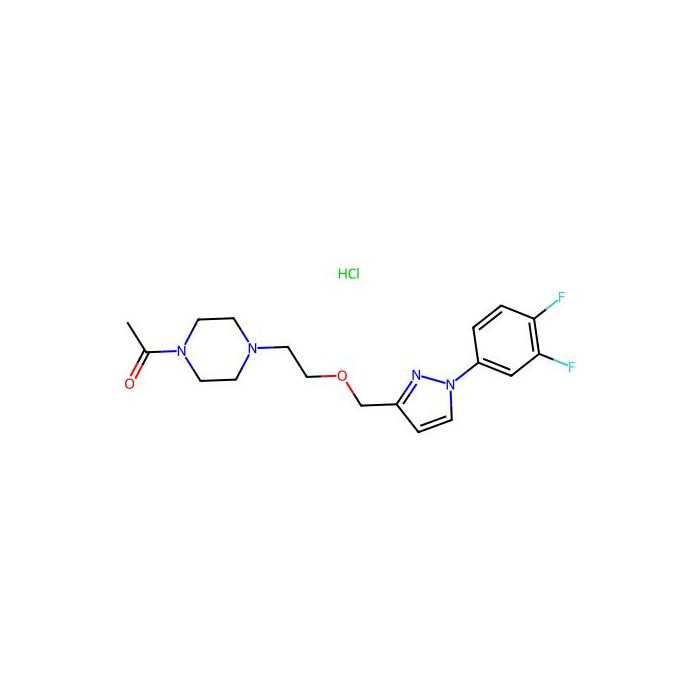
EST64454 hydrochloride is a selective and orally active sigma-1 receptor antagonist with a K i of 22 nM. EST64454 hydrochloride has the potential for the research of the pain.
In Vivo
EST64454 (10 mg/kg; p.o.; male Wistar rats) treatment shows the C max , t 1/2 , AUC 0-∞ , V ss and F% are 771 ng/mL, 3.4 hours, 1431 ng h/mL, 4.4 l/kg and 69%, respectively . EST64454 (10 mg/kg; p.o.; male CD1 mice) treatment shows the C max , t 1/2 , AUC 0-∞ , V ss and F% were 1178 ng/mL, <1 hours, 2645 ng h/mL, 1.2 l/kg and 60%, respectively . MCE has not independently confirmed the accuracy of these methods. They are for reference only. Animal Model: Male Wistar rats (250-300 g) Dosage: 10 mg/kg Administration: P.o. (Pharmacokinetic Analysis) Result: The C max , t 1/2 , AUC 0-∞ , V ss and F% were 771 ng/mL, 3.4 hours, 1431 ng h/mL, 4.4 l/kg and 69%, respectively.
Form:Solid
仕様
仕様と純度
≥99%
生化学的・生理学的メカニズム
EST64454 hydrochloride is a selective and orally active sigma-1 receptor antagonist with a K i of 22 nM. EST64454 hydrochloride has the potential for the research of the pain.
This compound belongs to the class of organic compounds known as phenylpyrazoles. These are compounds containing a phenylpyrazole skeleton, which consists of a pyrazole bound to a phenyl group.
External Descriptors
Not available
1. Djoumbou Feunang Y, Eisner R, Knox C, Chepelev L, Hastings J, Owen G, Fahy E, Steinbeck C, Subramanian S, Bolton E, Greiner R, and Wishart DS. ClassyFire: Automated Chemical Classification With A Comprehensive, Computable Taxonomy. Journal of Cheminformatics, 2016, 8:61.
Determine the necessary mass, volume, or concentration for preparing a solution.
Dilution Calculator
Determine the dilution needed to prepare a stock solution.
Reconstitution Calculator
レビュー
顧客レビュー
Application Protocols
No tested application protocols are provided for this item. The following generic guidance is offered for small-molecule screening compounds (not item-specific):
Stock preparation: Dissolve in DMSO or water at a convenient concentration (e.g., 10–50 mM), based on confirmed solubility. Filter sterilize (0.22 μm) if sterility is required and the compound is stable.
Dose–response studies: Prepare serial dilutions in assay-compatible vehicle, ensuring constant final solvent percentage across wells. Include vehicle-only and positive control treatments.
Storage of working stocks: Aliquot to minimize freeze–thaw; store cold and protected from light as appropriate. Prepare fresh dilutions on the day of use.
Analytical verification: Confirm concentration by UV (if chromophore and ε known) or quantitative NMR with an internal standard. LC–MS can confirm identity and monitor degradation.
For detailed, validated protocols, refer to the CoA/Spec Sheet or literature associated with CAS 1950569-11-5.
Biological Roles
Item-specific biological targets, mechanisms, or pathways are not provided for EST64454 hydrochloride. No claims of biological function are made for this reagent beyond its use in research.
General considerations for small-molecule hydrochloride salts in biological research (literature/general):
Salt form rationale: Protonation increases water compatibility, simplifying dosing in biochemical and cell-based assays.
Target engagement studies: When targets are known (not specified here), binding or activity can be profiled via biochemical assays, thermal shift assays, or cellular phenotypes.
ADME-relevant properties: Ionization state influences apparent permeability and distribution; however, such properties are compound-specific and must be experimentally determined.
Best practices:
Confirm integrity and concentration of stocks by analytical methods (e.g., quantitative NMR or UV if chromophore present) before biological testing.
Evaluate cytotoxicity or off-target effects in parallel with primary readouts when used in cellular systems.
Use appropriate controls (vehicle controls, inactive analogs, and positive controls) to contextualize any observed biological effects.
Note: For any mechanistic or pathway annotations, consult the CoA/Spec Sheet or primary literature keyed to the CAS (1950569-11-5) or PubChem CID (121418768).
Buffer Applications
This product is not a classical buffering agent, and no buffer-specific application data are provided for EST64454 hydrochloride.
General guidance (literature/general) when preparing solutions in buffers:
pH selection: To keep amine hydrochloride salts in solution, use mildly acidic to neutral buffers (e.g., citrate, acetate, MES, phosphate in the pH 3–7 range), depending on the compound’s pKa (not provided for this item).
Ionic strength: Minimize unnecessary salts if LC–MS analysis follows; use volatile modifiers (formic or acetic acid) when possible.
Surfactants: For low-solubility compounds, small amounts of nonionic surfactants (e.g., 0.01–0.05% Tween-20) can improve dispersion in some bioassays; confirm no assay interference.
Sterility: If solutions are stored for more than a day, sterile-filter through 0.22 μm and keep cold as appropriate. Prepare fresh when feasible to avoid degradation.
For precise buffer recipes and compatibility, verify solubility and chemical stability empirically with small-scale tests before committing to large batches.
Green Alternatives
This section addresses greener handling choices for stock solutions and processing of small-molecule hydrochloride salts in general. Item-specific environmental metrics are not provided.
Prefer water or aqueous buffers when solubility and stability allow; this minimizes VOCs and hazard potential.
If organic cosolvent is required, consider ethanol or isopropanol over higher-toxicity options; maintain low percentages in assay media.
For chromatography, use aqueous-organic systems with volatile, low-toxicity modifiers (e.g., formic acid) rather than buffered salts when LC–MS is needed.
Comparison (general; benefits vs tradeoffs):
Water: Greenest option; may reduce chemical stability for hydrolysis-prone scaffolds; can lead to microbial growth—prepare fresh or add sterile filtration.
Ethanol: Renewable and lower toxicity than many aprotic solvents; slightly lower solvating power than DMSO and can affect some bioassays.
DMSO: Excellent solvency enabling low overall volumes; higher persistence and potential worker exposure concerns; minimize use and ensure tight container seals to limit moisture uptake.
Process choices:
Right-sizing stocks to usage windows reduces waste and repeated freeze–thaw cycles.
Employ microscale assay formats to lower total solvent consumption.
Implement closed transfer (syringe/positive displacement) to reduce exposure and losses.
Always balance green metrics with data quality, ensuring solubility and stability are sufficient for your application.
Pharmaceutical Uses
No pharmacopeial status or formulation role is specified for EST64454 hydrochloride. This product is supplied strictly for research use only.
General context for hydrochloride salts in formulation (literature/general; not item-specific and not a clinical claim):
Role of salt formation: Hydrochloride salts are commonly selected to enhance aqueous solubility, chemical stability, and manufacturability of basic small molecules.
Solid-state properties: HCl salts often exhibit improved crystallinity and reduced volatility of amines; polymorphism may occur and must be characterized case-by-case.
Excipients/vehicles: For research formulations, typical vehicles include water, buffered saline, or cosolvent systems (e.g., water/PEG/alcohol) depending on solubility and stability. Always confirm compatibility.
Manufacturing considerations (general):
Hygroscopic salts may require low-humidity handling and desiccated packaging to maintain consistent potency and flow.
Residual solvents and counterion stoichiometry should be controlled and documented in the CoA if relevant to your workflow.
Again, this product is not approved for human or veterinary use and should not be used in diagnostic or therapeutic applications.
Physical Properties
Item-specific specifications:
Appearance: Not specified for this item; refer to CoA/Spec Sheet.
Molecular weight: Not specified for this item; refer to CoA/Spec Sheet.
Melting point, boiling point, density, refractive index, logP, pKa, and solubility: Not specified for this item; refer to CoA/Spec Sheet.
Literature/general expectations for hydrochloride salts (not item-specific):
Physical form: Many small-molecule hydrochloride salts are crystalline solids with defined melting points that are higher than their corresponding free bases due to lattice stabilization.
Solubility profile: HCl salts of amines commonly show improved aqueous solubility (often freely to moderately soluble in water) relative to their free base forms; solubility in nonpolar solvents is typically reduced. Mixed solvent systems (water/alcohols) or pH adjustment can assist dissolution.
Hygroscopicity: Some amine hydrochlorides are hygroscopic and may absorb moisture; desiccated storage (as specified for this item) helps maintain stability and accurate weighing.
pKa/logD: Protonation equilibria dominate; apparent distribution coefficients are pH-dependent, with greater aqueous partitioning under acidic conditions.
Practical notes (general):
Prepare stock solutions using degassed water or aqueous buffer when possible; if organic cosolvent is required, ethanol, methanol, or DMSO are typical choices. Verify compatibility with your assay and confirm solubility empirically.
Filter sterilization (0.22 μm) can be used for sterile applications if the compound is stable in solution; check stability prior to extended storage.
Quality and Grades
Grade/Purity: Not specified for this item; refer to CoA/Spec Sheet.
Guidance on interpreting grades (general, for context only):
Research grade: Suitable for most discovery workflows; impurities may be acceptable within typical screening thresholds.
Analytical/AR grade: Tight impurity limits for routine analytical work.
HPLC grade (for solvents/solubles): Low UV absorbance and particulates; relevant if product is supplied as solution.
Bioactive screening compounds: Often provided at high chemical purity (e.g., ≥95% by HPLC) with accompanying LC–MS/NMR data; verify on the CoA.
Stabilizers/inhibitors: None specified for this item. If present, the CoA will indicate stabilizers, residual solvents, or counterions.
What to check on receipt (best practice):
Confirm identity against CAS (1950569-11-5) and, if available, structure/CID (121418768) by matching to the CoA.
Review analytical data (HPLC trace, purity %, LC–MS m/z, NMR) to ensure suitability for your application.
If quantitative work is planned, dry under vacuum over desiccant and verify water content (e.g., Karl Fischer) as appropriate. Any numeric specification not present here must be taken from the CoA/Spec Sheet.
Reaction and Applications
Manufacturer Applications: Not specified for this item in the product data. This product is categorized under small molecules/compound libraries and is intended for research use only.
General research applications for small-molecule hydrochloride salts (literature/general):
Screening and SAR: Hydrochloride salts facilitate handling and dosing in aqueous systems for enzymatic or cellular assays.
Reference standards: Can serve as analytical standards for LC–MS method development and retention time matching when authenticated by CoA.
Chemical biology probes: If a target is known (not specified here), salts are often supplied to enhance solubility for target engagement studies.
Practical considerations:
Weighing: Rapidly weigh under low humidity or in a glovebox/desiccator if hygroscopic behavior is observed; record corrections for water content if quantitative assays demand it.
Solution prep: Start with small-scale solubility tests in water, buffer (pH 3–6), and DMSO. Filter if particulates persist.
Compatibility: Check for adsorption to plastics at low concentrations; glass vials may provide more reliable dosing for hydrophobic scaffolds.
Note: Without the compound’s specific structure or target, reaction chemistry (as a building block) cannot be recommended. If you plan synthetic transformations, obtain the free base and confirm functional group compatibility before use.
Reaction Conditions
No item-specific reaction conditions are provided for EST64454 hydrochloride. The following are general guidelines for handling amine hydrochloride salts in synthetic steps (literature/general):
Neutralization: Use a mild inorganic base (Na2CO3, K2CO3) in polar aprotic solvents (DMF, MeCN) or aqueous-organic mixtures to free the amine prior to nucleophilic reactions. Maintain temperatures at 0–25°C initially to control exotherms.
Amide coupling: Typical reagents include HATU, HBTU, EDCI, or DIC with additives (HOAt/Oxyma) and a tertiary amine base (DIPEA). Temperatures 0–25°C to limit side reactions; reaction times 0.5–16 h depending on substrate.
Alkylation: SN2 alkylation in DMF/MeCN with alkyl halides and K2CO3/NaHCO3 or Cs2CO3; 20–60°C as needed. Monitor to avoid over-alkylation.
Salt exchange: To generate the HCl salt from a free base, treat with HCl in ether or 1–2 M HCl in anhydrous alcohols at 0–25°C; isolate by filtration and dry under vacuum.
Workup: pH switching enables efficient extractions—basify to extract free base into organic phase; acidify to return to aqueous as needed.
All conditions should be validated experimentally with the actual structure of EST64454 to ensure selectivity and stability.
Safety and Handling
Authoritative safety information is provided in the Safety Data Sheet (SDS). The following item-specific hazard fields are not provided in the product data:
GHS Classification: Not specified for this item; refer to SDS.
Signal word: Not specified for this item; refer to SDS.
Hazard (H-) statements: Not specified for this item; refer to SDS.
Pictograms: Not specified for this item; refer to SDS.
General laboratory precautions for small-molecule HCl salts (not item-specific):
PPE: Wear lab coat, safety glasses, and appropriate gloves (e.g., nitrile). Handle powders in a fume hood to minimize inhalation and dust exposure.
Avoid contact with skin, eyes, and clothing. Prevent generation of dust. Wash hands thoroughly after handling.
Incompatibilities: Strong bases may liberate the free base; strong oxidizers should be avoided unless reaction conditions justify their use with appropriate controls.
First aid (overview; defer to SDS): If inhaled, move to fresh air; if on skin, wash with soap and water; if in eyes, rinse cautiously with water for several minutes; if ingested, rinse mouth—seek medical attention in all cases.
Spill/accidental release: Avoid dust; collect mechanically or dampen and wipe; dispose according to institutional and local regulations.
Special risks: Some amine salts can be hygroscopic; keep containers tightly closed under desiccation (as specified). Avoid prolonged exposure of solutions to elevated temperature or light if photolability is suspected; verify stability experimentally.
Solvent Selection
Item-specific solubility data are not provided; consult the CoA/Spec Sheet and verify empirically.
General solvent guidance for hydrochloride salts of small molecules (literature/general):
Aqueous media: Often readily soluble in water and acidic buffers due to salt formation. Adjust pH to maintain protonation for maximal solubility.
Polar organics: Methanol, ethanol, isopropanol, and DMSO commonly dissolve amine HCl salts. DMSO is a preferred stock solvent for many screening libraries due to broad solubilizing power and assay compatibility at low %.
Biphasic considerations: Compared to free bases, HCl salts partition preferentially into aqueous phases; basification can extract the free base into organic solvents (e.g., EtOAc, CH2Cl2) for workup.
Selection tips:
Screening assays: Prepare concentrated DMSO stocks (e.g., 10–50 mM) if water solubility is uncertain; dilute into assay buffer to ≤0.5–1% DMSO final.
Analytical prep: For HPLC, choose mobile phases compatible with the salt form (e.g., aqueous buffer with 0.1% formic acid for LC–MS).
Crystallization/recovery: If needed, convert to free base for crystallization from less polar solvents; reconvert to HCl as required.
Comparison (general):
Water/buffer: Maximizes solubility for HCl salts; may limit stability depending on hydrolysis/oxidation liability.
DMSO: Highest solvating power; minimize freeze-thaw and moisture uptake.
Alcohols: Useful compromise; often compatible with bioassays at low percentages.
Storage and Reconstitution
Storage (from Product Data):
Store at 2–8°C, desiccated.
Shipped on wet ice.
Research use only.
Item-specific stabilizers, solution stability, and reconstitution solvents: Not specified for this item; refer to CoA/Spec Sheet.
General guidance for hydrochloride salts (literature/general):
Solid material: Keep tightly capped in a desiccator or dry cabinet to limit moisture uptake. Equilibrate to room temperature before opening to avoid condensation.
Reconstitution: Start with water or buffer (pH 3–6) to test solubility; if limited, use DMSO or alcohols as cosolvents. Record final solvent composition for reproducibility.
Concentrated stocks: Prepare single-use aliquots (e.g., 50–200 μL) to avoid repeated freeze–thaw cycles; store at 2–8°C for short-term or below −20°C for longer-term if compound is stable—verify experimentally.
Light/air sensitivity: If the scaffold is unknown, protect solutions from light and air as a precaution (amber vials, inert headspace).
Documentation: Note preparation date, solvent, concentration, and any observed precipitation. Periodically reassess by LC–MS/HPLC for stability.
Always defer to the CoA/Spec Sheet and SDS for definitive storage, handling, and reconstitution instructions specific to EST64454 hydrochloride.
Structure and Identity
Brief overview: EST64454 hydrochloride is supplied as the hydrochloride salt of an organic small molecule screening compound. Core structure and stereochemistry are not specified in the product data.
SMILES: Not specified for this item; refer to CoA/Spec Sheet.
Molecular formula: Not specified for this item; refer to CoA/Spec Sheet.
Molecular weight: Not specified for this item; refer to CoA/Spec Sheet.
Structural features (general/literature context):
Hydrochloride salts typically indicate the presence of a basic nitrogen (e.g., amine) in the free base that is protonated to improve stability and aqueous solubility.
Without a provided structure, ring systems, functional groups, and stereocenters for EST64454 cannot be detailed. Refer to the CoA/Spec Sheet or structure file for the definitive 2D depiction and identifiers.
2D structure description: Not available in the product data. Typically, HCl salts are drawn as the protonated amine cation paired with chloride anion; the exact backbone for EST64454 should be confirmed from the official structure record (CoA/PubChem entry corresponding to the provided CID).
Synthetic Utility
Item-specific functional groups and reactivity cannot be detailed without the compound’s structure. The following notes provide general guidance for working with amine-containing hydrochloride salts in synthesis (literature/general):
Free base liberation: For use as a nucleophile/base, the amine hydrochloride is typically neutralized with a stoichiometric base (e.g., NaHCO3, K2CO3, Et3N) in situ or pre-freed, enabling acylation, alkylation, or coupling reactions.
Protection strategies: If multifunctional, consider temporary protection of the amine (e.g., Boc, Fmoc) after basification to direct chemoselectivity.
Couplings: As amine partners in amide formation, HCl salts can be engaged directly with carbodiimide or uronium reagents in the presence of base. Control pH to avoid salt precipitation.
Phase behavior: Salt form increases water affinity; phase-transfer techniques or biphasic systems can be tuned by adjusting pH.
Purification: Convert to the free base to facilitate extraction into organic solvents, then regenerate the hydrochloride by gas-phase HCl or ethanolic HCl as needed.
For EST64454 specifically, consult the CoA/structural dossier to identify reactive handles and compatibility with planned transformations.
Target Specificity
Not specified for this item; refer to CoA/Spec Sheet and primary literature. No target, pathway, or selectivity profile is provided in the product data for EST64454 hydrochloride.
General note: If EST64454 has a known biochemical target (e.g., enzyme, receptor, transporter), consult the PubChem CID (121418768) and associated references for curated activity data and assay conditions. Any claims of specificity should be supported by orthogonal assays and, ideally, structure–activity relationships.
よくある質問
What is the purity of this product?
This product is supplied at ≥99% purity (chemical assay). Lot-specific values are stated on the Certificate of Analysis.
How should this product be stored?
Store at 2–8 °C, desiccated. Keep the container tightly closed with desiccant — the material is moisture-sensitive.
How is this product shipped?
This product ships chilled on wet ice. Unpack on arrival and transfer it to the storage condition stated above.
What are the CAS number, molecular formula and molecular weight?
The CAS Number is 1950569-11-5, the molecular formula is C18H23ClF2N4O2, and the molecular weight is 400.85 g/mol. InChIKey YJZGDOPAALDWAT-UHFFFAOYSA-N.
What documentation is provided?
Available product documentation, including Certificates of Analysis (COA), Safety Data Sheets (SDS), and specification sheets, is shown in the product document area. Document availability and access follow the current site policy.
Products are supplied to verified businesses, institutions, and qualified professionals for research and development use only. Not for use in humans, animals, diagnosis, or therapy.