Determine the necessary mass, volume, or concentration for preparing a solution.
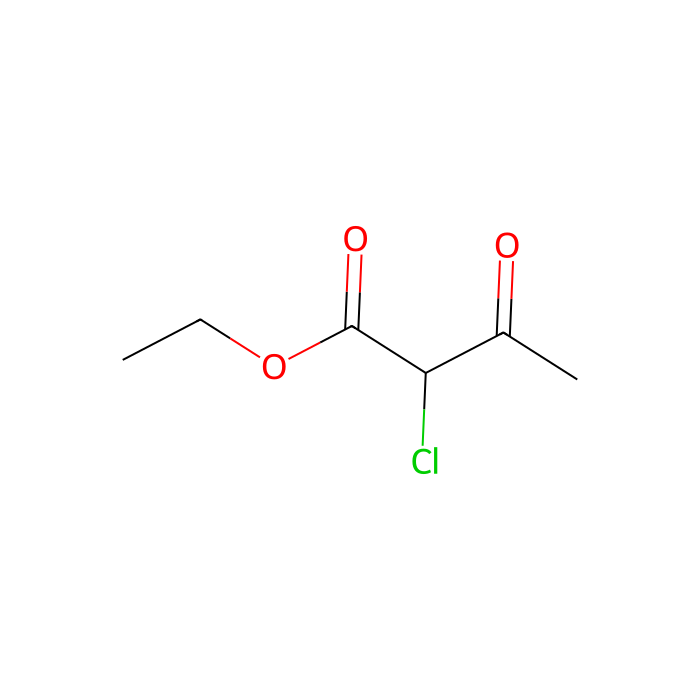
2-クロラセト酢酸エチルは、ペルオキシソーム増殖剤活性化受容体δのアゴニストとしてオキサゾールやチアゾールの調製に使用される。また、抗がん活性を有するジメチルイミダゾチアジアゾールカルボヒドラジドの合成にも使用される。
Taxonomy Tree
| Kingdom | Organic compounds |
|---|---|
| Superclass | Organic acids and derivatives |
| 分類 | Keto acids and derivatives |
| Subclass | Beta-keto acids and derivatives |
| Intermediate Tree Nodes | Not available |
| Direct Parent | Beta-keto acids and derivatives |
| Alternative Parents | Fatty acid esters 1,3-dicarbonyl compounds Alpha-halocarboxylic acid derivatives Alpha-chloroketones Carboxylic acid esters Monocarboxylic acids and derivatives Organochlorides Organic oxides Hydrocarbon derivatives Alkyl chlorides |
| Molecular Framework | Aliphatic acyclic compounds |
| Substituents | Beta-keto acid - Fatty acid ester - 1,3-dicarbonyl compound - Fatty acyl - Alpha-halocarboxylic acid derivative - Alpha-halocarboxylic acid or derivatives - Alpha-haloketone - Alpha-chloroketone - Ketone - Carboxylic acid ester - Monocarboxylic acid or derivatives - Carboxylic acid derivative - Organochloride - Organohalogen compound - Organic oxygen compound - Carbonyl group - Alkyl halide - Organic oxide - Organooxygen compound - Alkyl chloride - Hydrocarbon derivative - Aliphatic acyclic compound |
| 説明 | This compound belongs to the class of organic compounds known as beta-keto acids and derivatives. These are organic compounds containing an aldehyde substituted with a keto group on the C3 carbon atom. |
| External Descriptors | Not available |
Find and download the COA for your product by matching the lot number on the packaging.
| Lot Number | Certificate Type | 日付 | 商品 |
|---|---|---|---|
| Certificate of Analysis | Sep 04, 2025 | E124653 | |
| Certificate of Analysis | Sep 04, 2025 | E124653 | |
| Certificate of Analysis | Mar 28, 2025 | E124653 | |
| Certificate of Analysis | Mar 28, 2025 | E124653 | |
| Certificate of Analysis | Jun 13, 2024 | E124653 | |
| Certificate of Analysis | Jun 13, 2024 | E124653 | |
| Certificate of Analysis | Jun 13, 2024 | E124653 | |
| Certificate of Analysis | Jan 11, 2024 | E124653 | |
| Certificate of Analysis | Apr 23, 2023 | E124653 | |
| Certificate of Analysis | Jun 06, 2022 | E124653 | |
| Certificate of Analysis | Jun 06, 2022 | E124653 | |
| Certificate of Analysis | Jun 06, 2022 | E124653 | |
| Certificate of Analysis | Jun 06, 2022 | E124653 | |
| Certificate of Analysis | Jun 06, 2022 | E124653 | |
| Certificate of Analysis | Apr 26, 2022 | E124653 |
| 溶解度 | Chloroform (Slightly), Ethyl Acetate (Slightly) |
|---|---|
| 感度 | air sensitive |
| 屈折率 | 1.441 |
| 引火点(°F) | 180°F |
| 引火点(°C) | 54℃ |
| 沸点(°C) | 107 °C/14 mmHg |
| 融点(°C) | <-80°C |
| 分子量 | 164.59 |
| XLogP3 | 1.100 |
| Hydrogen Bond Donor Count | 0 |
| Hydrogen Bond Acceptor Count | 3 |
| Rotatable Bond Count | 4 |
| Exact Mass | 164.024 Da |
| Monoisotopic Mass | 164.024 Da |
| Topological Polar Surface Area | 43.400 Ų |
| Heavy Atom Count | 10 |
| Formal Charge | 0 |
| Complexity | 144.000 |
| Isotope Atom Count | 0 |
| Defined Atom Stereocenter Count | 0 |
| Undefined Atom Stereocenter Count | 1 |
| Defined Bond Stereocenter Count | 0 |
| Undefined Bond Stereocenter Count | 0 |
| The total count of all stereochemical bonds | 0 |
| Covalently-Bonded Unit Count | 1 |
H226:Flammable liquid and vapor
H302:Harmful if swallowed
H314:Causes severe skin burns and eye damage
H318:Causes serious eye damage
H400:Very toxic to aquatic life
P210:Keep away from heat, hot surface, sparks, open flames and other ignition sources. - No smoking.
P233:Keep container tightly closed.
P240:Ground/bond container and receiving equipment.
P241:Use explosion-proof [electrical/ventilating/lighting/.../] equipment.
P242:Use only non-sparking tools.
P243:Take precautionary measures against static discharge.
P260:Do not breathe dust/fume/gas/mist/vapors/spray.
P264:Wash hands [and …] thoroughly after handling.
P270:Do not eat, drink or smoke when using this product.
P273:Avoid release to the environment.
P280:Wear protective gloves/protective clothing/eye protection/face protection.
P321:Specific treatment (see ... on this label).
P330:Rinse mouth.
P363:Wash contaminated clothing before reuse.
P391:Collect spillage.
P301+P330+P331:IF SWALLOWED: Rinse mouth. Do NOT induce vomiting.
P303+P361+P353:IF ON SKIN (or hair): Take off Immediately all contaminated clothing. Rinse SKIN with water [or shower].
P304+P340:IF INHALED: Remove person to fresh air and keep comfortable for breathing.
P370+P378:In case of fire: Use ... to extinguish.
P405:Store locked up.
P403+P235:Store in a well-ventilated place. Keep cool.
P501:Dispose of contents/container to an approved waste disposal plant.
P264+P265:Wash hands [and …] thoroughly after handling. Do not touch eyes.
P301+P317:IF SWALLOWED: Get medical help.
P305+P354+P338:IF IN EYES: Immediately rinse with water for several minutes. Remove contact lenses if present and easy to do. Continue rinsing.
P317:Get emergency medical help.
P302+P361+P354:IF ON SKIN: Take off Immediately all contaminated clothing. Immediately rinse with water for several minutes.
P316:Get emergency medical help immediately.
No biological assay protocols (WB, IHC, IF, FC) are applicable to this small-molecule reagent. For synthetic operations, see Reaction Conditions and Synthetic Utility sections for generalized procedures. Users should adapt solvent/base/temperature to their specific nucleophile/electrophile pairing and scale, and validate by TLC/GC/HPLC.
This product is a small-molecule synthetic building block and does not have a primary biological role in vivo. No biochemical function is assigned to this substance as a natural metabolite.
Research context (general):
Metabolism/biotransformation (speculative/literature context):
Safety note: Any discussion of biological effects is outside the scope of this research-grade listing. Use strictly for research and laboratory synthesis as indicated (Research Use Only).
Not typically applicable. Ethyl 2-chloroacetoacetate is an organic synthetic reagent, not a buffering agent. It is moisture-sensitive and prone to hydrolysis in aqueous media, making it unsuitable for preparing or stabilizing aqueous buffer systems. For aqueous work, consider completing synthetic steps in organic media, isolate the product, and then formulate into buffers separately if required for downstream assays.
Greener choices focus on solvent and reagent selection while retaining the unique electrophilicity of an α-chloro β-keto ester (literature/practice; not product-specific):
Solvent substitutions:
Base and additives:
Reagent-level considerations:
Energy and waste minimization:
Trade-offs: Greener solvents may slow SN2 rates; modest temperature elevation or catalyst use (e.g., PTC) can compensate.
No excipient or pharmacopeial role is specified for this item; refer to CoA/Spec Sheet.
General process-chemistry context (non-clinical; no therapeutic claims):
Regulatory note: This is provided for research use only. It is not intended for use in humans or for clinical applications. Any use in GMP or scale-up should be supported by full specifications, impurity profiles, and validated analytical methods obtained via the product’s CoA and method files.
Item-specific specifications (this lot):
General/literature properties (for reference only; confirm on CoA/SDS before use):
Note: Because α-halo carbonyls can undergo decomposition (e.g., HCl release, hydrolysis), measured properties (e.g., color, acid number) may drift with storage if not protected from moisture and bases.
How to interpret grades (general guidance):
Stabilizers/inhibitors:
Quality notes specific to α-halo β-keto esters (general):
Verification:
This α-chloro β-keto ester is a versatile electrophile and synthon for constructing C–C, C–N, C–O, and C–S bonds (literature/practice; expand from common catalog use cases):
SN2 Displacement at the α-chloromethyl unit:
Enolate-based C–C bond formation (β-keto ester chemistry):
Heterocycle synthesis:
Acylation equivalents:
Orthogonal reactivity strategies:
Practical tips:
The following conditions are general literature guidance for α-chloro β-keto esters; optimize for your substrate set and scale. They are not product specifications.
SN2 substitution (amines/thiols/alcohols):
Enolate alkylation at β-keto site:
Heterocycle formation (e.g., pyrazoles/isoxazoles):
Decarboxylation to ketones:
Workup/purification:
Always run small-scale trials to assess competing hydrolysis and self-condensation.
Item-specific hazard information:
General safety guidance for α-halo β-keto esters (literature/practice; not product-specific):
Always consult the product SDS for authoritative, product-specific safety information.
Applicability: This is a moderately polar, electrophilic organic reagent rather than a solvent. The guidance below addresses solvents for using/storing this reagent (literature/practice; not product-specific specs).
Polarity/miscibility profile (literature):
Selection by transformation:
Process considerations:
Storage/solution prep:
General handling and stability (literature/practice):
Research Use Only: This product is intended for research and laboratory use only.
Ethyl 2-chloroacetoacetate is a chlorinated 1,3-dicarbonyl (an α-halo β-keto ester) frequently used as an electrophilic building block in organic synthesis.
Item-specific identifiers (as provided):
Structure (general/literature description):
Empirical formula and molecular weight: Not specified for this item; refer to CoA/Spec Sheet. (Literature identifies this substance as an α-chloro β-keto ethyl ester; verify exact identifiers on the product CoA.)
Synonym context (literature): often referred to as ethyl chloroacetoacetate or ECAA in synthetic protocols.
Key reactivity elements and how to exploit them (literature/practice):
Bifunctional synthon:
Named/related transformations:
Retrosynthetic value:
Downstream diversification:
Practical cautions:
Not applicable. This product is a small-molecule chemical reagent and does not have biological target specificity parameters (e.g., antigen, epitope, clone, isotype). For biochemical targets relevant to compounds synthesized from this reagent, consult the literature pertinent to those specific analogs.