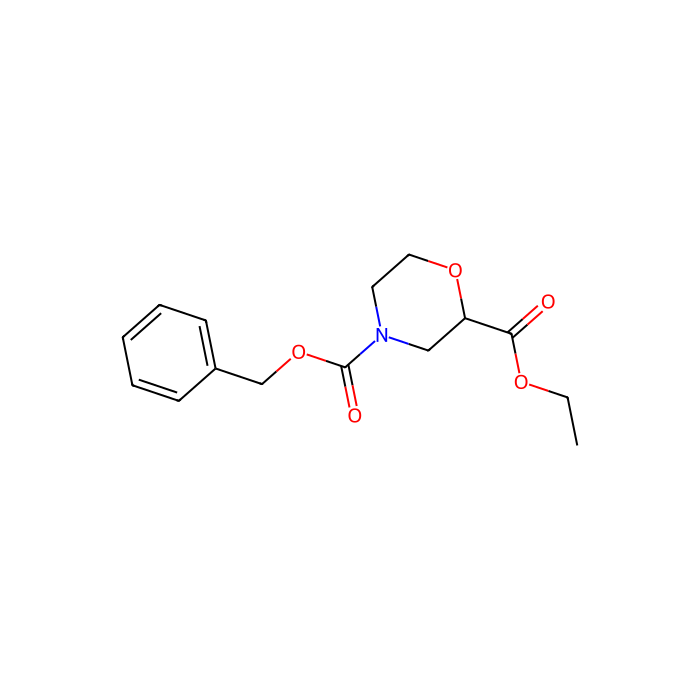
This compound belongs to the class of organic compounds known as benzyloxycarbonyls. These are organic compounds containing a carbonyl group substituted with a benzyloxyl group.
External Descriptors
Not available
1. Djoumbou Feunang Y, Eisner R, Knox C, Chepelev L, Hastings J, Owen G, Fahy E, Steinbeck C, Subramanian S, Bolton E, Greiner R, and Wishart DS. ClassyFire: Automated Chemical Classification With A Comprehensive, Computable Taxonomy. Journal of Cheminformatics, 2016, 8:61.
Determine the necessary mass, volume, or concentration for preparing a solution.
Dilution Calculator
Determine the dilution needed to prepare a stock solution.
Reconstitution Calculator
レビュー
顧客レビュー
Application Protocols
No application protocols are specified for this item.
Context
As a synthetic building block, protocols are route-dependent (e.g., hydrogenolysis for Cbz removal, ester saponification, coupling). See the Reaction Conditions tab for general procedures.
For analytical QC, typical methods include 1H/13C NMR in CDCl3 or DMSO-d6, LC–MS in water/MeCN with formic acid, and HPLC purity by UV at 210–254 nm.
Product Data: Tested applications, recommended dilutions, or positive controls are not applicable to this compound class.
Biological Roles
This product is intended for research and synthetic use; no biological activity data are provided for the item.
General context (literature)
Morpholine motifs are common in medicinal chemistry as polar, H-bond-accepting heterocycles that improve solubility and tune basicity. N-protection (Cbz) temporarily masks basicity, enabling selective chemistry at other positions.
2-Substituted morpholine scaffolds appear in ligands for kinases, GPCRs, and enzymes, often as part of solubilizing side chains or as conformationally biased amide linkers.
Biochemical considerations (general)
The Cbz carbamate and ethyl ester are typically hydrolytically stable at physiological pH but can be cleaved enzymatically or chemically under specific conditions; under research settings, they serve as protecting/activating groups rather than biofunctional units.
No known endogenous role exists for this synthetic intermediate; it is not a natural metabolite.
Use limitations
For research use only (per Product Data). Not for diagnostic, therapeutic, or clinical use.
For any biological testing or ADME profiling, verify purity, residual solvents, and stereochemical composition via the CoA and your internal QC.
Buffer Applications
Not typically applicable. Ethyl N-Cbz-morpholine-2-carboxylate is a neutral organic building block, not a buffering agent. It lacks a free basic amine (masked as Cbz) and is not designed to maintain pH.
Practical guidance
If solubilization for screening or reactions in aqueous media is needed, use co-solvents (DMSO, DMF, MeCN) or convert the ester to an acid/salt form after deprotection.
For pH control, choose appropriate laboratory buffers (e.g., phosphate, HEPES, acetate) unrelated to this compound.
Green Alternatives
While the compound itself is a substrate rather than a solvent, greener choices can be applied to its key transformations.
Greener solvent selections (general guidance)
Replace DCM with EtOAc or 2-MeTHF for extractions and reactions when feasible.
Prefer 2-MeTHF or CPME over THF for reductions and coupling steps due to better safety/greener scores and reduced peroxide concerns.
Use aqueous ethanol or isopropanol for hydrogenolysis where solubility allows, minimizing halogenated waste.
Greener deprotection strategies
Cbz removal via catalytic transfer hydrogenation (e.g., HCO2NH4 or HCO2H/Et3N with Pd/C) can avoid high-pressure hydrogen.
Electrochemical hydrogenation or flow hydrogenation may reduce solvent/catalyst use and improve safety.
Comparison snapshot (general)
DCM vs EtOAc: EtOAc offers lower toxicity and better biodegradability; workup similar; sometimes slower dissolution of aromatic carbamates.
THF vs 2-MeTHF: 2-MeTHF derived from renewable sources; higher boiling point aids process intensification; check substrate solubility and reaction rates.
Waste minimization
Plan orthogonal protection/deprotection to limit protecting-group manipulations.
Choose coupling reagents with more benign byproducts (e.g., CDI or DMTMM in water/MeOH when compatible).
Note: These are general green-chemistry considerations; adapt based on your route and equipment.
Pharmaceutical Uses
No pharmacopeial or excipient status is provided for this item. It is supplied for research use only.
General role in pharmaceutical R&D (literature)
Intermediate: Serves as a protected heterocycle for assembling candidate molecules. Orthogonal functionality (Cbz on N, ester at C2) enables convergent synthesis and late-stage diversification.
Pre-formulation studies: After deprotection/derivatization, morpholine-containing APIs or leads may be evaluated for solubility/permeability; this protected precursor itself is not a typical excipient.
Manufacturing considerations (general)
Cbz removal by catalytic hydrogenation is widely scalable; selection of solvent and catalyst scavenging strategies (e.g., silica-thiol, metal scavengers) is key for GMP routes.
Control of residual benzyl-containing byproducts and carbonate species is critical after deprotection.
Regulatory note
No USP/EP monograph known for this protected intermediate (literature context). Any use beyond research requires appropriate qualification and impurity profiling per ICH guidelines.
Physical Properties
Product Data (as provided)
Appearance: Not specified for this item; refer to CoA/Spec Sheet.
Molecular Formula: Not specified for this item; refer to CoA/Spec Sheet.
Molecular Weight: Not specified for this item; refer to CoA/Spec Sheet.
Literature/computed physical data (for context; not item specifications)
Approx. formula: C15H20NO5 (computed from structure rationale)
Expected physical state: solid or viscous oil depending on purity and stereochemical composition (general expectation for carbamate/ester building blocks).
Solubility profile (qualitative, literature):
Organic: Good in EtOAc, DCM, THF, MeCN; moderate in toluene; limited in hexanes.
Aqueous: Low due to neutral, non-ionized state; acid/base treatment can change partitioning via hydrolysis/ionization.
LogP/logD: Likely moderate due to aromatic Cbz plus polar heteroatoms (no measured value located; literature expectation only).
Boiling/melting: Carbamate/ester building blocks often decompose before boiling under ambient pressure; many show melting between 60–120 C when crystalline; actual values not established here (literature generalization only).
Refractive index, density, UV cutoff: Not located in literature; verify experimentally if needed.
Practical notes (general)
Cbz chromophore absorbs in UV (~200–230 nm, aromatic band), useful for TLC visualization (UV254). For quantitative properties and acceptance criteria, consult the specific batch CoA.
Quality and Grades
Product Data (as provided)
Grade/Purity: Not specified for this item; refer to CoA/Spec Sheet.
How to interpret typical grades (general guidance)
Research grade: Suitable for synthetic and discovery chemistry; purity commonly established by NMR/LC–MS and/or HPLC. For sensitive applications (e.g., stereochemical studies), request chiral purity if relevant.
HPLC grade (when applicable to solvents): Low UV background and minimal trace metals. Not directly relevant to this solid/liquid building block but HPLC assay is often used to report purity.
Trace metal content, residual solvents, water content: Not specified for this item; refer to CoA/Spec Sheet.
Stabilizers/additives
This compound class (carbamates/esters) is typically shipped neat without stabilizers. If any stabilizer or form (salt/solvate) is used, it will be indicated on the CoA.
Verification & release (best practices)
Identity: 1H/13C NMR, HRMS/ESI, and IR (carbamate/ester C=O ~1680–1750 cm−1; aromatic signatures).
Purity: HPLC/UPLC (UV 210–254 nm suitable due to Cbz chromophore); GC generally less applicable for non-volatile carbamates.
Optical: If enantioenriched material is required, ensure ee/er data and method (chiral HPLC) are provided. Otherwise, assume racemic unless specified.
Reaction and Applications
As a protected morpholine-2-carboxylate building block, this reagent is well-suited to multi-step synthesis in medicinal and heterocycle chemistry.
Typical transformations (general)
N-deprotection (Cbz → H2/Pd): Reveals the morpholine nitrogen while preserving the 2-ester, enabling divergent functionalization at nitrogen vs C2.
Ester functionalization:
Saponification to the acid (morpholine-2-carboxylic acid) followed by amide coupling (HATU/EDC/DEPBT) to install diverse amide side chains.
Direct transesterification under acid/base catalysis to change the alkoxy group.
Reduction (e.g., DIBAL-H, LiAlH4) to the corresponding alcohol or further to diol-containing motifs (with caution to avoid carbamate cleavage).
Carbamate chemistry:
Cbz migration is uncommon under mild conditions; stability facilitates manipulations elsewhere in the molecule.
Alternative deprotections (transfer hydrogenation, catalytic formate) available when H2 handling is restricted.
Utility in SAR and library synthesis
Orthogonal protection: Independent toggling of N-protection (Cbz) and C2-ester enables parallel diversification.
Late-stage diversification: After Cbz removal, the liberated secondary amine engages in alkylation, acylation, and urea formation while the C2 functionality remains available for further coupling.
Workup/purification tips (general)
The aromatic Cbz group enhances UV detection for HPLC/TLC.
Avoid strong aqueous base at elevated temperature when retaining both carbamate and ester is essential (minimize concurrent hydrolysis).
Manufacturer Applications: Not specified in Product Data; the above reflects common literature uses for this protected morpholine scaffold.
Reaction Conditions
General literature guidance for common operations on N-Cbz morpholine-2-carboxylate esters (not item specifications):
Cbz deprotection (hydrogenolysis)
Catalyst: 5–10 wt% Pd/C (relative to substrate) or 10% Pd/C at 5–20 mol% Pd.
Solvent: MeOH, EtOH, EtOAc, THF, or mixtures; add Et3N if acid-sensitive sites are present.
Hydrogen: 1 atm (balloon) to 3–5 bar; 20–25 C; 2–16 h typical.
Tip: Filter through Celite; scavenge residual Pd (e.g., silica–thiol) for sensitive applications.
Ester saponification → acid
Conditions: Aqueous NaOH or K2CO3 (1–2 equiv) in MeOH/THF/H2O (1:1:1) at 20–40 C, 1–6 h.
Acidification: 1–2 M HCl to pH ~2; extract with EtOAc; dry and concentrate.
Note: Carbamate generally survives mild base; avoid prolonged reflux.
Amide coupling (from acid)
Reagents: HATU or EDCI/HOBt (or Oxyma), DIPEA (2–3 equiv), DMF/DCM/MeCN, 0–25 C, 2–12 h.
Alternative: DMTMM in MeOH or water/MeCN blends for greener conditions.
Reduction of ester
DIBAL-H (1.2–1.5 equiv), toluene/2-MeTHF at −78 to −20 C → aldehyde/alcohol; quench carefully.
LiAlH4 (2–3 equiv), THF at 0–25 C → primary alcohol; risk of partial carbamate cleavage under forcing conditions.
Purification
Silica gel chromatography with gradients of hexanes/EtOAc or toluene/EtOAc; monitor by UV (254 nm) and LC–MS.
Adjust conditions to substrate solubility and sensitivity; confirm by small-scale trials.
Safety and Handling
Product Data (as provided)
Storage Conditions: Room temperature
Shipped In: Normal
GHS Classification / Signal Word / H-Statements / Pictograms: Not specified for this item; refer to SDS.
General safety guidance (not item-specific; consult the SDS for authoritative data)
Likely hazards: Neutral carbamates/esters typically present low acute toxicity but may cause skin/eye irritation and respiratory tract irritation as dust/aerosol. Avoid inhalation, ingestion, and contact.
PPE: Wear lab coat, safety glasses or goggles, and appropriate chemically resistant gloves (e.g., nitrile). Use in a fume hood to avoid inhalation of vapors or particulates.
Handling: Avoid moisture and strong bases/acids if hydrolysis is undesired. Prevent peroxide concerns are not typical for this class (non-ether solvent), but standard good practice applies.
Incompatibilities: Strong acids/bases (hydrolysis of ester/carbamate), strong oxidizers (aromatic carbamate oxidation), strong reducing conditions unless intentional deprotection is targeted (e.g., hydrogenolysis can remove Cbz).
First aid (overview):
Skin/eye: Rinse with water for ≥15 minutes; remove contaminated clothing; seek medical attention if irritation persists.
Inhalation: Move to fresh air; monitor breathing; seek medical advice if symptoms occur.
Ingestion: Rinse mouth; do not induce vomiting; seek medical attention.
Fire safety: Combustible organic solid/liquid; use CO2, dry chemical, or foam. Thermal decomposition may produce CO/CO2 and nitrogen oxides.
Always defer to and follow the product-specific SDS for risk phrases, exposure limits, and disposal instructions.
Solvent Selection
Applicability: This is a neutral, moderately polar organic building block. Solvent choice is typically driven by synthetic transformation (coupling, hydrolysis, hydrogenolysis) rather than by the compound’s use as a solvent.
Polarity/miscibility (general)
Expected good solubility in: DCM, EtOAc, THF, MeCN, DMF, DMSO.
Moderate solubility in: Toluene; limited in aliphatic hydrocarbons (hexanes/heptane).
Aqueous solubility: Low at neutral pH; increases upon saponification (formation of carboxylate) or with water-miscible co-solvents.
Practical choices by operation
Hydrogenolysis (Cbz removal): Alcoholic solvents (MeOH/EtOH) or EtOAc/THF under H2 with Pd/C are common; choose solvent that dissolves substrate well at reaction temperature.
Ester hydrolysis: Aqueous THF/MeOH/EtOH for basic (NaOH, K2CO3) or acidic (HCl, H2SO4) conditions.
Amidation after saponification: DMF, DCM, or MeCN with standard coupling reagents (e.g., EDCI, HATU).
Small comparison (general)
DCM vs EtOAc: DCM offers faster dissolution and easy removal; EtOAc is greener and often adequate for workup/extractions.
THF vs 2-MeTHF: 2-MeTHF offers greener profile and broader azeotrope utility; verify solubility and stability under reaction conditions.
Note: No item-specific solvent specifications are provided; select based on method and verify compatibility experimentally.
Storage and Reconstitution
Product Data (as provided)
Storage Conditions: Room temperature
Shipped In: Normal
General storage guidance (applicable to carbamate/ester building blocks)
Store tightly capped under dry, inert conditions (desiccator or dry box) to minimize hydrolysis of the ester/carbamate over long periods.
Protect from prolonged exposure to moisture and strong light/heat. Ambient laboratory temperatures are typically acceptable; refrigeration may extend shelf life but is not required per Product Data.
If stored as a solution (e.g., in DCM, EtOAc, or MeCN) for short-term use, keep under inert gas and at 2–8 C; prepare fresh solutions when possible.
Reconstitution/Preparation
The item is supplied neat; no reconstitution is required. For weighing/dosing, dissolve in a suitable dry organic solvent (DCM, EtOAc, THF, MeCN, DMF, or DMSO) based on downstream chemistry.
Avoid aqueous stocks unless immediate hydrolysis is intended. Filter solutions (0.2 µm PTFE) before use in sensitive reactions or analytical assays.
Stability notes
Under neutral, dry conditions, Cbz carbamates and simple ethyl esters are generally stable for many months. Monitor by HPLC/NMR for long-term projects.
Always consult the batch CoA for any item-specific storage notes and retest dates.
Structure and Identity
Brief: Ethyl N-Cbz-morpholine-2-carboxylate is a protected morpholine building block bearing an N-carbobenzyloxy (Cbz) carbamate and an ethyl ester at the 2-position of the ring.
Ring system: Six-membered morpholine heterocycle (O in ring, tertiary amine when protected).
Functional groups: N-carbamate (Cbz, benzyloxycarbonyl), secondary carbamate carbonyl, ethyl ester at the 2-position of the ring.
2D description: A morpholine ring bearing an ethoxycarbonyl substituent alpha to nitrogen; nitrogen is capped as a Cbz carbamate (–NH–C(=O)–O–CH2–Ph). The benzylic oxygen connects to the carbamate carbonyl; the morpholine nitrogen connects to the carbamate nitrogen.
Stereochemistry: The 2-substituted morpholine creates a stereogenic center at C-2; unless otherwise specified, materials are commonly supplied as racemates (general context; item-specific stereochemistry not specified).
Notes
Any exact identifiers beyond those listed should be confirmed against the product’s CoA/SDS before critical use.
Synthetic Utility
Key functional groups and their reactivity enable orthogonal manipulations:
Functional handles
N-Cbz carbamate: Stable to many nucleophilic substitutions and mild bases; removable by hydrogenolysis (H2, Pd/C) or transfer hydrogenation, revealing the secondary amine.
Ethyl ester at C2: Convertible to the acid (saponification), amides (coupling), alcohols (reductions), or other esters (transesterification). Provides a point of attachment for peptidomimetics and linkers.
Strategic value in retrosynthesis (general)
Disconnect at the ester: Access morpholine-2-carboxylic acid derivatives for downstream amide libraries.
Disconnect at the N-protection: Free morpholine nitrogen after deprotection allows alkylation/acylation while retaining the C2 functionality for second diversification.
Couplings: HATU/EDC/DIC-mediated amidations from the acid obtained via saponification.
Reductions: DIBAL-H (ester → aldehyde/alcohol) at low temperature; LiAlH4 (ester → alcohol) with caution to avoid carbamate cleavage.
Carbon–carbon formation: After converting the ester to an acid chloride or imidazolide, engage in Curtius or mixed anhydride strategies to access ureas/carbamates (advanced routes).
This dual-protected scaffold is highly versatile for library synthesis and scaffold hopping in medicinal chemistry.
Target Specificity
Not applicable. This product is a small-molecule synthetic intermediate, not a biological targeting reagent or antibody.
Product Data: No antigen/epitope/clone/isotype information is provided (not relevant to this compound type).
We use cookies to ensure the website functions properly and, where permitted, to improve your experience. You can manage your preferences at any time in Settings. Learn more in our Cookie Policy.
Shall we send you a message when we have discounts available?
Remind me later
Thank you! Please check your email inbox to confirm.
Products are supplied to verified businesses, institutions, and qualified professionals for research and development use only. Not for use in humans, animals, diagnosis, or therapy.