
Molecular Interaction Detection
Molecular Interaction Detection
Isothermal Titration Calorimetry (ITC) is a commonly used biophysical experimental technique to study the interactions between biomolecules by measuring the process of heat exchange between them. It can measure thermodynamic parameters such as thermodynamic equilibrium constants, enthalpy and entropy of interactions between biological macromolecules (e.g., proteins, nucleic acids, polysaccharides, etc.).
Principle
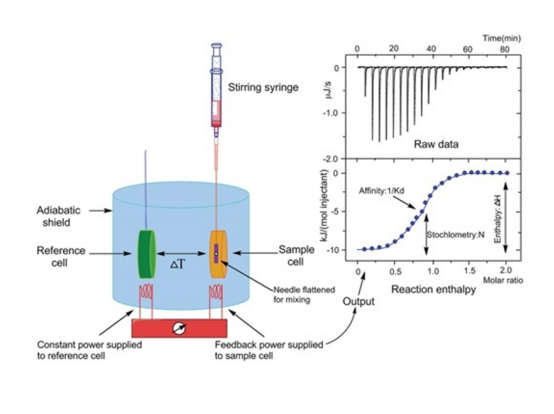
The ITC technique is a process that utilizes a calorimeter to measure the exchange of heat between biomolecules. In an ITC experiment, a container called a sample cell contains one biomolecule and another container called a syringe contains another biomolecule. When the two biomolecules combine, a certain thermal effect, known as enthalpy change, occurs.The ITC technique measures this thermal effect and calculates it to determine thermodynamic parameters such as thermodynamic equilibrium constant, enthalpy change and entropy change.
Appliance
ITC technology can be used to study interactions between biomolecules, such as protein-ligand interactions, protein-protein interactions, enzymatic reactions, etc. ITC technology can provide quantitative information about biomolecular interactions, which can help researchers better understand the functions and regulatory mechanisms of biomolecules.
Operation method
Isothermal titration calorimetry (ITC)
Principle
The ITC technique is a process that utilizes a calorimeter to measure the exchange of heat between biomolecules. In an ITC experiment, a container called a sample cell contains one biomolecule and another container called a syringe contains another biomolecule. When the two biomolecules combine, a certain thermal effect, known as enthalpy change, occurs.The ITC technique measures this thermal effect and calculates it to determine thermodynamic parameters such as thermodynamic equilibrium constant, enthalpy change and entropy change.
Materials and Instruments
ITC instruments, calorimeter cells, syringes, sample substances Move 1. The microcalorimeter contains two cells, one of which contains water as a reference cell and the other contains the sample. The microcalorimeter must maintain the two pools at exactly the same temperature. The thermal device detects the temperature difference between the two cells when binding occurs and feeds it back to the heater, which compensates for the difference and returns the two cells to the same temperature. Caveat (1) Personal protection should be observed during operation to avoid contact with toxic chemicals.(2) Attention should be paid to the concentration and dilution of the sample during operation to obtain accurate measurement results.(3) Temperature fluctuations should be avoided during temperature control to ensure the accuracy of the measurement.(4) The ITC instrument should be sufficiently warmed up and calibrated before operation to ensure the reliability of the experiment.(5) Clean sample cells and syringes should be ensured before measurement to avoid interference from impurities.(6) Pay attention to the time and speed of the experiment when performing measurements to avoid over-measurement or too fast measurement speed leading to inaccurate data.(7) Care should be taken to statistically analyze the measurement results when performing data processing in order to obtain reliable thermodynamic parameters. For more product details, please visit Aladdin Scientific website.
Reference substance, buffer, distilled water
2、Prepare the sample cell and syringe, add the buffer into the sample cell, and add the reference substance and the substance to be measured into the syringe.
3、Place the sample cell and syringe into the ITC instrument and control the temperature at a constant temperature.
4、Inject the reference substance into the sample cell and record the baseline value of the thermal effect signal.
5. Add the substance to be measured into the sample cell and record the change of the thermal effect signal.
Repeat steps 3-4 until the end of the measurement.
7、Calculate the thermodynamic parameters, such as thermodynamic equilibrium constant, enthalpy change and entropy change, etc., according to the measurement results.