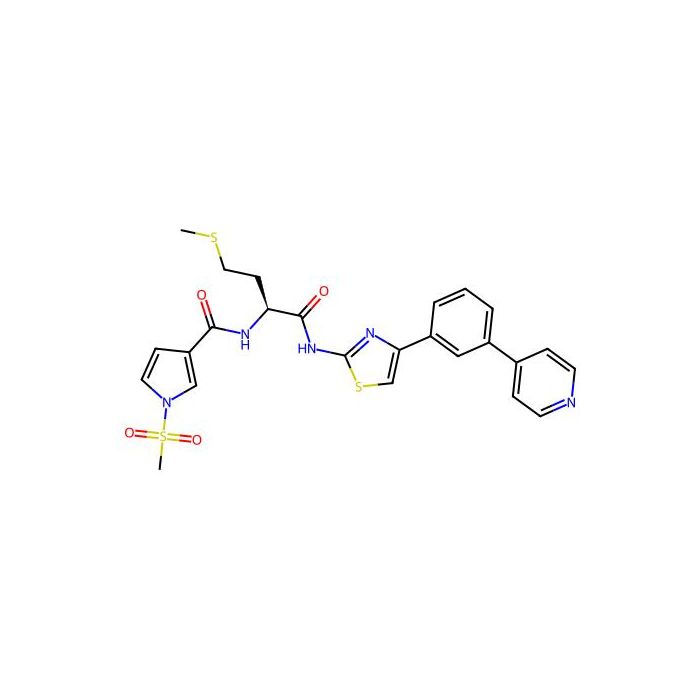
FHT-1205 is a potent SMARCA4/SMARCA2 ATPase (BRG1 and BRM) inhibitor with IC 50 s of ≤10 nM (WO2020160180A1; compound 67).
Form:Solid
仕様
仕様と純度
≥98%
生化学的・生理学的メカニズム
FHT-1205 is a potent SMARCA4/SMARCA2 ATPase (BRG1 and BRM) inhibitor with IC 50 s of ≤10 nM (WO2020160180A1; compound 67).
保管条件
Store at -20°C
入荷
Ice chest + Ice pads
この製品は冷冷この冷このこの製品の運送が必要です。地上およびその他の経済サービスは利用できません。
アクションタイプ
INHIBITOR
純度
≥98%
名前と識別子
分子量
555.69
詳細データ
証明書(CoA、COO、BSE/TSEと分析図)
C of A & Other Certificates(BSE/TSE, COO):
Analytical Chart:
化学的性質と物理的性質
溶解度
DMSO : ≥ 100 mg/mL (179.96 mM)
ソリューション計算機
Molarity Calculator
Determine the necessary mass, volume, or concentration for preparing a solution.
Dilution Calculator
Determine the dilution needed to prepare a stock solution.
Reconstitution Calculator
レビュー
顧客レビュー
Application Protocols
No item-specific, validated application protocols are provided. The following are general best practices for handling small-molecule library compounds in research settings (not item-specific; adapt to your assay and consult SDS).
Stock preparation
Warm the vial to ambient in a desiccator to prevent condensation. Open under dry air or nitrogen if moisture sensitivity is suspected.
Prepare a concentrated stock in anhydrous DMSO (e.g., 10–50 mM). Filter through a 0.22 µm PTFE filter if particulates are observed and the compound is stable to filtration.
Aliquot into low-bind tubes/plates to minimize adsorption and freeze–thaw cycles.
Working solution and assay setup
Dilute the DMSO stock into assay buffer/media immediately before use. Keep final DMSO ≤0.5–1% v/v unless your assay tolerates higher.
Include solvent-only controls and, where applicable, positive/negative controls to benchmark performance.
Inspect for precipitation or turbidity after dilution; adjust solvent composition or concentration accordingly.
Analytical verification
Confirm concentration by UV-Vis (if chromophore known) or quantitative LC-UV/LC-MS using an external calibration curve. Record plate maps and timestamps.
Stability considerations
Limit ambient exposure and repeated freeze–thaw. Store working stocks on ice during use and return aliquots promptly to −20°C.
Safety
Handle in a fume hood with appropriate PPE; consult SDS for hazard-specific precautions.
Biological Roles
Item-specific biological information
No target, pathway, or mode-of-action data are provided for FHT-1015 in the Product Data. Any biological role is therefore not established.
General considerations for small-molecule library members (not item-specific)
Library compounds are typically used to explore biological space empirically. Potential roles (enzyme modulation, receptor interaction, pathway perturbation) are determined experimentally and require confirmation across orthogonal assays.
Early observations should be triaged for common assay interferences (aggregation, redox cycling, fluorescence quenching/activation, metal chelation, detergent sensitivity). Structural information is necessary to conduct PAINS and liability filters.
If activity is observed, determine basic ADME-relevant properties (solubility, stability in assay buffer, microsomal stability, permeability) in research settings to contextualize results. Do not infer therapeutic relevance from screening data.
Documentation and data integrity
Record exact lot, solvent composition, plate map, and timing of additions to ensure reproducibility of biological findings.
Include solvent-only and known-positive/negative controls for each assay plate.
Note: No clinical or therapeutic claims are made or implied; this material is supplied strictly for research use.
Buffer Applications
This product is a small-molecule library compound with no disclosed acid/base properties or pKa values, so defined buffering applications are not typically applicable.
Item-specific data
pKa and ionic state: Not specified for this item; refer to CoA/Spec Sheet.
Practical assay-related guidance (general; not item-specific)
Preparation: Dissolve the compound in an organic stock solvent (commonly DMSO), then dilute into the desired assay buffer (e.g., HEPES, PBS, Tris) immediately prior to use.
Vehicle control: Maintain constant final DMSO (often ≤0.5–1% v/v) across wells/tubes to control for solvent effects.
Precipitation control: Add stock last while plate is on a shaker; consider a brief pre-dilution step into buffer containing a small amount of nonionic surfactant (e.g., 0.01–0.05% Tween-20) if permitted by the assay to mitigate aggregation/precipitation.
pH sensitivity: In absence of pKa data, avoid extreme pH conditions that may cause degradation; conduct small-scale stability checks at your working pH.
For dedicated buffer-making guidance (component masses, buffering ranges), refer to documented buffer systems such as HEPES (pH 6.8–8.2), MOPS (pH 6.5–7.9), and Tris (pH-dependent, strong ΔpKa/°C), which are external to this specific compound.
Green Alternatives
With structure-specific hazards and solvent needs unknown for FHT-1015, green chemistry considerations focus on solvent choice, minimization of waste, and efficient assay design.
Item-specific facts
None provided regarding solvent or hazard profile. Refer to SDS/CoA for this item.
General greener-practice options (not item-specific)
Prefer ethanol or water-miscible green co-solvents (e.g., ethanol, propylene carbonate) over higher-toxicity solvents when physicochemically feasible.
Use DMSO stocks at the highest practical concentration to reduce solvent volume in assays and shipping-related footprints.
Employ miniaturized assay formats (e.g., 384/1536-well plates) to decrease reagent consumption and waste.
Where chemical synthesis or analog preparation is undertaken, consider 2-MeTHF or CPME instead of halogenated solvents; evaluate life-cycle and safety tradeoffs.
Balanced comparison (general; not item-specific)
DMSO: excellent solvency; not classed as green but widely accepted; low vapor pressure reduces emissions.
Ethanol: renewable and lower-toxicity; solvency limitations for highly lipophilic compounds.
Acetonitrile: effective for LC-MS and dissolution; toxicity and petrochemical origin are drawbacks.
Operational measures
Consolidate shipments, use reusable cold packs, and recycle secondary packaging when possible.
Document and track solvent usage; implement recovery where analytically acceptable.
Note: Specific greener substitutions for reaction solvents or workups require knowledge of functional groups present in FHT-1015; consult the structure and process requirements before changing solvents.
Pharmaceutical Uses
No pharmacopeial status, excipient role, or formulation designation is provided for FHT-1015. This material is supplied strictly for research use only and is not intended for human or animal therapeutic, diagnostic, or clinical applications.
Item-specific facts
Grade/Purity: Not specified for this item; refer to CoA/Spec Sheet.
Molecular identity details suitable for regulatory filing (e.g., USP/EP monographs): Not provided.
General R&D context (not item-specific)
In early discovery, library compounds may be used for in vitro screening and pre-formulation feasibility studies (e.g., solubility profiling, salt screening) under research-only conditions.
If transitioning a research compound toward developability assessments, generate a full analytical package (identity, purity profile, residual solvents, polymorph, hygroscopicity) and establish storage/stability-indicating methods.
Any scale-up, GMP manufacturing, or clinical formulation work requires separate sourcing under appropriate quality systems and regulatory controls.
Handling notes relevant to formulation experiments (general)
Use glassware and low-bind plastics to reduce adsorption losses if compound is highly lipophilic.
Evaluate compatibility with common vehicles (e.g., PEG 400, Captisol, polysorbates) only within a research setting and with appropriate safety assessments.
Reminder: Do not use this product as a drug substance, excipient, or in any clinical context.
Physical Properties
Item-specific physicochemical properties are not provided in the Product Data and should be verified on the CoA/SDS for the exact lot.
Item-specific facts (from Product Data)
Appearance: Not specified for this item; refer to CoA/Spec Sheet.
Molecular Weight: Not specified for this item; refer to CoA/Spec Sheet.
Melting point (MP): Not specified for this item; refer to CoA/Spec Sheet.
Boiling point (BP): Not specified for this item; refer to CoA/Spec Sheet.
Density: Not specified for this item; refer to CoA/Spec Sheet.
LogP/LogD: Not specified for this item; refer to CoA/Spec Sheet.
pKa(s): Not specified for this item; refer to CoA/Spec Sheet.
Refractive index: Not specified for this item; refer to CoA/Spec Sheet.
UV-Vis λmax / extinction: Not specified for this item; refer to CoA/Spec Sheet.
Solubility: Not specified for this item; refer to CoA/Spec Sheet.
General guidance (literature/practice—not item-specific)
For small-molecule screening compounds, initial dissolution is commonly attempted in anhydrous DMSO (1–50 mM stock), with subsequent dilution into assay media.
When physical form is unknown, test for solubility by tiered addition of DMSO or MeOH, then aqueous buffer containing surfactant (e.g., 0.01–0.05% Tween-20) if compatible with the assay.
Employ nephelometry or visual inspection to detect precipitation after dilution into aqueous systems.
Important note
Do not treat the above as specifications. For quantitative method development, stability indicating assays, or safety assessments, obtain and reference the official CoA/SDS for this item.
Quality and Grades
Item-specific facts (from Product Data)
Grade/Purity: Not specified for this item; refer to CoA/Spec Sheet.
Appearance: Not specified for this item; refer to CoA/Spec Sheet.
Interpreting grade/purity (general guidance; not item-specific)
Library/Screening Compounds: Vendors often supply ≥90–95% purity by HPLC/UPLC with LC-UV/MS identity verification. However, actual acceptance criteria are supplier- and lot-specific. Always confirm on the CoA accompanying your lot.
Low water/peroxide/metal content and UV cutoff may be critical for some applications; these values are not specified for this item and should be requested if required for analytical or photochemical work.
Residual solvents and counter-ions/salts (if applicable) may affect solubility and assay interference; review the analytical section of the CoA.
Stabilizers and formulation
No stabilizers or special additives are listed in the Product Data. If stabilizers or salt forms are important to your workflow, verify with the CoA.
Practical recommendations
Record the lot number and retain the CoA for traceability in screening campaigns or SAR workflows.
If UV purity or low-absorbance background is needed (e.g., for kinetic photometric assays), request a chromatogram at the relevant wavelength(s).
For structural registration, request definitive identifiers (SMILES, InChI/InChIKey) and analytical spectra (1H/13C NMR, HRMS) when available.
Reaction and Applications
Item-specific intended use (from Product Data)
Listed under small molecules and compound library; no specific application claims are provided. For research use only.
Research applications (general guidance; not item-specific)
High-throughput screening (HTS) and hit identification: FHT-1015 can serve as a member of a screening panel to probe biochemical or cell-based assay readouts. Maintain appropriate vehicle controls and include orthogonal counterscreens to flag assay interference.
Chemical biology workflows: If an activity signal is observed, follow-up with dose–response titration, orthogonal assay formats, and minimal physicochemical triage (solubility, stability, redox activity, PAINS alerts) using the structure once available.
Reference material and QC spike: Can be used as an internal check for plate handling, evaporation studies, or method development for LC-MS quantitation after structure and ionization behavior are established.
Practical handling tips (general)
Prepare concentrated DMSO stocks (e.g., 10–50 mM) under dry conditions. Aliquot to minimize freeze–thaw.
Verify absence of precipitation in the assay medium at working concentrations. Use nephelometry or plate-reader light scattering if available.
Control for redox/fluorescence interference by incorporating appropriate assay controls (e.g., Amplex Red counterassay, autofluorescence scans) once optical properties are known.
Synthesis/transformations
No synthetic reactivity or building-block applications can be provided without structural information. If synthetic derivatization or SAR expansion is planned, obtain structural identifiers and analytical data.
Reaction Conditions
Reaction conditions are not applicable without knowledge of the compound’s structure and functional groups.
Item-specific facts
None provided regarding reactivity, stability, or catalytic compatibility.
General notes (not item-specific)
Prior to any chemical transformation, obtain full structural information and baseline stability data (e.g., in acid/base, oxidizing/reducing environments, heat, light).
If derivatization is intended, run micro-scale scouts across a small matrix of solvents, bases/acids, and temperatures to map compatibility. Monitor by LC-MS with appropriate detection wavelengths.
Protect from moisture/oxygen if sensitive motifs are suspected; use inert atmosphere techniques as warranted.
Because no structure or reactivity data are provided for FHT-1015, no representative temperatures, catalysts, or yields can be responsibly recommended.
Safety and Handling
Safety data specific to FHT-1015 are not included in the provided Product Data; therefore, follow a conservative approach and consult the official SDS before use.
Item-specific hazard data
GHS Classification: Not specified for this item; refer to SDS.
Signal Word: Not specified for this item; refer to SDS.
H-Statements: Not specified for this item; refer to SDS.
Pictograms: Not specified for this item; refer to SDS.
General laboratory precautions for small organic research compounds (general guidance; not item-specific)
Work in a chemical fume hood; avoid inhalation of dusts/aerosols and skin/eye contact.
Wear appropriate PPE: lab coat, safety glasses, and chemically resistant gloves (e.g., nitrile). Consider double-gloving for extended handling or unknown toxicity materials.
Prevent ingestion; do not pipette by mouth; wash hands after handling.
Avoid generating dust; use antistatic measures if powdery. If supplied in solution, prevent aerosolization and cap promptly.
Incompatibilities are structure-dependent. As a precaution, segregate from strong oxidizers, strong acids/bases, and reactive reducing/alkylating agents until specific compatibility is known.
First-aid overview (consult SDS for definitive procedures)
Skin/eye contact: Immediately flush with water for ≥15 min; remove contaminated clothing; seek medical attention if irritation persists.
Inhalation: Move to fresh air; monitor breathing; seek medical evaluation if symptoms occur.
Ingestion: Rinse mouth; do not induce vomiting unless directed by medical personnel; seek medical attention.
Spill, fire, and disposal (general)
Small spills: Absorb with inert material; collect in compatible waste. Avoid dust.
Fire: Use CO2, dry chemical, or foam as appropriate to surrounding materials.
Disposal: Treat as hazardous chemical waste; dispose per institutional and local regulations.
Solvent Selection
Because the chemical structure of FHT-1015 is not provided, solvent choice should follow a general, structure-agnostic strategy used for small-molecule screening materials.
Item-specific facts (from Product Data)
None provided regarding solubility or recommended solvents; consult CoA/Spec Sheet.
General guidance (not item-specific)
Primary stock solvent: Anhydrous DMSO is typically preferred for library compounds due to broad solvency and assay compatibility at low final percentages (≤0.5–1% v/v in most biochemical assays).
Secondary solvents: Methanol, ethanol, or acetonitrile can be used for initial dissolution; mixtures (e.g., DMSO:water or MeOH:water) may aid difficult solutes.
Aqueous use: Prepare concentrated organic stock, then dilute into buffer immediately before use. Include solvent-only controls to deconvolute vehicle effects.
Poorly soluble materials: Consider minimal heating (≤40 °C), brief sonication, or co-solvent blends. Avoid prolonged heating that may degrade unknown functionalities.
Adsorption losses: For lipophilic/neutral compounds, minimize plastic adsorption by using glass vials/plates or low-bind plastics.
Comparison snapshot (general)
DMSO: broad solvency, high boiling point; widely used in HTS.
Ethanol: greener, volatile; limited solvency for very lipophilic compounds.
Acetonitrile: good solvency, miscible; stronger extractant, higher toxicity than EtOH.
Documentation
Record the final solvent composition in assay protocols; verify compound stability in the chosen solvent over the intended time window.
Storage and Reconstitution
Item-specific facts (from Product Data)
Storage Conditions: Store at −20°C
Shipped In: Ice chest + Ice pads
General storage guidance for small-molecule library compounds (not item-specific)
Keep tightly closed in the original container, protected from light and moisture. If hygroscopic or photosensitive (unknown here), consider amber vials and desiccant.
For long-term storage, maintain at −20°C in a non-defrosting freezer. Avoid exposure to temperature cycling.
Minimize headspace and use inert gas backfill (nitrogen or argon) if oxidative sensitivity is suspected.
Reconstitution (general; adapt to your application)
Allow vial to equilibrate to room temperature in a desiccator before opening to prevent condensation.
Prepare a concentrated stock solution in an appropriate solvent, most commonly anhydrous DMSO (e.g., 10–50 mM), unless the CoA suggests alternative solvents.
Mix gently by inversion or brief vortex; if undissolved solids persist, apply short sonication or mild warming (≤40°C). Do not overheat unknown compounds.
If sterile conditions are required for cell-based assays, pass through a 0.22 µm PTFE or PVDF syringe filter compatible with the solvent.
Aliquoting and freeze–thaw management
Dispense single-use aliquots to avoid repeated freeze–thaw. Label aliquots with concentration, solvent, date, and lot.
Store aliquots at −20°C; avoid frost-free freezers.
Stability notes
Explicit stability/shelf-life for this item is not specified; refer to CoA/Spec Sheet and monitor by LC-MS/LC-UV as appropriate for your workflow.
Structure and Identity
Brief overview: FHT-1015 (SKU F649677) is listed in our small-molecule and compound library category. Item-specific structural identifiers are not provided in the product data.
Item-specific facts (from Product Data)
SKU: F649677
Product Name: FHT-1015
CAS: 2368903-18-6
Category: Small molecules and compound library (全部 / 可售 / 小分子和化合物库)
Research Use: For research use only
Storage: Store at −20°C
Shipping: Ice chest + Ice pads
Structure identifiers
Molecular Formula: Not specified for this item; refer to CoA/Spec Sheet.
Molecular Weight: Not specified for this item; refer to CoA/Spec Sheet.
SMILES: Not specified for this item; refer to CoA/Spec Sheet.
InChIKey: Not specified for this item; refer to CoA/Spec Sheet.
Structural features and 2D description
Functional groups, ring systems, stereochemistry: Not available for this item in the provided data. No 2D or 3D structural description can be given without SMILES/InChI.
Notes
If you require definitive identifiers (SMILES/InChIKey) for database registration, QSAR modeling, or LIMS ingestion, please request the current CoA/Spec Sheet for this specific lot.
The CAS number supplied can be used for cross-referencing in external databases; however, do verify that the registry entry corresponds to the exact supplier material and lot.
Synthetic Utility
Synthetic roles cannot be outlined without structural information. No functional groups, protecting-group considerations, or reactivity handles are available from the Product Data.
Item-specific facts
Structure and functional groups: Not specified for this item; refer to CoA/Spec Sheet.
General guidance (not item-specific)
If FHT-1015 is to be used as a starting material or intermediate, obtain the structure (SMILES/InChI) and analytical data to plan transformations and assess compatibility with conditions (e.g., strong acids/bases, oxidants/reductants, metal catalysts).
For SAR or analog expansion, route scouting should consider step economy, chemoselectivity, and scalability. Green solvent options (e.g., 2-MeTHF, CPME) can be evaluated once the functional group array is known.
If chiral centers are present (unknown here), plan for asymmetric synthesis or chiral resolution and verify enantiopurity by chiral HPLC/SFC.
Conclusion: Treat this item as a screening compound rather than a defined synthetic building block until structural details are confirmed.
Target Specificity
No target, epitope, or binding specificity information is provided for FHT-1015. As a small-molecule library member with undisclosed structure, no claims can be made about target class, isoform selectivity, or off-target profile.
Item-specific facts
Target/epitope/clone/isotype: Not applicable to this product type and not provided.
General guidance (not item-specific)
Establish target engagement through biochemical binding/functional assays, followed by orthogonal confirmation (e.g., thermal shift, SPR, ITC, CETSA) and cellular assays as appropriate.
If a target hypothesis emerges, corroborate with structure–activity relationships and, where feasible, structural biology (e.g., co-crystallography or cryo-EM) to substantiate specificity claims.
Note: No biological or therapeutic claims are made for this product.
よくある質問
What is the purity of this product?
This product is supplied at ≥98% purity (chemical assay). Lot-specific values are stated on the Certificate of Analysis.
How should this product be stored?
Store at ?20 °C. Freezer storage is required to maintain the specified shelf life.
How is this product shipped?
This product ships in an insulated container with ice pads. Unpack on arrival and transfer it to the storage condition stated above.
What are the CAS number, molecular formula and molecular weight?
The CAS Number is 2368903-18-6, the molecular formula is C25H25N5O4S3, and the molecular weight is 555.69 g/mol.
What documentation is provided?
Available product documentation, including Certificates of Analysis (COA), Safety Data Sheets (SDS), and specification sheets, is shown in the product document area. Document availability and access follow the current site policy.
Products are supplied to verified businesses, institutions, and qualified professionals for research and development use only. Not for use in humans, animals, diagnosis, or therapy.