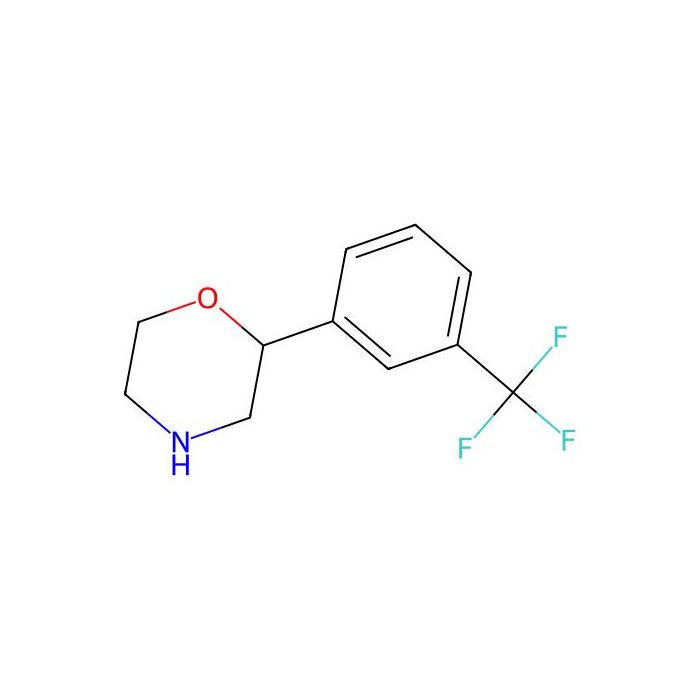
Flumexadol is a selective and affinity 5-HT 2C receptor agonist with a K i of 25 nM for the (+)-enantiomer of Flumexadol, and is 40-fold selective over the 5-HT 2A receptor. Flumexadol is an orally active non-narcotic analgesic
In Vivo
In rats and dogs dosed with 14 C-Flumexadol (CERM1841), the 14 C is excreted in the urine. The 14 C eliminated in the faeces of dog is significantly higher than for rat. Conjugated metabolites, mostly glucuronides, accounted for the greater part of the urinary radioactivity in both species. Biotransformation products are predominantly acids in both species, follows by significant amounts of basic metabolites, with very little neutral substances. The major urinary metabolite in rats is 3-trifluoromethylbenzoic acid and 3-trifluoromethylhipuric acid. In the dog it is 3-trifluoromethylmandelic acid in addition to the benzoic acid and its conjugate. The basic products identified in the urine of both species are unchanged drug and 1-amino-2-hydroxy-2-(3-trifluoromethylphenyl)ethane, with the first predominating. MCE has not independently confirmed the accuracy of these methods. They are for reference only.
IC50& Target:5-HT 2C Receptor 25 nM (Ki)
仕様
仕様と純度
10mM in DMSO
生化学的・生理学的メカニズム
Flumexadol is a selective and affinity 5-HT 2C receptor agonist with a K i of 25 nM for the (+)-enantiomer of Flumexadol, and is 40-fold selective over the 5-HT 2A receptor. Flumexadol is an orally active non-narcotic analgesic.
保管条件
Store at -80°C
入荷
Dry ice packs + Cold packs
この製品は冷冷この冷このこの製品の運送が必要です。地上およびその他の経済サービスは利用できません。
アクションタイプ
AGONIST
名前と識別子
異性体SMILES
C1COC(CN1)C2=CC(=CC=C2)C(F)(F)F
代替CAS番号
31599-68-5
分子量
231.21
詳細データ
証明書(CoA、COO、BSE/TSEと分析図)
C of A & Other Certificates(BSE/TSE, COO):
Analytical Chart:
ソリューション計算機
Molarity Calculator
Determine the necessary mass, volume, or concentration for preparing a solution.
Dilution Calculator
Determine the dilution needed to prepare a stock solution.
Reconstitution Calculator
レビュー
顧客レビュー
Application Protocols
No tested applications or protocols are supplied for this SKU. The following are general, non-binding guidelines for small-molecule handling in research.
Small-molecule stock preparation (general):
Weigh in a dry environment; dissolve to 10–50 mM in anhydrous DMSO. Vortex and, if needed, sonicate gently. Filter (0.22 µm) if particulates persist.
Pre-dilute DMSO stock into assay buffer to achieve final DMSO ≤1–2% v/v (or per assay tolerance). Include vehicle controls.
Cell-based assay addition:
Target final DMSO ≤0.5–1% v/v. Add compound to warmed media with rapid mixing. Assess cytotoxicity of vehicle and compound separately.
Analytical method development:
Start with 50:50 MeOH/H2O + 0.1% formic acid for LC–MS scouting. Optimize gradient and ionization polarity empirically. Establish calibration curves from stable DMSO stocks.
Note: These are generic practices; tailor to your system and consult the SDS and CoA for any item-specific constraints.
Biological Roles
No item-specific biological mechanism or target information is provided for this SKU. The following notes reflect general considerations for small bioactive molecules used in research. Research use only; no clinical or diagnostic use.
Use context: Compounds like Flumexadol are often deployed in discovery biology as putative modulators in biochemical or cell-based assays to interrogate pathways and phenotypes.
Profiling: Typical workflows include primary screening, counterscreens for assay interference (e.g., redox activity, aggregation), secondary target panels, and off-target safety pharmacology cascades (e.g., hERG binding in vitro) in research settings.
ADME/Tox (in vitro research): Solubility, permeability (PAMPA/Caco-2), microsomal stability, and plasma protein binding are commonly measured to contextualize biological readouts; these are study-specific and not provided with this item.
Data integrity: Validate the identity and purity of each lot in your lab (LC–MS, NMR) and re-check stability in assay media/timeframes used to avoid misattribution of activity to impurities or degradation products.
Important: Because no target or MOA is specified here, experimental results should be interpreted cautiously with appropriate controls, including orthogonal assays and concentration–response confirmation.
Buffer Applications
This compound is not a buffering agent. However, buffer selection is often critical when using small molecules in biochemical or cell-based assays.
General buffer guidance for small-molecule testing:
Common assay buffers: PBS, HEPES, Tris, or MOPS, selected for pH stability and minimal reactivity with the compound or detection chemistry.
Organic co-solvent: Introduce DMSO stocks into buffer with rapid mixing; maintain final DMSO ≤0.5–1% v/v (cells) or ≤2% v/v (biochemical) unless validated otherwise.
Detergents: Low levels of nonionic detergents (e.g., 0.01–0.05% Tween-20 or 0.01% Triton X-100) can mitigate nonspecific adsorption/aggregation if compatible with the assay.
pH and ionic strength: Optimize to balance target activity and compound stability/solubility; avoid extremes that can induce hydrolysis or precipitation.
Note: No item-specific pKa or solubility is provided; perform small-scale compatibility checks to confirm that the compound remains in solution over the assay duration.
Green Alternatives
Green chemistry considerations here focus on solvent management and lifecycle, as the compound itself is fixed by design.
Greener solvent strategies (general guidance):
Prefer water and aqueous buffers as final assay media; keep DMSO ≤0.5–1% v/v.
Use ethanol or isopropanol instead of methanol where feasible (lower toxicity), recognizing possible solubility tradeoffs.
For chromatography, consider greener mobile phases (e.g., MeOH/water over ACN/water when compatible) and minimize additives.
For sample prep, microscale wherever possible to reduce solvent volumes.
Comparison (typical pros/cons):
DMSO: Strong solvency, but persistent; manage as hazardous waste. Alternative: PEG400/water co-solvent systems can reduce DMSO load but may affect assay readouts.
Acetonitrile vs methanol (LC): ACN offers lower backpressure and better peak shape for many analytes; MeOH is generally greener but may require higher pressures and longer run times.
Isopropanol (IPA): Useful as a stronger, greener organic modifier for LC or as a rinse solvent; higher viscosity may affect system pressure.
Operational improvements:
Consolidate runs, adopt shorter columns with sub-2 µm or core–shell media to reduce solvent use.
Implement solvent recycling for large-scale prep workflows where permitted.
Note: These are general recommendations; confirm compatibility with your compound’s stability and your analytical/assay requirements.
Pharmaceutical Uses
No pharmacopeial status or excipient/functionality designation is provided for this item. The product is supplied strictly for research use only and is not intended for human or veterinary applications.
Relevant non-clinical uses in pharmaceutical R&D (general):
Reference compound in analytical method development and validation (e.g., LC–MS/MS bioanalytical methods for nonclinical studies).
Internal standard or system suitability marker (if validated in-house) for chromatographic runs.
Tool compound candidate for mechanism studies, SAR benchmarking, and DMPK investigations in discovery research.
Documentation:
If used as a reference material, establish an internal certificate detailing identity, purity, and assigned value with uncertainty based on your laboratory’s characterization.
For stability-indicating methods, evaluate degradation pathways under ICH-like stress (light, heat, oxidative, acidic/basic) to ensure peak purity and accurate quantitation in research matrices.
Important: No claims are made regarding suitability for clinical development, GMP manufacturing, or compendial compliance for this SKU.
Physical Properties
Item-specific physicochemical specifications are not listed in this entry. When planning handling and formulation, consult the CoA/Spec Sheet and SDS for authoritative details.
Appearance: Not specified for this item; refer to CoA/Spec Sheet.
Melting point (MP): Not specified for this item; refer to CoA/Spec Sheet. (Use DSC or capillary MP if verification is required.)
Boiling point (BP): Not specified for this item; refer to CoA/Spec Sheet.
Density: Not specified for this item; refer to CoA/Spec Sheet.
Solubility: Not specified for this item; refer to CoA/Spec Sheet.
LogP/logD: Not specified for this item; refer to CoA/Spec Sheet.
pKa: Not specified for this item; refer to CoA/Spec Sheet.
Refractive index: Not applicable/unknown for solid samples; otherwise Not specified for this item; refer to CoA/Spec Sheet.
Practical guidance (general, literature-informed best practices for drug-like small molecules):
Stock solutions for screening are commonly prepared at 10–50 mM in anhydrous DMSO, then diluted into assay buffer or media (final DMSO ≤0.5–1% v/v typically).
If solubility in DMSO is limited, co-solvent systems (e.g., DMSO:water, DMSO:EtOH, or DMSO:PEG400) or mild heating/sonication may help; always filter (0.22 µm) if particulate remains.
Hygroscopicity and polymorphism can affect handling; store tightly capped under dry, inert conditions when possible to maintain consistency between experiments.
Note: Treat any values derived in your lab as method-specific until reconciled with the product CoA.
Quality and Grades
Grade/Purity: Not specified for this item; refer to CoA/Spec Sheet.
UV cutoff, residual solvents, metal content, water/peroxide limits: Not specified for this item; refer to CoA/Spec Sheet.
Context and expectations:
Screening-library compounds are typically supplied to support medicinal chemistry, chemical biology, and method-development workflows. Purity is commonly assessed by HPLC/UPLC with UV or MS detection and confirmed by NMR/HRMS as needed. Verify the exact analytical package on the CoA for this SKU.
If your application demands low-UV-absorbing solvent residues (e.g., HPLC/LC–MS reference standard use), request or review the residual solvent profile on the CoA.
If chiral, verify enantiopurity/absolute configuration (if applicable). If racemic, ensure this aligns with experimental plans.
Batch-to-batch control: Document lot numbers, and keep aliquots for reference stability checks (HPLC re-checks every 3–6 months under your storage conditions).
Stabilizers/additives:
Any stabilizers or salt forms would be listed on the CoA/Spec Sheet for this specific lot. If unspecified, assume neat free base/free acid or neutral compound until documentation indicates otherwise.
Reaction and Applications
This product is primarily intended as a research/screening compound rather than a general-purpose synthetic reagent. No manufacturer reaction-application notes are provided for this SKU.
Suitable research uses (non-clinical):
Use as a reference compound or probe candidate in target-agnostic or targeted screening panels (biochemical, cellular, or phenotypic assays).
Analytical standard for method development (HPLC/UPLC, LC–MS) including retention-time indexing, extraction recovery checks, and matrix effect studies.
Structure–activity relationship (SAR) exploration in medicinal chemistry campaigns when coupled with literature structure data.
If synthetic transformations are planned:
The lack of structural detail in this listing precludes specific reaction guidance. Should you intend to derivatize or use it as a building block, obtain the structure from the CoA/literature and design conditions around the functional group tolerance (e.g., protecting groups for nucleophiles/electrophiles, base/acid sensitivity, redox liability).
General practical tips:
Maintain rigorous documentation (lot, storage history, analytical re-checks) to ensure reproducibility across screening campaigns.
Validate stability in your assay buffers and under analytical autosampler conditions to avoid degradation artifacts.
Reaction Conditions
No manufacturer-supplied reaction conditions are associated with this SKU, and the structure is not disclosed here. Consequently, specific conditions for transformations cannot be provided.
General guidance for handling during any potential chemical manipulation:
Solvent: Choose based on functional groups and solubility (e.g., DCM/DMF/MeCN/EtOH or DMSO for polar substrates). Start with small-scale trials.
Temperature: Begin at ambient and adjust cautiously. If unknown stability, avoid >50 °C until a stability profile is established.
Atmosphere: If redox- or hydrolysis-sensitive motifs are suspected, use dry, inert conditions (N2/Ar) and anhydrous solvents.
Catalysts/reagents: Select chemoselective, mild reagents when structure is uncertain; avoid strong oxidants/reductants without prior compatibility checks.
Workup: Partitioning between aqueous buffer and organic solvent (e.g., EtOAc) may be used; however, confirm stability across pH 3–10 before exposure.
Analytical checkpoints:
Monitor by LC–MS (positive/negative mode as applicable) and TLC/UPLC; confirm integrity post-treatment.
Note: For definitive reaction planning, consult the CoA/literature structure and tailor conditions to the specific functional groups present.
Safety and Handling
Safety data are not itemized in the Product Data; defer to the product SDS for authoritative guidance.
GHS classification: Not specified for this item; refer to SDS.
Signal word / pictograms / H-statements: Not specified for this item; refer to SDS.
Primary hazards (general for small bioactive organics): May cause irritation to skin/eyes/respiratory tract; avoid inhalation of dust and contact with skin/eyes. Handle in a fume hood.
PPE: Lab coat, safety glasses, and appropriate chemically resistant gloves (e.g., nitrile). Use a dust mask/respirator if powders/aerosols may form and local rules require.
Engineering controls: Work in a chemical fume hood or ventilated enclosure; use closed containers and local exhaust during weighing/aliquoting.
Incompatibilities: Unknown for this item; avoid strong oxidizers and strong acids/bases until specific compatibility is confirmed from SDS/literature.
First aid (overview): If inhaled—move to fresh air; if on skin—wash with soap/water; if in eyes—rinse cautiously for several minutes; if ingested—rinse mouth and seek medical advice. Follow institutional emergency procedures.
Spill/accidental release: Avoid dust formation; contain and collect with inert absorbent; dispose per institutional and regulatory requirements.
Waste: Dispose as organic laboratory waste according to local regulations; avoid drain release.
Research use only: Not for human or veterinary use. Follow all institutional EHS policies and consult the SDS before use.
Solvent Selection
Item-specific solubility data are not provided; selection should follow general best practices for small-molecule stocks and assay dilutions.
Recommended approach (general):
Primary solvent for stocks: Anhydrous DMSO (analytical/anhydrous grade) at 10–50 mM is typical for screening compounds.
Secondary solvents/co-solvents: Ethanol (absolute), acetonitrile, methanol, or PEG400 can assist if DMSO solubility is limited. Use water-miscible mixtures for biological assays.
Aqueous compatibility: Pre-dilute DMSO stocks into buffer with vigorous mixing to prevent precipitation. Keep final DMSO ≤0.5–1% v/v in cell-based assays unless otherwise validated.
Practical notes:
Sonication and mild warming (≤40 °C) can help dissolution; avoid prolonged heating and protect from moisture.
Filter through 0.22 µm PTFE/nylon for particulate removal when preparing analytical standards.
Comparison snapshot (general):
DMSO: Highest dissolving power for diverse chemotypes; hygroscopic; potential assay interference at high %.
Ethanol/MeOH: Useful for less polar to moderately polar compounds; volatility can cause concentration drift.
Acetonitrile: LC–MS friendly; moderate dissolving power; lower viscosity vs DMSO.
PEG400: Enhances solubility for very lipophilic compounds; viscous; may require dilution strategy.
Always verify solvent choice against your analytical/assay system and consult CoA for any item-specific restrictions.
Storage and Reconstitution
Storage (as supplied):
Store at -80°C (per Product Data). Keep tightly sealed in the original container to minimize moisture and air exposure.
Shipped in: Dry ice packs + Cold packs (per Product Data). Inspect upon receipt; if thawing occurred, re-freeze promptly after integrity check.
Stability practices (general):
Minimize freeze–thaw cycles. Prepare single-use aliquots immediately after first opening.
Protect from light and humidity. If hygroscopicity is unknown, handle quickly and re-cap promptly; consider desiccant storage.
Reconstitution (general guidance for small molecules):
Solvents: Anhydrous DMSO is a common choice for concentrated stocks; alternatives include ethanol, acetonitrile, or PEG400 mixtures depending on solubility.
Concentration: 10–50 mM typical for screening stocks; verify solubility experimentally. Warm gently (≤40 °C) and/or sonicate if required. Do not overheat.
Post-reconstitution storage: Store aliquots at -20°C to -80°C, tightly capped, ideally under inert gas for oxidation-sensitive compounds. Track time-in-storage and number of freeze–thaw events.
Critical note:
Because item-specific stability, solubility, and hydration state are not provided, confirm these parameters in your lab and consult the CoA/Spec Sheet for any lot-specific instructions.
Structure and Identity
Brief overview: Flumexadol is listed as a small-molecule research compound in our screening library. Item-specific structural identifiers are not provided in this listing.
Chemical name: Flumexadol (preferred name in catalog)
CAS: 30914-89-7 (catalog identifier)
CID: 65774 (catalog reference)
Molecular formula: Not specified for this item; refer to CoA/Spec Sheet.
Molecular weight: Not specified for this item; refer to CoA/Spec Sheet.
SMILES: Not specified for this item; refer to CoA/Spec Sheet.
InChIKey: Not specified for this item; refer to CoA/Spec Sheet.
Synonyms: Not specified for this item; refer to CoA/Spec Sheet.
Structural features (general guidance):
As a drug-like small molecule, Flumexadol would typically possess one or more heteroatoms (e.g., N, O, halogens) and aromatic/aliphatic features; however, specific functional groups and ring systems are not provided in this product data.
2D description: Without the SMILES/InChI, a definitive 2D structural narrative cannot be supplied here. Please consult the CoA/Spec Sheet or primary literature associated with CAS 30914-89-7 for definitive structural representation.
Documentation note:
For identity confirmation in your lab, we recommend orthogonal methods such as HRMS and 1H/13C NMR against reference data, and, when applicable, HPLC/UPLC purity profiling.
Synthetic Utility
No structural details are provided in this listing, so specific synthetic roles or transformations cannot be recommended.
General notes if derivatization is contemplated:
Obtain the definitive structure (from CoA/literature) and map functional groups for chemoselectivity planning.
Assess liabilities: groups sensitive to oxidation, strong acid/base, or transition-metal catalysis may require protection or alternative routes.
Parallel synthesis: If using Flumexadol as a core scaffold for SAR libraries, design divergent coupling points (e.g., amide, ether, or Suzuki–Miyaura handles) based on documented substituents.
Analytical control: Track reactions with LC–MS; confirm products by HRMS and 2D NMR, and check purity by HPLC/UPLC.
Because this SKU is primarily a screening compound rather than a reagent or building block, many users will employ it as-is for biological/analytical studies rather than as a substrate in synthetic sequences.
Target Specificity
No target, enzyme, receptor, or pathway specificity has been provided for this item in the Product Data.
Target/epitope/clone/isotype details: Not applicable—this is a small molecule, not an antibody or protein reagent.
For biological testing, treat as target-agnostic unless you have independent literature assigning a mechanism of action. Validate any observed activity with orthogonal assays and appropriate positive/negative controls.
よくある質問
How should this product be stored?
Store at ?80 °C. Ultra-low temperature storage is required to maintain the specified shelf life.
How is this product shipped?
This product ships frozen with dry ice and cold packs. Unpack on arrival and transfer it to the storage condition stated above; handle dry ice with insulated gloves in a ventilated area.
What are the CAS number, molecular formula and molecular weight?
The CAS Number is 30914-89-7, the molecular formula is C11H12F3NO, and the molecular weight is 231.21 g/mol.
What documentation is provided?
Available product documentation, including Certificates of Analysis (COA), Safety Data Sheets (SDS), and specification sheets, is shown in the product document area. Document availability and access follow the current site policy.
Products are supplied to verified businesses, institutions, and qualified professionals for research and development use only. Not for use in humans, animals, diagnosis, or therapy.