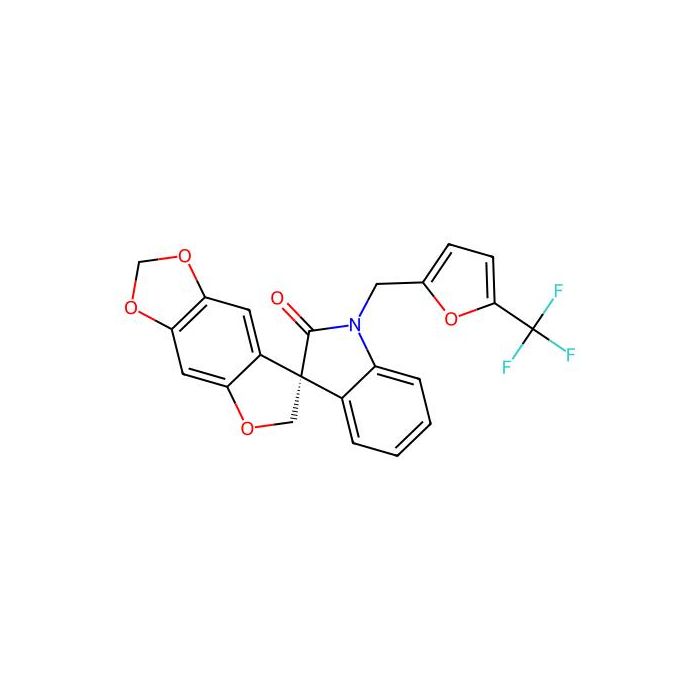
Funapide - Moligand™,≥99% , CAS No.1259933-16-8

CAS: 1259933-16-8 Cat. No.: F650183 分子式: C22H14F3NO5 分子量: 429.35 EC番号: 810-417-7 PubChem CID: 49836093
注文可能
グレード&純度 Moligand™ ? Moligand™ — Aladdin's line of ligands and bioactive small molecules. Use for receptor, pathway, and binding studies needing defined small-molecule tools. ≥99%
Synonyms
(7S)-1'-[[5-(trifluoromethyl)furan-2-yl]methyl]spiro[6H-furo[2,3-f][1,3]benzodioxole-7,3'-indole]-2'-one|XEN402|XPF-002|TV 45070
Storage
Store at -20°C
Shipped In
Ice chest + Ice pads
★
サイズ
USA
ドイツ (EU)*
価格
個数
1mg
F650183-1mg
受注生産 · 8~12週間
$119.90
5mg
F650183-5mg
受注生産 · 8~12週間
$299.90
25mg
F650183-25mg
受注生産 · 8~12週間
$747.90
Enter a quantity for the sizes you want to add.

概要

Funapide is an active inhibitor of voltage-gated sodium channels (VGSC) in the peripheral nervous system with IC50 values of 84 nM and 54 nM for Nav1.5 and Nav1.7, respectively. Funapide has analgesic effects.

仕様

同義語
(7S)-1'-[[5-(trifluoromethyl)furan-2-yl]methyl]spiro[6H-furo[2,3-f][1,3]benzodioxole-7,3'-indole]-2'-one | XEN402 | XPF-002 | TV 45070
仕様と純度
Moligand™,≥99%
生化学的・生理学的メカニズム
Funapide (TV 45070; XEN402) is a potent Sodium Channel Nav1.7 inhibitor.
保管条件
Store at -20°C
入荷
Ice chest + Ice pads
この製品は冷冷この冷このこの製品の運送が必要です。地上およびその他の経済サービスは利用できません。
等級
Moligand™
アクションタイプ
INHIBITOR
純度
≥99%
名前と識別子
異性体SMILES
C1[C@]2(C3=CC=CC=C3N(C2=O)CC4=CC=C(O4)C(F)(F)F)C5=CC6=C(C=C5O1)OCO6
PubChem CID
49836093
分子量
429.35

詳細データ

関連ターゲット(人間)
SCN2A Tclin Sodium channel protein type 2 subunit alpha (1 Activities)
Activity TypeActivity Value -log(M)Mechanism of ActionActivity ReferencePublications (PubMed IDs)
SCN7A Tclin Sodium channel protein type 7 subunit alpha (1 Activities)
Activity TypeActivity Value -log(M)Mechanism of ActionActivity ReferencePublications (PubMed IDs)
SCN5A Tclin Sodium channel protein type 5 subunit alpha (1 Activities)
Activity TypeActivity Value -log(M)Mechanism of ActionActivity ReferencePublications (PubMed IDs)
SCN10A Tclin Sodium channel protein type 10 subunit alpha (1 Activities)
Activity TypeActivity Value -log(M)Mechanism of ActionActivity ReferencePublications (PubMed IDs)
SCN9A Tclin Sodium channel protein type 9 subunit alpha (5 Activities)
Activity TypeActivity Value -log(M)Mechanism of ActionActivity ReferencePublications (PubMed IDs)
SCN8A Tclin Sodium channel protein type 8 subunit alpha (1 Activities)
Activity TypeActivity Value -log(M)Mechanism of ActionActivity ReferencePublications (PubMed IDs)
SCN5A Tclin Sodium channel protein type V alpha subunit (3462 Activities)
Activity TypeRelationActivity valueUnitsAction TypeJournalPubMed IddoiAssay Aladdin ID
SCN7A Tclin Sodium channel protein type VII alpha subunit (136 Activities)
Activity TypeRelationActivity valueUnitsAction TypeJournalPubMed IddoiAssay Aladdin ID
Homo sapiens (32628 Activities)
Activity TypeRelationActivity valueUnitsAction TypeJournalPubMed IddoiAssay Aladdin ID
関連ターゲット(非人間)
Scn2a Sodium channel protein type II alpha subunit (191 Activities)
Activity TypeRelationActivity valueUnitsAction TypeJournalPubMed IddoiAssay Aladdin ID
Scn9a Sodium channel protein type IX alpha subunit (69 Activities)
Activity TypeRelationActivity valueUnitsAction TypeJournalPubMed IddoiAssay Aladdin ID
Scn8a Sodium channel protein type VIII alpha subunit (53 Activities)
Activity TypeRelationActivity valueUnitsAction TypeJournalPubMed IddoiAssay Aladdin ID
Scn10a Sodium channel protein type X alpha subunit (425 Activities)
Activity TypeRelationActivity valueUnitsAction TypeJournalPubMed IddoiAssay Aladdin ID
Mus musculus (284745 Activities)
Activity TypeRelationActivity valueUnitsAction TypeJournalPubMed IddoiAssay Aladdin ID
Rattus norvegicus (775804 Activities)
Activity TypeRelationActivity valueUnitsAction TypeJournalPubMed IddoiAssay Aladdin ID
作用メカニズム
証明書(CoA、COO、BSE/TSEと分析図)
C of A & Other Certificates(BSE/TSE, COO):
Analytical Chart:

Find and download the COA for your product by matching the lot number on the packaging.

3 results found

Lot NumberCertificate Type日付商品
I2611462I2611462Certificate of AnalysisApr 11, 2026 F650183
I2611463I2611463Certificate of AnalysisApr 11, 2026 F650183
I2611468I2611468Certificate of AnalysisApr 11, 2026 F650183
化学的性質と物理的性質
溶解度DMSO : 200 mg/mL (465.82 mM; Need ultrasonic)
分子量429.3
XLogP33.500
Hydrogen Bond Donor Count0
Hydrogen Bond Acceptor Count8
Rotatable Bond Count2
Exact Mass429.082 Da
Monoisotopic Mass429.082 Da
Topological Polar Surface Area61.100 Ų
Heavy Atom Count31
Formal Charge0
Complexity734.000
Isotope Atom Count0
Defined Atom Stereocenter Count1
Undefined Atom Stereocenter Count0
Defined Bond Stereocenter Count0
Undefined Bond Stereocenter Count0
The total count of all stereochemical bonds0
Covalently-Bonded Unit Count1
ソリューション計算機
レビュー

顧客レビュー

Application Protocols

No vendor-validated application protocols are provided for this SKU in the Product Data.

General guidance (to be adapted and validated by the user):

  • Stock preparation: Dissolve in high-purity DMSO to prepare a concentrated stock. Vortex and, if needed, briefly sonicate. Filter through a 0.22 μm PTFE filter if particulates are observed. Record exact concentration gravimetrically or by quantitative NMR if required.
  • Dosing: Dilute stock into assay buffer or culture medium with thorough mixing. Maintain a constant final vehicle concentration across all wells/samples.
  • Controls: Include vehicle-only controls and, where applicable, an orthogonal reference compound to assess assay sensitivity and dynamic range.

Because performance is assay- and system-dependent, users must optimize parameters such as incubation time, temperature, and readout modality in their own laboratories. Refer to the SDS and institutional procedures for safe handling.

Biological Roles

Funapide is widely used in research as a small-molecule modulator of voltage-gated sodium channels (general literature context), making it a valuable tool to dissect neuronal excitability and pain-related signaling pathways in vitro. The compound serves as a reference ligand in studies aimed at understanding sodium current contributions to action potential initiation and propagation in peripheral and central neurons.

Typical research uses (non-clinical):

  • Probe for target validation of specific NaV channel isoforms in expression systems and primary neuronal cultures. By attenuating sodium currents, researchers can quantify the relative contributions of different channel subtypes to excitability phenotypes.
  • Mechanistic studies: Assessment of state-dependent block, recovery from inactivation, and frequency-dependent inhibition by evaluating current–voltage relationships and use-dependence under patch-clamp protocols.
  • Systems biology: Parsing signaling networks downstream of sodium-channel modulation, including changes in calcium dynamics, neurotransmitter release, and gene expression in neuronal models.

Assay modalities:

  • Automated or manual whole-cell patch clamp to obtain IC50/kinetic parameters across isoforms, alongside counter-screens for off-target ion channels to establish selectivity profiles.
  • Target engagement readouts such as thermal shift, CETSA-like assays, or bioluminescence resonance energy transfer (as appropriate) to confirm cellular binding under assay conditions.

No medical or therapeutic claims are made. All uses are limited to in vitro or ex vivo research contexts, subject to institutional approvals and good laboratory practice.

Buffer Applications

This product is not a buffering reagent and is not typically used to establish or maintain solution pH.

Practical guidance for assay buffers (general, not product-specific):

  • Prepare biological assay buffers (e.g., HEPES, phosphate, or bicarbonate systems) independently, then introduce Funapide from a concentrated organic stock (commonly DMSO) into the buffer immediately before use.
  • Maintain constant vehicle concentration across all wells/tubes, including negative and positive controls, to avoid confounding solvent effects.
  • If precipitation is observed upon dilution, adjust with a minimal increase in co-solvent (DMSO or ethanol as permitted by the assay) or use solubilization aids (e.g., cyclodextrins) validated for your system.

For pH ranges, ionic strength, and recipes, consult the documentation of your chosen buffer system; no item-specific buffer guidance is provided for this SKU.

Green Alternatives

As a bioactive test article, Funapide itself is the variable under study and is not replaceable in experiments requiring this specific ligand. However, greener choices can be made in the handling solvents and workflows surrounding its use.

Greener handling options (general guidance):

  • Reduce DMSO volume: Validate the lowest effective DMSO percentage in the final assay (e.g., 0.1–0.5% v/v) to minimize solvent burden without compromising solubility.
  • Alternative vehicles: Consider aqueous solubilization aids (hydroxypropyl-β-cyclodextrin, small amounts of PEG 300/400) to reduce reliance on high-boiling dipolar solvents. Balance with potential biological interference.
  • Plate formats: Use low-dead-volume dispensing and acoustic transfer to reduce waste. Seal plates to minimize evaporative losses and emissions.
  • Workup/waste: Consolidate organic waste streams and choose non-halogenated solvents when preparing intermediate dilutions (e.g., ethanol in place of chlorinated solvents when compatible).

Tradeoffs:

  • DMSO remains the most reliable vehicle for hydrophobic probes; greener alternatives may introduce assay artifacts or reduced shelf-life. Always re-validate assay performance when modifying solvent systems.

Note: No item-specific solubility or green chemistry metrics are provided for this SKU. Implement general green lab practices (mass minimization, right-first-time experimental design) to lessen environmental impact without compromising data quality.

Pharmaceutical Uses

This product is supplied strictly for research use only and is not intended for human or veterinary use, diagnostics, or clinical applications.

Typical roles in pharmaceutical R&D workflows (general, non-clinical):

  • Reference compound in target validation and mechanism-of-action studies for voltage-gated sodium channels using recombinant cell lines or primary cells.
  • Control article in high-throughput and high-content screens to benchmark assay dynamic range, Z′ factor, and signal window.
  • Analytical reference in developing and qualifying bioanalytical methods (e.g., LC–MS/MS quantification in in vitro matrices), pending internal qualification by the user.
  • ADME profiling: Employed as a test article in permeability, solubility screening, metabolic stability, and protein binding assays to contextualize exposure–response relationships in preclinical systems.
  • Formulation screening for in vitro dosing: Evaluation of cosolvent systems, surfactants, or complexation strategies to maximize apparent solubility for cellular assays.

Compliance notes:

  • No pharmacopeial monograph or compliance status is provided for this item. If a certified reference standard or GMP-grade material is required, please source accordingly. For this Moligand™ SKU, consult the CoA/Spec Sheet for identity and purity data relevant to research-grade use.
Physical Properties

Item-specific physicochemical specifications are not provided in this entry.

  • Appearance: Not specified for this item; refer to CoA/Spec Sheet.
  • Melting point: Not specified for this item; refer to CoA/Spec Sheet.
  • Boiling point: Not applicable for most solids; specific value not specified for this item; refer to CoA/Spec Sheet.
  • Density: Not specified for this item; refer to CoA/Spec Sheet.
  • Solubility: Not specified for this item; refer to CoA/Spec Sheet. (General practice: bioactive probes are commonly prepared as DMSO stock solutions and diluted into assay buffers.)
  • LogP/logD: Not specified for this item; refer to CoA/Spec Sheet.
  • pKa: Not specified for this item; refer to CoA/Spec Sheet.
  • Refractive index: Not applicable (solid), not specified for this item; refer to CoA/Spec Sheet.

Practical notes (general guidance for bioactive small molecules; not product specifications):

  • For screening use, prepare a concentrated DMSO stock (e.g., 10–50 mM) if compatible with your assay. Verify clarity and absence of particulates. Filter through 0.22 μm PTFE if necessary.
  • Upon aqueous dilution, monitor for precipitation or turbidity; maintain final DMSO content consistent across controls (e.g., 0.1–1% v/v as assay permits). Adjust with co-solvents or surfactants if justified by your protocol.
Quality and Grades
  • Grade/Purity: Moligand™ (Product Data)

What Moligand™ signifies (general description of this Aladdin grade):

  • Moligand™ items are intended for small-molecule screening, target validation, and chemical biology workflows where reliable identity and assay-ready handling are important. While exact assay purity, residual solvent profile, and counterion state can vary by item, identity is controlled to support research-grade use. For exact acceptance criteria (e.g., HPLC area %, water/volatile content, residual metals), consult the CoA/Spec Sheet for this SKU (F650183). No item-specific numerical specifications are provided here.

Implications for use:

  • Suited for high-throughput screening (HTS), hit triage, secondary assays, and mechanistic studies when paired with appropriate controls.
  • If ultra-low UV background, trace-metal limits, or pharmacopoeial compliance are required (e.g., for analytical reference standard qualification), verify conformity via CoA or request additional documentation.

Category path: 全部 / 可售 / 小分子和化合物库 (Product Data) — indicates inclusion in a small-molecule/compound library collection for research discovery.

Stabilizers and additives: Not specified for this item; refer to CoA/Spec Sheet.

Documentation: Each lot’s CoA will provide the definitive specifications (purity method and result, identification tests). Always match your LIMS entry to the exact lot received.

Reaction and Applications

This product is supplied as a bioactive screening compound rather than a general synthetic reagent. Consequently, it is not typically used as a stoichiometric substrate, catalyst, or solvent in classical organic reactions (e.g., cross-couplings, condensations). Instead, its primary applications are in discovery biology and pharmacology research.

Research applications (general, non-clinical):

  • Chemical probe for voltage-gated sodium channel biology in neuronal systems, used to interrogate sodium channel contributions to excitability and nociceptive signaling in vitro and in ex vivo tissues.
  • Tool compound for assay development, including automated patch-clamp, fluorescence-based membrane potential assays, and ligand-binding or target-engagement formats.
  • Benchmark control in screening cascades to contextualize potency/selectivity of new hits or analogs.

Practical tips:

  • Prepare fresh working dilutions immediately prior to assays to minimize adsorption and vehicle effects. Maintain consistent vehicle fractions across compound and control wells.
  • For electrophysiology, use high-quality DMSO stocks, confirm absence of particulates, and pre-screen for nonspecific effects on seal quality at the highest vehicle concentration.

Note: If you require a building block or reagent for synthesis, refer to Aladdin’s catalog of synthetic intermediates and reagents; this Moligand™ item is intended for mechanism-of-action and target-validation experiments, not for preparative chemistry.

Reaction Conditions

Not typically applicable. This product is supplied as a bioactive screening compound rather than a reagent used to conduct chemical reactions.

If your work requires chemical transformation of the scaffold (e.g., for prodrug exploration or tag attachment), consult primary literature for conditions pertinent to the exact functional groups present in the verified structure (not provided in this entry). Standard reaction-condition guidance (solvent, base, catalyst, temperature) would be highly structure-dependent and cannot be generalized without the specific functional group context.

For conducting chemical reactions more broadly, select reagents and solvents from Aladdin’s synthesis portfolio with conditions validated for your transformation class (e.g., amide couplings, cross-couplings, heterocycle construction).

Safety and Handling

GHS/SDS information is not provided in this entry; consult the product SDS for authoritative hazard classification and precautions.

  • Signal word: Not specified for this item; refer to SDS.
  • Hazard statements (H-codes): Not specified for this item; refer to SDS.
  • Pictograms/GHS classification: Not specified for this item; refer to SDS.

General laboratory handling (good practice for organic small molecules; not product-specific):

  • PPE: Wear lab coat, nitrile gloves, and safety glasses. Use in a chemical fume hood to avoid inhalation of dust or solvent vapors.
  • Avoid contact with skin, eyes, and clothing. Prevent ingestion and inhalation. Wash thoroughly after handling.
  • Incompatibilities: Avoid strong oxidizers and strong acids/bases unless your protocol explicitly requires them and appropriate controls are in place.
  • Spill/cleanup: Collect solids with disposable tools; for solutions, absorb with inert material. Dispose according to institutional and local regulations.
  • First aid overview: If on skin/eyes, rinse with water for at least 15 minutes. If inhaled, move to fresh air. If swallowed, rinse mouth. Seek medical attention according to SDS guidance.
  • Waste: Treat as organic laboratory chemical waste; segregate halogenated vs non-halogenated as applicable to your solvent system.

Note: This product is for research use only (Product Data). Always defer to the SDS for definitive risk, exposure limits, and emergency procedures.

Solvent Selection

This product is a bioactive small molecule typically handled as concentrated organic stock solutions for biochemical or cell-based assays.

  • Primary solvent choice (general practice): DMSO is the default due to broad solvency, chemical inertness under storage, and compatibility with most screening assays when diluted to ≤1% v/v. Start with a small pilot dissolution to confirm clarity.
  • Alternative organic vehicles: Anhydrous DMF or ethanol can be used when DMSO is unsuitable (e.g., certain biophysical readouts). Verify assay tolerance to these vehicles and maintain matched vehicle controls.
  • Aqueous delivery: After preparing a clear stock, dilute into assay buffer with vigorous mixing. If precipitation is observed, consider co-solvent systems (e.g., DMSO 1–5% v/v), nonionic surfactants at low ppm, or inclusion complexes (cyclodextrins) as appropriate for your protocol.
  • Materials compatibility: Use glass or solvent-rated plastics (PP, PTFE). Minimize adsorption by pre-wetting tips and plates with vehicle.
  • Stability considerations: Protect from moisture and repeated freeze–thaw. Aliquot DMSO stocks to minimize headspace and thermal cycling.

Quick comparison (general guidance):

  • DMSO: Highest solvency, good freezer stability; may perturb some membrane assays at >1%.
  • Ethanol: Volatile, compatible with many biochemical assays; can affect cell membranes and evaporates rapidly in open formats.
  • DMF: Good solvency but hygroscopic; ensure biocompatibility and remove promptly upon dilution.

Note: No item-specific solubility or stability data are provided; consult the CoA/Spec Sheet and validate in your assay.

Storage and Reconstitution
  • Storage conditions: Store at -20°C (Product Data). Protect from moisture and prolonged light exposure. Keep container tightly closed.
  • Shipping: Shipped in ice chest with ice pads (Product Data) to help maintain a low temperature during transit.
  • Reconstitution: Not specified for this item; refer to CoA/Spec Sheet. General practice for bioactive small molecules is to prepare a concentrated stock in dry DMSO under an inert headspace, then aliquot.

Practical guidance (general, not item-specific):

  • Aliquoting: Prepare single-use aliquots (e.g., 10–100 μL) to avoid repeated freeze–thaw. Use low-bind tubes, minimize headspace, and label aliquots with concentration, lot, and date.
  • Freeze–thaw: Avoid cycling. Thaw at room temperature or in hand, mix gently to redissolve, and promptly return unused material to -20°C.
  • Stability: Without item-specific data, assume best stability when dry (if supplied as solid) or in anhydrous DMSO. Discard aliquots showing discoloration, precipitation that does not redissolve, or unexpected assay behavior.
  • Aqueous working solutions: Prepare immediately before use and do not store unless stability has been demonstrated under your exact conditions.

Documentation: Retain CoA and any in-house qualification data with your LIMS record for SKU F650183 to ensure traceability of storage, handling, and use across studies.

Structure and Identity

Funapide is a bioactive small molecule supplied in Aladdin’s Moligand™ format for screening and chemical biology.

  • CAS: 1259933-16-8 (Product Data)
  • PubChem CID: 49836093 (Product Data)
  • Synonyms (literature): Often referenced in screening literature as TV-45070 or XEN402
  • Molecular formula: Not specified for this item; refer to CoA/Spec Sheet.
  • Molecular weight: Not specified for this item; refer to CoA/Spec Sheet.
  • InChIKey: Not specified for this item; refer to CoA/Spec Sheet.
  • SMILES: Not specified for this item; refer to CoA/Spec Sheet.

Structural description (general/literature context):

  • Funapide is described in the literature as a small-molecule voltage-gated sodium channel modulator used as a chemical probe in neurobiology. Detailed atom-by-atom structure, stereochemistry, and functional group pattern are not provided in this product entry; consult the CoA/Spec Sheet or authoritative databases (e.g., PubChem CID above) for the exact 2D/3D representation required for modeling, docking, or registration.

Notes for cheminformatics workflows:

  • When building screening libraries or informatics records, use the CAS and CID to retrieve a verified structure file (SDF/MOL) and to harmonize identifiers across ELNs and LIMS. Ensure salt/solvate state and stereochemical flags match your intended use.
Synthetic Utility

This Moligand™ product is a finished bioactive small molecule and is not generally used as a synthetic building block or reagent.

  • Not a common substrate or coupling partner: There is no typical role for this compound in cross-coupling, condensation, or protection/deprotection sequences in organic synthesis workflows.
  • Use context: Its value lies in its function as a chemical probe or control compound in biochemical and electrophysiological assays, not as a transformable intermediate.

Guidance for chemists engaged in analog synthesis (general, not specific to this SKU):

  • If you are pursuing structure–activity relationship (SAR) studies around this scaffold, obtain or construct the exact structure from authoritative databases (see CID in this entry), then plan retrosynthesis to modularize key pharmacophoric elements (e.g., aryl/heteroaryl fragments, linker motifs, ionizable groups) while preserving properties aligned with your target profile (potency, selectivity, permeability).
  • Maintain consistent reference controls in your assay cascade to ensure comparability across analogs; the present compound can serve as such a benchmark if validated internally.

For synthetic reagents and building blocks, refer to Aladdin’s catalog of halogenated aromatics, heterocycles, linkers, and coupling auxiliaries.

Target Specificity

Target specificity data are not provided for this item in the Product Data.

  • Tested targets/isoforms: Not specified for this item; refer to CoA/Spec Sheet or internal validation data.
  • Potency/selectivity metrics (e.g., IC50, Ki): Not specified for this item; refer to CoA/Spec Sheet.

Note: While literature may discuss sodium-channel isoform selectivity for related compounds, no item-specific target data are included here. Users should generate or consult internal assay results to define specificity under their conditions.

よくある質問

What is the purity of this product?
This product is supplied at ≥99% purity (chemical assay). Lot-specific values are stated on the Certificate of Analysis.
What is Moligand??
Moligand? is one of Aladdin Scientific's premium product lines, formulated for high-purity applications across multiple workflows. Compared to standard grades in the same workflow, Moligand? products typically offer tighter specifications, more rigorous QC, and stronger lot-to-lot consistency.
How should this product be stored?
Store at ?20 °C. Freezer storage is required to maintain the specified shelf life.
How is this product shipped?
This product ships in an insulated container with ice pads. Unpack on arrival and transfer it to the storage condition stated above.
What are the CAS number, molecular formula and molecular weight?
The CAS Number is 1259933-16-8, the molecular formula is C22H14F3NO5, and the molecular weight is 429.35 g/mol.
What documentation is provided?
Available product documentation, including Certificates of Analysis (COA), Safety Data Sheets (SDS), and specification sheets, is shown in the product document area. Document availability and access follow the current site policy.

グレードの選択でお困りですか?

当社のグレード選定ガイドでは、カタログ内のすべてのバリエーションについて、純度、安定剤の状態、用途への適合性を網羅しています。

Moligand™ グレードガイドを見る →

Shall we send you a message when we have discounts available?

Remind me later

Thank you! Please check your email inbox to confirm.

Oops! Notifications are disabled.