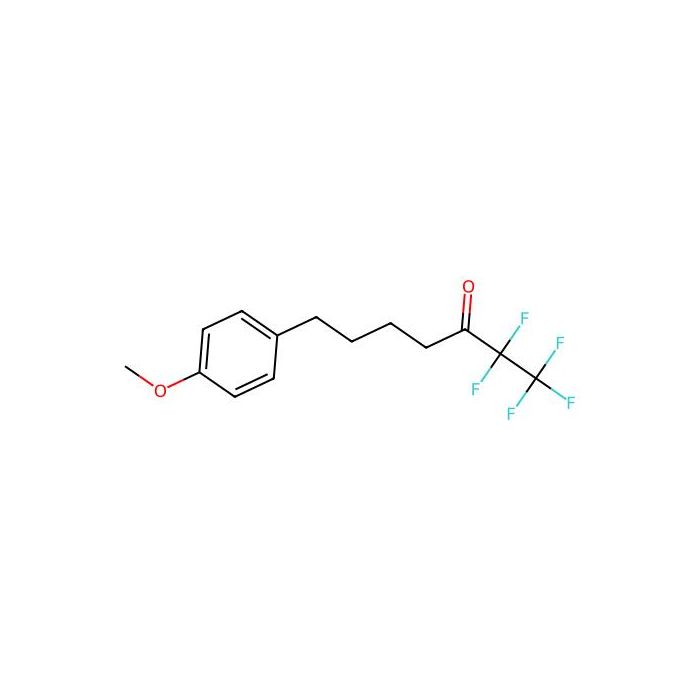
GK187 is a potent and selective Group VIA calcium-independent phospholipase A 2 (GVIA iPLA 2 ) inhibitor with an X I (50) value of 0.0001. GK187 can be used for researching various neurological disorders [The X I (50) is the mole fraction of the inhibitor in the total substrate interface required to inhibit the enzyme by 50%.]
IC50& Target:X I (50): 0.0001 (GVIA iPLA 2 )
仕様
仕様と純度
10mM in DMSO
生化学的・生理学的メカニズム
GK187 is a potent and selective Group VIA calcium-independent phospholipase A 2 (GVIA iPLA 2 ) inhibitor with an X I (50) value of 0.0001. GK187 can be used for researching various neurological disorders. [The X I (50) is the mole fraction of the inh
保管条件
Store at -80°C
入荷
Dry ice packs + Cold packs
この製品は冷冷この冷このこの製品の運送が必要です。地上およびその他の経済サービスは利用できません。
アクションタイプ
INHIBITOR
名前と識別子
異性体SMILES
COC1=CC=C(C=C1)CCCCC(=O)C(C(F)(F)F)(F)F
PubChem CID
25060072
分子量
310.26
詳細データ
証明書(CoA、COO、BSE/TSEと分析図)
C of A & Other Certificates(BSE/TSE, COO):
Analytical Chart:
ソリューション計算機
Molarity Calculator
Determine the necessary mass, volume, or concentration for preparing a solution.
Dilution Calculator
Determine the dilution needed to prepare a stock solution.
Reconstitution Calculator
レビュー
顧客レビュー
Application Protocols
No validated, item-specific application protocols are provided for GK187. The following is a general template suitable for many small-molecule screening compounds.
Example workflow (general):
Reconstitution: Bring vial to room temperature in a desiccator, briefly centrifuge to collect material, then add anhydrous DMSO to prepare a concentrated stock. Vortex/sonicate until fully dissolved.
Aliquoting: Dispense into low-bind tubes or 96/384-well source plates. Seal (heat, adhesive, or thermal seals) and label with compound code, concentration, date, and lot.
Serial dilution: Prepare intermediate dilutions in DMSO, then back-dilute into assay buffer/media to achieve final test concentrations. Maintain constant vehicle percentage across control and test wells.
Controls: Include vehicle-only controls and, if available, positive reference controls for the assay. Incorporate counterscreens for assay interference where relevant.
Data integrity: Track freeze–thaw cycles and plate storage time. Confirm concentration by UV or LC where critical.
Adapt parameters (concentrations, incubation times, readouts) to your specific assay. Consult the SDS and CoA for any compound-specific constraints.
Biological Roles
No biological function, target class, or pathway annotation is provided for GK187 in this product record. It is supplied strictly for research use in discovery workflows.
General considerations for small-molecule library members:
Without an assigned mechanism of action, compounds are typically profiled in broad biochemical or phenotypic panels to reveal potential interactions (enzymes, receptors, transporters) or pathway modulation.
If a structure (from CoA/database) suggests motifs linked to assay interference (e.g., redox-active scaffolds, aggregators), include orthogonal counterscreens and detergent controls.
For cell-based experiments, document the vehicle percentage, exposure time, and media composition; conduct dose–response studies and evaluate cytotoxicity separately from pathway readouts.
Employ target deconvolution techniques (chemoproteomics, CRISPR knockout/knock-in sensitivity, CETSA/TPP) to generate hypotheses on biological roles when phenotypes are observed.
This product is not intended for human or animal therapeutic use and is labeled: For research use only.
Buffer Applications
GK187 is not a buffering reagent. However, its use in biochemical assays requires compatible buffer systems.
Practical guidance (general):
Select buffers that maintain target protein stability and activity (e.g., HEPES, Tris, phosphate), typically 10–50 mM ionic strength, with 100–150 mM NaCl as needed.
Maintain DMSO or other co-solvent at the minimum effective level (often 0.1–1% v/v) and keep vehicle consistent across controls and test wells.
Include a small amount of nonionic surfactant (e.g., 0.01–0.05% Tween-20 or Triton X-100) when aggregation is a concern and assay-compatible.
Filter or centrifuge working solutions to remove precipitates before dosing.
No item-specific pKa or solubility is provided for GK187; adjust pH and buffer composition empirically only after structure and ionization behavior are known.
Green Alternatives
As a discrete library compound, GK187 itself does not have a direct “greener alternative” in the way solvents or bulk reagents do. However, greener choices can be made in how it is handled and formulated.
Solvent choices for stock solutions (general guidance):
Prefer ethanol or isopropanol when solubility permits over higher-toxicity polar aprotics (DMF, NMP). DMSO is widely used; while not classed as a high-hazard solvent, take care due to dermal penetration.
For aqueous-compatible compounds, formulate in buffered saline with minimal co-solvent if precipitation does not occur.
Assay design:
Minimize DMSO carryover (≤0.5–1% v/v) to reduce environmental and biological impact, where compatible with assay performance.
Use miniaturized assay volumes to reduce solvent usage.
Packaging and waste:
Consolidate dilutions to reduce single-use plastics. Opt for glass vials when using strong solvents.
Segregate halogenated from non-halogenated solvent waste streams to facilitate appropriate disposal.
Trade-offs:
Greener solvents may reduce solubility or stability for certain chemotypes; always perform a small-scale solubility/stability study before adopting alternative media.
Pharmaceutical Uses
No pharmacopeial status, excipient role, or manufacturing use is provided for GK187. This product is supplied for research use only and is not intended for human or veterinary applications.
Context (general, non-clinical):
Library compounds like GK187 may be used in early discovery for target validation and hit finding. Any subsequent use in development would require extensive characterization (identity, purity, stability, solid form, residual solvents, elemental impurities) well beyond the scope of this catalog item.
No compendial monograph (USP/EP/JP) is indicated. No claims are made regarding GMP production, suitability for clinical trials, or finished dosage form manufacture.
If you require material for regulated applications, contact us regarding custom synthesis under appropriate quality systems; this catalog item is not qualified for such use.
Physical Properties
Item-specific physical constants are not supplied in the product record.
Appearance: Not specified for this item; refer to CoA/Spec Sheet.
Melting point (MP): Not specified for this item; refer to CoA/Spec Sheet.
Boiling point (BP): Not applicable/rarely reported for discrete screening solids; Not specified for this item; refer to CoA/Spec Sheet.
Density: Not specified for this item; refer to CoA/Spec Sheet.
LogP/logD, pKa: Not specified for this item; refer to CoA/Spec Sheet.
Refractive index: Not applicable for solids; Not specified for this item; refer to CoA/Spec Sheet.
Solubility: Not specified for this item; refer to CoA/Spec Sheet.
General considerations for small-molecule library members (literature/practice):
Many discovery compounds are handled as solids at ambient temperature and reconstituted in high-boiling polar aprotic solvents (e.g., DMSO) to prepare assay stocks (commonly 1–50 mM). Always verify solubility and stability empirically.
If the structure (once obtained) suggests ionizable groups, aqueous solubility can often be improved by pH adjustment (weak acids: basic pH; weak bases: acidic pH) or by co-solvent systems (e.g., DMSO/water, DMSO/PEG-400/water).
Light/moisture/oxygen sensitivity varies by chemotype; absent item-specific data, protect from light, store dry, and minimize headspace oxygen for long-term frozen storage.
Quality and Grades
Grade/Purity: Not specified for this item; refer to CoA/Spec Sheet.
Context for library compounds (general):
Discovery library members are commonly supplied at assay-grade quality, typically supported by an HPLC/UPLC purity value and LC–MS molecular ion confirmation. Some offerings include 1H NMR verification. Actual specifications (e.g., purity threshold, residual solvent limits, water content) are item- and lot-specific; consult the CoA.
If the compound can exist in multiple forms (free base/acid, salt, solvate, polymorph), the CoA should state the exact form. This affects molecular weight, dosing, and solubility.
For sensitive chemotypes, stabilizers or amber packaging may be used; this product record does not list any stabilizer for GK187.
For analytical uses (e.g., as a reference standard), verify lot-specific purity and any known impurities. For biological screening, ensure endotoxin is not relevant (typically not specified for small molecules).
If low-UV impurities matter (e.g., LC/UV quantitation), request UV cutoff/purity at multiple wavelengths. If chiral, ask for enantiomeric/diastereomeric ratio.
Documentation available on request: CoA, Spec Sheet, and SDS for the specific lot.
Reaction and Applications
This product is offered as a discrete small molecule for research screening rather than as a general-purpose synthetic reagent. No item-specific reactivity/application notes are provided in the catalog entry.
Research usage patterns (general, non-item-specific):
Biochemical target screening: Evaluate GK187 in enzyme or receptor assays to identify activity; follow with orthogonal confirmation (e.g., SPR, DSF, CETSA) if applicable.
Cell-based phenotypic assays: Test across relevant cell lines with appropriate vehicle controls and counterscreens for cytotoxicity and assay interference (e.g., redox cycling, PAINS-like behaviors if structurally indicated).
SAR enablement: If analogs are available, assemble a focused panel for preliminary SAR. Use matched molecular series to deconvolute physicochemical vs pharmacological effects.
Mechanism-of-action follow-up: If activity is observed, consider chemoproteomics or thermal profiling to identify potential targets; ensure the structure (from CoA/database) supports attachment points if probe derivatization is planned.
Given the absence of structural and reactivity data, GK187 is not recommended for use as a stoichiometric reagent or catalyst without first confirming its chemical functionality and stability.
Reaction Conditions
No chemical reactivity or transformation data are provided for GK187. The following practical notes address preparation and handling for screening applications rather than synthetic reactions.
Stock preparation (general practice): Dissolve the solid in dry DMSO to a convenient concentration suitable for your assay format (commonly mM range). Vortex/sonicate and inspect for clarity; filter if particulate persists and the compound is filter-stable.
Dilution into assay media: Add stock solution to buffer or cell culture media as the last step with thorough mixing. Keep final DMSO low and uniform across wells/conditions. Verify absence of precipitation over the assay timeframe.
Stability checks: Perform short-term stability at room temperature and long-term at 4 °C and −20/−80 °C by LC–MS/UPLC. Monitor for degradation (new peaks) and adsorption losses at low concentrations.
Light/oxygen sensitivity: If unknown, handle under reduced light and minimize headspace oxygen. Consider amberware and inert gas blanketing for long-term storage of solutions.
For any true chemical transformations using GK187 as a substrate/reagent, obtain the full structure and consult reaction-specific literature to select appropriate catalysts, solvents, and temperatures.
Safety and Handling
Hazard classification is not provided in the product record. Handle as a research chemical of unknown toxicity.
GHS classification / pictograms / H-Statements / Signal Word: Not specified for this item; refer to SDS.
General PPE: Lab coat, safety glasses, and suitable gloves (e.g., disposable nitrile). Use a fume hood to avoid inhalation of dust/aerosols or solvent vapors.
Storage incompatibilities: Unknown for this specific item; as a precaution, keep away from strong oxidizers and acids/bases until compatibility is known. Avoid contact with reactive reducing/oxidizing agents if the structure is unknown.
First aid (general): In case of skin/eye contact, rinse with water for 15 minutes and seek medical advice. If inhaled, move to fresh air. If ingested, do not induce vomiting; seek medical attention. Always consult the SDS for authoritative instructions.
Cryogenic handling: Product ships on dry ice and cold packs; avoid direct contact with cryogens. Vent containers upon warming to prevent pressure buildup from cold-trapped gases.
Good practices: Avoid repeated freeze–thaw. Work with small aliquots. If preparing DMSO stocks, prevent skin exposure (enhanced dermal absorption risk with DMSO). Label all secondary containers with the compound code and concentration.
Waste: Collect organic solvent waste and solid residues per institutional and local regulations.
Solvent Selection
Item-specific solubility data are not provided. The following is general guidance for reconstituting small-molecule screening compounds.
Primary stock solvent (common practice): Anhydrous DMSO due to broad solvency for heteroaromatic and polyfunctional chemotypes. If DMSO is unsuitable, consider DMF, NMP, ethanol, isopropanol, or mixed co-solvent systems.
Aqueous use: Prepare a concentrated organic stock (e.g., in DMSO) and dilute into assay buffer, maintaining a low final co-solvent fraction (often 0.1–1% v/v in biochemical assays; verify assay tolerance). Additive sequential dilution (add compound last) can minimize precipitation.
Solubility screening workflow (practical):
Start with 10–20 mg/mL test in DMSO; vortex/sonicate, inspect clarity.
If insoluble, test DMF or NMP; if soluble, back-blend with DMSO to desired solvent.
For aqueous delivery, titrate into buffer containing surfactant (e.g., 0.01–0.05% nonionic) if assay-compatible.
Use pH adjustment only when compatible with the compound’s ionization (requires structural information).
Compatibility notes: Avoid plasticizers with strong solvents; prefer glass vials. Confirm adsorption losses at low concentrations by recovery checks.
Because GK187’s structure is not disclosed here, verify its solubility and stability empirically before committing to high-throughput use.
Storage and Reconstitution
Storage conditions (as provided): Store at −80 °C.
Shipping: Shipped with dry ice packs + cold packs to maintain low temperature during transit.
Research use note: For research use only.
General best practices (non–item-specific):
Store the solid in tightly sealed, dry, inert-atmosphere containers (e.g., screw-cap vials with PTFE liners) protected from light. Equilibrate to room temperature before opening to prevent condensation.
After first opening, promptly prepare single-use aliquots to minimize cumulative freeze–thaw and headspace exposure. Record open date and number of freeze–thaw cycles.
For solution stocks (e.g., in DMSO), aliquot into amber vials/plates, blanket with inert gas if feasible, and store at −20 to −80 °C depending on stability. Avoid frost-free freezers that cycle temperature.
Inspect solutions for precipitation or discoloration before use; assess integrity by LC–MS/UPLC at appropriate intervals for critical applications.
Thaw on ice or at room temperature as appropriate, mix thoroughly, and use promptly. Do not refreeze partially thawed master containers—use aliquots instead.
Item-specific parameters such as solubility limits, light sensitivity, and stability in solution are not provided; refer to the CoA/Spec Sheet and verify empirically.
Structure and Identity
Overview: GK187 (SKU G654853) is listed in our small-molecule/compound library category and is intended for research screening and discovery workflows. Specific structural identifiers are not provided in the product record.
InChIKey: Not specified for this item; refer to CoA/Spec Sheet.
SMILES: Not specified for this item; refer to CoA/Spec Sheet.
Molecular formula: Not specified for this item; refer to CoA/Spec Sheet.
Molecular weight: Not specified for this item; refer to CoA/Spec Sheet.
Structural features and 2D description:
Not specified for this item; refer to CoA/Spec Sheet.
Notes for identity confirmation (general guidance):
For library compounds, identity is commonly confirmed by LC–MS (ESI), 1H NMR (and 13C NMR when feasible), and HPLC/UPLC purity profiling. If stereochemistry is relevant, chiral HPLC or optical rotation may be reported on the CoA.
Cross-reference the provided CAS and CID against public databases to retrieve structure, synonyms, and additional identifiers when needed for cheminformatics or ELN registration.
If salt form/solvate is involved, ensure the exact form matches your registration to avoid MW inconsistencies during dosing calculations.
Synthetic Utility
GK187 is offered as a discrete screening compound rather than a general synthetic building block, and no functional group information is provided in this listing.
General guidance if derivatization is contemplated (requires structural data from CoA/database):
Identify potential vector points for modification (e.g., halogens, aryl/heteroaryl C–H for late-stage functionalization, protected amines/acids/alcohols) to build analogs for SAR.
Applicable named reactions and strategies depend entirely on the chemotype (e.g., Suzuki–Miyaura for aryl boron/halide pairs, Buchwald–Hartwig for aryl amination, amide couplings for carboxylic acids/amines, SNAr for activated heteroaryls).
If chiral centers are present, consider asymmetric synthesis or resolution to access enantioenriched material for pharmacological differentiation.
Assess stability under common transformation conditions (acids/bases, oxidants/reductants) before planning multistep sequences.
Because no structural features are provided here, no item-specific synthetic recommendations can be made.
Target Specificity
No target, epitope, or specificity information is provided for GK187 in this product record.
Item-specific target class, binding constants, or selectivity panels: Not specified for this item; refer to CoA/Spec Sheet or published studies (if any) associated with CAS 1071001-50-7 / CID 25060072.
If pursuing target identification, consider unbiased profiling: chemoproteomics, thermal proteome profiling, activity-based protein profiling (when derivatizable), or broad biochemical panels.
This product is supplied without biological target claims and is intended for research use only.
よくある質問
How should this product be stored?
Store at ?80 °C. Ultra-low temperature storage is required to maintain the specified shelf life.
How is this product shipped?
This product ships frozen with dry ice and cold packs. Unpack on arrival and transfer it to the storage condition stated above; handle dry ice with insulated gloves in a ventilated area.
What are the CAS number, molecular formula and molecular weight?
The CAS Number is 1071001-50-7, the molecular formula is C14H15F5O2, and the molecular weight is 310.26 g/mol.
What documentation is provided?
Available product documentation, including Certificates of Analysis (COA), Safety Data Sheets (SDS), and specification sheets, is shown in the product document area. Document availability and access follow the current site policy.
Products are supplied to verified businesses, institutions, and qualified professionals for research and development use only. Not for use in humans, animals, diagnosis, or therapy.