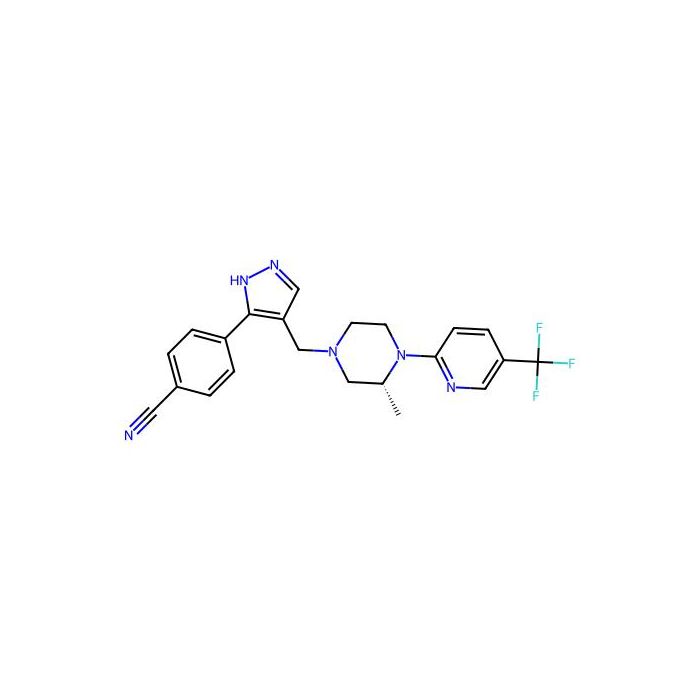
GNF362 is a selective, potent, and orally bioavailable inhibitor of inositol trisphosphate 3’ kinase B (Itpkb) with an IC 50 of 9 nM. GNF362 also inhibits Itpka and Itpkc with IC 50 values of 20 nM and 19 nM, respectively. Inositol trisphosphate 3’ kinase B (Itpkb) is a Ca 2+ -dependent kinase, which phosphorylates the 3’ position of Ins (1,4,5) P3 to generate inositol 1,3,4,5-tetrakisphosphate [Ins (1,3,4,5) P4].
In Vitro
GNF362 (0-10 mM) blocks Ins (1,3,4,5) P4 production, enhances antigen receptor-driven Ca 2+ responses and lead to apoptosis of activated T cells in an Itpkb-dependent manner in lymphocytes. GNF362 augments SOC responses following antigen receptor cross-linking, with an EC 50 of 12 nM in primary B or T lymphocytes. MCE has not independently confirmed the accuracy of these methods. They are for reference only.
In Vivo
GNF362 (orally administration; 6 or 20 mg/kg; twice daily; 21 days) shows minimal block in antibody production but shows significant inhibition of joint swelling at 6 mg/kg, reduces inflammatory cell infiltrate, joint damage, and proteoglycan loss at 20 mg/kg . MCE has not independently confirmed the accuracy of these methods. They are for reference only. Animal Model: A Lewis rat antigen-induced arthritis (rAIA) model Dosage: 6 or 20 mg/kg Administration: Orally administration; 6 or 20 mg/kg; twice daily; 21 days Result: Reduced knee swelling in both the 20mg/kg and 6mg/kg treatment groups of GNF362 by 47% and 34%, respectively.
Form:Solid
仕様
仕様と純度
≥99%
生化学的・生理学的メカニズム
GNF362 is a selective, potent, and orally bioavailable inhibitor of inositol trisphosphate 3’ kinase B (Itpkb) with an IC 50 of 9 nM. GNF362 also inhibits Itpka and Itpkc with IC 50 values of 20 nM and 19 nM, respectively. Inositol trisphosphate 3’ kinase
This compound belongs to the class of organic compounds known as pyridinylpiperazines. These are compounds containing a pyridinylpiperazine skeleton, which consists of a pyridine linked (not fused) to a piperazine by a bond by a single bond that is not part of a ring.
External Descriptors
Not available
1. Djoumbou Feunang Y, Eisner R, Knox C, Chepelev L, Hastings J, Owen G, Fahy E, Steinbeck C, Subramanian S, Bolton E, Greiner R, and Wishart DS. ClassyFire: Automated Chemical Classification With A Comprehensive, Computable Taxonomy. Journal of Cheminformatics, 2016, 8:61.
Determine the necessary mass, volume, or concentration for preparing a solution.
Dilution Calculator
Determine the dilution needed to prepare a stock solution.
Reconstitution Calculator
レビュー
顧客レビュー
Application Protocols
No vendor-validated application protocols are provided for this item. Do not assume suitability for specific assays without prior validation.
Tested Applications (WB, IHC, IF, FC, enzymatic assays, etc.): Not specified for this item; refer to CoA/Spec Sheet.
Recommended concentrations/dilutions: Not specified for this item; refer to CoA/Spec Sheet.
Positive/negative controls: Not specified for this item; refer to CoA/Spec Sheet.
Guidance:
Develop and validate protocols internally based on your assay system. Control for vehicle effects, compound solubility, and potential assay interference.
Cite CAS 1003019-41-7 and your lot number when documenting methods to ensure reproducibility.
Biological Roles
Item-specific biological targets, pathways, and modes of action are not provided in the product data. No medical or clinical claims are made or implied.
Item-specific status (spec-level):
Biological function/target: Not specified for this item; refer to CoA/Spec Sheet and primary literature keyed to CAS 1003019-41-7 or CID 57999583.
General considerations for small-molecule probes (non-item-specific):
Screening compounds are often used to perturb biochemical pathways transiently to test hypotheses about target function. Rigorous target validation requires orthogonal lines of evidence (genetic knockdown/knockout, multiple chemotypes, inactive analog controls).
Physicochemical properties (e.g., logD, polar surface area, H-bond donors/acceptors) influence membrane permeability, subcellular localization, and promiscuity; determine these parameters from a verified structure before interpreting biological data.
For cellular assays, assess compound stability in media (serum binding, oxidation, hydrolysis) and potential off-target liabilities (e.g., hERG, PAINS alerts) using computational filters and careful experimental controls.
If using in complex systems, characterize compound carryover, adsorption to plastics, and potential interference with detection modalities (fluorescence quenching, assay readout absorbance).
Documentation:
Cite unambiguous identifiers (CAS, CID, lot number) in reports and publications. Archive structural files, assay conditions, and raw spectra to ensure reproducibility and traceability.
Buffer Applications
GNF362 is not a buffering agent and is not typically used to establish or maintain pH in biochemical systems.
For experiments involving GNF362, buffers are chosen for the biological assay rather than for the compound itself. Select buffers with minimal compound interaction and spectral interference (e.g., HEPES, PBS, Tris) appropriate to the assay pH and temperature.
If a DMSO stock is used, maintain a consistent vehicle percentage across buffer conditions to isolate compound effects from solvent effects.
When low aqueous solubility is suspected, small amounts of nonionic surfactant (e.g., 0.01% Tween-20) may reduce aggregation in certain enzyme assays; confirm compatibility with your system.
Refer to your assay’s validated buffer system for composition, ionic strength, and pH range.
Green Alternatives
Because GNF362 is a screening compound (not a process solvent or bulk reagent), “green alternatives” center on solvent choices and experimental design rather than substituting the compound itself.
Greener handling strategies (general guidance):
Prefer water-based buffers with minimal organic cosolvent where solubility permits. Titrate pH/ionic strength to maximize aqueous solubility without compromising assay biology.
If organic cosolvent is required, minimize the final DMSO concentration (e.g., ≤0.5% v/v) and maintain a constant vehicle across conditions.
For chromatographic analysis, consider ACN/water gradients instead of MeOH where lower viscosity and energy savings are beneficial; explore bufferless or volatile-buffer methods to reduce salt waste.
Scale down: use miniaturized assay formats (e.g., 384/1536-well plates) to reduce solvent volumes and chemical consumption.
Implement closed vials/low-evaporation plates to reduce VOC emissions and improve result consistency.
Pool compatible organic wastes; avoid halogenated solvents unless required by analytics.
Adopt in-silico screening upstream to prioritize only the most promising wet-lab experiments, reducing chemical usage.
Pharmaceutical Uses
This product is supplied strictly for laboratory research use and is not intended for human or veterinary applications, diagnostics, or therapeutic use.
Item-specific regulatory/formulation status:
Pharmacopeial status (USP/EP/JP): Not specified for this item; refer to CoA/Spec Sheet.
Excipient role/formulation use: Not specified for this item; refer to CoA/Spec Sheet.
General considerations for research compounds (non-item-specific):
If used as a tool compound in pre-formulation research, basic assessments often include solubility profiling (pH–solubility, cosolvents), solid-state characterization (XRPD, DSC/TGA), and preliminary stability (pH, oxidative, photolytic).
Early-stage enabling formulations for research dosing (not clinical) may utilize cyclodextrins, cosolvent systems, or lipid-based vehicles; these approaches must be evaluated for the specific compound’s properties and intended research model.
Compliance note:
No claims are made regarding safety, efficacy, or suitability for clinical use. All handling must comply with institutional policies for nonclinical research materials.
Physical Properties
Item-specific physical constants are not provided in the current data set. Do not treat any values below as specifications.
Item-specific properties (spec-level):
Appearance: Not specified for this item; refer to CoA/Spec Sheet.
Molecular Weight: Not specified for this item; refer to CoA/Spec Sheet.
Melting point (mp): Not specified for this item; refer to CoA/Spec Sheet.
Boiling point (bp): Not specified for this item; refer to CoA/Spec Sheet.
Density: Not specified for this item; refer to CoA/Spec Sheet.
Refractive index: Not applicable/Not specified for this item; refer to CoA/Spec Sheet.
Solubility: Not specified for this item; refer to CoA/Spec Sheet.
Partition coefficients (logP/logD): Not specified for this item; refer to CoA/Spec Sheet.
General guidance (literature/practice, not item-specific):
Many drug-like screening compounds are solids with good solvency in DMSO and variable solubility in DMF/MeOH/EtOH; water solubility often depends on ionizable groups and salt form.
If the free base/neutral form is poorly aqueous-soluble, consider preparing buffered solutions with a small percentage of DMSO (e.g., ≤0.5–1% v/v in final assays) after forming a concentrated DMSO stock (e.g., 10–50 mM). Verify compatibility with biological assays.
To assess solubility and stability, perform a small-scale screen: DMSO, DMF, MeOH, EtOH, acetonitrile, and buffered aqueous media at relevant pH. Evaluate by visual inspection and HPLC/UPLC after 24–48 h at room temperature and 4 °C.
Screen for potential light or air sensitivity by storing an aliquot protected from light and another under ambient light, then analyze by LC–MS.
Always rely on CoA/SDS for authoritative, lot-specific physical property information.
Quality and Grades
Grade/purity and stabilizer details are not specified in the current product data. The notes below explain typical interpretations and what to verify on receipt.
Item-specific status (spec-level):
Grade/Purity: Not specified for this item; refer to CoA/Spec Sheet.
Stabilizers/Inhibitors: Not specified for this item; refer to CoA/Spec Sheet.
How to interpret grades (general guidance):
For small-molecule screening compounds, vendors may list purity as ≥95% (HPLC) or similar. Such values indicate area% purity under stated HPLC conditions; they do not guarantee absolute purity across all methods. Review the CoA to see chromatographic method, detection wavelength(s), and any reported impurity profiles.
If a salt form is provided, CoA should indicate counterion content and water/solvent of crystallization. Calculate concentrations on a free-base/neutral-equivalent basis when preparing assay solutions.
For analytical use (LC–MS reference), request accompanying spectra (1H/13C NMR, HRMS) when available. Confirm identity against the reported CAS/CID.
Practical QA/QC tips:
Re-check purity after receipt via your in-house HPLC/UPLC method and LC–MS, as peak shape/purity can be solvent- and method-dependent.
Verify absence of residual reactive impurities (e.g., alkyl halides, strong acids/bases) that could interfere in biological assays.
Document storage history (temperature logs) from shipment through receipt, particularly for compounds stored at −20 °C.
Reaction and Applications
This product is intended as a small-molecule research tool (screening/assay compound) rather than a synthetic reagent. No manufacturer application notes are provided for specific targets or assays.
Item-specific applications (spec-level):
Manufacturer Applications: Not specified for this item; refer to CoA/Spec Sheet.
General research applications (non-item-specific):
In vitro screening: Prepare DMSO stock solutions and perform concentration–response assays to explore potency and efficacy in biochemical or cell-based systems. Include vehicle controls and consider solubility/aggregation artifacts (e.g., detergent controls, light scattering).
Mechanistic studies: If a putative target is identified from literature or screening, perform orthogonal assays (e.g., thermal shift/DSF, SPR/BLI, CETSA) to confirm direct engagement.
Target deconvolution: Combine phenotypic readouts with chemoproteomics or photoaffinity/biotinylated analogs (if you derivatize a suitable handle) to identify binding partners.
ADME profiling: Assess stability, microsomal clearance, permeability, and plasma protein binding to understand exposure constraints in research models.
Practical considerations:
Validate identity and purity via LC–MS and NMR before critical studies.
Confirm that observed activity is not due to colloidal aggregation (add nonionic detergent, test activity vs enzyme concentration) or redox cycling.
For plate-based assays, standardize DMSO at a constant final % across all wells.
Note: Avoid inferring therapeutic relevance—this material is supplied strictly for laboratory research use.
Reaction Conditions
This product is not positioned as a synthetic reagent; therefore, canonical named-reaction conditions are not applicable. Instead, the most relevant “conditions” pertain to preparing and handling solutions for research assays and analytics.
Item-specific conditions (spec-level):
No item-specific dissolution or processing conditions are provided. Refer to CoA/Spec Sheet.
General handling conditions (non-item-specific):
Stock preparation: Dissolve compound in an appropriate solvent (commonly DMSO) to prepare 10–50 mM stocks, if solubility allows. Sonication and gentle warming (≤40 °C) may assist dissolution. Avoid moisture and light if stability is uncertain.
Assay dilution: Dilute stocks into assay buffer to desired concentrations while keeping a constant vehicle percentage (e.g., ≤0.5–1% v/v DMSO). Mix thoroughly to prevent precipitation.
Filtration: If particulates are observed, filter through 0.2 µm PTFE for organic solutions or PES/nylon for aqueous mixtures, verifying no adsorption losses.
Stability checks: Analyze freshly prepared and aged solutions (e.g., 24–48 h at ambient and 4 °C) by HPLC/UPLC to ensure chemical integrity.
Analytical methods: LC–MS or UPLC-UV with gradients of water/ACN (0.1% formic acid or ammonium formate) are typical starting points. Optimize detection wavelength based on UV spectrum of the verified structure.
All conditions above are general guidance and should be validated experimentally for GNF362.
Safety and Handling
Safety data are incomplete in the current product listing. Treat GNF362 as a research chemical of unknown hazards and follow robust laboratory precautions.
Item-specific hazard data (spec-level):
Signal Word: Not specified for this item; refer to SDS.
H-Statements: Not specified for this item; refer to SDS.
GHS Classification: Not specified for this item; refer to SDS.
Pictograms: Not specified for this item; refer to SDS.
General laboratory precautions (best practice):
Handle in a chemical fume hood. Avoid inhalation of dust/aerosols and contact with skin/eyes.
Wear appropriate PPE: lab coat, safety glasses or goggles, and suitable chemical-resistant gloves (e.g., nitrile). Change gloves regularly.
Prevent cross-contamination: dedicate spatulas, use clean weigh boats, and promptly close containers. Minimize repeated freeze–thaw cycles by aliquoting.
If preparing DMSO stocks, avoid skin contact—DMSO enhances dermal absorption of solutes.
Avoid incompatible materials until verified (strong oxidizers/reductants, reactive acids/bases). Use only with dry, compatible solvents.
First-aid overview (refer to SDS for details):
Inhalation: move to fresh air; seek medical attention if symptoms develop.
Skin/eye contact: rinse with water for ≥15 minutes; remove contaminated clothing; obtain medical advice.
Ingestion: rinse mouth; do not induce vomiting; get medical attention.
Waste and spills:
Collect solid/liquid waste as organic hazardous waste unless otherwise characterized. Absorb spills with inert material; clean the area with appropriate solvent while wearing PPE.
Authoritative reference: Always defer to the product-specific SDS for definitive hazard, handling, and first-aid information.
Solvent Selection
As a research screening compound, GNF362 is commonly handled as concentrated stocks in aprotic polar solvents, then diluted into assay buffers. Item-specific solubility is not provided; verify experimentally.
General solvent guidance (literature/practice):
Primary stock solvent: DMSO is the default for many drug-like molecules due to broad solvency and biological assay compatibility at low final %.
Alternatives: DMF (good solvency; higher toxicity), acetonitrile (moderate solvency; volatile), methanol/ethanol (protic; assay-dependent), and buffered aqueous media (if ionizable groups permit sufficient solubility).
Small comparison (general, not item-specific):
| Solvent | Typical use | Pros | Considerations |
|---|---|---|---|
| DMSO | Concentrated stocks (10–50 mM) | Excellent solvency; assay-friendly at ≤0.5–1% v/v | Enhances dermal absorption; control for vehicle effects |
| DMF | Backup for poorly soluble analytes | High solvency | Greater toxicity; harder to remove |
| MeOH/EtOH | Quick screens, spectroscopic prep | Volatile; easy handling | Can affect enzymes/cells; lower solvency for hydrophobes |
| ACN | LC-compatible, moderate solvency | Low UV cut-off; volatile | Lower solvency vs DMSO for many drug-like compounds |
| Aqueous buffer | Direct dosing | Physiological relevance | Requires ionizable functionality; watch pH/aggregation |
Practical tips:
Start with a small solubility screen (e.g., 1 mg in 1 mL across candidate solvents). Inspect clarity, then analyze by HPLC.
Warm gently (≤40 °C) and sonicate to aid dissolution if compatible; avoid prolonged heating. Filter through 0.2 µm PTFE if particulates persist.
Keep final assay vehicle ≤0.5% v/v DMSO unless your system tolerates higher.
Storage and Reconstitution
Item-specific storage information is provided; reconstitution specifics are not.
Item-specific (spec-level):
Storage Conditions: Store at −20 °C.
Shipped In: Ice chest + Ice pads.
Reconstitution and handling (not item-specific; general best practices):
Reconstitution solvent: Not specified for this item; refer to CoA/Spec Sheet. In general, many screening compounds are dissolved in DMSO to make concentrated stocks; verify solubility and stability experimentally.
Aliquoting: To minimize freeze–thaw cycles, prepare single-use aliquots in inert, airtight vials or plates. Flush with inert gas if compound is air/moisture sensitive (status not specified).
Light/moisture: In absence of specific data, protect from light and moisture and allow vials to equilibrate to room temperature in a desiccator before opening to prevent condensation.
Stability: Not specified for this item; verify by periodic LC–MS/HPLC.
Always consult the product’s CoA and SDS for definitive, lot-specific instructions on storage, handling, and dissolution.
Structure and Identity
Brief overview: GNF362 is a cataloged, research-use small molecule (screening compound). Core identifiers are provided below; detailed structural descriptors are not supplied in the current product data.
SKU: G649476
Product Name: GNF362
CAS: 1003019-41-7
PubChem CID: 57999583
InChIKey: 383756 (as provided; note: typical InChIKeys are 27 characters — consult CoA/SDS or PubChem for the complete key)
SMILES: Not specified for this item; refer to CoA/Spec Sheet.
Molecular Formula: Not specified for this item; refer to CoA/Spec Sheet.
Molecular Weight: Not specified for this item; refer to CoA/Spec Sheet.
Structural features (general note):
Item-specific functional groups, ring systems, and stereochemistry are not provided in the product data. Users should consult the CAS (1003019-41-7) or CID (57999583) to retrieve the authoritative 2D/3D structure prior to computational work, assay design, or analytical method development.
How to describe the 2D structure (guidance):
Retrieve a structure from a trusted database (e.g., PubChem with CID 57999583), verify the tautomeric form and stereochemistry (if any), then document: heteroatoms, ring scaffolds (aromatic/heteroaromatic), substitution pattern, and any ionizable centers. This supports downstream method development (LC–MS transitions, logP/logD estimation, and salt selection) and aids in choosing solvents for stock solutions.
Provenance note:
All missing identity elements above are intentionally left as “Not specified” to avoid overinterpretation. Use the Certificate of Analysis (CoA) and SDS for definitive, lot-specific identity details.
Synthetic Utility
GNF362 is offered as a finished small molecule for research and screening rather than as a general synthetic reagent or building block.
Item-specific reactivity details:
Functional groups and chemoselectivity are not specified in the product data; do not assume availability of handles for coupling or derivatization without consulting the verified structure (CAS 1003019-41-7; CID 57999583).
General considerations (non-item-specific):
If derivatization is desired (e.g., to prepare an affinity probe, photoaffinity label, or fluorophore conjugate), inspect the structure for: anilines/phenols (for carbamates/urethanes), primary/secondary amines (for amide coupling), or halogens (for cross-coupling). Protect pharmacophores to retain activity where necessary.
Analytical support for modifications: monitor by LC–MS, HRMS, and NMR; confirm retention of activity with orthogonal assays and include an inactive negative control analog where possible.
For SAR studies, prioritize modifications at positions minimally impacting binding (as inferred from docking, crystallography, or literature analogs), and avoid motifs associated with PAINS or reactive liabilities.
If you intend to use GNF362 as a synthetic intermediate, first confirm the complete structural assignment and compatibility of its functional groups with your planned transformations.
Target Specificity
Item-specific biological targets, binding sites, and selectivity data are not provided in the current product data and should not be inferred.
Target/Pathway: Not specified for this item; refer to CoA/Spec Sheet and peer-reviewed literature indexed by CAS 1003019-41-7 or CID 57999583.
Selectivity/Cross-reactivity: Not specified for this item; refer to CoA/Spec Sheet.
Assay-validated activity: Not specified for this item; refer to CoA/Spec Sheet.
Recommendation:
Prior to use as a tool compound, consult primary literature and, where available, independent profiling datasets. Employ orthogonal assays and appropriate control compounds to confirm any proposed target engagement.
よくある質問
What is the purity of this product?
This product is supplied at ≥99% purity (chemical assay). Lot-specific values are stated on the Certificate of Analysis.
How should this product be stored?
Store at ?20 °C. Freezer storage is required to maintain the specified shelf life.
How is this product shipped?
This product ships in an insulated container with ice pads. Unpack on arrival and transfer it to the storage condition stated above.
What are the CAS number, molecular formula and molecular weight?
The CAS Number is 1003019-41-7, the molecular formula is C22H21F3N6, and the molecular weight is 426.44 g/mol. InChIKey VNTCGXMLDSKOKN-OAHLLOKOSA-N.
What documentation is provided?
Available product documentation, including Certificates of Analysis (COA), Safety Data Sheets (SDS), and specification sheets, is shown in the product document area. Document availability and access follow the current site policy.
Products are supplied to verified businesses, institutions, and qualified professionals for research and development use only. Not for use in humans, animals, diagnosis, or therapy.