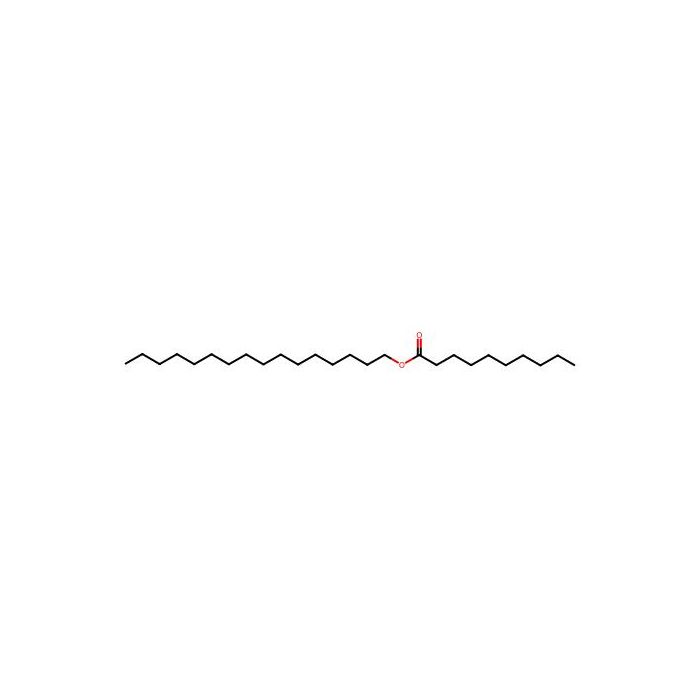
This compound belongs to the class of organic compounds known as fatty alcohol esters. These are ester derivatives of a fatty alcohol.
External Descriptors
Not available
1. Djoumbou Feunang Y, Eisner R, Knox C, Chepelev L, Hastings J, Owen G, Fahy E, Steinbeck C, Subramanian S, Bolton E, Greiner R, and Wishart DS. ClassyFire: Automated Chemical Classification With A Comprehensive, Computable Taxonomy. Journal of Cheminformatics, 2016, 8:61.
Determine the necessary mass, volume, or concentration for preparing a solution.
Dilution Calculator
Determine the dilution needed to prepare a stock solution.
Reconstitution Calculator
レビュー
顧客レビュー
Application Protocols
No assay/application protocols are provided for this specific item in the Product Data. For general laboratory use, consider the following context-specific starting points (literature/general):
Preparing analytical standards: dissolve in n-hexane, isooctane, or CH2Cl2 to 1–10 mg/mL; warm gently (30–40°C) if needed. Use glassware free of surfactants.
Lipase assay substrate: disperse the ester in isooctane (or solvent-free) and add immobilized enzyme; maintain 35–45°C with controlled water activity (e.g., salt hydrates). Sample periodically for GC analysis of acid/alcohol formation.
Saponification control sample: treat a known mass with 1–2 M KOH in EtOH/H2O at 60°C; after completion, acidify and extract to recover decanoic acid and hexadecanol as reference materials.
These are general, literature-informed suggestions and are not validated protocols for this product. Optimize conditions for your specific system and consult primary sources as needed.
Biological Roles
Hexadecyl decanoate is a saturated wax ester, a class of neutral lipids present in diverse organisms. While the exact chain-length pairing varies in nature, wax esters broadly play structural and energy-storage roles.
Occurrence (literature/general):
Wax esters are major components of certain plant oils (notably jojoba, though often with very long chains/unsaturation) and marine lipids (zooplankton and fish wax esters used for buoyancy and energy reserves).
In microorganisms, wax esters can function as carbon storage compounds formed via esterification of fatty alcohols and fatty acids.
Physicochemical/biochemical properties:
Extremely hydrophobic and uncharged; partition strongly into lipid phases and hydrophobic matrices.
Lack of polar headgroup means minimal interaction with aqueous environments; they segregate into droplets or solid/waxy phases depending on temperature.
Relevance to research:
Model substrate for lipase specificity studies, enabling assessment of chain-length effects on enzyme kinetics in both aqueous emulsions and nonaqueous media.
Useful in biophysical studies of phase transitions, crystallization, and rheology in lipid mixtures (e.g., blending with triglycerides or other waxes to tune melting and hardness).
Acts as a benchmark neutral lipid for partitioning experiments (e.g., determining distribution into polymer matrices, membranes, or environmental sorbents).
Note: This product is for research use only and not intended for food, cosmetic, diagnostic, or therapeutic applications.
Buffer Applications
This compound is an apolar wax ester and is not used as a buffer component or pH modifier. It is effectively insoluble in water and does not contribute to aqueous buffering capacity.
Practical note: If conducting enzymatic hydrolysis in biphasic systems, prepare the aqueous buffer phase (e.g., phosphate, Tris) independently and emulsify with the ester using appropriate surfactants or mechanical dispersion. Control ionic strength and pH of the aqueous phase according to the enzyme/system requirements.
For buffer recipes and optimization, refer instead to your specific aqueous system; hexadecyl decanoate itself does not function in buffer applications.
Green Alternatives
Because hexadecyl decanoate is a target molecule/reagent (not a solvent), green chemistry considerations focus on its sourcing and the media/catalysts used with it rather than substituting the molecule itself.
Greener sourcing (literature/general):
Bio-based feedstocks: decanoic acid and hexadecanol can be sourced from renewable fats/oils (e.g., coconut/palm derivatives or fermented fatty acids). Selecting renewable, RSPO-certified sources reduces petrochemical footprint.
Enzymatic synthesis: lipase-catalyzed esterification under solvent-free or green solvent conditions (e.g., 2-MeTHF, cyclopentyl methyl ether, or even neat) at 40–60°C affords high selectivity and minimizes byproducts.
Greener media for applications:
For dissolving/processing: prefer heptane/isooctane over chlorinated solvents; consider esters (EtOAc) where compatible, though solubility may require mild heating.
For transesterification: heterogeneous solid bases (e.g., Mg–Al hydrotalcites) or ion-exchange resins can replace soluble strong bases/acids, simplifying workup and reducing waste.
Energy minimization:
Operate slightly above the melting point to enable solvent-free handling and reduce solvent use; use jacketed equipment to avoid overheating.
Waste and end-of-life:
Wax esters are readily biodegradable under appropriate conditions; nevertheless, avoid discharge to drains. Implement solvent recovery and lipid waste segregation.
Trade-offs: Nonpolar hydrocarbons have lower toxicity but contribute to VOC emissions; esters (EtOAc) are greener but may offer limited solvency. Optimize for minimal solvent volume and recyclability.
Pharmaceutical Uses
No pharmacopeial grade or excipient designation is provided for this item; refer to CoA/Spec Sheet. The following notes reflect general formulation roles of long-chain wax esters and are not product-specific claims.
Excipient/functionality (literature/general):
Acts as a structurant, emollient, and lubricant in semi-solids and ointment bases by raising melting point and modulating hardness and spreadability.
Can plasticize or stiffen lipid matrices in suppositories, sticks, and topical dosage forms when blended with triglycerides, hydrocarbons, or other waxes.
Provides hydrophobic barrier properties; influences occlusivity and moisture retention in topical vehicles.
Processing considerations:
Melt blending at controlled temperatures slightly above the wax ester’s melting range prevents thermal degradation while ensuring homogeneity.
Choice of co-excipients (e.g., medium-chain triglycerides, cetyl alcohol, stearyl alcohol) tunes crystallization kinetics and final texture.
Analytical/quality:
Differential scanning calorimetry (DSC) and texture analysis help qualify lot-to-lot performance in formulation screens.
Monitor residual free acid/alcohol content (e.g., by GC) to ensure stability and consistency in excipient function.
Regulatory note: This product is offered for research use only and is not supplied under any pharmacopeial monograph or GMP status unless explicitly stated on the CoA.
Physical Properties
Item-specific physical specifications are not provided in the Product Data. Refer to CoA/Spec Sheet for definitive values. The following are literature/general properties of long-chain wax esters structurally identical to hexadecyl decanoate and are provided for context only.
Phase/appearance (literature): waxy solid or semi-solid near ambient; may soften/melt slightly above room temperature depending on purity and thermal history.
Melting point (literature): typically in the low-to-mid 20s–30s °C range for C26 saturated wax esters; exact mp depends on polymorph and purity. Not specified for this item; refer to CoA/Spec Sheet.
Boiling point (literature): very high; thermal decomposition occurs before atmospheric boiling; vacuum distillation required if purification by distillation is attempted.
Density (literature, 20–25°C): ~0.84–0.87 g/mL for similar wax esters. Not specified for this item; refer to CoA/Spec Sheet.
Refractive index (literature, 20–25°C): ~1.440–1.455 for comparable long-chain esters. Not specified for this item; refer to CoA/Spec Sheet.
LogP (estimated/literature): very high (>>6), reflecting extreme hydrophobicity.
Solubility (literature):
Water: essentially insoluble.
Organic: soluble in nonpolar/aprotic media (hexanes, heptane, cyclohexane, petroleum ether, toluene, xylene) and in chlorinated solvents (CH2Cl2, CHCl3). Limited solubility in alcohols at room temperature; improves upon gentle warming.
Acid/base behavior: neutral ester; no pKa relevant to aqueous acid/base titration.
Caution: Do not construe literature ranges as product specifications.
Quality and Grades
Item-specific grade/purity: Not specified for this item; refer to CoA/Spec Sheet.
Implications of grade (general guidance for wax esters and neutral lipids):
Research-grade materials focus on identity and typical organic impurity control suitable for synthetic, materials, and biochemical research. Trace metal content, water content, peroxide value, and UV absorbance are not generally controlling specifications unless stated.
For chromatographic or biophysical measurements, higher purity and tighter control of residual solvents and isomers may be desirable; verify via CoA or request tighter specs.
Stabilizers/inhibitors: Not specified for this item; refer to CoA/Spec Sheet. Saturated wax esters typically do not require antioxidants, but presence/absence of any stabilizer should be confirmed.
Batch-specific documentation:
CoA should include identification (e.g., GC/FID or HPLC), assay or area% purity, and residual solvent profile where applicable.
If low-temperature polymorph behavior or melting range is critical to your application (e.g., thermal analysis, formulation rheology), request DSC/TGA data or differential scanning calorimetry traces when available.
Suitability notes:
For enzymatic assays (lipases), ensure low residual acid/alcohol content to avoid rate artifacts.
For surface science or thin-film work, consider additional purification (e.g., recrystallization from ethanol/acetone or short-path distillation under high vacuum) to narrow melting transitions.
Contact Aladdin Scientific to discuss specialized specifications or QC documentation tailored to your application.
Reaction and Applications
As a saturated long-chain wax ester, hexadecyl decanoate is valuable in lipid chemistry, catalysis screening, and materials/formulation research.
Representative applications (literature/general):
Enzymatic transformations: model substrate for lipase-catalyzed hydrolysis and transesterification; useful for comparing selectivity/activity across biocatalysts in nonaqueous media or solvent-free systems.
Chemical hydrolysis/saponification: benchmark for kinetics and mechanism studies of ester cleavage in heterogeneous and biphasic systems; yields hexadecanol and decanoic acid (or decanoate salts).
Transesterification: acyl-donor in base- or acid-catalyzed exchange to generate alternative esters; amenable to sodium methoxide, potassium tert-butoxide, solid bases, or ion-exchange resins.
Reduction/cleavage: Stoichiometric hydride (LiAlH4) or catalytic hydrogenolysis can provide alcohols; used to probe scission vs over-reduction pathways on metal catalysts.
Materials science: model wax for phase-change studies, lubrication/friction testing, and crystallization/polymorph behavior of long-chain esters; blends with other lipids/waxes to tune rheology.
Practical tips:
Ensure dryness of reaction media when avoiding hydrolysis; moisture accelerates unwanted saponification under base.
For enzyme-catalyzed processes, select anhydrous, nonpolar solvents (isooctane, heptane) and operate at 25–50°C; control water activity for optimal turnover.
When handling near/above the melting range, use jacketed vessels and preheated lines to maintain homogeneity.
Analytical monitoring: GC-FID of derivatized acids/alcohols or direct GC of the ester (high-T columns) is effective; HPLC with ELSD/RI is an alternative when volatility is insufficient.
Reaction Conditions
Guidance below is based on literature/general practice for saturated long-chain esters; adapt to scale and safety requirements. These are not specifications.
Fischer esterification (synthesis from decanoic acid + hexadecanol):
Catalyst: p-TsOH (1–5 mol%) or H2SO4 (0.5–2 wt%).
Solvent: toluene or xylene with Dean–Stark water removal; or solvent-free at 80–120°C with continuous water removal (e.g., N2 sweep/vacuum).
Time/Temp: 4–16 h depending on water removal efficiency; drive to >90% conversion.
Transesterification (ester exchange):
Base-catalyzed: 0.5–2 mol% NaOMe in anhydrous methanol/hexane biphasic or neat at 40–70°C; monitor by GC.
Acid-catalyzed: Amberlyst-15 (5–20 wt%) in toluene at 60–90°C; easy separation and reuse of catalyst.
Enzymatic: immobilized Candida antarctica lipase B (CALB, 5–10 wt% relative to substrates) in isooctane or solvent-free at 35–60°C; water activity control enhances rates/selectivity.
Hydrolysis/saponification:
Base: KOH/NaOH (1–2 equiv) in EtOH/H2O (e.g., 95:5) at 50–70°C, 1–4 h; work up to isolate hexadecanol and decanoate/decanoic acid.
Acid: reflux in aqueous mineral acid (e.g., HCl) with co-solvent/emulsifier; generally slower and less selective.
Reduction/cleavage:
LiAlH4 (1.5–2.5 equiv) in dry THF at 0–25°C then warm to 50–60°C; quench cautiously; affords hexadecanol and decanol.
Hydrogenolysis: Raney Ni or Pd/C, H2 (10–30 bar), 80–150°C in decalin/hexadecane; conditions tuned for C–O scission vs over-hydrogenation.
Analysis and workup:
Monitor by GC-FID (high-temp columns) or HPLC-ELSD/RI; confirm identity by FTIR (ester C=O ~1735–1750 cm−1) and 1H/13C NMR.
Always perform risk assessments and consult primary literature/SDS before scale-up.
Safety and Handling
GHS hazard data: Not specified for this item; consult the product SDS before use.
Anticipated hazard profile (general chemistry for saturated wax esters):
Typically considered low acute toxicity and low volatility; may cause mechanical irritation if aerosolized.
Combustible organic liquid/solid; can burn if ignited.
Personal protective equipment (good laboratory practice):
Safety glasses or goggles; lab coat; appropriate chemically resistant gloves (e.g., nitrile). Avoid skin contact due to potential defatting effects of solvents used for dissolution.
Handling notes:
Work with adequate ventilation to avoid inhalation of mists or heated vapors.
Avoid contact with strong oxidizers (risk of exothermic reaction) and strong bases/acids under heating (ester hydrolysis/transesterification).
For operations above the melting point, use temperature control to prevent overheating and decomposition.
First-aid overview (refer to SDS for details):
Eye: Rinse cautiously with water for several minutes; seek medical attention if irritation persists.
Skin: Wash with soap and water; remove contaminated clothing.
Inhalation: Move to fresh air; obtain medical advice if symptoms occur.
Ingestion: Rinse mouth; do not induce vomiting; seek medical advice.
Fire safety:
Suitable extinguishing media: dry chemical, CO2, foam. Cool containers with water spray.
Combustion products may include CO/CO2; firefighters should wear self-contained breathing apparatus.
Spill response:
Contain with inert absorbent; avoid release to drains. Clean residues with suitable organic solvent while observing flammability precautions.
Always defer to the current SDS for authoritative safety classifications and response measures.
Solvent Selection
Hexadecyl decanoate is a highly hydrophobic, nonpolar wax ester. Solvent choice should reflect its low polarity and high melting/softening temperature relative to room temperature.
Polarity and miscibility (general/literature):
Water: essentially insoluble.
Hydrocarbons (hexane, heptane, cyclohexane, isooctane): good to excellent solubility above ambient; may require gentle warming near room temperature.
Aromatics (toluene, xylene): very good solubility; useful for higher-temperature processing.
Chlorinated solvents (CH2Cl2, CHCl3): very good solubility at room temperature.
Alcohols (EtOH, i-PrOH): limited solubility at ambient; improves with heating.
Polar aprotics (EtOAc, MTBE): moderate solubility; may need warming.
Practical selection tips:
For analytical sample prep (GC/HPLC): dissolve in n-hexane, isooctane, or CH2Cl2 to prepare stock solutions; warm to 30–40°C if needed.
For transesterification or lipase assays: use nonpolar organic media (isooctane, heptane) or solvent-free systems; buffer-free biphasic systems minimize hydrolysis.
For film/coating studies: toluene or xylene provide slower evaporation and better film formation; hexane affords faster drying.
Small comparison (general):
Hexane vs toluene: hexane gives lower viscosity and faster evaporation but may need warming; toluene increases solubility at slightly elevated temperatures and improves wetting.
CH2Cl2 offers excellent solvency but is less preferred environmentally; reserve for cases demanding rapid dissolution at room temperature.
Note: No item-specific solubility specifications are provided; optimize solvent choice empirically under your conditions.
Storage and Reconstitution
Item-specific storage (from Product Data):
Store at 2–8°C.
Shipped on wet ice.
Container considerations:
Use tightly sealed, chemically compatible containers (e.g., amber glass) to minimize contamination and oxidation of any trace unsaturation/impurities. Headspace flushing with inert gas is optional but can improve long-term stability for lipid materials.
Handling/aliquoting:
If solid/semi-solid at refrigerator temperature, warm to ambient or slightly above the melting range (e.g., 25–35°C) to liquefy before aliquoting. Avoid overheating.
Work quickly to minimize repeated thermal cycling; prepare small aliquots to reduce freeze–thaw/melt–solidify cycles that can alter crystallinity.
Reconstitution/dissolution (general guidance):
For stock solutions, use nonpolar solvents such as n-hexane, heptane, isooctane, toluene, or dichloromethane. Gentle warming (30–40°C) and sonication can aid dissolution. Ensure complete dissolution before quantitative transfers.
For emulsions or biphasic systems, use appropriate surfactants or high-shear mixing to disperse the ester phase.
Stability notes:
Saturated wax esters are generally robust; avoid strong acids/bases, oxidizers, and prolonged exposure to elevated temperatures.
Research Use Only: This product is intended for laboratory research use and is not for human or veterinary use, diagnostic procedures, or food/cosmetic applications.
Structure and Identity
Hexadecyl decanoate is a long-chain wax ester formed from decanoic (capric) acid and hexadecanol (cetyl alcohol). It is a neutral, highly hydrophobic molecule with one ester linkage.
Item-specific identifiers (from Product Data):
SKU: H769127
CAS: 29710-34-7
InChIKey: 297575 (as provided)
Storage: 2–8°C; shipped on wet ice
Structural features (literature/derived):
Molecular formula: C26H52O2 (literature/derived from name)
Molecular weight: ~396.70 g/mol (calculated from formula; literature)
Functional groups: one aliphatic ester (–COO–) linking a C10 acyl chain and a C16 alkyl chain; no heteroatoms other than the two oxygens; no rings; no unsaturation assumed by the name (both chains saturated).
2D description in words (general chemistry):
Left segment: a linear C9 methylene chain terminating in a carbonyl carbon (the decanoyl portion, total C10 including the carbonyl carbon).
Central motif: an ester linkage (–C(=O)–O–).
Right segment: a linear C16 n-alkyl chain (hexadecyl moiety) attached to the ester oxygen.
Notes:
Where values are labeled literature/derived, they are provided for identity/context and are not item-specific specifications. Refer to the product CoA/Spec Sheet for definitive specifications.
Synthetic Utility
Hexadecyl decanoate serves as a versatile, bench-stable model substrate and functional intermediate within lipid and ester chemistry.
Transformations (literature/general):
Hydrolysis/saponification: affords decanoic acid (or decanoate) and hexadecanol; useful for generating both fragments cleanly under basic aqueous or biphasic conditions.
Transesterification: exchange the hexadecyl group with alternative alcohols using base (NaOMe, KOtBu) or acid catalysts (p-TsOH, Amberlyst-15), enabling libraries of structured wax esters.
Reductive cleavage: LiAlH4 or catalytic hydrogenolysis (e.g., Raney Ni under H2) provides the corresponding alcohols; conditions inform on chemoselectivity in complex lipid matrices.
Oxidative transformations: selective oxidation of the alcohol side after cleavage; or, less commonly, Baeyer–Villiger-type pathways are not favored for saturated aliphatic esters but can be probed under strong conditions.
Utility in method development:
Benchmark for lipase screening in organic media to assess activity, enantioselectivity (where applicable to chiral alcohol partners in mixed systems), and stability versus chain length.
Test compound for studying crystallization, polymorphism, and phase behavior in n-alkyl ester series, aiding design of phase-change materials.
Retrosynthetic perspective:
Readily assembled from decanoic acid and hexadecanol via Fischer esterification (acid catalysis, Dean–Stark or azeotrope removal of water) or via activated derivatives (acid chloride/anhydride) for milder, high-yielding couplings.
These transformations make it a robust standard for evaluating catalysts, reaction engineering, and purification strategies with high-melting hydrophobes.
Target Specificity
Not applicable. This product is a small-molecule wax ester, not an antibody, probe, or ligand with defined biological target specificity. No target, epitope, clone, or isotype information applies.
We use cookies to ensure the website functions properly and, where permitted, to improve your experience. You can manage your preferences at any time in Settings. Learn more in our Cookie Policy.
Shall we send you a message when we have discounts available?
Remind me later
Thank you! Please check your email inbox to confirm.
Products are supplied to verified businesses, institutions, and qualified professionals for research and development use only. Not for use in humans, animals, diagnosis, or therapy.