
Determine the necessary mass, volume, or concentration for preparing a solution.
| Activity Type | Activity Value -log(M) | Mechanism of Action | Activity Reference | Publications (PubMed IDs) |
|---|
Moligand™, 10mM in DMSO Moligand™ for sensitive chromatographic and analytical workflows requiring minimal baseline interference.
Store at -80°C Ships Dry ice packs + Cold packs Check lot-specific COA for exact specifications.
SDS, COA, datasheet, and spec sheet available for download. Lot-specific COA accessible via lot number lookup.
Cited in 38 peer-reviewed publications across chromatography, organic synthesis, and cross-coupling reactions.
Information
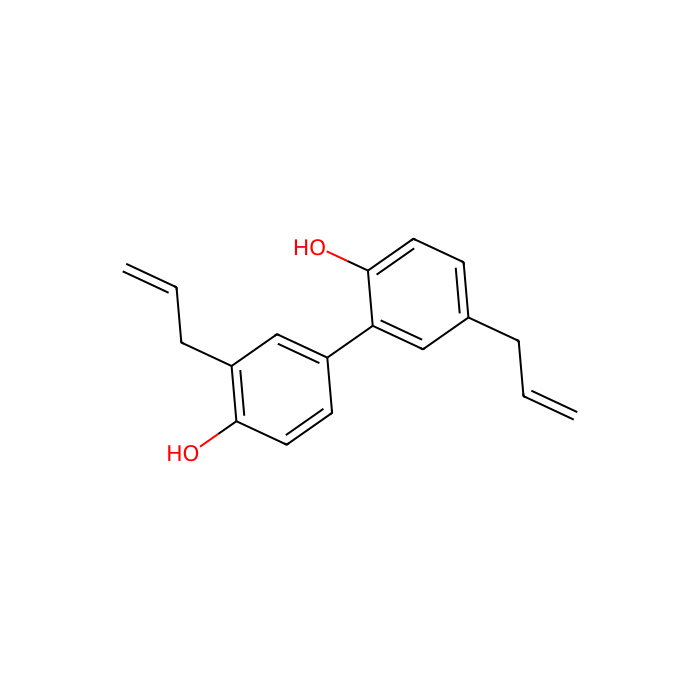
Honokiol (NSC 293100) Honokiol (NSC 293100) is the active principle of magnolia extract that inhibits Akt -phosphorylation and promotes ERK1/2 phosphorylation. Honokiol causes G0/G1 phase arrest, induces apoptosis , and autophagy via the ROS/ERK1/2 sign
In vitro
Honokiol shows pro-apoptotic effects in melanoma, sarcoma, myeloma, leukemia, bladder, lung, prostate, oral squamous cell carcinoma and colon cancer cell lines. Honokiol is effective on inducing apoptosis in SVR angiosarcoma cells. Treatment of SVR cells with honokiol causes decreased phosphorylation of MAP kinase, akt, and c-src. In addition, honokiol potentiates TRAIL-mediated apoptosis, and honokiol cytotoxicity is partially abrogated by neutralizing antibodies to TRAIL. Honokiol also has direct antiangiogenic activity, in that honokiol blocks the phosphorylation and rac activation due to VEGF-VEGFR2 interactions. Honokiol causes apoptosis in CLL cells through activation of caspase 8, followed by caspase 9 and 3 activation. Honokiol prevents interleukin-4-mediated survival of CLL cells, and potentiats the cytotoxicity of chlorambucil, fludarabine, and cladribine. Honokiol kills myeloma cells from relapsed patients at doses that does not kill PBMCs. Caspase 3, 7, 8, and 9 are induced by honokiol treatment, as well as PARP cleavage. Honokiol is found to induce apoptosis in the colon cancer cell lines RKO. Honokiol potentiates apoptosis, suppresses osteoclastogenesis, and inhibits invasion through modulation of nuclear factor-kappaB activation pathway. Honokiol may act as a potent anti-inflammatory agent with multipotential activities due to an inhibitory effect on the PI3K/Akt pathway.
In vivo
Honokiol is highly effective against SVR angiosarcoma in nude mice. Honokiol inhibits the growth of RKO cells in murine xenografts. Honokiol prevents the growth of MDA-MD-231 breast cancer cells in murine xenografts.
Cell Data
cell lines:
Concentrations:
Incubation Time:
Powder Purity:≥99%
| 異性体SMILES | C=CCC1=CC(=C(C=C1)O)C2=CC(=C(C=C2)O)CC=C |
|---|---|
| WGKドイツ | 3 |
| UN番号 | 3077 |
| 分子量 | 266.33 |
| Reaxy-Rn | 1982052 |
| Reaxys-RN_link_address | https://www.reaxys.com/reaxys/secured/hopinto.do?context=S&query=IDE.XRN=1982052&ln= |
Comprehensive hazard, handling, storage, and regulatory compliance document.
Download SDS →Lot-specific quality data. Enter your lot number to retrieve the exact COA.
Look up COA →Full quality attributes and acceptance criteria for this grade.
View spec sheet →| Activity Type | Activity Value -log(M) | Mechanism of Action | Activity Reference | Publications (PubMed IDs) |
|---|
| Activity Type | Activity Value -log(M) | Mechanism of Action | Activity Reference | Publications (PubMed IDs) |
|---|
| Activity Type | Activity Value -log(M) | Mechanism of Action | Activity Reference | Publications (PubMed IDs) |
|---|
| 融点(°C) | 85°C |
|---|
Our grade selection guide covers purity, stabilizer status, and application suitability for all variants in our catalog.
View Moligand™ grade guide →