グレード&純度ExactAb™?ExactAb™ — Aladdin's antibody line emphasizing precision and validated quality. Use for reliable, specificity-validated antibody applications.Validated?Validated grade — performance confirmed in defined applications before release. Use when you want documented assurance the reagent works as stated.0.5 mg/mL
Human IgG Antibody; Isotype Control Antibody, could be used for Flow Cytometry.
仕様
Product Name
Human IgG (AF405) - アイソタイプ対照抗体
同義語
Human IgG
仕様と純度
ExactAb™, Validated, 0.5 mg/mL
宿主種
人間
活用
AF405
励起波長(nm)
Violet Laser(405nm)
発光波長(nm)
422nm
Ex/Em(nm)
Ex:401nm;Em:422nm
等級
ExactAb™, Validated
精製方法
Affinity chromatography
集中
0.5 mg/mL
Product Line
生物製品
保管と配送
保管条件
Store at 2-8°C,Protected from light,Do not freeze
入荷
Wet ice,Do not freeze
安定性と保管
The antibody solution should be stored undiluted between 2°C and 8°C, and protected from prolonged exposure to light. Do not freeze.
画像
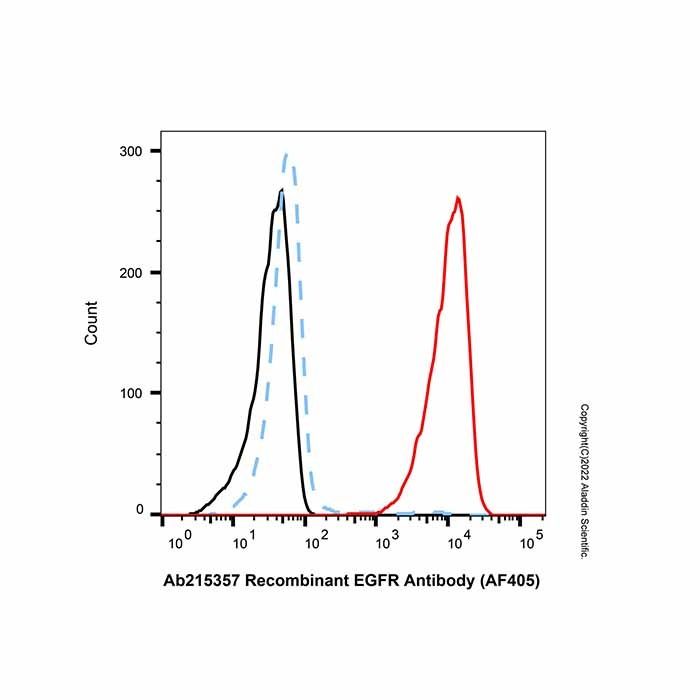
Human IgG (AF405) (Ab215369) - Flow Cytometry Flow cytometry analysis of EGFR expression by A431 cells (red) compared to an isotype control (blue). Cells were stained with Recombinant EGFR Antibody (AF405) (Ab215357) at 5μL/test for 1 hour at 4°C. Blue - Human IgG (AF405) (Ab215369). Black - Unlabelled control, cells without incubation with primary antibody.
適用#テキヨウ#
適用#テキヨウ#
Dilution info
Flow Cytometry
Use at an assay dependent concentration. Each lot of this antibody is quality control tested by flow cytometric analysis as negative control. Use at concentrations comparable to those of the speci
Determine the necessary mass, volume, or concentration for preparing a solution.
Dilution Calculator
Determine the dilution needed to prepare a stock solution.
Reconstitution Calculator
レビュー
顧客レビュー
Application Protocols
Item-specific protocols and recommended dilutions
Not specified for this item; refer to CoA/Spec Sheet.
General workflow guidance (non-binding, literature-based)
Titration: Perform a small-scale titration to determine the lowest amount that provides adequate signal with acceptable background for your platform (flow cytometry, microscopy, ELISA, bead assays). Blue fluorophores often require careful optimization due to lower brightness and higher autofluorescence in the near-UV/blue range.
Controls: Include unstained, single-stained, and isotype controls as appropriate. For multicolor panels, establish compensation using single-color controls excited at 405 nm.
Incubation: Typical antibody incubations range from 15–60 minutes at ambient temperature or 4 °C for sensitive samples; exact times and concentrations should be determined empirically.
Washes: Use gentle washing with compatible buffers (e.g., PBS/TBS with or without mild detergent) to reduce background; avoid harsh centrifugation for fragile cells.
Mounting/fixation: If imaging fixed samples, verify AF405 signal retention after fixation and consider anti-fade mounting media compatible with blue emission.
No validated applications, positive controls, or dilution factors are provided in the Product Data for SKU Ab215369.
Biological Roles
General biology of Human IgG (literature)
Function: Immunoglobulin G (IgG) is the predominant antibody class in human serum, mediating adaptive humoral immunity. It neutralizes pathogens, opsonizes antigens for phagocytosis, activates complement (subclass-dependent), and engages Fcγ receptors on immune cells.
Structure–function: Antigen recognition occurs at the Fab regions’ variable domains; effector functions are mediated by the Fc region, whose glycosylation modulates receptor binding and complement activation.
Subclasses: Humans have IgG1–IgG4 with distinct effector profiles and serum abundances. The subclass for this item is Not specified.
Receptors and partners: FcγRI/II/III on leukocytes; Protein A (Staphylococcus aureus) and Protein G (Streptococcus) bind the Fc region and are commonly used for purification and capture in assays.
Implications for the AF405 conjugate (general)
Fluorophore tagging typically does not affect antigen binding if labeling is controlled; over-labeling can impair affinity or increase non-specific interactions. Degree of labeling (DOL) for this item is Not specified.
Blue-channel detection (AF405) facilitates multiplexing with green/red dyes but can be more sensitive to sample autofluorescence and photobleaching; careful control selection and instrument configuration are recommended.
Item-specific notes
Antigen specificity, host, clonality, and subclass are Not specified for this item; users should consult the CoA/Spec Sheet for experimental planning.
Buffer Applications
Relevance
This product is not a buffering agent. However, antibody performance depends strongly on the buffer environment. The following are general, literature-based practices; they are not item-specific specifications.
General buffer guidance
Working buffers: PBS or TBS at pH ~7.2–7.6 commonly support IgG stability and binding performance.
Additives: Low concentrations of carrier proteins (e.g., BSA) and sugars (e.g., trehalose) can reduce adsorption and aggregation; presence/levels for this item are Not specified.
Detergents: 0.01–0.1% mild nonionic detergents (e.g., Tween 20) may decrease nonspecific binding in immunoassays; verify compatibility with your assay.
Metal ions and chelators: EDTA can be included to mitigate metal-catalyzed oxidation; confirm that chelation does not interfere with your system.
Filtration: 0.22 µm filtration of working solutions can reduce particulates but may adsorb protein at very low concentrations; pre-rinse filters with buffer.
Optical considerations for AF405
Use low-autofluorescence buffers and plastics; avoid components with strong absorbance/fluorescence between 380–450 nm that elevate background.
Item-specific information such as supplied buffer, pH, preservatives, and recommended working dilutions are Not specified for this item; refer to CoA/Spec Sheet.
Green Alternatives
Applicability
As a protein fluorescent conjugate, this product does not present the typical solvent or reagent selection tradeoffs addressed by green chemistry for small molecules. Nevertheless, greener lab practices can be applied.
Greener practice suggestions (general)
Minimize waste: Scale experiments to reduce disposal of aqueous dye-containing solutions. Consolidate compatible aqueous waste streams.
Light management: Use reusable amber carriers and foil wraps to protect from light, reducing repeat experiments due to photobleaching.
Cold-chain efficiency: Store at 2–8 °C in energy-efficient refrigerators; avoid unnecessary ultra-cold storage (and product-specific guidance prohibits freezing).
Safer materials: Use low-autofluorescence, recyclable plastics where compatible; avoid unnecessary halogenated solvents in ancillary cleaning steps.
Spectral alternatives (contextual, not endorsements)
If reducing phototoxicity or enhancing brightness allows shorter exposures and fewer repeats, longer-wavelength alternatives (e.g., AF488, AF532, AF546) may provide practical sustainability benefits in imaging workflows. Tradeoff: altered panel design and potential spectral overlap.
Note
No alternative formulation or dye for SKU Ab215369 is specified by the supplier; the above are general considerations.
Pharmaceutical Uses
Scope
This product is designated For research use only. It is not manufactured or qualified for diagnostic or therapeutic applications.
General context (not specific to this item)
Human IgG molecules are used in biopharmaceutical development as reference standards, process controls, and analytical positive controls in assays such as ELISA, SEC-HPLC, CE-SDS, and LC-MS peptide mapping. Fluorophore-conjugated IgGs may be used in process development to evaluate capture ligands, resin performance, or to calibrate fluorescence-based analytics.
Excipient compatibility studies: Formulators often assess antibody stability in various buffer/excipient matrices (pH, ionic strength, sugars, amino acids, surfactants) to optimize colloidal and conformational stability.
Constraints
No pharmacopeial grade, GMP status, endotoxin limits, host cell protein/DNA, or viral safety claims are provided for SKU Ab215369. Such attributes are Not specified for this item; refer to CoA/Spec Sheet if available.
No clinical or diagnostic claims are made or implied.
Physical Properties
Item-specific specifications
Appearance, concentration, buffer composition, pH, degree of labeling (DOL), protein concentration, and excipients: Not specified for this item; refer to CoA/Spec Sheet.
Molecular weight/formula: Not specified for this item; refer to CoA/Spec Sheet.
Literature/general properties (for context; not lot-specific)
IgG size: Typical intact IgG has an apparent molecular mass of ~150 kDa by SDS-PAGE under non-reducing conditions (literature).
Isoelectric point (pI): Human IgG subclasses commonly span pI ~6–9, varying with sequence and glycoform (literature).
Hydrodynamic diameter: ~10–14 nm by DLS for monomeric IgG (literature). Viscosity increases strongly with concentration.
Solubility: Readily soluble in aqueous buffers such as PBS and TBS; insoluble in most neat organic solvents (literature). Stability depends on ionic strength, pH, and excipients.
Stability window: Many IgGs are most stable between pH ~6.5–7.5 with moderate ionic strength and stabilizers (e.g., sugars, amino acids, proteins) (literature).
AF405 photophysics: Excitation/emission maxima typically around Ex ~401 nm / Em ~421 nm; bright blue fluorescence with relatively low photostability compared to longer-wavelength dyes; strong sensitivity to photobleaching mitigated by light protection and oxygen scavengers (literature values; actual lot may vary).
Optical considerations: AF405 is efficiently excited by 405 nm laser lines; detection in ~420–450 nm bandpasses is common in flow cytometry and microscopy (literature guidance).
Note: Specific numeric specs for this item (e.g., DOL, buffer, concentration) are not provided here and should be confirmed on the CoA/Spec Sheet.
Quality and Grades
Item-specific designation
Grade/Purity: ExactAb™, Validated (as provided by supplier).
Interpretation and implications (general)
ExactAb™ (general description): Branding typically denotes an antibody product line with emphasis on documented identity and performance. While specifics for this SKU are not listed here, such designations commonly indicate traceable production records and quality checkpoints. Refer to the CoA/Spec Sheet for the exact criteria applied to this lot.
Validated: Indicates that performance characteristics were assessed using defined assays (e.g., fluorescence signal verification, purity by SDS-PAGE, absence of visible aggregates). The exact validation assays for this item are not specified here; consult the lot-specific documentation.
Lot-to-lot consistency: Validated antibody conjugates are generally qualified to minimize variability in signal intensity and background, but final signal depends on instrument settings, sample matrix, and degree of labeling (DOL). DOL and protein concentration are not specified for this item.
What this means for end-users: Expect a research-grade reagent suitable for fluorescence-dependent workflows. Always perform small-scale pilot titrations with each new lot to confirm application-specific performance.
Not included in Product Data
Residual preservatives (e.g., sodium azide), carrier proteins (e.g., BSA), endotoxin, bioburden, and binding activity metrics are Not specified for this item; refer to CoA/Spec Sheet.
Compliance: No pharmacopoeial or GMP claims are made here; product is for research use only.
Reaction and Applications
Scope of use (research-only)
Fluorescence detection: AF405-labeled human IgG is suitable in principle for blue-channel detection in plate assays, bead-based assays, microscopy, and flow cytometry. Specific validated applications for this SKU are Not specified; users should verify performance empirically.
Common experimental roles (general)
Isotype control: Non-antigen-specific human IgG conjugates are frequently used to estimate non-specific binding in immunofluorescence and flow cytometry, matching host species and isotype. Antigen specificity for this item is Not specified.
Assay development and calibration: Use to optimize instrument settings (405 nm laser, ~450/50 detection), compensation, and to evaluate fixation/permeabilization compatibility of blue fluorophores.
Binding/Fc studies: Human IgG can serve as a ligand to probe Fc receptor interactions, Protein A/G binding, or surface immobilization strategies.
Surface blocking and orientation controls: Passivate or pre-block Fc-binding surfaces; compare signals against antigen-specific conjugates.
Practical tips (general)
Protect from light at all times to limit photobleaching.
Titrate to determine the minimal concentration affording acceptable signal-to-noise; blue dyes often show lower brightness than green/red counterparts.
Include appropriate controls: unstained, single-stained, and fluorescence-minus-one (FMO) controls when building multicolor panels.
If fixation is required, test aldehyde fixatives for retention of AF405 fluorescence; blue dyes can be more sensitive to quenching than longer-wavelength dyes.
Note: No application has been specifically validated for SKU Ab215369 in the Product Data; consult the CoA or perform in-house qualification.
Reaction Conditions
Not typically applicable to this product.
Context
Human IgG (AF405) is intended for detection and binding assays, not for chemical reactions under defined stoichiometric or catalytic conditions. Therefore, conventional reaction parameters (solvent, temperature, catalysts, yields) are not relevant.
Practical handling conditions (general)
Temperature: Maintain 2–8 °C during handling and storage. Work on ice for prolonged manipulations.
Light: Minimize exposure to ambient/UV light; use amber containers to preserve AF405 fluorescence.
Mixing: Gentle inversion or slow pipetting; avoid vigorous vortexing that can induce aggregation or foaming.
Concentration: Determine working concentration empirically by titration; specific recommendations are Not specified for this item.
If conducting ancillary bioconjugation or immobilization steps, follow literature protocols appropriate for proteins and ensure compatibility with existing AF405 labels. No item-specific reaction conditions are provided.
Safety and Handling
Item-specific safety data
GHS classification, signal word, hazard statements, pictograms: Not specified for this item; refer to the SDS for authoritative information.
Storage: 2–8 °C, protected from light; Do not freeze. Ship on wet ice; Do not freeze.
General safety guidance (literature/best practice)
Intended use: For research use only. Not for human or animal diagnostic, therapeutic, or other clinical uses.
Biological nature: Protein solution; treat as a low-risk biological reagent unless otherwise stated on SDS. Avoid ingestion, inhalation of aerosols, or contact with skin/eyes.
PPE: Lab coat, gloves (nitrile), and safety glasses. Handle in a clean area to prevent microbial contamination.
Light sensitivity: AF405 is light-sensitive. Minimize exposure to ambient/UV light; use amber tubes/foils and keep samples covered when possible.
Incompatibilities: Avoid strong oxidants, extreme pH, denaturants, and organic solvents that can precipitate or unfold proteins. Avoid metal-catalyzed oxidation; low-binding plasticware recommended to mitigate adsorption.
Hygiene/handling: Work on ice or at 2–8 °C for prolonged handling. Avoid vigorous vortexing or frothing that can induce aggregation; mix by gentle inversion.
First aid (general): Skin/eye contact—rinse with water for 15 minutes and remove contaminated clothing; inhalation—move to fresh air; ingestion—rinse mouth and seek medical advice. Follow institutional biosafety procedures.
Waste: Dispose of proteinaceous and dye-containing solutions per institutional guidelines; AF405-containing waste may fall under non-halogenated organic/aqueous dye waste streams. Consult local regulations.
Solvent Selection
Applicability
This product is a proteinaceous reagent intended for use in aqueous buffers; classical solvent selection paradigms for small-molecule solutes (e.g., polarity indexes) are not directly applicable.
General guidance (literature)
Compatible media: Phosphate-buffered saline (PBS), Tris-buffered saline (TBS), HEPES-buffered saline at neutral pH commonly support IgG stability. Inclusion of stabilizers (e.g., trehalose, glycerol) may mitigate aggregation, but composition for this item is Not specified.
Avoid: Neat organic solvents (acetone, acetonitrile, methanol) and strong denaturants (urea, guanidinium) that can denature/precipitate IgG. Minimize exposure to extreme pH (<5 or >9) unless validated for your assay.
Photophysics: AF405 is efficiently excited by 405 nm light; choose optical-grade, low-autofluorescence buffers and plastics. Avoid additives with significant absorbance or fluorescence in the 380–450 nm window.
Adsorption: Use low-bind tubes and block surfaces to limit non-specific adsorption, especially at low nanomolar concentrations.
When to choose alternatives
If spectral overlap with other blue fluorophores or sample autofluorescence is problematic, consider longer-wavelength conjugates (e.g., AF488/AF546) for multiplexed panels (general guidance).
Storage and Reconstitution
Item-specific instructions (from Product Data)
Storage: Store at 2–8 °C.
Light protection: Protect from light.
Freezing: Do not freeze.
Shipping: Shipped on wet ice; Do not freeze.
Additional notes
Appearance, supplied buffer, concentration, and preservatives: Not specified for this item; refer to CoA/Spec Sheet.
Reconstitution: Not specified for this item. If the product is supplied as a liquid (common for light-sensitive conjugates), use as provided and avoid freeze–thaw cycles. If supplied lyophilized (not stated here), consult the label/CoA for precise reconstitution volume and buffer recommendations.
Handling: Mix gently by inversion; avoid vigorous vortexing. Work quickly at 2–8 °C and minimize light exposure during aliquoting or setup.
Aliquoting: Since freezing is explicitly discouraged for this item, plan experiments to use working quantities directly from refrigerated storage. If absolutely necessary to create working stocks, maintain 2–8 °C and use within a short, validated timeframe.
Stability and shelf life are Not specified for this item; always check the product label or CoA for lot-specific expiry and storage buffer details.
Structure and Identity
Brief description: Human immunoglobulin G (IgG) conjugated to a blue-emitting fluorophore (AF405), suitable for fluorescence-based research applications.
Item-specific facts (from Product Data)
Product name: Human IgG (AF405)
Grade/Purity: ExactAb™, Validated
Storage conditions: 2–8 °C, protected from light; Do not freeze
Shipping: Wet ice; Do not freeze
CAS, CID, InChIKey, SMILES: Not specified for this item; refer to CoA/Spec Sheet.
Molecular formula and molecular weight: Not specified for this item; refer to CoA/Spec Sheet.
General structural description (literature/general information)
IgG architecture: A Y-shaped glycoprotein comprising two identical heavy chains (~50 kDa each) and two identical light chains (~25 kDa each) linked by disulfide bonds. Domains include variable (VH/VL) antigen-binding regions (Fab) and a constant Fc region mediating effector interactions.
Conjugation: AF405 is a small-molecule fluorescent dye typically linked to solvent-accessible lysine side chains via amide bonds (e.g., NHS-ester chemistry), forming a heterogeneous distribution of fluorophores per antibody. Exact degree of labeling (DOL) is not specified for this item.
Stereochemistry/functional groups: Proteinaceous backbone with multiple chiral centers (amino acids), disulfide bridges, N-glycosylation in the Fc region (heterogeneous). AF405 contains an aromatic polycyclic fluorophore core with delocalized π-system enabling absorption/emission in the near-UV/blue.
2D/feature summary in words
Two Fab arms with complementary-determining regions (CDRs) at the tips; an Fc stem with an N-glycan; multiple lysine residues potentially bearing AF405 labels; overall globular tertiary structure stabilized by intra- and inter-chain disulfides.
Synthetic Utility
Not typically applicable.
Explanation
Human IgG (AF405) is a biomacromolecular reagent used in bioanalytical and imaging workflows rather than a building block or reagent for small-molecule synthesis. It does not participate in named organic reactions or serve as a precursor/intermediate in traditional synthetic chemistry.
Relevant laboratory utilities (general)
Bioconjugation platform: Although this SKU is already AF405-labeled, human IgG generally offers primary amines (lysines) and interchain disulfides as handles for conjugation chemistry (e.g., NHS-ester, maleimide-thiol after mild reduction). For this product, additional conjugation should only be attempted if compatible with existing AF405 labels and assay needs.
Surface immobilization: Passive adsorption or oriented capture via Protein A/G can be used to immobilize IgG on sensors or plates for binding studies.
Item-specific reactivity, available functional groups post-labeling, and residual reactive handles are Not specified for this item; consult the CoA/Spec Sheet.
Target Specificity
Item-specific information
Antigen/epitope: Not specified for this item; refer to CoA/Spec Sheet.
Host species/clonality/subclass: Not specified for this item; refer to CoA/Spec Sheet. The product name indicates Human IgG, but exact subclass (IgG1–IgG4) and clonality are not provided.
Reactivity: Not specified for this item.
General notes (literature)
Human IgG, when used as an isotype control, is selected to match the isotype and conjugation of a test antibody to assess non-specific binding under identical conditions.
Fc interactions: Human IgG can bind Protein A/G and Fcγ receptors; blocking strategies or Fc-blocking reagents may be needed in cellular assays to reduce background.
No clone ID, antigen name, or validated species reactivity is provided in the Product Data for SKU Ab215369.
よくある質問
What does ExactAb? mean?
ExactAb? indicates the product has been validated for use in rigorous antibody validation workflows. Validation may include positive/negative control samples, signal-to-noise testing, and protocol-specific QC. Lot-specific test data is published on the Certificate of Analysis where available.
How should this product be stored?
Store at 2–8 °C, protected from light. Do not freeze. Freezing may cause irreversible damage to this material.
What does Validated mean?
Validated indicates the product has been validated for use in rigorous antibody validation workflows. Validation may include positive/negative control samples, signal-to-noise testing, and protocol-specific QC. Lot-specific test data is published on the Certificate of Analysis where available.
How is this product shipped?
This product ships chilled on wet ice. Unpack on arrival and transfer it to the storage condition stated above.
What documentation is provided?
Available product documentation, including Certificates of Analysis (COA), Safety Data Sheets (SDS), and specification sheets, is shown in the product document area. Document availability and access follow the current site policy.
Which species reactivity has this antibody been validated against?
Validated reactivity is listed on the PDP and on each lot's datasheet. We validate against the most commonly tested species for the target (Human IgG (AF405)); cross-reactivity in untested species may exist but is not guaranteed. Contact technical support for specific species inquiries.
Products are supplied to verified businesses, institutions, and qualified professionals for research and development use only. Not for use in humans, animals, diagnosis, or therapy.

 ZJ25F0319783