Determine the necessary mass, volume, or concentration for preparing a solution.
Taxonomy Tree
| Kingdom | Inorganic compounds |
|---|---|
| Superclass | Homogeneous non-metal compounds |
| 分類 | Homogeneous halogens |
| Subclass | Not available |
| Intermediate Tree Nodes | Not available |
| Direct Parent | Homogeneous halogens |
| Alternative Parents | Inorganic chloride salts |
| Molecular Framework | Not available |
| Substituents | Homogeneous halogen - Inorganic chloride salt - Inorganic salt |
| 説明 | This compound belongs to the class of inorganic compounds known as homogeneous halogens. These are inorganic non-metallic compounds in which the largest atom is a nobel gas. |
| External Descriptors | Not available |
Find and download the COA for your product by matching the lot number on the packaging.
| Lot Number | Certificate Type | 日付 | 商品 |
|---|---|---|---|
| Certificate of Analysis | Aug 29, 2025 | I434152 |
| 引火点(°C) | 40°C |
|---|---|
| 沸点(°C) | 97 °C |
| 融点(°C) | 112°C |
| 分子量 | 162.36 |
| XLogP3 | 1.700 |
| Hydrogen Bond Donor Count | 0 |
| Hydrogen Bond Acceptor Count | 0 |
| Rotatable Bond Count | 0 |
| Exact Mass | 161.873 Da |
| Monoisotopic Mass | 161.873 Da |
| Topological Polar Surface Area | 0.000 Ų |
| Heavy Atom Count | 2 |
| Formal Charge | 0 |
| Complexity | 2.000 |
| Isotope Atom Count | 0 |
| Defined Atom Stereocenter Count | 0 |
| Undefined Atom Stereocenter Count | 0 |
| Defined Bond Stereocenter Count | 0 |
| Undefined Bond Stereocenter Count | 0 |
| The total count of all stereochemical bonds | 0 |
| Covalently-Bonded Unit Count | 1 |
H300:Fatal if swallowed
H313:May be harmful in contact with skin
H314:Causes severe skin burns and eye damage
H336:May cause drowsiness or dizziness
H351:Suspected of causing cancer
H370:Causes damage to organs
H372:Causes damage to organs through prolonged or repeated exposure
P201:Obtain special instructions before use.
P202:Do not handle until all safety precautions have been read and understood.
P260:Do not breathe dust/fume/gas/mist/vapors/spray.
P264:Wash hands [and …] thoroughly after handling.
P270:Do not eat, drink or smoke when using this product.
P271:Use only outdoors or in a well-ventilated area.
P280:Wear protective gloves/protective clothing/eye protection/face protection.
P363:Wash contaminated clothing before reuse.
P301+P330+P331:IF SWALLOWED: Rinse mouth. Do NOT induce vomiting.
P303+P361+P353:IF ON SKIN (or hair): Take off Immediately all contaminated clothing. Rinse SKIN with water [or shower].
P308+P311:IF exposed or concerned: Call a POISON CENTER/doctor/...
P405:Store locked up.
P403+P233:Store in a well-ventilated place. Keep container tightly closed.
P501:Dispose of contents/container to an approved waste disposal plant.
P301+P310+P330:IF SWALLOWED: Rinse mouth.Immediately call a POISON CENTER/doctor/.
P304+P340+P310:IF INHALED: Remove person to fresh air and keep comfortable for breathing. Immediately call a POISON CENTER/ doctor.
P305+P351+P338+P310:IF IN EYES: Rinse cautiously with water for several minutes. If contact lenses are worn and can be easily removed, remove Contact lenses. Continue rinsing. Immediately call an emergency center/doctor.
No application protocols are item-validated in the Product Data. For general use as a halogenating reagent:
Standardization (iodometry, literature):
Representative iodochlorination (literature example outline):
Safety workflow:
These outlines are general literature practices and must be adapted to your substrate and to the actual solvent/concentration listed on the CoA/label.
This product is a chemical reagent solution intended for laboratory synthesis and analysis; it is not intended for biological use in living systems.
General biochemical context (literature, not item-specific):
Implications for lab work:
No endogenous pathways, receptors, or transporters are relevant to iodine monochloride in research contexts; treat strictly as a reactive chemical reagent.
Not typically applicable. Iodine monochloride is incompatible with aqueous buffer systems due to rapid hydrolysis and oxidizing/halogenating behavior. For work-up, aqueous thiosulfate/sulfite solutions can be used to quench residual halogen, followed by standard buffer preparation for downstream steps if needed.
Iodine monochloride is effective but corrosive, moisture-sensitive, and typically used in halogenated or polar aprotic media. Greener choices may be available depending on the target transformation.
Comparison (literature, general guidance):
ICl vs N-Iodosuccinimide (NIS)
ICl vs I2/oxidant systems (I2/H2O2, I2/TBHP, I2/Selectfluor)
ICl vs Electrochemical iodination (I− anodic oxidation)
Solvent considerations:
Waste minimization:
Note: Choice of alternative should be guided by substrate sensitivity, EHS priorities, and required chemoselectivity.
This product is for research use only and is not intended for use in humans or clinical formulations.
Relevant non-clinical/analytical roles (literature, not item-specific):
Operational considerations:
Item-specific specifications (this catalog entry):
Literature/general properties of neat iodine monochloride (ICl) for reference (not item-specific):
Practical notes for solutions (general guidance):
Item-specific quality information:
Guidance on grades and implications (general):
Recommendations:
Iodine monochloride is a versatile electrophilic halogenating reagent. As a solution, it is immediately deployable in a variety of halogenation/iodination contexts.
Key transformations (literature):
Practical tips:
Applications include small-molecule synthesis, polymer modification (halogenation), and classical analytical assays (e.g., iodine value determinations in lipids, with appropriate standardization).
Guidance below reflects literature precedent and typical practice for iodine monochloride reactions; adjust to your substrate and consult primary sources. These are not item-specific specifications.
Electrophilic aromatic iodination:
Iodochlorination of alkenes:
Iodolactonization/iodocyclization:
Alpha-iodination of ketones/enol ethers:
Work-up:
Expected yields:
Always verify the concentration of the ICl solution (titration) for accurate stoichiometry.
Item-specific hazard fields were not provided in the Product Data; consult the product SDS for authoritative classification and response measures.
General GHS expectations for iodine monochloride and its solutions (not item-specific):
PPE and engineering controls:
Handling precautions:
First-aid overview (consult SDS):
Spill/fire:
Applicability: This product is a reagent solution rather than a solvent. Solvent selection here refers to choosing reaction media compatible with iodine monochloride chemistry.
General solvent compatibility (literature):
Avoid/limit:
Selection tips:
Note: The actual solvent composing this catalog “iodine monochloride solution” is not specified—consult the CoA/label for exact medium and concentration before planning.
Item-specific instructions (from Product Data):
Additional handling guidance (general best practice for ICl solutions; not item-specific specifications):
Reconstitution: Not applicable—this is a ready-to-use solution. Do not dilute or concentrate unless the solvent system and stability have been confirmed from the CoA/Spec Sheet.
Disposal: Quench small residues with aqueous sodium thiosulfate under controlled conditions; dispose of according to local regulations for halogenated oxidizers/corrosives.
Brief overview: Iodine monochloride (ICl) is a diatomic interhalogen reagent widely used as an electrophilic iodinating/chloro-iodinating agent. This product is supplied as a solution.
From Product Data (item-specific):
Literature/computed (general reference for ICl, not item-specific):
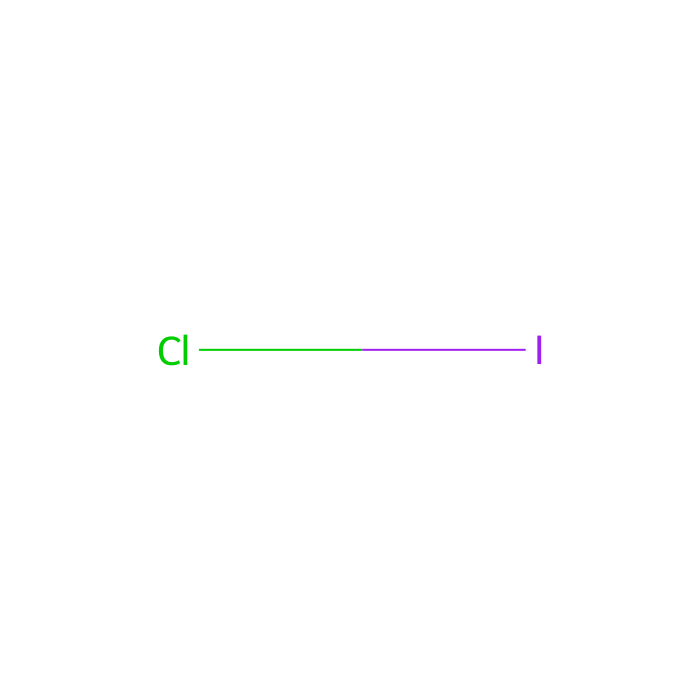
2D structure description (general):
Notes:
Functional group and reactivity profile (literature):
Strategic applications:
Selectivity and compatibility:
Workflow tips:
Not applicable. This product is a small-molecule reagent solution (iodine monochloride), not a biological targeting agent or antibody. No antigen/epitope specificity, clone, isotype, or species reactivity data apply.